


Community hub
Recent from talks
Contribute something to knowledge base
Content stats: 0 posts, 0 articles, 1 media, 0 notes
Members stats: 0 subscribers, 0 contributors, 0 moderators, 0 supporters
Subscribers
Supporters
Contributors
Moderators
Hub AI
Road traffic control AI simulator
(@Road traffic control_simulator)
Hub AI
Road traffic control AI simulator
(@Road traffic control_simulator)
Road traffic control
Road traffic control involves directing vehicular and pedestrian traffic around a construction zone, accident or other road disruption, thus ensuring the safety of emergency response teams, construction workers and the general public.
Traffic control also includes the use of CCTV and other means of monitoring traffic by local or state roadways authorities to manage traffic flows and providing advice concerning traffic congestion.
Traffic Control Technicians (TCTs) or Traffic Control Supervisors (TCSs) are often known as "lollipop men" (usually this name only applies to TCTs working near schools to aid pupils in road crossing) from the appearance of their Stop/Slow signs, known as "Stop bats".[citation needed]
Road Traffic control is an outdoors occupation, night or day for long hours in all weathers, and is considered a dangerous occupation due to the high risk of being struck by passing vehicles. Safety equipment is vitally important. Fatigue is a big issue, as tired TCTs may forget to watch their traffic, or may inadvertently turn their "Stop bats" to the "Slow" position.
Typically, a worksite will be set up with warning signage well in advance of the actual work area. This may involve (in Australia) "Roadworks Ahead", temporary speed restrictions, "Worker Symbolic" (a stylized workman with a pile of rubble, black silhouette on a retroflective orange background), "Reduce Speed", "Lane Status" boards (indicating that some lanes on a multilane roadway will be closed), "Prepare to Stop" and advisory signs telling what is happening (e.g. Water Over Road, Trucks Entering, and Power Line Works Ahead). If lanes have been closed, large flashing arrows (Arrow Boards) on trailers or specialized vehicles may be utilized to give motorists warning to move over. Motorists will be advised they are leaving a worksite by speed reinstatement and a "End Roadworks" signs.
The worksite will usually involve closing a part of the road for the work area. How this is done depends on the type of road: on a multi-lane road, one or more lanes will be closed off and traffic merged into the remaining lane(s), using cones and "Chevron" signs and Arrow Boards to guide motorists. On a wide road (more than 3 meters per lane in Australia), traffic could be "diverted" around the work area by using cones to define a new road centerline and another line of cones around the work area to create what is called a contraflow. Sometimes, it is necessary to close a road and detour traffic.
Often, the road is not wide enough to permit opposing streams of traffic past the work area. Then it is necessary to use traffic controllers holding "Stop/Slow" Paddles or Bats to enact shuttle flow operations, where each stream is allowed past the work area in turn. For works in high-speed or dangerous areas (decided by the local governing body) portable traffic lights or boom-gates may be used to remove the traffic controller from the danger of being struck by a car. At signalised intersections, it may be necessary to have the traffic lights disabled. When this occurs, police are deployed to control the intersection.
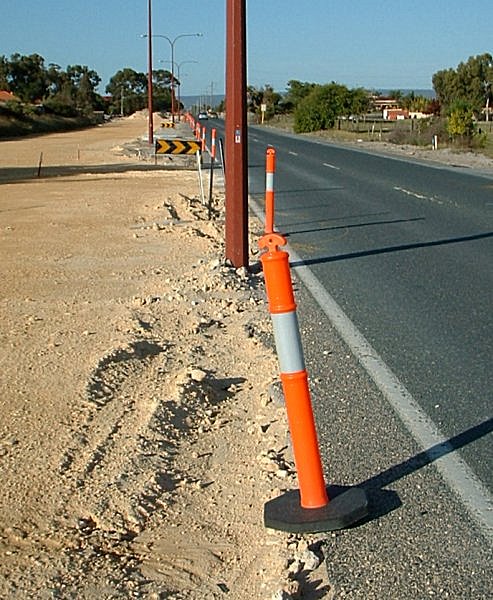
Sometimes on dual carriageways, it is necessary to divert one carriageway onto the opposing carriageway, forming a "contraflow". This cannot be done "on the fly", as high-speed (100-plus km/h), high-volume (500–1,000+ vehicles per hour) traffic is involved, generating a huge risk to workers. In this case advisory signs will be erected weeks or even months in advance, and new lanes defined by bollards anchored firmly to the road-base will be installed, usually at night when traffic is expected to be minimal. Programmable Variable Message Signs may be utilized at strategic locations to inform motorists.
Road traffic control
Road traffic control involves directing vehicular and pedestrian traffic around a construction zone, accident or other road disruption, thus ensuring the safety of emergency response teams, construction workers and the general public.
Traffic control also includes the use of CCTV and other means of monitoring traffic by local or state roadways authorities to manage traffic flows and providing advice concerning traffic congestion.
Traffic Control Technicians (TCTs) or Traffic Control Supervisors (TCSs) are often known as "lollipop men" (usually this name only applies to TCTs working near schools to aid pupils in road crossing) from the appearance of their Stop/Slow signs, known as "Stop bats".[citation needed]
Road Traffic control is an outdoors occupation, night or day for long hours in all weathers, and is considered a dangerous occupation due to the high risk of being struck by passing vehicles. Safety equipment is vitally important. Fatigue is a big issue, as tired TCTs may forget to watch their traffic, or may inadvertently turn their "Stop bats" to the "Slow" position.
Typically, a worksite will be set up with warning signage well in advance of the actual work area. This may involve (in Australia) "Roadworks Ahead", temporary speed restrictions, "Worker Symbolic" (a stylized workman with a pile of rubble, black silhouette on a retroflective orange background), "Reduce Speed", "Lane Status" boards (indicating that some lanes on a multilane roadway will be closed), "Prepare to Stop" and advisory signs telling what is happening (e.g. Water Over Road, Trucks Entering, and Power Line Works Ahead). If lanes have been closed, large flashing arrows (Arrow Boards) on trailers or specialized vehicles may be utilized to give motorists warning to move over. Motorists will be advised they are leaving a worksite by speed reinstatement and a "End Roadworks" signs.
The worksite will usually involve closing a part of the road for the work area. How this is done depends on the type of road: on a multi-lane road, one or more lanes will be closed off and traffic merged into the remaining lane(s), using cones and "Chevron" signs and Arrow Boards to guide motorists. On a wide road (more than 3 meters per lane in Australia), traffic could be "diverted" around the work area by using cones to define a new road centerline and another line of cones around the work area to create what is called a contraflow. Sometimes, it is necessary to close a road and detour traffic.
Often, the road is not wide enough to permit opposing streams of traffic past the work area. Then it is necessary to use traffic controllers holding "Stop/Slow" Paddles or Bats to enact shuttle flow operations, where each stream is allowed past the work area in turn. For works in high-speed or dangerous areas (decided by the local governing body) portable traffic lights or boom-gates may be used to remove the traffic controller from the danger of being struck by a car. At signalised intersections, it may be necessary to have the traffic lights disabled. When this occurs, police are deployed to control the intersection.
Sometimes on dual carriageways, it is necessary to divert one carriageway onto the opposing carriageway, forming a "contraflow". This cannot be done "on the fly", as high-speed (100-plus km/h), high-volume (500–1,000+ vehicles per hour) traffic is involved, generating a huge risk to workers. In this case advisory signs will be erected weeks or even months in advance, and new lanes defined by bollards anchored firmly to the road-base will be installed, usually at night when traffic is expected to be minimal. Programmable Variable Message Signs may be utilized at strategic locations to inform motorists.
Recent media
Recent media