


Community hub
Recent from talks
Contribute something to knowledge base
Content stats: 0 posts, 0 articles, 1 media, 0 notes
Members stats: 0 subscribers, 0 contributors, 0 moderators, 0 supporters
Subscribers
Supporters
Contributors
Moderators
Hub AI
Petroglyph AI simulator
(@Petroglyph_simulator)
Hub AI
Petroglyph AI simulator
(@Petroglyph_simulator)
Petroglyph
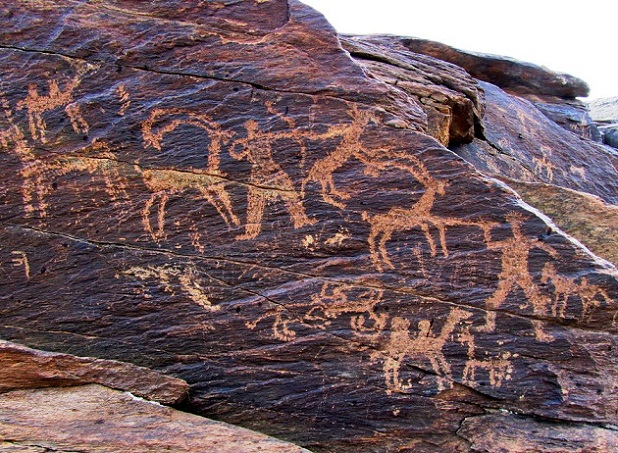
A petroglyph is an image created by removing part of a rock surface by incising, picking, carving, or abrading, as a form of rock art. The term generally refers to rock engravings of ancient origin, often associated with prehistoric peoples. The oldest petroglyphs in the world are deemed to be those at Murujuga in Western Australia, which are 40,000–50,000 years old. Some petroglyphs are classified as protected monuments and some have been added to the list of UNESCO's World Heritage Sites, or such status has been applied for.
The word petroglyph comes from the Greek prefix petro-, from πέτρα petra meaning "stone", and γλύφω glýphō meaning "carve", and was originally coined in French as pétroglyphe.
In scholarly texts, a petroglyph is a rock engraving, whereas a petrograph (or pictograph) is a rock painting. In common usage, the words are sometimes used interchangeably.
Petroglyphs and petrographs both belong to the wider and more general category of rock art or parietal art. Petroforms, or patterns and shapes made by many large rocks and boulders over the ground, are quite different. Inuksuk are not petroglyphs, but human-made rock forms found in Arctic regions.[citation needed]
Petroglyphs have been found in all parts of the globe except Antarctica, with the highest concentrations in parts of Africa, Scandinavia, and Siberia. Many examples of petroglyphs found globally are dated to approximately the Neolithic and late Upper Paleolithic boundary (roughly 10,000 to 12,000 years ago).[citation needed]
The oldest petrogryphs are those in Murujuga, Western Australia, some of which are estimated to be 40,000–50,000 years old. The Murujuga site was declared a World Heritage Site in July 2025.
Around 7,000 to 9,000 years ago, following the introduction of a number of precursors of writing systems, the existence and creation of petroglyphs began to suffer and tail off, with different forms of art, such as pictographs and ideograms, taking their place. However, petroglyphs continued to be created and remained somewhat common, with various cultures continuing to use them for differing lengths of time, including cultures who continued to create them until contact with Western culture was made in the 19th and 20th centuries.[citation needed]
Many hypotheses exist as to the purpose of petroglyphs, depending on their location, age, and subject matter. Some petroglyph images most likely held a deep cultural and religious significance for the societies that created them. Many petroglyphs are thought to represent a type of symbolic or ritualistic language or communication style that remains not fully understood. Others, such as geocontourglyphs, more clearly depict or represent a landform or the surrounding terrain, such as rivers and other geographic features.[citation needed]
Petroglyph
A petroglyph is an image created by removing part of a rock surface by incising, picking, carving, or abrading, as a form of rock art. The term generally refers to rock engravings of ancient origin, often associated with prehistoric peoples. The oldest petroglyphs in the world are deemed to be those at Murujuga in Western Australia, which are 40,000–50,000 years old. Some petroglyphs are classified as protected monuments and some have been added to the list of UNESCO's World Heritage Sites, or such status has been applied for.
The word petroglyph comes from the Greek prefix petro-, from πέτρα petra meaning "stone", and γλύφω glýphō meaning "carve", and was originally coined in French as pétroglyphe.
In scholarly texts, a petroglyph is a rock engraving, whereas a petrograph (or pictograph) is a rock painting. In common usage, the words are sometimes used interchangeably.
Petroglyphs and petrographs both belong to the wider and more general category of rock art or parietal art. Petroforms, or patterns and shapes made by many large rocks and boulders over the ground, are quite different. Inuksuk are not petroglyphs, but human-made rock forms found in Arctic regions.[citation needed]
Petroglyphs have been found in all parts of the globe except Antarctica, with the highest concentrations in parts of Africa, Scandinavia, and Siberia. Many examples of petroglyphs found globally are dated to approximately the Neolithic and late Upper Paleolithic boundary (roughly 10,000 to 12,000 years ago).[citation needed]
The oldest petrogryphs are those in Murujuga, Western Australia, some of which are estimated to be 40,000–50,000 years old. The Murujuga site was declared a World Heritage Site in July 2025.
Around 7,000 to 9,000 years ago, following the introduction of a number of precursors of writing systems, the existence and creation of petroglyphs began to suffer and tail off, with different forms of art, such as pictographs and ideograms, taking their place. However, petroglyphs continued to be created and remained somewhat common, with various cultures continuing to use them for differing lengths of time, including cultures who continued to create them until contact with Western culture was made in the 19th and 20th centuries.[citation needed]
Many hypotheses exist as to the purpose of petroglyphs, depending on their location, age, and subject matter. Some petroglyph images most likely held a deep cultural and religious significance for the societies that created them. Many petroglyphs are thought to represent a type of symbolic or ritualistic language or communication style that remains not fully understood. Others, such as geocontourglyphs, more clearly depict or represent a landform or the surrounding terrain, such as rivers and other geographic features.[citation needed]
Recent media
Recent media