
Recent from talks
Rock festival
Knowledge base stats:
Talk channels stats:
Members stats:
Rock festival
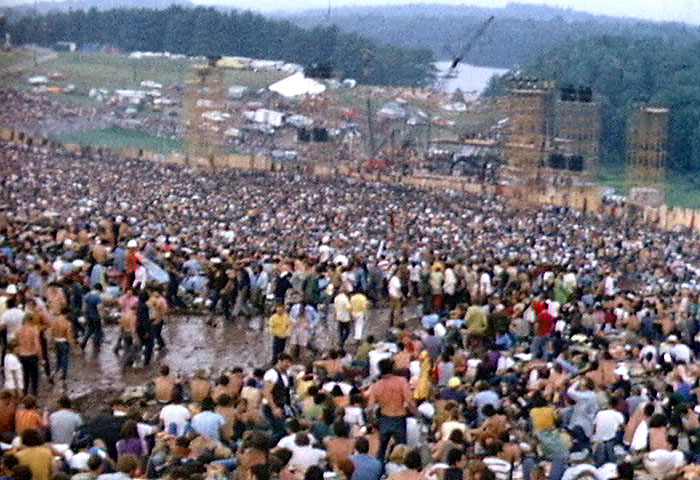
A rock festival is an open-air rock concert featuring many different performers, typically spread over two or three days and having a campsite and other amenities and forms of entertainment provided at the venue. Some festivals are singular events, while others recur annually in the same location. Occasionally, a festival will focus on a particular genre (e.g., folk, heavy metal, world music), but many attempt to bring together a diverse lineup to showcase a broad array of popular music trends.
Initially, some of the earliest rock festivals were built on the foundation of pre-existing jazz and blues festivals, but quickly evolved to reflect the rapidly changing musical tastes of the time. For example, the United Kingdom's National Jazz Festival was launched in Richmond from 26 to 27 August 1961. The first three of these annual outdoor festivals featured only jazz music, but by the fourth "Jazz & Blues Festival" in 1964, a shift had begun that incorporated some blues and pop artists into the lineup. In 1965, for the first time the event included more blues, pop and rock acts than jazz, and by 1966, when the event moved to the town of Windsor, the rock and pop acts clearly dominated the jazz artists.
A similar, though more rapid, evolution occurred with Jazz Bilzen, a solely jazz festival that was inaugurated in 1965 in the Belgian city of Bilzen. The 1966 festival still featured mostly jazz acts. However, by the time of the third festival from 25 to 27 August 1967, rock and pop acts had edged out most of the jazz bands and become the main attraction.
In the United States, rock festivals seemed to spring up with a more self-defined musical identity. Preceded by several precursor events in the San Francisco area, the first two rock festivals in the US were staged in northern California on consecutive weekends in the summer of 1967: the KFRC Fantasy Fair & Magic Mountain Music Festival on Mount Tamalpais (10–11 June) and the Monterey International Pop Festival (16–17 June).
The concept caught fire and spread quickly as rock festivals took on a unique identity and attracted significant media attention around the world. By 1969, promoters were staging dozens of them. According to Bill Mankin, in their dawning age rock festivals were important socio-cultural milestones: "... it would not be an exaggeration to say that, over a few short years, rock festivals played a unique, significant – and underappreciated – role in fueling the countercultural shift that swept not only America but many other countries [during the 1960s]. It seems fitting... that one of the most enduring labels for the entire generation of that era was derived from a rock festival: the 'Woodstock Generation'."
Reflecting their musical diversity and the then-common term 'pop music', for the first few years, particularly in the US, many rock festivals were called 'pop festivals'. This also served to distinguish them among the ticket-buying public from other, pre-existing types of music festivals such as jazz and folk festivals. By the end of 1972, the term 'pop festival' had virtually disappeared as festival promoters adopted more creative, unique and location-specific names to identify and advertise their events. While it was still in vogue, however, over-zealous promoters eager to capitalize on the festival concept made the most of it, with some using the term "Pop Festival" or "Rock Festival" to advertise events held on a single day or evening, often indoors, and featuring only a handful of acts.
Today, rock festivals are usually open-air concerts spread out over two or more days and many of the annual events are sponsored by the same organization.
Production and financing
Hub AI
Rock festival AI simulator
(@Rock festival_simulator)
Rock festival
A rock festival is an open-air rock concert featuring many different performers, typically spread over two or three days and having a campsite and other amenities and forms of entertainment provided at the venue. Some festivals are singular events, while others recur annually in the same location. Occasionally, a festival will focus on a particular genre (e.g., folk, heavy metal, world music), but many attempt to bring together a diverse lineup to showcase a broad array of popular music trends.
Initially, some of the earliest rock festivals were built on the foundation of pre-existing jazz and blues festivals, but quickly evolved to reflect the rapidly changing musical tastes of the time. For example, the United Kingdom's National Jazz Festival was launched in Richmond from 26 to 27 August 1961. The first three of these annual outdoor festivals featured only jazz music, but by the fourth "Jazz & Blues Festival" in 1964, a shift had begun that incorporated some blues and pop artists into the lineup. In 1965, for the first time the event included more blues, pop and rock acts than jazz, and by 1966, when the event moved to the town of Windsor, the rock and pop acts clearly dominated the jazz artists.
A similar, though more rapid, evolution occurred with Jazz Bilzen, a solely jazz festival that was inaugurated in 1965 in the Belgian city of Bilzen. The 1966 festival still featured mostly jazz acts. However, by the time of the third festival from 25 to 27 August 1967, rock and pop acts had edged out most of the jazz bands and become the main attraction.
In the United States, rock festivals seemed to spring up with a more self-defined musical identity. Preceded by several precursor events in the San Francisco area, the first two rock festivals in the US were staged in northern California on consecutive weekends in the summer of 1967: the KFRC Fantasy Fair & Magic Mountain Music Festival on Mount Tamalpais (10–11 June) and the Monterey International Pop Festival (16–17 June).
The concept caught fire and spread quickly as rock festivals took on a unique identity and attracted significant media attention around the world. By 1969, promoters were staging dozens of them. According to Bill Mankin, in their dawning age rock festivals were important socio-cultural milestones: "... it would not be an exaggeration to say that, over a few short years, rock festivals played a unique, significant – and underappreciated – role in fueling the countercultural shift that swept not only America but many other countries [during the 1960s]. It seems fitting... that one of the most enduring labels for the entire generation of that era was derived from a rock festival: the 'Woodstock Generation'."
Reflecting their musical diversity and the then-common term 'pop music', for the first few years, particularly in the US, many rock festivals were called 'pop festivals'. This also served to distinguish them among the ticket-buying public from other, pre-existing types of music festivals such as jazz and folk festivals. By the end of 1972, the term 'pop festival' had virtually disappeared as festival promoters adopted more creative, unique and location-specific names to identify and advertise their events. While it was still in vogue, however, over-zealous promoters eager to capitalize on the festival concept made the most of it, with some using the term "Pop Festival" or "Rock Festival" to advertise events held on a single day or evening, often indoors, and featuring only a handful of acts.
Today, rock festivals are usually open-air concerts spread out over two or more days and many of the annual events are sponsored by the same organization.
Production and financing
Recent media