


Community hub
Recent from talks
Contribute something to knowledge base
Content stats: 0 posts, 0 articles, 1 media, 0 notes
Members stats: 0 subscribers, 0 contributors, 0 moderators, 0 supporters
Subscribers
Supporters
Contributors
Moderators
Hub AI
Rocket engine AI simulator
(@Rocket engine_simulator)
Hub AI
Rocket engine AI simulator
(@Rocket engine_simulator)
Rocket engine
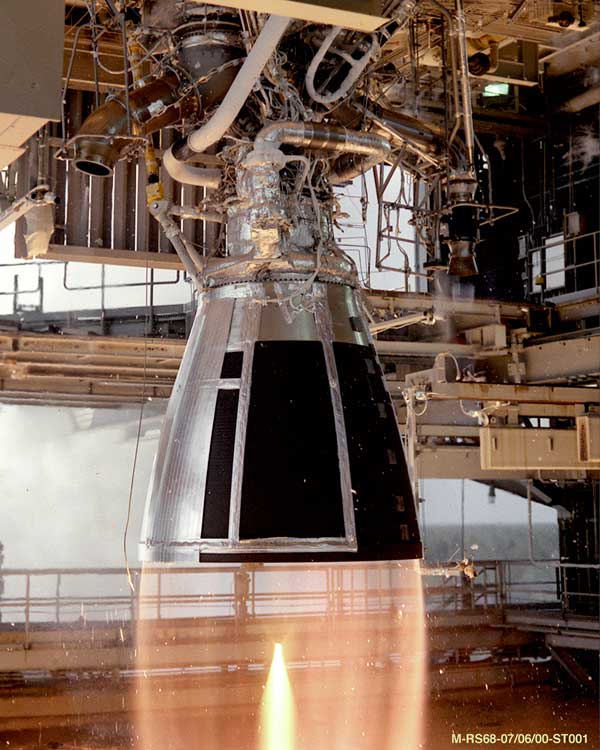
A rocket engine is a reaction engine, producing thrust in accordance with Newton's third law by ejecting reaction mass rearward, usually a high-speed jet of high-temperature gas produced by the combustion of rocket propellants stored inside the rocket. However, non-combusting forms such as cold gas thrusters and nuclear thermal rockets also exist. Rocket vehicles carry their own oxidiser, unlike most combustion engines, so rocket engines can be used in a vacuum, and they can achieve great speed, beyond escape velocity. Vehicles commonly propelled by rocket engines include missiles, artillery shells, ballistic missiles and rockets of any size, from tiny fireworks to man-sized weapons to huge spaceships.
Compared to other types of jet engine, rocket engines are the lightest and have the highest thrust, but are the least propellant-efficient (they have the lowest specific impulse). For thermal rockets, pure hydrogen, the lightest of all elements, gives the highest exhaust velocity, but practical chemical rockets produce a mix of heavier species, reducing the exhaust velocity.
Here, "rocket" is used as an abbreviation for "rocket engine".
Thermal rockets use an inert propellant, heated by electricity (electrothermal propulsion) or a nuclear reactor (nuclear thermal rocket).
Chemical rockets are powered by exothermic reduction-oxidation chemical reactions of the propellant:
Rocket engines produce thrust by the expulsion of an exhaust fluid that has been accelerated to high speed through a propelling nozzle. The fluid is usually a gas created by high pressure (150-to-4,350-pound-per-square-inch (10 to 300 bar)) combustion of solid or liquid propellants, consisting of fuel and oxidiser components, within a combustion chamber. As the gases expand through the nozzle, they are accelerated to very high (supersonic) speed, and the reaction to this pushes the vehicle (rocket) in the opposite direction. Combustion is most frequently used for practical rockets, as the laws of thermodynamics (more specifically Carnot's theorem) dictate that high temperatures and pressures are desirable for the best thermal efficiency. Nuclear thermal rockets are capable of higher efficiencies, but have low thrust, thanks to the low mass of the propellants used, and also have environmental problems which preclude their routine use in the Earth's atmosphere and cislunar space.
For model rocketry, an available alternative to combustion is a water rocket pressurized by compressed air, carbon dioxide, nitrogen, or any other readily available, inert gas.
Rocket propellant is mass that is stored, usually in some form of tank, or within the combustion chamber itself, prior to being ejected from a rocket engine in the form of a fluid jet to produce thrust.
Rocket engine
A rocket engine is a reaction engine, producing thrust in accordance with Newton's third law by ejecting reaction mass rearward, usually a high-speed jet of high-temperature gas produced by the combustion of rocket propellants stored inside the rocket. However, non-combusting forms such as cold gas thrusters and nuclear thermal rockets also exist. Rocket vehicles carry their own oxidiser, unlike most combustion engines, so rocket engines can be used in a vacuum, and they can achieve great speed, beyond escape velocity. Vehicles commonly propelled by rocket engines include missiles, artillery shells, ballistic missiles and rockets of any size, from tiny fireworks to man-sized weapons to huge spaceships.
Compared to other types of jet engine, rocket engines are the lightest and have the highest thrust, but are the least propellant-efficient (they have the lowest specific impulse). For thermal rockets, pure hydrogen, the lightest of all elements, gives the highest exhaust velocity, but practical chemical rockets produce a mix of heavier species, reducing the exhaust velocity.
Here, "rocket" is used as an abbreviation for "rocket engine".
Thermal rockets use an inert propellant, heated by electricity (electrothermal propulsion) or a nuclear reactor (nuclear thermal rocket).
Chemical rockets are powered by exothermic reduction-oxidation chemical reactions of the propellant:
Rocket engines produce thrust by the expulsion of an exhaust fluid that has been accelerated to high speed through a propelling nozzle. The fluid is usually a gas created by high pressure (150-to-4,350-pound-per-square-inch (10 to 300 bar)) combustion of solid or liquid propellants, consisting of fuel and oxidiser components, within a combustion chamber. As the gases expand through the nozzle, they are accelerated to very high (supersonic) speed, and the reaction to this pushes the vehicle (rocket) in the opposite direction. Combustion is most frequently used for practical rockets, as the laws of thermodynamics (more specifically Carnot's theorem) dictate that high temperatures and pressures are desirable for the best thermal efficiency. Nuclear thermal rockets are capable of higher efficiencies, but have low thrust, thanks to the low mass of the propellants used, and also have environmental problems which preclude their routine use in the Earth's atmosphere and cislunar space.
For model rocketry, an available alternative to combustion is a water rocket pressurized by compressed air, carbon dioxide, nitrogen, or any other readily available, inert gas.
Rocket propellant is mass that is stored, usually in some form of tank, or within the combustion chamber itself, prior to being ejected from a rocket engine in the form of a fluid jet to produce thrust.
Recent media
Recent media