



Community hub
Recent from talks
Contribute something
Nothing was collected or created yet.
Specific impulse
View on Wikipedia
Specific impulse (usually abbreviated Isp) is a measure of how efficiently an engine, such as a rocket or jet engine generates thrust. It is either measured in units of velocity (metres per second, or feet per second), or time (seconds). When measured in velocity, this is the effective exhaust velocity used in the Tsiolkovsky rocket equation which calculates how much an engine with a given quantity of fuel can change a vehicle's velocity. When measured as a time, Isp is the velocity divided by earth's gravity, g. This is convenient because the time is the same in metric and English units. This is the time that one kilogram of fuel can produce one kilogram of thrust, which is equal to the time that one pound of fuel can produce one pound of thrust.
Specific impulse is a ratio of the impulse, i.e. change in momentum, to the mass of propellant. This is equivalent to "thrust per massflow".
Mathematical derivation
[edit]If the engine expels mass at a constant exhaust velocity then the thrust is:

.

If this is integrated over time, the result is the total change in momentum. This is divided by the mass, showing that the specific impulse is equal to the exhaust velocity . In practice, the specific impulse is usually lower than the actual physical exhaust velocity due to inefficiencies in the rocket, and thus corresponds to an "effective" exhaust velocity.
That is, the specific impulse in units of velocity is defined by

- ,

where is the average thrust.

The practical meaning of the measurement varies with different types of engines. Car engines consume onboard fuel, breathe environmental air to burn the fuel, and react (through the tires) against the ground beneath them. In this case, the interpretation is momentum per fuel burned.
Chemical rocket engines, by contrast, carry with them their fuel, oxidizer, and reaction mass, so the measure is momentum per reaction mass.
Airplane engines are in the middle, as they only react against airflow through the engine, but some of this reaction mass (and combustion ingredients) is breathed rather than carried on board. As such, "specific impulse" could be taken to mean either "per reaction mass", as with a rocket, or "per fuel burned" as with cars. The latter is the traditional and common choice. In sum, specific impulse is not practically comparable between different types of engines.
Specific impulse can be taken as a measure of efficiency. In cars and planes, it typically corresponds with fuel mileage; in rocketry, it corresponds to the achievable delta-v,[1][2] which is the typical way to measure changes between orbits, via the Tsiolkovsky rocket equation

where is the specific impulse measured in units of velocity and are the initial and final masses of the rocket.

Propulsion systems
[edit]Rockets
[edit]For any chemical rocket engine, the momentum transfer efficiency depends heavily on the effectiveness of the nozzle; the nozzle is the primary means of converting reactant energy (e.g. thermal or pressure energy) into a flow of momentum all directed the same way. Therefore, nozzle shape and effectiveness has a great impact on total momentum transfer from the reaction mass to the rocket.
Efficiency of conversion of input energy to reactant energy also matters; be that thermal energy in combustion engines or electrical energy in ion engines, the engineering involved in converting such energy to outbound momentum can have high impact on specific impulse. Specific impulse in turn affects the achievable delta-v (through the rocket equation) and associated orbits achievable given a certain mass fraction. That is, a higher specific impulse allows one to deliver a larger fraction of mass as payload after imparting a certain delta-v. Optimizing the tradeoffs between mass fraction and specific impulse is one of the fundamental engineering challenges in rocketry.
Although the specific impulse has units equivalent to velocity, it almost never corresponds to an actual physical velocity. In chemical and cold gas rockets, the shape of the nozzle has a high impact on the energy-to-momentum conversion, and is never perfect, and there are other sources of losses and inefficiencies (e.g. the details of the combustion in such engines). As such, the physical exhaust velocity is higher than the "effective exhaust velocity", i.e. that "velocity" suggested by the specific impulse. In any case, the momentum exchanged and the mass used to generate it are physically real measurements. Typically, rocket nozzles work better when the ambient pressure is lower, i.e. better in space than in atmosphere. Ion engines operate without a nozzle, although they have other sources of losses such that the momentum transferred is lower than the physical exhaust velocity.
It is common to express specific impulse as the product of two numbers: characteristic velocity which summarizes combustion chamber performance into a quantity with units of speed; and thrust coefficient, a dimensionless quantity that summarizes nozzle performance. An additional factor of is simply a units conversion.


Units of seconds
[edit]Rocketry typically converts units of velocity to units of time by dividing by a standard reference acceleration, that being standard gravity g0. This is a historical quirk of the imperial system which was pervasively used in early rocket engineering (and still is to a great extent). Properly written out, specific impulse was originally defined as:

which is significantly easier to directly measure on a test stand than effective exhaust velocity (e.g. with load cells and flow meters). Unlike the SI system with N and kg which uses a more direct relationship, the one-to-one correspondence between pound-force lbf and pound-mass lbm only works in standard Earth gravity, hence the appearance of g0 in the final equation. One could argue that using slugs instead of pound-mass would have been more dimensionally consistent, and would result in specific impulse being expressed in feet/second. Generally speaking however, lbm was and is a much more common unit and is what flowmeters, tanks and the like would have expressed propellant mass in. Specific impulse is literally just exhaust velocity expressed in a different unit system.
Physically, it is the amount of time a rocket engine can generate thrust, given a quantity of propellant whose weight is equal to the engine's thrust. That is, in units of seconds the specific impulse is defined by

where is again the average thrust and is the standard gravity.
Cars
[edit]Although the car industry almost never uses specific impulse on any practical level, the measure can be defined, and makes good contrast against other engine types. Car engines breathe external air to combust their fuel, and (via the wheels) react against the ground. As such, the only meaningful way to interpret "specific impulse" is as "thrust per fuelflow", although one must also specify if the force is measured at the crankshaft or at the wheels, since there are transmission losses. Such a measure corresponds to fuel mileage.
Airplanes
[edit]In an aerodynamic context, there are similarities to both cars and rockets. Like cars, airplane engines breathe outside air; unlike cars they react only against fluids flowing through the engine (including the propellers as applicable). As such, there are several possible ways to interpret "specific impulse": as thrust per fuel flow, as thrust per breathing-flow, or as thrust per "turbine-flow" (i.e. excluding air though the propeller/bypass fan). Since the air breathed is not a direct cost, with wide engineering leeway on how much to breathe, the industry traditionally chooses the "thrust per fuel flow" interpretation with its focus on cost efficiency. In this interpretation, the resulting specific impulse numbers are much higher than for rocket engines, although this comparison is quite different — one is with and the other is without reaction mass. It exemplifies the advantage an airplane engine has over a rocket due to not having to carry the air it uses.
As with all kinds of engines, there are many engineering choices and tradeoffs that affect specific impulse. Nonlinear air resistance and the engine's inability to keep a high specific impulse at a fast burn rate are limiting factors to the fuel consumption rate.
As with rocket engines, the interpretation of specific impulse as a "velocity" does not actually correspond to the physical exhaust velocity. Since the usual interpretation excludes much of the reaction mass, the physical velocity of the reactants downstream is much lower than the effective exhaust velocity suggested from the Isp.
General considerations
[edit]Specific impulse should not be confused with energy efficiency, which can decrease as specific impulse increases, since propulsion systems that give high specific impulse require high energy to do so.[3]
Specific impulse should not be confused with total thrust. Thrust is the force supplied by the engine and depends on the propellant mass flow through the engine. Specific impulse measures the thrust per propellant mass flow. Thrust and specific impulse are related by the design and propellants of the engine in question, but this relationship is tenuous: in most cases, high thrust and high specific impulse are mutually exclusive engineering goals. For example, LH2/LO2 bipropellant produces higher Isp (due to higher chemical energy and lower exhaust molecular mass) but lower thrust than RP-1/LO2 (due to higher density and propellant flow). In many cases, propulsion systems with very high specific impulse—some ion thrusters reach 25x-35x better Isp than chemical engines—produce correspondingly low thrust.[4]
When calculating specific impulse, only propellant carried with the vehicle before use is counted, in the standard interpretation. This usage best corresponds to the cost of operating the vehicle. For a chemical rocket, unlike a plane or car, the propellant mass therefore would include both fuel and oxidizer. For any vehicle, optimizing for specific impulse is generally not the same as optimizing for total performance or total cost. In rocketry, a heavier engine with a higher specific impulse may not be as effective in gaining altitude, distance, or velocity as a lighter engine with a lower specific impulse, especially if the latter engine possesses a higher thrust-to-weight ratio. This is a significant reason for most rocket designs having multiple stages. The first stage can optimized for high thrust to effectively fight gravity drag and air drag, while the later stages operating strictly in orbit and in vacuum can be more easily optimized for higher specific impulse, especially for high delta-v orbits.
Propellant quantity units
[edit]The amount of propellant could be defined either in units of mass or weight. If mass is used, specific impulse is an impulse per unit of mass, which dimensional analysis shows to be equivalent to units of speed; this interpretation is commonly labeled the effective exhaust velocity. If a force-based unit system is used, impulse is divided by propellant weight (weight is a measure of force), resulting in units of time. The problem with weight, as a measure of quantity, is that it depends on the acceleration applied to the propellant, which is arbitrary with no relation to the design of the engine. Historically, standard gravity was the reference conversion between weight and mass. But since technology has progressed to the point that we can measure Earth gravity's variation across the surface, and where such differences can cause differences in practical engineering projects (not to mention science projects on other solar bodies), modern science and engineering focus on mass as the measure of quantity, so as to remove the acceleration dependence. As such, measuring specific impulse by propellant mass gives it the same meaning for a car at sea level, an airplane at cruising altitude, or a helicopter on Mars.
No matter the choice of mass or weight, the resulting quotient of "velocity" or "time" usually doesn't correspond directly to an actual velocity or time. Due to various losses in real engines, the actual exhaust velocity is different from the Isp "velocity" (and for cars there isn't even a sensible definition of "actual exhaust velocity"). Rather, the specific impulse is just that: a physical momentum from a physical quantity of propellant (be that in mass or weight).
Units
[edit]| Specific impulse | Effective exhaust velocity |
Specific fuel consumption | ||
|---|---|---|---|---|
| By weight* | By mass | |||
| SI | = x s | = 9.80665·x N·s/kg | = 9.80665·x m/s | = 101,972/x g/(kN·s) |
| US customary units | = x s | = x lbf·s/lb | = 32.17405·x ft/s | = 3,600/x lb/(lbf·h) |
| *as mentioned below, x s·g0 would be physically correct | ||||
The most common unit for specific impulse is the second, as values are identical regardless of whether the calculations are done in SI, imperial, or US customary units. Nearly all manufacturers quote their engine performance in seconds, and the unit is also useful for specifying aircraft engine performance.[5]
The use of metres per second to specify effective exhaust velocity is also reasonably common. The unit is intuitive when describing rocket engines, although the effective exhaust speed of the engines may be significantly different from the actual exhaust speed, especially in gas-generator cycle engines. For airbreathing jet engines, the effective exhaust velocity does not account for the mass of the air used (as the air is taken in from the environment), although it can still be used for comparison purposes.[6]
Metres per second are numerically equivalent to newton-seconds per kg (N·s/kg), and SI measurements of specific impulse can be written in terms of either units interchangeably. This unit highlights the definition of specific impulse as impulse per unit mass of propellant.
Specific fuel consumption is inversely proportional to specific impulse and has units of g/(kN·s) or lb/(lbf·h). Specific fuel consumption is used extensively for describing the performance of air-breathing jet engines.[7]
Specific impulse in seconds
[edit] | This section needs additional citations for verification. (August 2019) |
Specific impulse, measured in seconds, can be thought of as how many seconds one kilogram of fuel can produce one kilogram of thrust. Or, more precisely, how many seconds a given propellant, when paired with a given engine, can accelerate its own initial mass at 1 g. The longer it can accelerate its own mass, the more delta-V it delivers to the whole system.
In other words, given a particular engine and a mass of a particular propellant, specific impulse measures for how long a time that engine can exert a continuous force (thrust) until fully burning that mass of propellant. A given mass of a more energy-dense propellant can burn for a longer duration than some less energy-dense propellant made to exert the same force while burning in an engine. Different engine designs burning the same propellant may not be equally efficient at directing their propellant's energy into effective thrust.
For all vehicles, specific impulse (impulse per unit weight-on-Earth of propellant) in seconds can be defined by the following equation:[8]
|
Where:
|
Where:
|


Isp in seconds is the amount of time a rocket engine can generate thrust, given a quantity of propellant the weight of which is equal to the engine's thrust.
The advantage of this formulation is that it may be used for rockets, where all the reaction mass is carried on board, as well as airplanes, where most of the reaction mass is taken from the atmosphere. In addition, giving the result as a unit of time makes the result easily comparable between calculations in SI units, imperial units, US customary units or other unit framework.

Imperial units conversion
[edit]The English unit pound mass is more commonly used than the slug, and when using pounds per second for mass flow rate, it is more convenient to express standard gravity as 1 pound-force per pound-mass. Note that this is equivalent to 32.17405 ft/s2, but expressed in more convenient units. This gives:

Rocketry
[edit]In rocketry, the only reaction mass is the propellant, so the specific impulse is calculated using an alternative method, giving results with units of seconds. Specific impulse is defined as the thrust integrated over time per unit weight-on-Earth of the propellant:[9]

where
- is the specific impulse measured in seconds,
- is the average exhaust speed along the axis of the engine (in m/s or ft/s),
- is the standard gravity (in m/s2 or ft/s2).

In rockets, due to atmospheric effects, the specific impulse varies with altitude, reaching a maximum in a vacuum. This is because the exhaust velocity is not simply a function of the chamber pressure, but is a function of the difference between the interior and exterior of the combustion chamber. Values are usually given for operation at sea level ("sl") or in a vacuum ("vac").
Specific impulse as effective exhaust velocity
[edit] | This section needs additional citations for verification. (August 2019) |
Because of the geocentric factor of g0 in the equation for specific impulse, many prefer an alternative definition. The specific impulse of a rocket can be defined in terms of thrust per unit mass flow of propellant. This is an equally valid (and in some ways somewhat simpler) way of defining the effectiveness of a rocket propellant. For a rocket, the specific impulse defined in this way is simply the effective exhaust velocity relative to the rocket, ve. "In actual rocket nozzles, the exhaust velocity is not really uniform over the entire exit cross section and such velocity profiles are difficult to measure accurately. A uniform axial velocity, ve, is assumed for all calculations which employ one-dimensional problem descriptions. This effective exhaust velocity represents an average or mass equivalent velocity at which propellant is being ejected from the rocket vehicle."[10] The two definitions of specific impulse are proportional to one another, and related to each other by: where
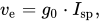
- is the specific impulse in seconds,
- is the specific impulse measured in m/s, which is the same as the effective exhaust velocity measured in m/s (or ft/s if g is in ft/s2),
- is the standard gravity, 9.80665 m/s2 (in United States customary units 32.174 ft/s2).
This equation is also valid for air-breathing jet engines, but is rarely used in practice.
(Note that different symbols are sometimes used; for example, c is also sometimes seen for exhaust velocity. While the symbol might logically be used for specific impulse in units of (N·s3)/(m·kg); to avoid confusion, it is desirable to reserve this for specific impulse measured in seconds.)
It is related to the thrust, or forward force on the rocket by the equation:[11] where is the propellant mass flow rate, which is the rate of decrease of the vehicle's mass.

A rocket must carry all its propellant with it, so the mass of the unburned propellant must be accelerated along with the rocket itself. Minimizing the mass of propellant required to achieve a given change in velocity is crucial to building effective rockets. The Tsiolkovsky rocket equation shows that for a rocket with a given empty mass and a given amount of propellant, the total change in velocity it can accomplish is proportional to the effective exhaust velocity.
A spacecraft without propulsion follows an orbit determined by its trajectory and any gravitational field. Deviations from the corresponding velocity pattern (these are called Δv) are achieved by sending exhaust mass in the direction opposite to that of the desired velocity change.
Actual exhaust speed versus effective exhaust speed
[edit]When an engine is run within the atmosphere, the exhaust velocity is reduced by atmospheric pressure, in turn reducing specific impulse. This is a reduction in the effective exhaust velocity, versus the actual exhaust velocity achieved in vacuum conditions. In the case of gas-generator cycle rocket engines, more than one exhaust gas stream is present as turbopump exhaust gas exits through a separate nozzle. Calculating the effective exhaust velocity requires averaging the two mass flows as well as accounting for any atmospheric pressure.[12]
For air-breathing jet engines, particularly turbofans, the actual exhaust velocity and the effective exhaust velocity are different by orders of magnitude. This happens for several reasons. First, a good deal of additional momentum is obtained by using air as reaction mass, such that combustion products in the exhaust have more mass than the burned fuel. Next, inert gases in the atmosphere absorb heat from combustion, and through the resulting expansion provide additional thrust. Lastly, for turbofans and other designs there is even more thrust created by pushing against intake air which never sees combustion directly. These all combine to allow a better match between the airspeed and the exhaust speed, which saves energy/propellant and enormously increases the effective exhaust velocity while reducing the actual exhaust velocity.[13] Again, this is because the mass of the air is not counted in the specific impulse calculation, thus attributing all of the thrust momentum to the mass of the fuel component of the exhaust, and omitting the reaction mass, inert gas, and effect of driven fans on overall engine efficiency from consideration.
Essentially, the momentum of engine exhaust includes a lot more than just fuel, but specific impulse calculation ignores everything but the fuel. Even though the effective exhaust velocity for an air-breathing engine seems nonsensical in the context of actual exhaust velocity, this is still useful for comparing absolute fuel efficiency of different engines.
Density specific impulse
[edit]A related measure, the density specific impulse, sometimes also referred to as Density Impulse and usually abbreviated as Isd is the product of the average specific gravity of a given propellant mixture and the specific impulse.[14] While less important than the specific impulse, it is an important measure in launch vehicle design, as a low specific impulse implies that bigger tanks will be required to store the propellant, which in turn will have a detrimental effect on the launch vehicle's mass ratio.[15]
Specific fuel consumption
[edit]Specific impulse is inversely proportional to specific fuel consumption (SFC) by the relationship Isp = 1/(go·SFC) for SFC in kg/(N·s) and Isp = 3600/SFC for SFC in lb/(lbf·hr).
Examples
[edit]| Rocket engines in vacuum | |||||||
|---|---|---|---|---|---|---|---|
| Model | Type | First run |
Application | TSFC | Isp (by weight) | Isp (by mass) | |
| lb/lbf·h | g/kN·s | s | m/s | ||||
| Avio P80 | solid fuel | 2006 | Vega stage 1 | 13 | 360 | 280 | 2700 |
| Avio Zefiro 23 | solid fuel | 2006 | Vega stage 2 | 12.52 | 354.7 | 287.5 | 2819 |
| Avio Zefiro 9A | solid fuel | 2008 | Vega stage 3 | 12.20 | 345.4 | 295.2 | 2895 |
| Merlin 1D | liquid fuel | 2013 | Falcon 9 | 12 | 330 | 310 | 3000 |
| RD-843 | liquid fuel | 2012 | Vega upper stage | 11.41 | 323.2 | 315.5 | 3094 |
| Kuznetsov NK-33 | liquid fuel | 1970s | N-1F, Soyuz-2-1v stage 1 | 10.9 | 308 | 331[16] | 3250 |
| NPO Energomash RD-171M | liquid fuel | 1985 | Zenit-2M, -3SL, -3SLB, -3F stage 1 | 10.7 | 303 | 337 | 3300 |
| LE-7A | cryogenic | 2001 | H-IIA, H-IIB stage 1 | 8.22 | 233 | 438 | 4300 |
| Snecma HM-7B | cryogenic | 1979 | Ariane 2, 3, 4, 5 ECA upper stage | 8.097 | 229.4 | 444.6 | 4360 |
| LE-5B-2 | cryogenic | 2009 | H-IIA, H-IIB upper stage | 8.05 | 228 | 447 | 4380 |
| Aerojet Rocketdyne RS-25 | cryogenic | 1981 | Space Shuttle, SLS stage 1 | 7.95 | 225 | 453[17] | 4440 |
| Aerojet Rocketdyne RL-10B-2 | cryogenic | 1998 | Delta III, Delta IV, SLS upper stage | 7.734 | 219.1 | 465.5 | 4565 |
| NERVA NRX A6 | nuclear | 1967 | 869 | ||||
| Jet engines with Reheat, static, sea level | |||||||
|---|---|---|---|---|---|---|---|
| Model | Type | First run |
Application | TSFC | Isp (by weight) | Isp (by mass) | |
| lb/lbf·h | g/kN·s | s | m/s | ||||
| Turbo-Union RB.199 | turbofan | Tornado | 2.5[18] | 70.8 | 1440 | 14120 | |
| GE F101-GE-102 | turbofan | 1970s | B-1B | 2.46 | 70 | 1460 | 14400 |
| Tumansky R-25-300 | turbojet | MIG-21bis | 2.206[18] | 62.5 | 1632 | 16000 | |
| GE J85-GE-21 | turbojet | F-5E/F | 2.13[18] | 60.3 | 1690 | 16570 | |
| GE F110-GE-132 | turbofan | F-16E/F | 2.09[18] | 59.2 | 1722 | 16890 | |
| Honeywell/ITEC F125 | turbofan | F-CK-1 | 2.06[18] | 58.4 | 1748 | 17140 | |
| Snecma M53-P2 | turbofan | Mirage 2000C/D/N | 2.05[18] | 58.1 | 1756 | 17220 | |
| Snecma Atar 09C | turbojet | Mirage III | 2.03[18] | 57.5 | 1770 | 17400 | |
| Snecma Atar 09K-50 | turbojet | Mirage IV, 50, F1 | 1.991[18] | 56.4 | 1808 | 17730 | |
| GE J79-GE-15 | turbojet | F-4E/EJ/F/G, RF-4E | 1.965 | 55.7 | 1832 | 17970 | |
| Saturn AL-31F | turbofan | Su-27/P/K | 1.96[19] | 55.5 | 1837 | 18010 | |
| GE F110-GE-129 | turbofan | F-16C/D, F-15EX | 1.9[18] | 53.8 | 1895 | 18580 | |
| Soloviev D-30F6 | turbofan | MiG-31, S-37/Su-47 | 1.863[18] | 52.8 | 1932 | 18950 | |
| Lyulka AL-21F-3 | turbojet | Su-17, Su-22 | 1.86[18] | 52.7 | 1935 | 18980 | |
| Klimov RD-33 | turbofan | 1974 | MiG-29 | 1.85 | 52.4 | 1946 | 19080 |
| Saturn AL-41F-1S | turbofan | Su-35S/T-10BM | 1.819 | 51.5 | 1979 | 19410 | |
| Volvo RM12 | turbofan | 1978 | Gripen A/B/C/D | 1.78[18] | 50.4 | 2022 | 19830 |
| GE F404-GE-402 | turbofan | F/A-18C/D | 1.74[18] | 49 | 2070 | 20300 | |
| Kuznetsov NK-32 | turbofan | 1980 | Tu-144LL, Tu-160 | 1.7 | 48 | 2100 | 21000 |
| Snecma M88-2 | turbofan | 1989 | Rafale | 1.663 | 47.11 | 2165 | 21230 |
| Eurojet EJ200 | turbofan | 1991 | Eurofighter | 1.66–1.73 | 47–49[20] | 2080–2170 | 20400–21300 |
| Dry jet engines, static, sea level | |||||||
|---|---|---|---|---|---|---|---|
| Model | Type | First run |
Application | TSFC | Isp (by weight) | Isp (by mass) | |
| lb/lbf·h | g/kN·s | s | m/s | ||||
| GE J85-GE-21 | turbojet | F-5E/F | 1.24[18] | 35.1 | 2900 | 28500 | |
| Snecma Atar 09C | turbojet | Mirage III | 1.01[18] | 28.6 | 3560 | 35000 | |
| Snecma Atar 09K-50 | turbojet | Mirage IV, 50, F1 | 0.981[18] | 27.8 | 3670 | 36000 | |
| Snecma Atar 08K-50 | turbojet | Super Étendard | 0.971[18] | 27.5 | 3710 | 36400 | |
| Tumansky R-25-300 | turbojet | MIG-21bis | 0.961[18] | 27.2 | 3750 | 36700 | |
| Lyulka AL-21F-3 | turbojet | Su-17, Su-22 | 0.86 | 24.4 | 4190 | 41100 | |
| GE J79-GE-15 | turbojet | F-4E/EJ/F/G, RF-4E | 0.85 | 24.1 | 4240 | 41500 | |
| Snecma M53-P2 | turbofan | Mirage 2000C/D/N | 0.85[18] | 24.1 | 4240 | 41500 | |
| Volvo RM12 | turbofan | 1978 | Gripen A/B/C/D | 0.824[18] | 23.3 | 4370 | 42800 |
| RR Turbomeca Adour | turbofan | 1999 | Jaguar retrofit | 0.81 | 23 | 4400 | 44000 |
| Honeywell/ITEC F124 | turbofan | 1979 | L-159, X-45 | 0.81[18] | 22.9 | 4440 | 43600 |
| Honeywell/ITEC F125 | turbofan | F-CK-1 | 0.8[18] | 22.7 | 4500 | 44100 | |
| PW J52-P-408 | turbojet | A-4M/N, TA-4KU, EA-6B | 0.79 | 22.4 | 4560 | 44700 | |
| Saturn AL-41F-1S | turbofan | Su-35S/T-10BM | 0.79 | 22.4 | 4560 | 44700 | |
| Snecma M88-2 | turbofan | 1989 | Rafale | 0.782 | 22.14 | 4600 | 45100 |
| Klimov RD-33 | turbofan | 1974 | MiG-29 | 0.77 | 21.8 | 4680 | 45800 |
| RR Pegasus 11-61 | turbofan | AV-8B+ | 0.76 | 21.5 | 4740 | 46500 | |
| Eurojet EJ200 | turbofan | 1991 | Eurofighter | 0.74–0.81 | 21–23[20] | 4400–4900 | 44000–48000 |
| GE F414-GE-400 | turbofan | 1993 | F/A-18E/F | 0.724[21] | 20.5 | 4970 | 48800 |
| Kuznetsov NK-32 | turbofan | 1980 | Tu-144LL, Tu-160 | 0.72-0.73 | 20–21 | 4900–5000 | 48000–49000 |
| Soloviev D-30F6 | turbofan | MiG-31, S-37/Su-47 | 0.716[18] | 20.3 | 5030 | 49300 | |
| Snecma Larzac | turbofan | 1972 | Alpha Jet | 0.716 | 20.3 | 5030 | 49300 |
| IHI F3 | turbofan | 1981 | Kawasaki T-4 | 0.7 | 19.8 | 5140 | 50400 |
| Saturn AL-31F | turbofan | Su-27 /P/K | 0.666-0.78[19][21] | 18.9–22.1 | 4620–5410 | 45300–53000 | |
| RR Spey RB.168 | turbofan | AMX | 0.66[18] | 18.7 | 5450 | 53500 | |
| GE F110-GE-129 | turbofan | F-16C/D, F-15 | 0.64[21] | 18 | 5600 | 55000 | |
| GE F110-GE-132 | turbofan | F-16E/F | 0.64[21] | 18 | 5600 | 55000 | |
| Turbo-Union RB.199 | turbofan | Tornado ECR | 0.637[18] | 18.0 | 5650 | 55400 | |
| PW F119-PW-100 | turbofan | 1992 | F-22 | 0.61[21] | 17.3 | 5900 | 57900 |
| Turbo-Union RB.199 | turbofan | Tornado | 0.598[18] | 16.9 | 6020 | 59000 | |
| GE F101-GE-102 | turbofan | 1970s | B-1B | 0.562 | 15.9 | 6410 | 62800 |
| PW TF33-P-3 | turbofan | B-52H, NB-52H | 0.52[18] | 14.7 | 6920 | 67900 | |
| RR AE 3007H | turbofan | RQ-4, MQ-4C | 0.39[18] | 11.0 | 9200 | 91000 | |
| GE F118-GE-100 | turbofan | 1980s | B-2 | 0.375[18] | 10.6 | 9600 | 94000 |
| GE F118-GE-101 | turbofan | 1980s | U-2S | 0.375[18] | 10.6 | 9600 | 94000 |
| General Electric CF6-50C2 | turbofan | A300, DC-10-30 | 0.371[18] | 10.5 | 9700 | 95000 | |
| GE TF34-GE-100 | turbofan | A-10 | 0.37[18] | 10.5 | 9700 | 95000 | |
| CFM CFM56-2B1 | turbofan | C-135, RC-135 | 0.36[22] | 10 | 10000 | 98000 | |
| Progress D-18T | turbofan | 1980 | An-124, An-225 | 0.345 | 9.8 | 10400 | 102000 |
| PW F117-PW-100 | turbofan | C-17 | 0.34[23] | 9.6 | 10600 | 104000 | |
| PW PW2040 | turbofan | Boeing 757 | 0.33[23] | 9.3 | 10900 | 107000 | |
| CFM CFM56-3C1 | turbofan | 737 Classic | 0.33 | 9.3 | 11000 | 110000 | |
| GE CF6-80C2 | turbofan | 744, 767, MD-11, A300/310, C-5M | 0.307-0.344 | 8.7–9.7 | 10500–11700 | 103000–115000 | |
| EA GP7270 | turbofan | A380-861 | 0.299[21] | 8.5 | 12000 | 118000 | |
| GE GE90-85B | turbofan | 777-200/200ER/300 | 0.298[21] | 8.44 | 12080 | 118500 | |
| GE GE90-94B | turbofan | 777-200/200ER/300 | 0.2974[21] | 8.42 | 12100 | 118700 | |
| RR Trent 970-84 | turbofan | 2003 | A380-841 | 0.295[21] | 8.36 | 12200 | 119700 |
| GE GEnx-1B70 | turbofan | 787-8 | 0.2845[21] | 8.06 | 12650 | 124100 | |
| RR Trent 1000C | turbofan | 2006 | 787-9 | 0.273[21] | 7.7 | 13200 | 129000 |
| Jet engines, cruise | |||||||
|---|---|---|---|---|---|---|---|
| Model | Type | First run |
Application | TSFC | Isp (by weight) | Isp (by mass) | |
| lb/lbf·h | g/kN·s | s | m/s | ||||
| Ramjet | Mach 1 | 4.5 | 130 | 800 | 7800 | ||
| J-58 | turbojet | 1958 | SR-71 at Mach 3.2 (Reheat) | 1.9[18] | 53.8 | 1895 | 18580 |
| RR/Snecma Olympus | turbojet | 1966 | Concorde at Mach 2 | 1.195[24] | 33.8 | 3010 | 29500 |
| PW JT8D-9 | turbofan | 737 Original | 0.8[25] | 22.7 | 4500 | 44100 | |
| Honeywell ALF502R-5 | GTF | BAe 146 | 0.72[23] | 20.4 | 5000 | 49000 | |
| Soloviev D-30KP-2 | turbofan | Il-76, Il-78 | 0.715 | 20.3 | 5030 | 49400 | |
| Soloviev D-30KU-154 | turbofan | Tu-154M | 0.705 | 20.0 | 5110 | 50100 | |
| RR Tay RB.183 | turbofan | 1984 | Fokker 70, Fokker 100 | 0.69 | 19.5 | 5220 | 51200 |
| GE CF34-3 | turbofan | 1982 | Challenger, CRJ100/200 | 0.69 | 19.5 | 5220 | 51200 |
| GE CF34-8E | turbofan | E170/175 | 0.68 | 19.3 | 5290 | 51900 | |
| Honeywell TFE731-60 | GTF | Falcon 900 | 0.679[26] | 19.2 | 5300 | 52000 | |
| CFM CFM56-2C1 | turbofan | DC-8 Super 70 | 0.671[23] | 19.0 | 5370 | 52600 | |
| GE CF34-8C | turbofan | CRJ700/900/1000 | 0.67-0.68 | 19–19 | 5300–5400 | 52000–53000 | |
| CFM CFM56-3C1 | turbofan | 737 Classic | 0.667 | 18.9 | 5400 | 52900 | |
| CFM CFM56-2A2 | turbofan | 1974 | E-3, E-6 | 0.66[22] | 18.7 | 5450 | 53500 |
| RR BR725 | turbofan | 2008 | G650/ER | 0.657 | 18.6 | 5480 | 53700 |
| CFM CFM56-2B1 | turbofan | C-135, RC-135 | 0.65[22] | 18.4 | 5540 | 54300 | |
| GE CF34-10A | turbofan | ARJ21 | 0.65 | 18.4 | 5540 | 54300 | |
| CFE CFE738-1-1B | turbofan | 1990 | Falcon 2000 | 0.645[23] | 18.3 | 5580 | 54700 |
| RR BR710 | turbofan | 1995 | G. V/G550, Global Express | 0.64 | 18 | 5600 | 55000 |
| GE CF34-10E | turbofan | E190/195 | 0.64 | 18 | 5600 | 55000 | |
| General Electric CF6-50C2 | turbofan | A300B2/B4/C4/F4, DC-10-30 | 0.63[23] | 17.8 | 5710 | 56000 | |
| PowerJet SaM146 | turbofan | Superjet LR | 0.629 | 17.8 | 5720 | 56100 | |
| CFM CFM56-7B24 | turbofan | 737 NG | 0.627[23] | 17.8 | 5740 | 56300 | |
| RR BR715 | turbofan | 1997 | 717 | 0.62 | 17.6 | 5810 | 56900 |
| GE CF6-80C2-B1F | turbofan | 747-400 | 0.605[24] | 17.1 | 5950 | 58400 | |
| CFM CFM56-5A1 | turbofan | A320 | 0.596 | 16.9 | 6040 | 59200 | |
| Aviadvigatel PS-90A1 | turbofan | Il-96-400 | 0.595 | 16.9 | 6050 | 59300 | |
| PW PW2040 | turbofan | 757-200 | 0.582[23] | 16.5 | 6190 | 60700 | |
| PW PW4098 | turbofan | 777-300 | 0.581[23] | 16.5 | 6200 | 60800 | |
| GE CF6-80C2-B2 | turbofan | 767 | 0.576[23] | 16.3 | 6250 | 61300 | |
| IAE V2525-D5 | turbofan | MD-90 | 0.574[27] | 16.3 | 6270 | 61500 | |
| IAE V2533-A5 | turbofan | A321-231 | 0.574[27] | 16.3 | 6270 | 61500 | |
| RR Trent 700 | turbofan | 1992 | A330 | 0.562[28] | 15.9 | 6410 | 62800 |
| RR Trent 800 | turbofan | 1993 | 777-200/200ER/300 | 0.560[28] | 15.9 | 6430 | 63000 |
| Progress D-18T | turbofan | 1980 | An-124, An-225 | 0.546 | 15.5 | 6590 | 64700 |
| CFM CFM56-5B4 | turbofan | A320-214 | 0.545 | 15.4 | 6610 | 64800 | |
| CFM CFM56-5C2 | turbofan | A340-211 | 0.545 | 15.4 | 6610 | 64800 | |
| RR Trent 500 | turbofan | 1999 | A340-500/600 | 0.542[28] | 15.4 | 6640 | 65100 |
| CFM LEAP-1B | turbofan | 2014 | 737 MAX | 0.53-0.56 | 15–16 | 6400–6800 | 63000–67000 |
| Aviadvigatel PD-14 | turbofan | 2014 | MC-21-310 | 0.526 | 14.9 | 6840 | 67100 |
| RR Trent 900 | turbofan | 2003 | A380 | 0.522[28] | 14.8 | 6900 | 67600 |
| GE GE90-85B | turbofan | 777-200/200ER | 0.52[23][29] | 14.7 | 6920 | 67900 | |
| GE GEnx-1B76 | turbofan | 2006 | 787-10 | 0.512[25] | 14.5 | 7030 | 69000 |
| PW PW1400G | GTF | MC-21 | 0.51[30] | 14.4 | 7100 | 69000 | |
| CFM LEAP-1C | turbofan | 2013 | C919 | 0.51 | 14.4 | 7100 | 69000 |
| CFM LEAP-1A | turbofan | 2013 | A320neo family | 0.51[30] | 14.4 | 7100 | 69000 |
| RR Trent 7000 | turbofan | 2015 | A330neo | 0.506[a] | 14.3 | 7110 | 69800 |
| RR Trent 1000 | turbofan | 2006 | 787 | 0.506[b] | 14.3 | 7110 | 69800 |
| RR Trent XWB-97 | turbofan | 2014 | A350-1000 | 0.478[c] | 13.5 | 7530 | 73900 |
| PW 1127G | GTF | 2012 | A320neo | 0.463[25] | 13.1 | 7780 | 76300 |
| Engine | Effective exhaust velocity (m/s) | Specific impulse (s) | Exhaust specific energy (MJ/kg) |
|---|---|---|---|
| Turbofan jet engine (actual V is ~300 m/s) | 29,000 | 3,000 | Approx. 0.05 |
| Space Shuttle Solid Rocket Booster | 2,500 | 250 | 3 |
| Liquid oxygen–liquid hydrogen | 4,400 | 450 | 9.7 |
| NSTAR[31] electrostatic xenon ion thruster | 20,000–30,000 | 1,950–3,100 | |
| NEXT electrostatic xenon ion thruster | 40,000 | 1,320–4,170 | |
| VASIMR predictions[32][33][34] | 30,000–120,000 | 3,000–12,000 | 1,400 |
| DS4G electrostatic ion thruster[35] | 210,000 | 21,400 | 22,500 |
| Ideal photonic rocket[d] | 299,792,458 | 30,570,000 | 89,875,517,874 |
An example of a specific impulse measured in time is 453 seconds, which is equivalent to an effective exhaust velocity of 4.440 km/s (14,570 ft/s), for the RS-25 engines when operating in a vacuum.[36] An air-breathing jet engine typically has a much larger specific impulse than a rocket; for example a turbofan jet engine may have a specific impulse of 6,000 seconds or more at sea level whereas a rocket would be between 200 and 400 seconds.[37]
An air-breathing engine is thus much more propellant efficient than a rocket engine, because the air serves as reaction mass and oxidizer for combustion which does not have to be carried as propellant, and the actual exhaust speed is much lower, so the kinetic energy the exhaust carries away is lower and thus the jet engine uses far less energy to generate thrust.[38] While the actual exhaust velocity is lower for air-breathing engines, the effective exhaust velocity is very high for jet engines. This is because the effective exhaust velocity calculation assumes that the carried propellant is providing all the reaction mass and all the thrust. Hence effective exhaust velocity is not physically meaningful for air-breathing engines; nevertheless, it is useful for comparison with other types of engines.[39]
The highest specific impulse for a chemical propellant ever test-fired in a rocket engine was 542 seconds (5.32 km/s) with a tripropellant of lithium, fluorine, and hydrogen. However, this combination is impractical. Lithium and fluorine are both extremely corrosive, lithium ignites on contact with air, fluorine ignites on contact with most fuels, and hydrogen, while not hypergolic, is an explosive hazard. Fluorine and the hydrogen fluoride (HF) in the exhaust are very toxic, which damages the environment, makes work around the launch pad difficult, and makes getting a launch license that much more difficult. The rocket exhaust is also ionized, which would interfere with radio communication with the rocket.[40][41][42]
Nuclear thermal rocket engines differ from conventional rocket engines in that energy is supplied to the propellants by an external nuclear heat source instead of the heat of combustion.[43] The nuclear rocket typically operates by passing liquid hydrogen gas through an operating nuclear reactor. Testing in the 1960s yielded specific impulses of about 850 seconds (8,340 m/s), about twice that of the Space Shuttle engines.[44]
A variety of other rocket propulsion methods, such as ion thrusters, give much higher specific impulse but with much lower thrust; for example the Hall-effect thruster on the SMART-1 satellite has a specific impulse of 1,640 s (16.1 km/s) but a maximum thrust of only 68 mN (0.015 lbf).[45] The variable specific impulse magnetoplasma rocket (VASIMR) engine currently in development will theoretically yield 20 to 300 km/s (66,000 to 984,000 ft/s), and a maximum thrust of 5.7 N (1.3 lbf).[46]
See also
[edit]- Jet engine
- Impulse
- Tsiolkovsky rocket equation
- System-specific impulse
- Specific energy
- Standard gravity
- Thrust specific fuel consumption—fuel consumption per unit thrust
- Specific thrust—thrust per unit of air for a duct engine
- Heating value
- Energy density
- Delta-v (physics)
- Rocket propellant
- Liquid rocket propellants
Notes
[edit]References
[edit]- ^ "What is specific impulse?". Qualitative Reasoning Group. Archived from the original on 4 July 2016. Retrieved 22 December 2009.
- ^ Hutchinson, Lee (14 April 2013). "New F-1B rocket engine upgrades Apollo-era design with 1.8M lbs of thrust". Ars Technica. Retrieved 15 April 2013.
The measure of a rocket's fuel effectiveness is called its specific impulse (abbreviated as 'ISP'—or more properly Isp).... 'Mass specific impulse ... describes the thrust-producing effectiveness of a chemical reaction and it is most easily thought of as the amount of thrust force produced by each pound (mass) of fuel and oxidizer propellant burned in a unit of time. It is kind of like a measure of miles per gallon (mpg) for rockets.'
- ^ "Laser-powered Interstellar Probe (Presentation)". Archived from the original on 2 October 2013. Retrieved 16 November 2013.
- ^ "Mission Overview". exploreMarsnow. Retrieved 23 December 2009.
- ^ "Specific Impulse". www.grc.nasa.gov.
- ^ "What is specific impulse?". www.qrg.northwestern.edu.
- ^ "Specific Fuel Consumption". www.grc.nasa.gov. Retrieved 13 May 2021.
- ^ Rocket Propulsion Elements, 7th Edition by George P. Sutton, Oscar Biblarz
- ^ Benson, Tom (11 July 2008). "Specific impulse". NASA. Retrieved 22 December 2009.
- ^ George P. Sutton & Oscar Biblarz (2016). Rocket Propulsion Elements. John Wiley & Sons. p. 27. ISBN 978-1-118-75388-0.
- ^ Thomas A. Ward (2010). Aerospace Propulsion Systems. John Wiley & Sons. p. 68. ISBN 978-0-470-82497-9.
- ^ "Rocket Thrust Equations". www.grc.nasa.gov. Archived from the original on 9 November 2024. Retrieved 11 December 2024.
- ^ "Research on Efficient Heat Transfer for Air Breathing Electric Propulsion". doi.org. 23 January 2023. doi:10.2514/6.2023-0450.vid. Retrieved 11 December 2024.
- ^ "Density specific impulse". The Free Dictionary. Retrieved 20 September 2022.
- ^ "Rocket Propellants". braeunig.us. Retrieved 20 September 2022.
- ^ "NK33". Encyclopedia Astronautica.
- ^ "SSME". Encyclopedia Astronautica.
- ^ a b c d e f g h i j k l m n o p q r s t u v w x y z aa ab ac ad ae af ag Nathan Meier (21 March 2005). "Military Turbojet/Turbofan Specifications". Archived from the original on 11 February 2021.
- ^ a b "Flanker". AIR International Magazine. 23 March 2017.
- ^ a b "EJ200 turbofan engine" (PDF). MTU Aero Engines. April 2016.
- ^ a b c d e f g h i j k Kottas, Angelos T.; Bozoudis, Michail N.; Madas, Michael A. "Turbofan Aero-Engine Efficiency Evaluation: An Integrated Approach Using VSBM Two-Stage Network DEA" (PDF). doi:10.1016/j.omega.2019.102167.
- ^ a b c Élodie Roux (2007). "Turbofan and Turbojet Engines: Database Handbook" (PDF). p. 126. ISBN 9782952938013.
- ^ a b c d e f g h i j k Nathan Meier (3 April 2005). "Civil Turbojet/Turbofan Specifications". Archived from the original on 17 August 2021.
- ^ a b Ilan Kroo. "Data on Large Turbofan Engines". Aircraft Design: Synthesis and Analysis. Stanford University. Archived from the original on 11 January 2017.
- ^ a b c David Kalwar (2015). "Integration of turbofan engines into the preliminary design of a high-capacity short-and medium-haul passenger aircraft and fuel efficiency analysis with a further developed parametric aircraft design software" (PDF).
- ^ "Purdue School of Aeronautics and Astronautics Propulsion Web Page - TFE731".
- ^ a b Lloyd R. Jenkinson & al. (30 July 1999). "Civil Jet Aircraft Design: Engine Data File". Elsevier/Butterworth-Heinemann.
- ^ a b c d "Gas Turbine Engines" (PDF). Aviation Week. 28 January 2008. pp. 137–138.
- ^ Élodie Roux (2007). "Turbofan and Turbojet Engines: Database Handbook". ISBN 9782952938013.
- ^ a b Vladimir Karnozov (19 August 2019). "Aviadvigatel Mulls Higher-thrust PD-14s To Replace PS-90A". AIN Online.
- ^ In-flight performance of the NSTAR ion propulsion system on the Deep Space One mission. Aerospace Conference Proceedings. IEEExplore. 2000. doi:10.1109/AERO.2000.878373.
- ^ Glover, Tim W.; Chang Diaz, Franklin R.; Squire, Jared P.; Jacobsen, Verlin; Chavers, D. Gregory; Carter, Mark D. "Principal VASIMR Results and Present Objectives" (PDF).
- ^ Cassady, Leonard D.; Longmier, Benjamin W.; Olsen, Chris S.; Ballenger, Maxwell G.; McCaskill, Greg E.; Ilin, Andrew V.; Carter, Mark D.; Gloverk, Tim W.; Squire, Jared P.; Chang, Franklin R.; Bering, III, Edgar A. (28 July 2010). "VASIMR R Performance Results" (PDF). www.adastra.com.
- ^ "Vasimr VX 200 meets full power efficiency milestone". spacefellowship.com. Retrieved 13 May 2021.
- ^ "ESA and Australian team develop breakthrough in space propulsion". cordis.europa.eu. 18 January 2006.
- ^ "SSME". www.astronautix.com. Archived from the original on 3 March 2016.
- ^ "11.6 Performance of Jet Engines". web.mit.edu.
- ^ Dunn, Bruce P. (2001). "Dunn's readme". Archived from the original on 20 October 2013. Retrieved 12 July 2014.
- ^ "Effective exhaust velocity | engineering". Encyclopedia Britannica.
- ^ "fuel - Where is the Lithium-Fluorine-Hydrogen tripropellant currently?". Space Exploration Stack Exchange.
- ^ Arbit, H.; Clapp, S.; Nagai, C. (1968). "Investigation of the lithium-fluorine-hydrogen tripropellant system". 4th Propulsion Joint Specialist Conference. doi:10.2514/6.1968-618.
- ^ ARBIT, H. A., CLAPP, S. D., NAGAI, C. K., Lithium-fluorine-hydrogen propellant investigation Final report NASA, 1 May 1970.
- ^ "Space Propulsion and Mission Analysis Office". Archived from the original on 12 April 2011. Retrieved 20 July 2011.
- ^ National Aeronautics and Space Administration (5 January 2017), Nuclear Propulsion in Space, archived from the original on 11 December 2021, retrieved 24 February 2021
- ^ "Characterization of a High Specific Impulse Xenon Hall Effect Thruster | Mendeley". Archived from the original on 24 March 2012. Retrieved 20 July 2011.
- ^ Ad Astra (23 November 2010). "VASIMR® VX-200 MEETS FULL POWER EFFICIENCY MILESTONE" (PDF). Archived from the original (PDF) on 30 October 2012. Retrieved 23 June 2014.
- ^ 10% better than Trent 700
- ^ 10% better than Trent 700
- ^ 15 per cent fuel consumption advantage over the original Trent engine
- ^ A hypothetical device doing perfect conversion of mass to photons emitted perfectly aligned so as to be antiparallel to the desired thrust vector. This represents the theoretical upper limit for propulsion relying strictly on onboard fuel and the rocket principle.
External links
[edit]Specific impulse
View on GrokipediaDefinition and Fundamentals
Core Definition
Specific impulse, denoted as , is a measure of propulsion efficiency defined as the total impulse delivered per unit weight of propellant consumed. It is mathematically expressed as the ratio of thrust to the propellant weight flow rate: where is the thrust force in newtons (N), is the propellant mass flow rate in kilograms per second (kg/s), and is the standard gravitational acceleration (), yielding units of seconds (s). This quantity is equivalent to the effective exhaust velocity of the propulsion system divided by , representing the speed at which propellant is expelled to generate thrust normalized by gravity.[1][6] In rocket propulsion, specific impulse directly influences the maximum achievable change in velocity, or , as described by the Tsiolkovsky rocket equation. A brief derivation begins with the conservation of momentum for a rocket expelling propellant: the instantaneous change in velocity satisfies , where is the instantaneous mass and is the negative mass change due to propellant expulsion. Integrating this from initial mass to final mass gives: where is the standard gravitational acceleration (9.81 m/s²). This equation highlights specific impulse's role in scaling the velocity gain with the logarithm of the initial-to-final mass ratio, underscoring its importance for mission design and propellant efficiency.[7][8] The concept of specific impulse originated in the 20th century amid the development of modern rocketry, evolving from 19th-century ballistic efficiency measures used in artillery and early gunpowder propulsion studies. Pioneers in rocketry, including figures like Robert H. Goddard, adapted and formalized it to evaluate engine performance as liquid- and solid-propellant technologies advanced during the mid-1900s.[9][10]Physical Significance
Specific impulse quantifies the efficiency of a propulsion system in converting propellant mass into thrust, serving as a key indicator of how effectively momentum is imparted to a vehicle. A higher value of specific impulse means that a given amount of propellant can produce more thrust over time, reducing the overall propellant mass required to achieve a desired change in velocity and thereby enabling missions with larger payloads or longer durations.[1] This metric stems from the foundational relationship in propulsion where thrust equals the product of propellant mass flow rate and effective exhaust velocity.[11] In practical terms, specific impulse functions similarly to fuel economy measures like miles per gallon in automobiles, providing a standardized way to compare propulsion performance across different systems, but it is tailored to evaluate thrust output per unit of propellant rather than distance per unit of fuel.[12] This analogy underscores its utility in optimizing designs for resource-limited environments, such as space travel, where minimizing propellant use is critical for mission success.[13] Despite its value, specific impulse relies on the assumption of constant exhaust velocity for its calculation and does not inherently incorporate influences like aerodynamic drag or atmospheric pressure variations, which can alter effective performance in non-vacuum conditions.[14] These simplifications make it a powerful comparative tool but limit its direct applicability to complex, real-time operational dynamics.[15]Units and Expressions
Impulse in Seconds
The specific impulse expressed in seconds, denoted as , is calculated using the formula where is the effective exhaust velocity in meters per second and is the standard gravitational acceleration of approximately 9.80665 m/s².[1][16] This derivation normalizes the exhaust velocity by Earth's surface gravity, yielding an efficiency metric with units of time.[1] The choice of seconds as the unit originated from conventions in early rocketry using imperial engineering units, where thrust is divided by propellant weight flow rate (pounds-force per pound per second), naturally resulting in seconds and avoiding conflation with pure velocity terms.[1][17] In modern contexts, although the effective exhaust velocity is expressed in meters per second under the International System of Units (SI), the seconds-based expression for specific impulse remains the standard in aerospace engineering literature due to its entrenched role in design, analysis, and cross-system benchmarking.[1]Effective Exhaust Velocity
The effective exhaust velocity, denoted , is defined as , where is the specific impulse and is the standard acceleration due to gravity (approximately 9.80665 m/s²). This parameter represents the equivalent average speed of the exhaust gases expelled relative to the propulsion system, encapsulating the momentum transfer efficiency while accounting for nozzle performance and exit pressure effects. It serves as a key metric in propulsion analysis, directly influencing the achievable delta-v in the Tsiolkovsky rocket equation.[18] In detail, the effective exhaust velocity arises from the dynamics of nozzle flow and can be decomposed as , where is the actual gas velocity at the nozzle exit, is the exit pressure, is the ambient pressure, and is the exhaust gas density at the exit plane. This expression highlights the contribution of under- or over-expansion in the nozzle, with ideal full expansion occurring when , simplifying to . The formula underscores the physical basis in compressible flow principles, where deviations from perfect expansion adjust the effective momentum imparted to the vehicle.[19] A primary advantage of expressing specific impulse as effective exhaust velocity lies in its direct connection to the thrust equation's momentum term: , where is the mass flow rate and is the nozzle exit area. This formulation isolates the velocity-driven thrust while explicitly including pressure contributions, enabling precise theoretical modeling of engine performance under varying ambient conditions, such as sea level versus vacuum operation. It proves invaluable for optimizing nozzle design and predicting overall system efficiency in propulsion studies.[7] The conventional reporting of specific impulse in seconds represents a scaled version of this velocity, obtained by dividing by , which simplifies engineering comparisons across different gravitational environments.[20]Conversions Between Units
Specific impulse is commonly expressed in seconds (s), meters per second (m/s), or US customary units such as feet per second (ft/s) or pound-force seconds per pound (lbf·s/lb). The conversions between these units rely on the relationship , where is the effective exhaust velocity and is the standard acceleration due to gravity.[1][21] To convert from SI units of effective exhaust velocity in m/s to specific impulse in seconds, divide the velocity by the standard gravitational acceleration m/s², which is equivalent to multiplying by s²/m.[1][22] For example, an exhaust velocity of 3000 m/s yields s. This scaling ensures consistency across unit systems by normalizing to Earth's surface gravity.[1] In US customary units, the conversion from effective exhaust velocity in ft/s to seconds follows a similar process using ft/s², so .[1] Additionally, specific impulse in lbf·s/lb is numerically equal to the value in seconds due to the definition of the pound-force in the foot-pound-second system, where the gravitational constant aligns the units directly.[1] For instance, an of 300 lbf·s/lb corresponds to 300 s.[23] When performing these conversions, engineers typically use the fixed standard value of at sea level for consistency, as variations between sea-level and vacuum conditions (or latitude-dependent changes) are negligible, on the order of 0.5% or less, and do not significantly impact propulsion calculations.[1] Software tools and engineering handbooks often incorporate these factors automatically to facilitate unit transformations in design workflows.[21]Applications in Propulsion Systems
Rocket Propulsion
In rocket propulsion, specific impulse serves as a key metric of efficiency, quantifying the thrust generated per unit of propellant consumed, typically expressed in seconds. For chemical rockets, which dominate launch vehicles and upper stages, specific impulse values generally range from 200 to 450 seconds, reflecting the combustion of stored propellants to produce high-temperature exhaust gases accelerated through a nozzle.[13] This range arises from the inherent limitations of chemical reactions, where exhaust velocities are constrained by the energy release from propellant bonds, typically yielding effective exhaust velocities of 2 to 4.5 km/s.[24] Design factors such as the oxidizer-to-fuel ratio and chamber pressure significantly influence specific impulse in chemical rockets by optimizing combustion temperature and exhaust expansion. The oxidizer-to-fuel ratio determines the completeness of combustion; for instance, a near-stoichiometric mixture maximizes energy release and thus higher exhaust velocity, while deviations can reduce performance.[25] Chamber pressure affects the power cycle efficiency and nozzle performance, with higher pressures enabling better expansion and up to 10-20% gains in specific impulse through reduced losses.[20] A representative example is the liquid oxygen (LOX)/RP-1 (refined kerosene) combination, commonly used in first-stage engines, which achieves approximately 300 seconds of specific impulse in vacuum due to its balanced density and energy density.[26] Electric propulsion systems, such as ion thrusters, achieve markedly higher specific impulses of 1000 to 9000 seconds by electrically accelerating ionized propellant to much greater velocities, often 20-50 km/s or more, albeit at low thrust levels suitable for in-space maneuvers.[13] In these systems, efficiency stems from minimizing propellant mass through high exhaust speeds, with xenon serving as a preferred propellant due to its low ionization energy and suitable atomic mass for grid extraction.[27] For example, gridded ion thrusters using xenon can deliver specific impulses around 3000-5000 seconds, enabling long-duration missions like deep space probes where thrust-to-power ratios prioritize endurance over rapid acceleration.[28] Specific impulse in rockets varies between sea-level and vacuum conditions because atmospheric back-pressure limits nozzle expansion at lower altitudes, reducing effective exhaust velocity. In vacuum, nozzles can expand fully to lower exit pressures, increasing specific impulse by 20-30% or more compared to sea level.[1] The Space Shuttle Main Engine (SSME), a hydrogen-oxygen bipropellant turbopump-fed design, exemplifies this: it delivers 363 seconds at sea level but reaches 452 seconds in vacuum, highlighting the optimization of its high-expansion nozzle for orbital operations.[29]Air-Breathing Engines
Air-breathing engines utilize ambient atmospheric air as the primary working fluid and reaction mass, with fuel providing only the energy for combustion. The specific impulse for these engines is defined as , where is the thrust, is the fuel mass flow rate, and is the standard gravitational acceleration (9.80665 m/s²). This formulation emphasizes fuel efficiency, as the air mass flow greatly exceeds the fuel flow, resulting in specific impulse values orders of magnitude higher than those of rockets.[30] Turbojets, which compress incoming air via a turbine-driven compressor before combustion and expansion through a nozzle, typically exhibit specific impulse values ranging from around 3000–4000 seconds at sea-level takeoff to 4000–5000 seconds during cruise conditions. These values stem from the engine's operation across subsonic to supersonic speeds, where higher exhaust velocities contribute to improved efficiency at altitude. In contrast, low-bypass turbofans, suited for higher-speed applications, achieve similar or slightly higher specific impulse compared to pure turbojets due to partial air bypassing the core, which adds thrust with minimal additional fuel consumption. High-bypass turbofans, common in commercial aviation, achieve effective specific impulse exceeding 5000 seconds at cruise altitudes, often reaching 6000–8000 seconds for modern designs with bypass ratios above 8:1. This superior performance arises from the large fan-accelerated air mass flow, which generates most of the thrust with minimal fuel consumption; for instance, engines like the GE90 have a cruise thrust-specific fuel consumption (TSFC) of approximately 0.545 lb/(lbf·h), corresponding to an I_{sp} of about 6600 seconds via the relation (with TSFC in lb/(lbf·h)). High-bypass configurations thus offer better fuel economy for subsonic flight but sacrifice some high-speed capability relative to turbojets.[30] Ramjets, lacking mechanical compression and relying on high flight speeds for air intake ram compression, operate efficiently above Mach 2 and deliver specific impulse up to 3000 seconds at Mach 3 or higher, with typical cruise values of 1000–2000 seconds depending on fuel-air ratio and speed. For example, theoretical analyses show ramjet I_{sp} increasing from 3550 seconds to 3900 seconds at Mach 6 as the fuel-air ratio decreases, highlighting their suitability for hypersonic cruise. Unlike turbomachinery-based engines, ramjets require initial acceleration from another system, such as a booster rocket or turbojet.[31][32] The specific impulse of air-breathing engines varies significantly with altitude due to changes in air density, intake efficiency, and drag. At low altitudes, higher air density supports greater mass flow but increases drag and compressor workload, reducing I_{sp}; it peaks at optimal cruise altitudes (typically 30,000–40,000 feet for turbojets and turbofans) where reduced density balances improved intake recovery and lower parasitic losses, often yielding 20–50% higher I_{sp} than at takeoff. For ramjets, this peak shifts to higher altitudes and speeds, aligning with minimal atmospheric interference.[33]Other Systems
In internal combustion engines used in automotive applications, such as gasoline-powered piston engines in cars, specific impulse is not directly measured as in rocket or jet propulsion but can be expressed equivalently through conversion from brake specific fuel consumption (BSFC), which quantifies fuel efficiency as the mass of fuel consumed per unit of power output. Typical BSFC values for naturally aspirated gasoline engines range from 0.40 to 0.50 lb/hp-hr (approximately 243 to 304 g/kWh), corresponding to an effective specific impulse of roughly 1000 to 1500 seconds when converted using standard propulsion analogies that account for the engine's thermal efficiency and exhaust kinetics.[34][35] The use of biofuels, such as biodiesel blends in diesel piston engines or ethanol in gasoline formulations, generally results in a minor increase in BSFC—typically 5-10% higher than pure fossil fuels—due to the lower heating value and higher viscosity of biofuels, leading to a correspondingly small reduction in effective specific impulse. For instance, B20 biodiesel blends (20% biodiesel) exhibit about 6% higher BSFC compared to conventional diesel, though this impact is mitigated in optimized engine calibrations and does not significantly alter overall propulsion performance in ground vehicles.[36][37] Emerging propulsion technologies extend the concept of specific impulse to hybrid and electric systems, where pulse detonation engines (PDEs) represent a promising advancement over conventional internal combustion by harnessing detonation waves for more efficient combustion. PDEs, which can operate in hybrid configurations combining detonation cycles with traditional cycles, offer potential specific impulses around 2000 seconds for hydrocarbon fuels, significantly higher than standard piston engines due to near-constant-volume combustion that enhances thermal efficiency.[38] Nuclear thermal rockets, another non-traditional system applicable to hybrid space-ground concepts or advanced propulsion, achieve specific impulses in the 800-1000 second range by heating hydrogen propellant through a nuclear reactor core, doubling the performance of chemical rockets while providing high thrust for applications beyond atmospheric flight. Historical tests, such as NASA's NERVA program, demonstrated values around 850 seconds, establishing nuclear thermal as a benchmark for efficient, high-impulse propulsion in vacuum environments.[39]Related Measures and Comparisons
Specific Fuel Consumption
Specific fuel consumption (SFC), often termed thrust-specific fuel consumption (TSFC) in aviation contexts, quantifies the fuel efficiency of air-breathing jet engines by measuring the mass of fuel required to produce a unit of thrust over a unit of time. It is formally defined as the ratio of the fuel mass flow rate () to the net thrust (), expressed as .[40] This metric focuses exclusively on the fuel consumed, excluding the mass of intake air, which distinguishes it from propellant-based measures in non-air-breathing systems.[41] Common units for SFC in metric systems include grams per kilonewton-second (g/kN·s) or kilograms per newton-second (kg/N·s), while imperial units are pounds per pound-force-hour (lb/lbf·h).[40] Lower SFC values indicate superior fuel efficiency, as less fuel is needed to sustain a given thrust level, which is critical for extending aircraft range and reducing operational costs in aviation.[42] For jet engines, SFC is approximately the inverse of specific impulse () scaled by standard gravity (), given by , allowing conceptual comparisons between fuel-focused and total-mass metrics.[43] The use of SFC emerged prominently in the development of jet propulsion during the mid-20th century, evolving from broader efficiency concepts like specific impulse that were initially applied to early experimental jet designs but adapted to emphasize fuel alone due to the reliance on atmospheric air.[44] This shift facilitated performance evaluations in aviation, where air mass flow is not a limiting factor, enabling engineers to prioritize fuel economy in subsonic and supersonic flight regimes.[45] In contrast to rocket systems, where specific impulse accounts for complete propellant consumption, SFC's fuel-centric approach better suits the operational demands of sustained atmospheric flight.[1]Density-Specific Impulse
Density-specific impulse, often denoted as or , is a performance metric for rocket propellants defined as the product of the standard specific impulse (in seconds) and the bulk density of the propellant (in kg/m³), yielding units of s·kg/m³. This formulation quantifies the total impulse generated per unit volume of stored propellant, shifting the focus from mass-based efficiency to volumetric efficiency, which is essential in propulsion system designs constrained by available tankage volume.[46][47] In applications, density-specific impulse is particularly valuable for evaluating propellant choices in volume-limited scenarios, such as upper stages or compact launch vehicles, where minimizing tank size impacts overall vehicle dimensions and structural mass. It facilitates comparisons between liquid and solid propellants; solid propellants typically achieve higher values due to their inherently greater densities (often exceeding 1.6 g/cm³), enabling more compact storage compared to liquids. For instance, hypergolic liquid propellants like nitrogen tetroxide/unsymmetrical dimethylhydrazine (NTO/UDMH), with bulk densities around 1.25 g/cm³ and of approximately 290 s, yield density-specific impulses of about 360 s·g/cm³, outperforming cryogenic combinations in volumetric terms.[20][48] A key trade-off arises between density-specific impulse and gravimetric specific impulse: propellants optimized for high often sacrifice some to achieve greater density, which suits designs prioritizing compactness over ultimate mass efficiency. Cryogenic propellants like liquid oxygen/liquid hydrogen (LOX/LH2), despite a high of around 450 s, suffer from low bulk density (approximately 0.31 g/cm³) due to hydrogen's low liquid density (0.07 g/cm³), resulting in a density-specific impulse of only about 140 s·g/cm³. In contrast, kerosene-based systems like RP-1/LOX, with a bulk density near 1.0 g/cm³ and of about 300 s, achieve roughly 300 s·g/cm³, making them preferable for first-stage boosters where reducing vehicle diameter and drag is critical, even if overall propellant mass is higher than for hydrogen systems.[20]Actual Versus Effective Exhaust Velocity
The actual velocity of exhaust gases in a rocket engine is fundamentally tied to the thermal motion of the gas molecules, characterized by the root-mean-square (RMS) speed derived from kinetic theory. This RMS speed, , represents the square root of the average of the squared molecular velocities and is calculated as where is the universal gas constant (8.314 J/mol·K), is the absolute temperature of the gas (typically the combustion chamber temperature), and is the molar mass of the exhaust species./University_Physics_II_-Thermodynamics_Electricity_and_Magnetism(OpenStax)/02%3A_The_Kinetic_Theory_of_Gases/2.03%3A_Pressure_Temperature_and_RMS_Speed) For typical rocket exhausts, such as those from liquid oxygen/hydrogen propellants with K and kg/mol for water vapor-dominated products, this yields on the order of several kilometers per second, providing an upper bound on achievable speeds before nozzle effects.[49] In contrast, the effective exhaust velocity , used in propulsion performance calculations, is generally lower than due to irreversible losses in the nozzle expansion process, including viscous effects, boundary layer growth, and incomplete conversion of thermal energy to directed kinetic energy. Nozzle efficiency , defined as where is the isentropic ideal velocity, typically ranges from 0.7 to 0.9 for practical rocket engines, reflecting these non-ideal behaviors.[50] The effective velocity also incorporates a pressure thrust component, arising from the net force due to exhaust pressure exceeding ambient pressure at the nozzle exit, which augments the momentum thrust () in the total thrust equation . This distinction ensures captures overall engine performance rather than isolated molecular speeds.[50] Measurement of is performed indirectly through thrust stands, which precisely quantify total thrust and propellant mass flow rate , allowing computation via (adjusted for pressure terms), as direct speed probes are impractical amid extreme temperatures and velocities exceeding 3 km/s.[51] Contemporary predictions of increasingly employ computational fluid dynamics (CFD) simulations to model complex nozzle flows, including shock structures and heat transfer, enabling optimization and validation against experimental data with accuracies within a few percent.[52]Examples and Performance Data
Typical Values Across Systems
Specific impulse values vary significantly across propulsion systems, reflecting differences in propellant types, operating environments, and design optimizations. Chemical rockets typically achieve 200–450 seconds, with lower values at sea level due to atmospheric pressure effects and higher in vacuum. Ion thrusters, relying on electric acceleration of ions, offer much higher efficiency in the range of 2000–5000 seconds, though with lower thrust. Air-breathing engines like turbojets operate at sea level with specific impulses of 1500–2100 seconds (often for afterburning modes), while high-bypass turbofans reach 6000–7000 seconds during cruise due to their efficient bypass airflow. The following table summarizes representative specific impulse values for selected real-world engines, highlighting performance in standard conditions:| System Type | Engine Example | Specific Impulse (s) | Conditions | Source |
|---|---|---|---|---|
| Chemical Rocket (Sea Level) | SpaceX Merlin 1D | 282 | Sea level static | [53] |
| Chemical Rocket (Vacuum) | SpaceX Merlin 1D (in vacuum) | 311 | Vacuum | [53] |
| Chemical Rocket (Vacuum) | SpaceX Raptor | 380 | Vacuum | [54] |
| Chemical Rocket (Vacuum) | Aerojet Rocketdyne RS-25 (SSME) | 452 | Vacuum | [55] |
| Ion Thruster | NASA NSTAR | 3100 | Vacuum | [56] |
| Ion Thruster | NEXT (NASA) | 4190 | Vacuum | [4] |
| Turbojet (Afterburning) | GE J79 | 1800 | Sea level static (with afterburner) | [57] |
| Turbofan | GE GE90 | 6600 | Cruise (Mach 0.85, 35,000 ft) | (Derived from TSFC 0.545 lb/lbf·hr) |