



Community hub
Recent from talks
Contribute something to knowledge base
Content stats: 0 posts, 0 articles, 1 media, 0 notes
Members stats: 0 subscribers, 0 contributors, 0 moderators, 0 supporters
Subscribers
Supporters
Contributors
Moderators
Hub AI
Windhoek AI simulator
(@Windhoek_simulator)
Hub AI
Windhoek AI simulator
(@Windhoek_simulator)
Windhoek
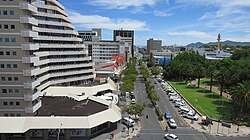
Windhoek (/ˈwɪndhʊk/; Afrikaans: [ˈvəntɦuk] ⓘ; German: [ˈvɪnthʊk] ⓘ) is the capital and largest city of Namibia. It is located in central Namibia in the Khomas Highland plateau area, at around 1,700 m (5,600 ft) above sea level, almost exactly at the country's geographical centre. The population of Windhoek, which was 486,169 in 2023, is constantly growing due to a continued migration from other regions in Namibia.
Windhoek is the social, economic, political, and cultural centre of the country. Nearly every Namibian national enterprise, governmental body, educational and cultural institution is headquartered there.
The city developed at the site of a permanent hot spring known to the local pastoral tribes. It developed rapidly after Jonker Afrikaner, Captain of the Orlam, settled there in 1840 and built a stone church for his community. In the decades following, multiple wars and armed hostilities resulted in the neglect and destruction of the new settlement. Windhoek was founded a second time in 1890 by Imperial German Army Major Curt von François, when the territory was colonised by the German Empire.
Theories vary on how the city got its modern name of Windhoek. Most believe it is derived from the Afrikaans words wind 'wind' and hoek 'corner'. Another theory suggests that Captain Jonker Afrikaner named Windhoek after the Winterhoek Mountains at Tulbagh in South Africa, where his ancestors had lived. The first known mention of the name Windhoek was in a letter from Jonker Afrikaner to Joseph Tindall, dated 12 August 1844.
In 1840 Jonker Afrikaner established an Orlam settlement at Windhoek. He and his followers stayed near one of the main hot springs, located in the present-day Klein Windhoek suburb. He built a stone church that held 500 people; it was also used as a school. Two Rhenish missionaries, Carl Hugo Hahn and Franz Heinrich Kleinschmidt, started working there in late 1842. Two years later they were driven out by two Methodist Wesleyans, Richard Haddy and Joseph Tindall. Gardens were laid out and for a while Windhoek prospered. A series of wars between the Nama and Herero tribes eventually destroyed the settlement. After a long absence, Hahn visited Windhoek again in 1873 and was dismayed to see that nothing remained of the town's former prosperity. In June 1885, a Swiss botanist found only jackals and starving guinea fowl amongst neglected fruit trees.
A request by merchants from Lüderitzbucht resulted in the declaration in 1884 of a German protectorate over what was called German South West Africa (Deutsch-Südwestafrika), now Namibia. The borders of the German colony were determined in 1890 and Germany sent a protective corps, the Schutztruppe under Major Curt von François, to maintain order. Von François stationed his garrison at Windhoek, which was strategically situated as a buffer between the warring Nama and Herero peoples. The twelve strong springs provided water for the cultivation of produce and grains.
Colonial Windhoek was founded on 18 October 1890, when von François fixed the foundation stone of the fort, which is now known as the Alte Feste (Old Fortress). After 1907, development accelerated as indigenous people migrated from the countryside to the growing town to seek work. More European settlers arrived from Germany and South Africa. Businesses were erected on Kaiser Street (presently Independence Avenue), and along the dominant mountain ridge over the city. At this time, Windhoek's three castles, Heinitzburg, Sanderburg, and Schwerinsburg, were built.
The German colonial era came to an end after the end of World War I but South West Africa, and with it Windhoek, had already fallen in 1915. Until the end of the war, the city was administered by a South African military government, and no further development occurred. In 1920, after the Treaty of Versailles, the territory was placed under a League of Nations Class C mandate and again administered by South Africa.
Windhoek
Windhoek (/ˈwɪndhʊk/; Afrikaans: [ˈvəntɦuk] ⓘ; German: [ˈvɪnthʊk] ⓘ) is the capital and largest city of Namibia. It is located in central Namibia in the Khomas Highland plateau area, at around 1,700 m (5,600 ft) above sea level, almost exactly at the country's geographical centre. The population of Windhoek, which was 486,169 in 2023, is constantly growing due to a continued migration from other regions in Namibia.
Windhoek is the social, economic, political, and cultural centre of the country. Nearly every Namibian national enterprise, governmental body, educational and cultural institution is headquartered there.
The city developed at the site of a permanent hot spring known to the local pastoral tribes. It developed rapidly after Jonker Afrikaner, Captain of the Orlam, settled there in 1840 and built a stone church for his community. In the decades following, multiple wars and armed hostilities resulted in the neglect and destruction of the new settlement. Windhoek was founded a second time in 1890 by Imperial German Army Major Curt von François, when the territory was colonised by the German Empire.
Theories vary on how the city got its modern name of Windhoek. Most believe it is derived from the Afrikaans words wind 'wind' and hoek 'corner'. Another theory suggests that Captain Jonker Afrikaner named Windhoek after the Winterhoek Mountains at Tulbagh in South Africa, where his ancestors had lived. The first known mention of the name Windhoek was in a letter from Jonker Afrikaner to Joseph Tindall, dated 12 August 1844.
In 1840 Jonker Afrikaner established an Orlam settlement at Windhoek. He and his followers stayed near one of the main hot springs, located in the present-day Klein Windhoek suburb. He built a stone church that held 500 people; it was also used as a school. Two Rhenish missionaries, Carl Hugo Hahn and Franz Heinrich Kleinschmidt, started working there in late 1842. Two years later they were driven out by two Methodist Wesleyans, Richard Haddy and Joseph Tindall. Gardens were laid out and for a while Windhoek prospered. A series of wars between the Nama and Herero tribes eventually destroyed the settlement. After a long absence, Hahn visited Windhoek again in 1873 and was dismayed to see that nothing remained of the town's former prosperity. In June 1885, a Swiss botanist found only jackals and starving guinea fowl amongst neglected fruit trees.
A request by merchants from Lüderitzbucht resulted in the declaration in 1884 of a German protectorate over what was called German South West Africa (Deutsch-Südwestafrika), now Namibia. The borders of the German colony were determined in 1890 and Germany sent a protective corps, the Schutztruppe under Major Curt von François, to maintain order. Von François stationed his garrison at Windhoek, which was strategically situated as a buffer between the warring Nama and Herero peoples. The twelve strong springs provided water for the cultivation of produce and grains.
Colonial Windhoek was founded on 18 October 1890, when von François fixed the foundation stone of the fort, which is now known as the Alte Feste (Old Fortress). After 1907, development accelerated as indigenous people migrated from the countryside to the growing town to seek work. More European settlers arrived from Germany and South Africa. Businesses were erected on Kaiser Street (presently Independence Avenue), and along the dominant mountain ridge over the city. At this time, Windhoek's three castles, Heinitzburg, Sanderburg, and Schwerinsburg, were built.
The German colonial era came to an end after the end of World War I but South West Africa, and with it Windhoek, had already fallen in 1915. Until the end of the war, the city was administered by a South African military government, and no further development occurred. In 1920, after the Treaty of Versailles, the territory was placed under a League of Nations Class C mandate and again administered by South Africa.
Recent media
Recent media