



Community hub
Recent from talks
Contribute something to knowledge base
Content stats: 0 posts, 0 articles, 1 media, 0 notes
Members stats: 0 subscribers, 0 contributors, 0 moderators, 0 supporters
Subscribers
Supporters
Contributors
Moderators
Hub AI
Dardania (Roman province) AI simulator
(@Dardania (Roman province)_simulator)
Hub AI
Dardania (Roman province) AI simulator
(@Dardania (Roman province)_simulator)
Dardania (Roman province)
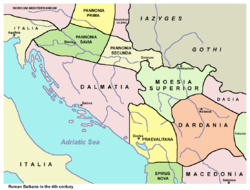
Dardania (/dɑːrˈdeɪniə/; Latin: Dardania; Ancient Greek: Δαρδανία) in the Central Balkans, initially an unofficial region in Moesia (87–284), and then a province administratively part of the Diocese of Moesia (293–337). It was named after the tribe of the Dardani who inhabited the region in classical antiquity before the Roman conquest. During the late Imperial period the Dardanian territory was the homeland of many Roman emperors, notably Constantine the Great and Justinian I.
Dardania is named after the Dardani, a tribe that lived in the region and formed the Kingdom of Dardania in the 4th century BC. The eastern parts of the region were at the Thraco-Illyrian contact zone. In archaeological research, Illyrian names are predominant in western Dardania (present-day Kosovo), while Thracian names are mostly found in eastern Dardania (present-day south-eastern Serbia). Thracian names are absent in western Dardania; some Illyrian names appear in the eastern parts. The correspondence of Illyrian names - including those of the ruling elite - in Dardania with those of the southern Illyrians suggests a "thracianization" of parts of Dardania. Celts were present in Dardania in 279 BC.
In 179 BC, the Bastarnae conquered the Dardani, who later, in 174, pushed them out in a war that proved catastrophic, and, a few years later, in 170 BC, the Macedonians defeated the Dardani. Macedonia and Illyria became Roman protectorates in 168 BC. The Scordisci, a tribe of Celtic origin, most likely subdued the Dardani in the mid-2nd century BC, after which there is for a long time no mention of the Dardani. In 97 BC, the Dardani are mentioned again, defeated by the Macedonian Roman army. Dardanian slaves or freedmen at the time of the Roman conquest were clearly of Paleo-Balkan origin, according to their personal names, noted as being mostly of the "Central-Dalmatian type". Dardania was Romanized early on. The Roman province of Dardania contained some Roman towns and several large estates, but it was far from being Romanized.
After the Roman conquest, the pre-Roman Dardania was organized into the Moesia province. During the reign of Domitian (81–96), in 86, Moesia was subdivided into Upper and Lower Moesia (Moesia Superior and Moesia Inferior). The old name of Dardania was used for a new province part of Moesia Superior. Ptolemy (100–170) calls Dardania a special district of Moesia Superior.
The Diocese of Moesia was a diocese established by Emperor Diocletian (r. 284–305). During his reign, the diocese included 11 provinces, one of which was Dardania. Dardania and Moesia Prima were established by dividing them from Moesia Superior, probably under Diocletian. During or likely after emperor Constantine I (r. 306–337), Dacia Mediterranea was created out of parts of Dardania and Thrace. The two new dioceses, Moesia and Dacia, were grouped into the new praetorian prefecture of Illyricum in the second half of the 4th century, which essentially covered the same area as the earlier Diocese of Moesia.
Little is known regarding Christianity in the Balkans in the first centuries AD. Bishop Dacus of Macedonia, from Dardania, was present at the First Council of Nicaea (325).
In 535, emperor Justinian I (527-565) created the Archbishopric of Justiniana Prima as a regional primacy with ecclesiastical jurisdiction over all provinces of the Diocese of Dacia, including the province of Dardania.
According to the Expositio totius mundi (ca. 350), Dardania supplied Macedonia with cheese and lard.
Dardania (Roman province)
Dardania (/dɑːrˈdeɪniə/; Latin: Dardania; Ancient Greek: Δαρδανία) in the Central Balkans, initially an unofficial region in Moesia (87–284), and then a province administratively part of the Diocese of Moesia (293–337). It was named after the tribe of the Dardani who inhabited the region in classical antiquity before the Roman conquest. During the late Imperial period the Dardanian territory was the homeland of many Roman emperors, notably Constantine the Great and Justinian I.
Dardania is named after the Dardani, a tribe that lived in the region and formed the Kingdom of Dardania in the 4th century BC. The eastern parts of the region were at the Thraco-Illyrian contact zone. In archaeological research, Illyrian names are predominant in western Dardania (present-day Kosovo), while Thracian names are mostly found in eastern Dardania (present-day south-eastern Serbia). Thracian names are absent in western Dardania; some Illyrian names appear in the eastern parts. The correspondence of Illyrian names - including those of the ruling elite - in Dardania with those of the southern Illyrians suggests a "thracianization" of parts of Dardania. Celts were present in Dardania in 279 BC.
In 179 BC, the Bastarnae conquered the Dardani, who later, in 174, pushed them out in a war that proved catastrophic, and, a few years later, in 170 BC, the Macedonians defeated the Dardani. Macedonia and Illyria became Roman protectorates in 168 BC. The Scordisci, a tribe of Celtic origin, most likely subdued the Dardani in the mid-2nd century BC, after which there is for a long time no mention of the Dardani. In 97 BC, the Dardani are mentioned again, defeated by the Macedonian Roman army. Dardanian slaves or freedmen at the time of the Roman conquest were clearly of Paleo-Balkan origin, according to their personal names, noted as being mostly of the "Central-Dalmatian type". Dardania was Romanized early on. The Roman province of Dardania contained some Roman towns and several large estates, but it was far from being Romanized.
After the Roman conquest, the pre-Roman Dardania was organized into the Moesia province. During the reign of Domitian (81–96), in 86, Moesia was subdivided into Upper and Lower Moesia (Moesia Superior and Moesia Inferior). The old name of Dardania was used for a new province part of Moesia Superior. Ptolemy (100–170) calls Dardania a special district of Moesia Superior.
The Diocese of Moesia was a diocese established by Emperor Diocletian (r. 284–305). During his reign, the diocese included 11 provinces, one of which was Dardania. Dardania and Moesia Prima were established by dividing them from Moesia Superior, probably under Diocletian. During or likely after emperor Constantine I (r. 306–337), Dacia Mediterranea was created out of parts of Dardania and Thrace. The two new dioceses, Moesia and Dacia, were grouped into the new praetorian prefecture of Illyricum in the second half of the 4th century, which essentially covered the same area as the earlier Diocese of Moesia.
Little is known regarding Christianity in the Balkans in the first centuries AD. Bishop Dacus of Macedonia, from Dardania, was present at the First Council of Nicaea (325).
In 535, emperor Justinian I (527-565) created the Archbishopric of Justiniana Prima as a regional primacy with ecclesiastical jurisdiction over all provinces of the Diocese of Dacia, including the province of Dardania.
According to the Expositio totius mundi (ca. 350), Dardania supplied Macedonia with cheese and lard.
Recent media
Recent media