Hubbry Logo
BastarnaeBastarnaeMain
Open search
Bastarnae
Community hub
Bastarnae
logo
8 pages, 0 posts
0 subscribers
Be the first to start a discussion here.
Contribute something
Bastarnae
Bastarnae
from Wikipedia
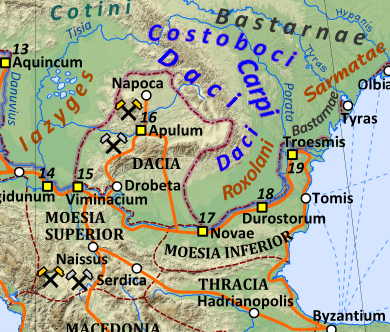
Map showing Roman Dacia and surrounding peoples in 125 AD

The Bastarnae, Bastarni or Basternae, also known as the Peuci or Peucini, were an ancient people who are known from Greek and Roman records to have inhabited areas north and east of the Carpathian Mountains between about 300 BC and about 300 AD, stretching in an arc from the sources of the Vistula in present-day Poland and Slovakia, to the Lower Danube, and including all or most of present-day Moldava. The Peucini were sometimes described as a subtribe, who settled the Peuke Island in the Danube Delta, but apparently due to their importance their name was sometimes used for the Bastarnae as a whole. Near the sources of the Vistula another part of the Bastarnae were the Sidones, while the Atmoni, another tribe of the Bastarnae are only mentioned in one listing by Strabo.

The earliest Graeco-Roman historians to refer to the Bastarnae imply that they were culturally Celtic. Also consistent with connections to the cultures to their west, later Roman-era sources state directly that they spoke Germanic languages, and could be considered Germanic peoples. In contrast, like other peoples who lived in this geographical region, Graeco-Roman writers also sometimes referred to the Bastarnae as a "Scythian" or "Sarmatian" people, but this was a reference to their location, and customs, rather than a linguistic category. Although largely sedentary, at least one Roman writer, Tacitus, stated that the Bastarnae had adopted some Sarmatian customs. So far, no archaeological sites have been conclusively attributed to the Bastarnae. The archaeological horizon most often associated by scholars with the Bastarnae is the Poieneşti-Lucașeuca culture.

From the first records which mention them, the Bastarnae were active in the region of the Danube estuary on the Black Sea coast. The Bastarnae first came into conflict with the Romans during the first century BC when, in alliance with Dacians and Sarmatians, they unsuccessfully resisted Roman expansion into Moesia and Pannonia, south of the Danube. Later, they appear to have maintained friendly relations with the Roman Empire during the first two centuries AD. This changed around 180 AD, when the Bastarnae are recorded as participants in an invasion of Roman territory, once again in alliance with Sarmatians and Dacians. In the mid-3rd century AD, the Bastarnae were part of a Gothic-led grand coalition of lower Danube tribes that repeatedly invaded the Balkan provinces of the Roman Empire.

Many Bastarnae were resettled within the Roman Empire in the late third century.

Etymology

[edit]

The origin of the tribal name is uncertain. It is not even clear whether it was an exonym (a name ascribed to them by outsiders) or an endonym (a name by which the Bastarnae described themselves). A related question is whether the groups denoted "Bastarnae" by the Romans considered themselves a distinct ethnic group at all (endonym) or whether it was a generic exonym used by the Greco-Romans to denote a disparate group of tribes of the Carpathian region that could not be classified as Dacians or Sarmatians.

One possible derivation is from the proto-Germanic word *bastjan (from Proto-Indo-European root *bʰas-), meaning "binding" or "tie".[1] In this case, Bastarnae may have had the original meaning of a coalition or bund of tribes.

It is possible that the Roman term basterna, denoting a type of wagon or litter, is derived from the name of this people (or, if it is an exonym, that the name of the people is derived from it) who were known, like many Germanic tribes, to travel with a wagon train for their families.[2][improper synthesis?]

It has also been suggested that the name is linked with the Germanic word bastard, meaning illegitimate or mongrel, and this name is sometimes contrasted to proposed Germanic etymologies for the name of the Sciri who lived in the same general region. However, Roger Batty considers this Germanic derivation unlikely.[3] If the name is an endonym, then this derivation is unlikely, as most endonyms have flattering meanings (e.g. "brave", "strong", "noble").

Trubačev[4] proposes a derivation from Old Persian, Avestan bast- "bound, tied; slave" (cf. Ossetic bættən "bind", bast "bound") and Iranian *arna- "offspring", equating it with the δουλόσποροι "slave Sporoi" mentioned by Nonnus and Cosmas, where the Sporoi are the people Procopius mentions as the ancestors of the Slavs.[5]

Location

[edit]
Location of Blastarni and the Alpes Bastarnicae north of Roman Dacia, as depicted on Tabula Peutingeriana

The earliest classical mentions of the Bastarnae locate them north of the Lower Danube, although they apparently made frequent crossings impacting upon the peoples living south of the Danube.

Strabo (about 20 AD) made several remarks about the location of the Bastarnae. In one place he described the lands beyond the Rhine and Danube as the home of the Galatian (Celtic) and the Germanic peoples, and beyond these (to the east) were the Bastarnae and their neighbours the Tyregetans "and the River Borysthenes" (Dnieper).[6] However, in another similar passage he says only that "most writers suspect" the Bastarnae to be next beyond the Germanic Peoples, but he indicates that it is also possible that "others lie in between, either the Iazyges, or the Roxolani, or certain other of the wagon-dwellers — it is not easy to say".[7] In yet another similar passage he describes the Bastarnae as the most inland (northerly) of the peoples living between the Borysthenes (Dnieper) and the Ister (Lower Danube), and indicates that their neighbours the Tyregetans are closer to the Black Sea.[8]

Strabo also mentioned their interactions with other peoples near the Danube, specifying that in his time, "wagon-dwelling" Scythians and Sarmatians, "as well as the Bastarnian tribes, are mingled with the Thracians (more indeed with those outside the Ister [North of the Danube], but also with those inside). And mingled with them are also the Celtic tribes — the Boii, the Scordisci, and the Taurisci". He confirmed that historically "the Scythians and Bastarnians and Sauromatians on the far side of the river [the Lower Danube] often prevail to the extent that they actually cross over to attack those whom they have already driven out, and some of them remain there, either in the islands or in Thrace". In particular, Near the outlets of the Ister River [Lower Danube] is a great island called Peuce; and when the Bastarnians took possession of it they received the appellation of Peucini."[8]

In one passage Pliny the Elder located the Bastarnae "and other Germanic peoples" in the lands beyond the Iazyges and Dacians (aversa Basternae tenent aliique inde Germani).[9] In another he describes "the Peucini, the Basternae", as neighbours of the Dacians.[10]

In the second century AD, the texts attached to Ptolemy's Geography say that "above Dacia are the Peucini and the Basternae"; "between the Peucini and the Basternae are the Carpiani"; "between the Basternae and the Rhoxolani" who he places on the Black Sea coast, "are the Chuni" (otherwise unknown); and "below the Basternae near Dacia are the Tigri and below these are the Tyrangitae" whose names are linked to the Tyras or Dniester river. Possibly relevant, he also mentioned a mountainous region called the "Peuca" mountains south of the Costoboci and Transmontani.[11] The Sidones, named as one part of the Bastarnae by Strabo, are described by Ptolemy as one of the peoples east of the Vistula, although the location is not clear. It thus appears that the Bastarnae were settled in a vast arc stretching around the northern and eastern flanks of the Carpathians from western Ukraine to the Danube Delta.[12]

The Peutinger Map (produced ca. 400 AD, but including material from as early as the first century) shows the Bastarnae (mis-spelt Blastarni) north of the Carpathian mountains and appears to name the Galician Carpathians as the Alpes Bastarnicae.[13]

Because of their apparent cultural and linguistic connections to the west, the Bastarnae are generally believed to have moved originally from that direction, but this remains uncertain. Babeş and Shchukin argue in favour of an origin in eastern Pomerania on the Baltic coast of today's north-west Poland, on the grounds of correspondences in archaeological material, e.g. a Pomeranian-style fibula found in a Poieneşti site in Moldavia,[14] although Batty considers the evidence insufficient.[15] Babeş identifies the Sidoni, a branch of the Bastarnae which Strabo mentioned[16] with the Sidini located by Ptolemy in Pomerania.[17]

Batty argues that Greco-Roman sources of the first century AD locate the Bastarnae homeland on the northern side of the Northern Carpathian mountain range, encompassing south-east Poland and south-west Ukraine (i.e. the region traditionally known as Galicia).[13]

Ethno-linguistic affiliation

[edit]

Scholars hold divergent theories about the ethnicity of the Bastarnae. One view, implied by some of the earliest reports, is that they spoke a Celtic language.[18] The only explicit description of their language, was a much later remark by Tacitus, who said they spoke a language like the Germanic peoples. However others hold that they were Scythian/Germanic,[7] or mixed Germanic/Sarmatian.[19] A fringe theory is that they were Proto-Slavic.[4] Shchukin argues that the ethnicity of the Bastarnae was unique and rather than trying to label them as Celtic, Germanic or Sarmatian, it should be accepted that the "Basternae were the Basternae".[20] Batty argues that assigning an "ethnicity" to the Bastarnae is meaningless; as in the context of the Iron Age Pontic-Danubian region, with its multiple overlapping peoples and languages, ethnicity was a very fluid concept, which changed rapidly and frequently, according to socio-political vicissitudes. That was especially true of the Bastarnae, who are attested over a relatively-vast area.[21] The Bastarnae maintained a separate name until ca. 300 AD, probably implying retention of their distinctive ethno-linguistic heritage up to that time.[22]

Celtic

[edit]

Polybius (200–118 BC) writing about the time of Perseus of Macedon (d. 166 BCE) explained how the Dardanians sought help from the Romans against the Bastarnae, who were allied with the Macedonian and Celtic (Galatian) enemies of Rome, which can be taken as implying that they were not Galatian. He described them as numerous, physically large, and valorous warriors.[23]

On the other hand, a much later report of these events by Livy (64 BC – 17 AD), writing about 10 AD, is sometimes understood to imply that the Bastarnae spoke a Celtic language (or a related language) because when comparing them to the Scordisci, a major Galatian tribe of Pannonia, it specifies that the Bastarnae were "neither in speech nor habits were they dissimilar".[18] The Scordisci are described as Celtic by Strabo, although he adds that they had mingled with Illyrians and Thracians).[24]

Much later still, the Greek historian Plutarch (about 46-120 AD), also talking the time of Perseus of Macedon, went further, writing that the Roman consul Hostilius "secretly stirred up the Gauls settled along the Danube, who are called Basternae".[25]

Another reason to consider the Bastarnae as Celtic is that the regions they are documented to have occupied (the northern and eastern slopes of the Carpathians) overlapped to a great extent with the locations of Celtic tribes attested in the northern Carpathians. (The modern name of this region, Galicia, is generally regarded as having a later origin, in either a Slavic or Turkic language. However, some scholars have instead suggested that the name Galicia may derive from its former Celtic inhabitants the Taurisci, Osi, Cotini and Anartes of Slovakia and northern Romania and the Britogalli of the Danube Delta region.[26]) In addition, archaeological cultures which some scholars have linked to the Bastarnae (Poieneşti-Lukashevka and Zarubintsy) display pronounced Celtic affinities. Finally, the arrival of the Bastarnae in the Pontic-Danubian region, which can be dated to 233–216 BC according to two ancient sources,[27] coincides with the latter phase of Celtic migration into the region (400–200 BC).

In addition, inscription AE (1905) 14, recording a campaign on the Hungarian Plain by the Augustan-era general Marcus Vinucius (10 BC[28] or 8 BC[29]), also appears to distinguish the Bastarnae from neighbouring Celtic tribes: "Marcus Vinucius... governor of Illyricum, the first [Roman general] to advance across the river Danube, defeated in battle and routed an army of Dacians and Basternae, and subjugated the Cotini, Osi,...[missing tribal name] and Anartii to the power of the emperor Augustus and of the people of Rome."[30]

The three names of Bastarnae leaders found in ancient sources are of Celtic origin: Cotto,[31] Clondicus[32] and Teutagonus.[33][34]

Germanic

[edit]

Three Greco-Roman geographers of the first century AD associated the Bastarnae and Peucini with the Germanic peoples, and one source, Tacitus, specifies that they spoke a language like the Germanic peoples. The Greek geographer Strabo (64 BC – 24 AD) writing c. 5–20 AD, made several remarks about the location of the Bastarnae in his own time. In one passage he says that their country borders on that of the Tyregetans towards the Black Sea and Danube, and Germanic peoples to the west, and that they "one might say", were of "Germanic stock".

The Roman geographer Pliny the Elder (c. 77 AD), classified the Bastarnae or Peucini as being one of the five main subdivisions of Germanic peoples, the other subdivisions as the three West Germanic groups, the Inguaeones, Istuaeones and Hermiones, and the East Germanic Vandili.[35]

Notably, the Roman historian Tacitus (56–120 AD), writing about 100 AD, described the Bastarnae as probably being a Germanic people, but with substantial Sarmatian cultural influence and intermarriage:[36]

As to the tribes of the Peucini, Veneti, and Fenni I am in doubt whether I should class them with the Germans or the Sarmatæ, although indeed the Peucini called by some Bastarnæ, are like Germans in their language, mode of life, and in the permanence of their settlements. They all live in filth and sloth, and by the intermarriages of the chiefs they are becoming in some degree debased into a resemblance to the Sarmatæ.

Scytho-Sarmatian

[edit]

Strabo includes the Roxolani, generally considered by scholars to have been a Sarmatian tribe, in a list of Bastarnae subgroups.[16] However, this may simply be an error due to the close proximity of the two peoples north of the Danube Delta.

In the third century, the Greek historian Dio Cassius (155–235 AD) stated that the "Bastarnae are properly classed as Scythians" and "members of the Scythian race".[37]

"During the same period in which these events occurred Marcus Crassus was sent into Macedonia and Greece and carried on war with the Dacians and Bastarnae. I have already stated who the former were and why they had become hostile; the Bastarnae, on the other hand, who are properly classed as Scythians, had at this time crossed the Ister and subdued the part of Moesia opposite them, and afterwards subdued the Triballi who adjoin this district and the Dardani who inhabit the Triballian country."[38]

Likewise, the sixth-century historian Zosismus (490s–510 AD), reporting events around 280 AD, refers to "the Bastarnae, a Scythian people".[39][40]

However, late Greco-Roman chroniclers used the term "Scythian" without regard to language. The earliest Scythians were steppe nomads associated with Iranic languages, as were their successors the Sarmatians, who were also called Scythians, while classical authors such as Zosimus also routinely refers to the Goths, who were undoubtedly Germanic-speakers, as "Scythians". On the other hand, it is likely that Bastarnae were influenced the surrounding Sarmatians, as reflected in Tacitus' comment that "mixed marriages" debasing them to appear more like the Sarmatians.[36]

Material culture

[edit]
Attempt to reconstruct Bastarnae costumes at the Archaeological Museum of Kraków. Such clothing and weapons were commonplace among peoples on the Roman Empire's borders.
Archaeological cultures in the early Roman period, c. 100 AD

According to Malcolm Todd, traditional archaeology has not been able to construct a typology of Bastarnae material culture, and thus to ascribe particular archaeological sites to the Bastarnae.[41] A complicating factor is that the regions where Bastarnae are attested contained a patchwork of peoples and cultures (Sarmatians, Scythians, Dacians, Thracians, Celts, Germans and others), some sedentary, some nomadic. In any event, post-1960s archaeological theory has questioned the validity of equating material "cultures", as defined by archaeologists, with distinct ethnic groups. In this view, it is impossible to attribute a "culture" to a particular ethnic group: it is likely that the material cultures discerned in the region belonged to several, if not all, of the groups inhabiting it. These cultures probably represent relatively large-scale socio-economic interactions between disparate communities of the broad region, possibly including mutually antagonistic groups.[41]

It is not even certain whether the Bastarnae were sedentary, nomadic or semi-nomadic. Tacitus' statement that they were "German in their way of life and types of dwelling" implies a sedentary bias, but their close relations with the Sarmatians, who were nomadic, may indicate a more nomadic lifestyle for some Bastarnae, as does their attested wide geographical range.[42] If the Bastarnae were nomadic, then the sedentary "cultures" identified by archaeologists in their lebensraum would not represent them. Nomadic peoples generally leave scant traces, due to the impermanent materials and foundations used in the construction of their dwellings.

Scholars have identified two closely related sedentary "cultures" as possible candidates to represent the Bastarnae (among other peoples) as their locations broadly correspond to where ancient sources placed the Basternae: the Zarubintsy culture lying in the forest-steppe zone in northern Ukraine and southern Belarus, and the Poieneşti-Lukashevka culture (Lucăşeuca) in northern Moldavia.[27][43] These cultures were characterised by agriculture, documented by numerous finds of sickles. Dwellings were either of surface or semi-subterranean types, with posts supporting the walls, a hearth in the middle and large conical pits located nearby. Some sites were defended by ditches and banks, structures thought to have been built to defend against nomadic tribes from the steppe.[44] Inhabitants practiced cremation. Cremated remains were either placed in large, hand-made ceramic urns, or were placed in a large pit and surrounded by food and ornaments such as spiral bracelets and Middle to Late La Tène-type fibulae (attesting the continuing strength of Celtic influence in this region).

A major problem with associating the Poieneşti-Lukashevka and Zarubintsy cultures with the Bastarnae is that both cultures had disappeared by the early first century AD, while the Bastarnae continue to be attested in those regions throughout the Roman Principate.[45] Another issue is that the Poieneşti-Lukashevka culture has also been attributed to the Costoboci, a people considered ethnically Dacian by mainstream scholarship, who inhabited northern Moldavia, according to Ptolemy (ca. 140 AD). Indeed, Mircea Babeş and Silvia Theodor, the two Romanian archaeologists who identified Lukashevka as Bastarnic, nevertheless insisted that the majority of the population in the Lukashevka sphere (in northern Moldavia) was "Geto-Dacian".[13] A further problem is that neither of these cultures were present in the Danube Delta region, where a major concentration of Bastarnae are attested by the ancient sources.[27]

Starting in about 200 AD, the Chernyakhov culture became established in the modern-day western Ukraine and Moldova region inhabited by the Bastarnae. The culture is characterised by a high degree of sophistication in the production of metal and ceramic artefacts, as well as of uniformity over a vast area. Although this culture has conventionally been identified with the migration of the Gothic ethnos into the region from the northwest, Todd argues that its most important origin is Scytho-Sarmatian. Although the Goths certainly contributed to it, so probably did other peoples of the region such as the Dacians, proto-Slavs, Carpi and possibly the Bastarnae.[46]

Relations with Rome

[edit]

Roman Republican era (to 30 BC)

[edit]

Allies of Philip of Macedon (179–8 BC)

[edit]
Silver tetradrachm of Philip V of Macedon

The Bastarnae first appear in the historical record in 179 BC, when they crossed the Danube in a massive force. They did so at the invitation of their long-time ally, King Philip V of Macedon, a direct descendant of Antigonus, one of the Diadochi, the generals of Alexander the Great who had shared his empire after his death in 323 BC. The Macedonian king had suffered a disastrous defeat at the hands of the Romans in the Second Macedonian War (200–197 BC), which had reduced him from a powerful Hellenistic monarch to the status of a petty client-king with a much-reduced territory and a tiny army.[Note 1] After nearly 20 years of slavish adherence to the Roman Senate's dictats, Philip had been goaded by the incessant and devastating raiding of the Dardani, a warlike Illyrian[48] tribe on his northern border, which his treaty-limited army was too small to counter effectively. Counting on the Bastarnae, with whom he had forged friendly relations, he plotted a strategy to deal with the Dardani and then to regain his lost territories in Greece and his political independence. First, he would unleash the Bastarnae against the Dardani. After the latter had been crushed, Philip planned to settle Bastarnae families in Dardania (southern Kosovo/Skopje region) to ensure that the region was permanently subdued. In a second phase, Philip aimed to launch the Bastarnae on an invasion of Italy via the Adriatic coast. Although he was aware that the Bastarnae were likely to be defeated, Philip hoped that the Romans would be distracted long enough to allow him to reoccupy his former possessions in Greece.[31]

However, Philip, now 60 years of age, died before the Bastarnae could arrive. The Bastarnae host was still en route through Thrace, where it became embroiled in hostilities with the locals, who had not provided them with sufficient food at affordable prices as they marched through. Probably in the vicinity of Philippopolis (modern Plovdiv, Bulgaria), the Bastarnae broke out of their marching columns and pillaged the land far and wide. The terrified local Thracians took refuge with their families and animal herds on the slopes of Mons Donuca (Mount Musala), the highest mountain in Thrace. A large force of Bastarnae chased them up the mountain, but were driven back and scattered by a massive hailstorm. Then the Thracians ambushed them, turning their descent into a panic-stricken rout. Back at their wagon fort in the plain, around half of the demoralised Bastarnae decided to return home, leaving c. 30,000 to press on to Macedonia.[32]

Philip's son and successor Perseus, while protesting his loyalty to Rome, deployed his Bastarnae guests in winter quarters in a valley in Dardania, presumably as a prelude to a campaign against the Dardani the following summer. However, in the depths of winter their camp was attacked by the Dardani. The Bastarnae easily beat off the attackers, chased them back to their chief town and besieged them, but they were surprised in the rear by a second force of Dardani, which had approached their camp stealthily by mountain paths, and proceeded to storm and ransack it. Having lost their entire baggage and supplies, the Bastarnae were obliged to withdraw from Dardania and to return home. Most perished as they crossed the frozen Danube on foot, only for the ice to give way.[49] Despite the failure of Philip's Bastarnae strategy, the suspicion aroused by these events in the Roman Senate, which had been warned by the Dardani of the Bastarnae invasion, ensured the demise of Macedonia as an independent state.[50] Rome declared war on Perseus in 171 BC and after the Macedonian army was crushed at the Battle of Pydna (168 BC), Macedonia was split up into four Roman puppet-cantons (167 BC).[51] Twenty-one years later, these were in turn abolished and annexed to the Roman Republic as the province of Macedonia (146 BC).

Allies of Getan high king Burebista (62 BC)

[edit]
Map of Scythia Minor (Dobruja), showing the Greek coastal cities of Histria, Tomis, Callatis and Dionysopolis (Istria, Constanța, Mangalia and Balchik)
Coin issued by the Greek coastal city of Histria (Sinoe)

The Bastarnae first came into direct conflict with Rome as a result of expansion into the lower Danube region by the proconsuls (governors) of Macedonia in 75–72 BC. Gaius Scribonius Curio (proconsul 75–73 BC) campaigned successfully against the Dardani and the Moesi, becoming the first Roman general to reach the Danube with his army.[52] His successor, Marcus Licinius Lucullus (brother of the famous Lucius Lucullus), campaigned against the Thracian Bessi tribe and the Moesi, ravaging the whole of Moesia, the region between the Haemus (Balkan) mountain range and the Danube. In 72 BC, his troops occupied the Greek coastal cities of Scythia Minor (modern Dobruja region, Romania/Bulgaria),[Note 2] which had sided with Rome's Hellenistic arch-enemy, King Mithridates VI of Pontus, in the Third Mithridatic War (73–63 BC).[54]

The presence of Roman forces in the Danube Delta was seen as a major threat by all the neighbouring transdanubian peoples: the Peucini Bastarnae, the Sarmatians and, most importantly, by Burebista (ruled 82–44 BC), king of the Getae. The Getae occupied the region today called Wallachia as well as Scythia Minor and were either a Dacian- or Thracian- speaking people.[Note 3] Burebista had unified the Getae tribes into a single kingdom, for which the Greek cities were vital trade outlets. In addition, he had established his hegemony over neighbouring Sarmatian and Bastarnae tribes. At its peak, the Getae kingdom reportedly was able to muster 200,000 warriors. Burebista led his transdanubian coalition in a struggle against Roman encroachment, conducting many raids against Roman allies in Moesia and Thrace, penetrating as far as Macedonia and Illyria.[59]

The coalition's main chance came in 62 BC, when the Greek cities rebelled against Roman rule. In 61 BC, the notoriously oppressive and militarily incompetent proconsul of Macedonia, Gaius Antonius, nicknamed Hybrida ("The Monster"), an uncle of the famous Mark Antony, led an army against the Greek cities. As his army approached Histria, Antonius detached his entire mounted force from the marching column and led it away on a lengthy excursion, leaving his infantry without cavalry cover, a tactic he had already used with disastrous results against the Dardani.[60] Dio implies that he did so out of cowardice, in order to avoid the imminent clash with the opposition, but it is more likely that he was pursuing a large enemy cavalry force, probably Sarmatians. A Bastarnae host, which had crossed the Danube to assist the Histrians, promptly attacked, surrounded and massacred the Roman infantry, capturing several of their vexilla (military standards).[61] This battle resulted in the collapse of the Roman position on the lower Danube. Burebista apparently annexed the Greek cities (55–48 BC).[62] At the same time, the subjugated "allied" tribes of Moesia and Thrace evidently repudiated their treaties with Rome, as they had to be reconquered by Augustus in 29–8 BC (see below).

In 44 BC, Roman dictator-for-life Julius Caesar planned to lead a major campaign to crush Burebista and his allies once and for all, but he was assassinated before it could start.[63] However, the campaign was made redundant by Burebista's overthrow and death in the same year, after which his Getae empire fragmented into four, later five, independent petty kingdoms. These were militarily far weaker, as Strabo assessed their combined military potential at just 40,000 armed men, and were often involved in internecine warfare.[64][65] The Geto-Dacians did not again become a threat to Roman hegemony in the lower Danube until the rise of Decebal 130 years later (86 AD).

Roman Principate (30 BC – 284 AD)

[edit]

Augustan era (30 BC – 14 AD)

[edit]
Statue of Augustus in the garb of Roman imperator (military supreme commander). By the end of his sole rule (14 AD), Augustus had expanded the empire to the Danube, which was to remain its central/eastern European border for its entire history (except for the occupation of Dacia 105–275).

Once he had established himself as sole ruler of the Roman state in 30 BC, Caesar's grand-nephew and adopted son Augustus inaugurated a strategy of advancing the empire's south-eastern European border to the line of the Danube from the Alps, the Dinaric Alps and Macedonia. The primary objective was to increase strategic depth between the border and Italy and also to provide a major fluvial supply route between the Roman armies in the region.[66]

On the lower Danube, which was given priority over the upper Danube, this required the annexation of Moesia. The Romans' target was thus the tribes which inhabited Moesia, namely (from west to east) the Triballi, Moesi and those Getae who dwelt south of the Danube. The Bastarnae were also a target because they had recently subjugated the Triballi, whose territory lay on the southern bank of the Danube between the tributary rivers Utus (Vit) and Ciabrus (Tsibritsa), with their chief town at Oescus (Gigen, Bulgaria).[67] In addition, Augustus wanted to avenge the defeat of Gaius Antonius at Histria 32 years before and to recover the lost military standards. These were held in a powerful fortress called Genucla (Isaccea, near modern Tulcea, Romania, in the Danube Delta region), controlled by Zyraxes, the local Getan king.[68] The man selected for the task was Marcus Licinius Crassus, grandson of Crassus the triumvir and an experienced general at 33 years of age, who was appointed proconsul of Macedonia in 29 BC.[69]

The Bastarnae provided the casus belli by crossing the Haemus and attacking the Dentheletae, a Thracian tribe who were Roman allies. Crassus marched to the Dentheletae's assistance, but the Bastarnae host hastily withdrew over the Haemus at his approach. Crassus followed them closely into Moesia but they would not be drawn into battle, withdrawing beyond the Tsibritsa.[70] Crassus now turned his attention to the Moesi, his prime target. After a successful campaign which resulted in the submission of a substantial section of the Moesi, Crassus again sought out the Bastarnae. Discovering their location from some peace envoys they had sent to him, he lured them into battle near the Tsibritsa by a stratagem. Hiding his main body of troops in a wood, he stationed as bait a smaller vanguard in open ground before the wood. As expected, the Bastarnae attacked the vanguard in force, only to find themselves entangled in the full-scale pitched battle with the Romans that they had tried to avoid. The Bastarnae tried to retreat into the forest but were hampered by the wagon train carrying their women and children, as these could not move through the trees. Trapped into fighting to save their families, the Bastarnae were routed. Crassus personally killed their king, Deldo, in combat, a feat which qualified him for Rome's highest military honour, spolia opima, but Augustus refused to award it on a technicality.[Note 4] Thousands of fleeing Bastarnae perished, many asphyxiated in nearby woods by encircling fires set by the Romans, others drowned trying to swim across the Danube. Nevertheless, a substantial force dug themselves into a powerful hillfort. Crassus laid siege to fort, but had to enlist the assistance of Rholes, a Getan petty king, to dislodge them, for which service Rholes was granted the title of socius et amicus populi Romani ("ally and friend of the Roman people").[74]

The following year (28 BC), Crassus marched on Genucla. Zyraxes escaped with his treasure and fled over the Danube into Scythia to seek aid from the Bastarnae.[75] Before he was able to bring reinforcements, Genucla fell to a combined land and fluvial assault by the Romans.[68] The strategic result of Crassus' campaigns was the permanent annexation of Moesia by Rome.

About a decade later, in 10 BC,[28] the Bastarnae again clashed with Rome during Augustus' conquest of Pannonia (the bellum Pannonicum 14–9 BC). Inscription AE (1905) 14 records a campaign on the Hungarian Plain by the Augustan-era general Marcus Vinucius:

Marcus Vinucius...[patronymic], Consul [in 19 BC]...[various official titles], governor of Illyricum, the first [Roman general] to advance across the river Danube, defeated in battle and routed an army of Dacians and Basternae, and subjugated the Cotini, Osi,...[missing tribal name] and Anartii to the power of the emperor Augustus and of the people of Rome.

Most likely, the Bastarnae, in alliance with Dacians, were attempting to assist the hard-pressed Illyrian/Celtic tribes of Pannonia in their resistance to Rome.

First and second centuries

[edit]
War scene of the Tropaeum Traiani (c. 109 AD): a Roman legionary fighting with a Dacian warrior, while a Germanic warrior (Bastarnae?), who has a suebian knot, is wounded on the ground.

It appears that in the final years of Augustus' rule, the Bastarnae made their peace with Rome. The Res Gestae Divi Augusti ("Acts of the divine Augustus", 14 AD), an inscription commissioned by Augustus to list his achievements, states that he received an embassy from the Bastarnae seeking a treaty of friendship.[76] It appears that a treaty was concluded and apparently proved remarkably effective, as no hostilities with the Bastarnae are recorded in surviving ancient sources until c. 175, some 160 years after Augustus' inscription was carved. But surviving evidence for the history of this period is so thin that it cannot be excluded that the Bastarnae clashed with Rome during it.[Note 5] The Bastarnae participated in the Dacian Wars of Domitian (86–88) and Trajan (101–102 and 105–106), fighting on both wars on the Dacian side[77]

In the late second century, the Historia Augusta mentions that in the rule of Marcus Aurelius (161–180), an alliance of lower Danube tribes including the Bastarnae, the Sarmatian Roxolani and the Costoboci took advantage of the emperor's difficulties on the upper Danube (the Marcomannic Wars) to invade Roman territory.[78]

Third century

[edit]

During the late second century, the main ethnic change in the northern Black Sea region was the immigration, from the Vistula valley in the North, of the Goths and accompanying Germanic tribes such as the Taifali and the Hasdingi, a branch of the Vandal people. This migration was part of a series of major population movements in the European barbaricum (the Roman term for regions outside their empire). The Goths appear to have established a loose political hegemony over the existing tribes in the region.

Under the leadership of the Goths, a series of major invasions of the Roman empire were launched by a grand coalition of lower Danubian tribes from c. 238 onwards. The participation of the Bastarnae in these is likely but largely unspecified, due to Zosimus' and other chroniclers' tendency to lump all these tribes under the general term "Scythians" – meaning all the inhabitants of Scythia, rather than the specific Iranic-speaking people called the Scythians.[79] Thus, in 250–251, the Bastarnae were probably involved in the Gothic and Sarmatian invasions which culminated in the Roman defeat at the Battle of Abrittus and the slaying of Emperor Decius (251).[80] This disaster was the start of the Third Century Crisis of the Roman Empire, a period of military and economic chaos. At this critical moment, the Roman army was crippled by the outbreak of a second smallpox pandemic, the plague of Cyprian (251–70). The effects are described by Zosimus as even worse than the earlier Antonine plague (166–180), which probably killed 15–30% of the empire's inhabitants.[81]

Taking advantage of Roman military disarray, a vast number of barbarian peoples overran much of the empire. The Sarmato-Gothic alliance of the lower Danube carried out major invasions of the Balkans region in 252, and in the periods 253–258 and 260–268.[82] The Peucini Bastarnae are specifically mentioned in the 267/268 invasion, when the coalition built a fleet in the estuary of the river Tyras (Dniester). The Peucini Bastarnae would have been critical to this venture since, as coastal and delta dwellers, they would have had seafaring experience that the nomadic Sarmatians and Goths lacked. The barbarians sailed along the Black Sea coast to Tomis in Moesia Inferior, which they tried to take by assault without success. They then attacked the provincial capital Marcianopolis (Devnya, Bulgaria), also in vain. Sailing on through the Bosporus, the expedition laid siege to Thessalonica in Macedonia. Driven off by Roman forces, the coalition host moved overland into Thracia, where finally it was crushed by Emperor Claudius II (r. 268–270) at Naissus (269).[83]

Claudius II was the first of a sequence of military emperors (the so-called "Illyrian emperors" from their main ethnic origin) who restored order in the empire in the late third century. These emperors followed a policy of large-scale resettlement within the empire of defeated barbarian tribes, granting them land in return for an obligation of military service much heavier than the usual conscription quota. The policy had the triple benefit, from the Roman point of view, of weakening the hostile tribe, repopulating the plague-ravaged frontier provinces (bringing their abandoned fields back into cultivation) and providing a pool of first-rate recruits for the army. It could also be popular with the barbarian prisoners, who were often delighted by the prospect of a land grant within the empire. In the fourth century, such communities were known as laeti.[84]

The emperor Probus (r. 276–282) is recorded as resettling 100,000 Bastarnae in Moesia, in addition to other peoples, including Goths, Gepids and Vandals. The Bastarnae are reported to have honoured their oath of allegiance to the emperor, while the other resettled peoples mutinied while Probus was distracted by usurpation attempts and ravaged the Danubian provinces far and wide.[39][85] A further massive transfer of Bastarnae was carried out by Emperor Diocletian (ruled 284–305) after he and his colleague Galerius defeated a coalition of Bastarnae and Carpi in 299.[86]

Later Roman empire (305 onwards)

[edit]

The remaining transdanubian Bastarnae disappear into historical obscurity in the late empire. Neither of the main ancient sources for this period, Ammianus Marcellinus and Zosimus, mention the Bastarnae in their accounts of the fourth century, possibly implying the loss of their separate identity, presumably assimilated by the regional hegemons, the Goths. Such assimilation would have been facilitated if, as is possible, the Bastarnae spoke an East Germanic language closely related to Gothic. If the Bastarnae remained an identifiable group, it is highly likely that they participated in the vast Gothic-led migration, driven by Hunnic pressure, that was admitted into Moesia by Emperor Valens in 376 and eventually defeated and killed Valens at Adrianople in 378. Although Ammianus refers to the migrants collectively as "Goths", he states that, in addition, "Taifali and other tribes" were involved.[87]

However, after a gap of 150 years, there is a final mention of Bastarnae in the mid-5th century. In 451, the Hunnic leader Attila invaded Gaul with a large army which was ultimately routed at the Battle of Châlons by a Roman-led coalition under the general Aetius.[88] Attila's host, according to Jordanes, included contingents from the "innumerable tribes that had been brought under his sway".[89] This included the Bastarnae, according to the Gallic nobleman Sidonius Apollinaris.[90] However, E.A. Thompson argues that Sidonius' mention of Bastarnae at Chalons is probably false: his purpose was to write a panegyric and not a history, and Sidonius added some spurious names to the list of real participants (e.g. Burgundians, Sciri and Franks) for dramatic effect.[91]

See also

[edit]

Notes

[edit]

References

[edit]

Bibliography

[edit]
Revisions and contributorsEdit on WikipediaRead on Wikipedia
from Grokipedia

The Bastarnae, also designated as Peucini in some sources, constituted an ancient tribal group classified by Roman authors such as and as Germanic, primarily inhabiting the territories between the , the River, and the northern coast from approximately the until the 3rd century AD. described their language, customs, and settlements as akin to those of , distinguishing them from neighboring despite geographical proximity. Originating possibly from the River region in modern and linked archaeologically to cultures like Zarubintsy, they exhibited a mix of influences, with earlier Celtic elements noted in Strabo's accounts but overridden by predominant Germanic traits in later attestations.
The Bastarnae first entered historical records around 179 BC as mercenaries allied with against the , subsequently migrating southward into the frontier zones where they clashed with , , and Romans. Notable among their engagements was the decisive defeat of Roman forces under at the in 61 BC, alongside Dacian and Sarmatian allies, though they suffered subjugation following Marcus Licinius Crassus's campaigns in 29–28 BC. By the 3rd century AD, they participated in Gothic-led coalitions invading Roman provinces, eventually serving as before fading through assimilation into larger groups like the amid Hunnic pressures, with their last mention in 451 AD at the . Their , reflected in Poienesti-Lukashevka settlements, underscores a semi-nomadic adapted to forested steppes, contributing to the dynamic ethnic mosaic of Eastern Europe's late .

Name and Etymology

Etymology

The ethnonym Bastarnae represents the Latinized form of the Ancient Greek Βαστάρναι (Bastaṟ́nai), first attested in ' Histories (ca. 150 BC) describing their migration across the River in 179 BC. The precise linguistic origin remains uncertain, with no self-designation recorded from the tribe itself. One scholarly proposal derives the name from the Proto-Germanic verb bastjaną "to bind" or "to tie" ( with bestan and tracing to Proto-Indo-European *bʰeh₂s- "to bind, fasten"), suggesting it denoted a or alliance of diverse subgroups, aligning with ancient accounts of their composite structure involving Celtic, Germanic, and possibly Sarmatian elements. Less accepted interpretations link it to Germanic bastardaz "mongrel" or "illegitimate," potentially an exonym reflecting Roman or Greek perceptions of their mixed ancestry, though this lacks direct philological support and may stem from later . No Celtic or Iranian derivations have gained traction among linguists, despite debates over the tribe's broader ethnic affiliations.

Geographic Origins and Movements

Hypothesized Homeland

The hypothesized homeland of the Bastarnae lies in the lower River region of present-day northern , a placement inferred from their sudden appearance in historical records further south around the 3rd–2nd centuries BC and cultural parallels with northern European groups. This area, encompassing parts of , aligns with early migrations southward, potentially triggered by population pressures or resource competition, as the tribe expanded into the territories between the and by circa 230 BC. Archaeological associations often connect the Bastarnae to the Pomeranian culture (c. 700–300 BC), known for distinctive face-urn burials and settlements in the Baltic coastal zone, which some scholars interpret as a precursor to early Germanic or mixed Indo-European populations before the transition to Iron Age cultures like Oksywie or Przeworsk. Expansion of Pomeranian material traits eastward during the early Iron Age supports this, with artifacts suggesting mobility from the Vistula basin toward modern Ukraine and Moldova, though direct attribution remains tentative due to the absence of inscribed or uniquely diagnostic Bastarnaean sites in the proposed homeland. Alternative hypotheses position the origins nearer the northern Carpathians or eastern Baltic fringes, based on Greco-Roman accounts implying a northern provenance without precise coordinates, but these lack the linkages seen with Pomeranian expansions. Overall, the Vistula-Pomerania model predominates in scholarly reconstructions, emphasizing a migratory from forested riverine lowlands southward across the Eastern , consistent with patterns observed in contemporaneous Germanic tribal movements.

Migrations and Occupied Territories

The Bastarnae undertook significant southward migrations beginning in the late , with their first documented incursion south of the occurring in 179 BC. A large expeditionary force, described by as comprising approximately 70,000 warriors supported by families, wagons, and non-combatants, crossed the river into at the behest of Macedonian king Philip V to bolster his position against Roman expansion. Originating from territories north of the in the vicinity of modern , this movement exploited the power vacuum following the Second Macedonian War and aimed to secure alliances or plunder in the . Following Philip V's death in 179 BC, the Bastarnae pressed further south, defeating Thracian tribes such as the Maedi and Dentheletae before advancing toward Macedonia. Harsh winter conditions, combined with renewed Thracian resistance, halted their progress, leading to a withdrawal north across the by early 178 BC; however, not all returned, as subgroups began establishing footholds in the lower basin. This partial settlement facilitated recurring raids into Roman client territories, including conflicts in 69–61 BC where Bastarnae forces under leaders like Deldo invaded and allied with Mithridates VI against Rome, only to suffer defeats by consular armies. Around 60–50 BC, the Bastarnae experienced a major reversal when the Dacian king launched campaigns that subjugated their southern branches, reportedly slaying multiple chieftains and compelling a northward from contested borderlands. Roman intervention compounded these losses: in 29 BC, defeated a Bastarnae army near the east of , killing King Deldo and expelling them from Inferior. These events curtailed Bastarnae dominance south of the , though the Peucini subtribe persisted in , occupying the Delta's and adjacent coastal zones into the AD. By the to AD, Bastarnae territories stabilized primarily north of the , encompassing the and woodland zones between the , the and rivers to the west, and extending eastward toward the River and the littoral. locates their core lands in the "interior" beyond the , roughly between the Tyras () and Borysthenes (), while Ptolemy's 2nd-century geography positions subtribes like the Peucini and Tetrafasti in Asiatica near the delta. These areas, corresponding to modern eastern , , and , served as bases for intermittent southward forays, including alliances with Dacian king during Trajan's wars (101–106 AD), after which surviving groups integrated into broader Germanic migrations or Roman auxiliary forces.

Ethnic and Linguistic Classification

Overview of Scholarly Debates

Scholarly consensus on the ethnic and linguistic identity of the Bastarnae remains elusive, with debates centering on Celtic, Germanic, or hybrid classifications based on ancient textual accounts, , and archaeological correlates such as the Poienesti-Lukashevka and Zarubintsy cultures. Early Hellenistic and Roman historians, including (ca. 150 BCE) and (ca. 27-9 BCE), portray the Bastarnae as migrants from regions associated with Celtic Belgic groups, implying a western European origin and cultural ties to La Tène material traditions, which feature in their early assemblages around the Carpathians from the BCE. This view posits them as part of broader Celtic expansions eastward, potentially forming a political confederation rather than a homogeneous . In contrast, later Roman authors like Pliny the Elder (ca. 77 CE) and Ptolemy (ca. 150 CE) explicitly group the Bastarnae with Germanic peoples east of the Vistula, a classification reinforced by their associations with tribes like the Peucini, who later merged into Gothic entities by the 3rd century CE. Proponents of a Germanic core argue that onomastic evidence, such as tribal names and leader titles (e.g., "Zizais" in Cassius Dio, ca. 229 CE), aligns with East Germanic patterns, and that their strategic position between Germanic and Sarmatian zones facilitated assimilation rather than origination from Celtic stock. Archaeological critiques of the Celtic hypothesis highlight discrepancies, noting that while some sites show Celtic imports, core grave goods and settlement patterns in the Zarubintsy horizon (2nd-1st centuries BCE) lack definitive La Tène hallmarks and instead exhibit Pomeranian culture traits linked to proto-Germanic groups. Hybrid models, emphasizing through intermixture, gain traction in recent analyses, viewing the Bastarnae as a multi-ethnic umbrella encompassing Celtic warrior elites, Germanic settlers, and Sarmatian nomads by the 1st century BCE, as evidenced by fused artifact styles in Dniester-Danube sites. These interpretations caution against rigid monolingual labels, attributing source divergences to Roman ethnographic biases—early accounts reflecting alliance politics, later ones geographic proximity to Magna—while prioritizing material evidence over textual generalizations. Fringe proposals, such as Proto-Slavic roots, lack substantiation from or and are dismissed in mainstream . Ongoing debates underscore the fluidity of tribal identities, with genetic studies pending broader sampling to resolve philological ambiguities.

Celtic Affiliation Hypothesis

The Celtic affiliation hypothesis maintains that the Bastarnae originated as a Celtic-speaking people, possibly from Belgic or other western Celtic groups that expanded eastward during the La Tène period (c. 450–1st century BC), prior to any Germanic overlay. This view draws from select ancient literary sources associating them with Celts; for instance, (c. 200–118 BC) grouped the Bastarnae with Galatians, a designation frequently applied to Celtic tribes in eastern expansions. (c. 59 BC–AD 17) further implied Celtic ties by describing a Bastarnae king with a Celtic-derived name (likely Zizimundus or similar, interpreted as akin to forms) and noting shared customs with Celtic peoples encountered in the around 179 BC. Plutarch's accounts of their alliances also echo Celtic military traditions, such as reliance on noble warrior elites. Linguistic arguments bolster this hypothesis through onomastic analysis: the ethnonym Bastarnae resists clear proto-Germanic derivation and may stem from Celtic basso- ("custom" or "bond") compounded with a tribal suffix, evoking Celtic confederation terms. Known leader names—Cotto, Clondicus, and Teutagonus—align with Celtic nomenclature patterns, such as Cotto- resembling Gaulish personal names and Teutagonus incorporating the Celtic divine epithet teutā- ("people" or "tribe"). These elements suggest an initial Celtic linguistic substrate, potentially preserved in mixed dialects among early Bastarnae groups migrating from Pomerania or Silesia c. 200 BC. Archaeological support centers on the Poienești-Lușani culture (c. –1st century AD), conventionally linked to the Bastarnae in and , which incorporates La Tène motifs in fibulae, swords, and pottery, including ritually "killed" weapons bent in distinctly Celtic fashion. Celtic imports and local imitations in Bastarnae settlements, such as chain mail fragments and wheel-turned ceramics from sites like Poiana-Coțofenești (dated c. 150–100 BC), indicate either ethnic Celtic founders or intensive cultural exchange with Carpathian Celts, predating dominant Germanic influences. Some researchers interpret this as evidence of a hybrid Celtic-Germanic formation, with Celts providing the initial migratory impetus around the 3rd–2nd centuries BC.

Germanic Affiliation Hypothesis

The Germanic affiliation hypothesis posits that the Bastarnae originated as an East Germanic tribal confederation, likely from the regions around the River, migrating southward into the Carpathian and Danubian areas during the 3rd–2nd centuries BCE. This view draws primarily from classical literary sources, which consistently categorize the Bastarnae or their subgroups—such as the Peucini—among , distinguishing them from or based on perceived linguistic, cultural, and nomadic traits. Proponents argue that Roman and Greek ethnographers employed "Germanic" as a descriptor for tribes sharing Indo-European linguistic roots and warrior customs east of the , separate from La Tène Celtic material culture. Key textual evidence includes Pliny the Elder's Natural History (4.81), which situates the Bastarnae in territories "occupied by the Basternae and then other German tribes," implying ethnic contiguity with groups like the Suebi or Vandals. Tacitus, in Germania (46), reinforces this by equating the Peucini—explicitly "sometimes called Bastarnae"—with Germans in "language, manner of life, and mode of settlement," noting their squalid dwellings and Germanic-style habits despite eastern exposures. Strabo (Geography 7.3.17) similarly groups Bastarnae subgroups like the Peucini as Germanic, describing them as nomadic herders akin to other trans-Danubian Germans, though he acknowledges intermixtures with local populations. These classifications, written between the 1st century BCE and 2nd century CE, reflect direct Roman intelligence on tribal alliances and linguistics, predating later scholarly debates and thus carrying weight for causal inferences of origin over later assimilations. Archaeological support for the hypothesis links Bastarnae settlements in and (ca. 200 BCE–100 CE) to influences from the , a proto-Germanic complex ( BCE– CE) in associated with East Germanic tribes like , , and early . Przeworsk sites yield iron swords, shield bosses, and fibulae paralleling Bastarnae warrior graves, suggesting migrations carried Germanic metallurgy and burial rites southward, distinct from Celtic oppida or Sarmatian kurgans. Some Przeworsk eastern extensions overlap Bastarnae zones, with weapon assemblages indicating shared tactical preferences for over Celtic chariots. However, material overlaps with Dacian or Celtic elements complicate attributions, leading critics to favor hybrid models; proponents counter that literary primacy and Przeworsk's linguistic correlations (e.g., via Gothic substrates) outweigh ambiguous artifacts. This hypothesis gained traction in 19th–20th-century scholarship emphasizing Roman source reliability over name-based etymologies favoring Celtic roots, though modern genetic studies remain inconclusive due to limited Iron Age samples from Bastarnae heartlands. It posits the Bastarnae's role in early Germanic expansions, allying with figures like (ca. 179 BCE) as Germanic mercenaries, prior to Roman subjugations by 100 CE.

Sarmatian and Other Influences

The Bastarnae maintained close geographical and military contacts with Sarmatian tribes, particularly the and , owing to their shared occupation of the Pontic-Danubian region from the onward. These interactions, including alliances against Roman expansion—such as joint campaigns with and in the 60s BC and during the of the 160s–170s AD—facilitated the adoption of select Sarmatian customs among certain Bastarnae groups, notably and enhanced equestrian tactics suited to warfare. , in his (ca. 98 AD), described the Peucini subgroup of the Bastarnae as fundamentally Germanic in language, settlements, and habits, explicitly lacking Sarmatian physical traits or cultural markers, yet their proximity to Sarmatian territories invited such borrowings without altering their core ethnic profile. Archaeological evidence for direct Sarmatian influence on Bastarnae remains elusive, as no sites are definitively attributed to the Bastarnae, complicating attribution of hybrid artifacts like Sarmatian-style horse gear or cauldrons found in the Lower and regions during the 1st–3rd centuries AD. Some scholars interpret occasional Iranian-derived motifs in East Germanic contexts as indicative of limited linguistic loans from Sarmatian into proto-East Germanic dialects, potentially via Bastarnae intermediaries, though these are sparse and contested, with no substantial Sarmatian substrate in attested Bastarnae . By the AD, amid Gothic expansions and Roman pressures, portions of the Bastarnae appear to have intermingled or been absorbed by dominant Sarmatian elements, contributing to a dilution of their distinct identity in the Carpathian-Pontic zone. Other influences on the Bastarnae stemmed from neighboring sedentary groups, including Thracian and Dacian substrata in the frontier areas they traversed or settled, evident in sporadic adoption of fortified hilltop settlements (oppida) akin to Getic prototypes rather than purely Germanic longhouses. These contacts likely introduced metallurgical techniques and agricultural practices, though archaeological ambiguity persists due to overlapping cultural horizons like the Poienești-Lukașevca complex, which blends Pomeranian (Germanic) and local elements without clear Sarmatian dominance. Overall, while Sarmatian and peripheral influences enriched Bastarnae adaptability, they did not supplant the prevailing Germanic linguistic and social framework inferred from ancient testimony and indirect artifact distributions.

Archaeological and Material Evidence

Archaeological evidence directly attributable to the Bastarnae remains elusive, with no settlements or cemeteries conclusively identified as theirs despite extensive excavations in potential regions such as the Dniester-Prut area and the Lower basin. Scholars have tentatively associated the tribe with the Poieneşti-Lukașeuca (PL) culture of the 2nd to 1st centuries BC and the earlier Zarubintsy culture ( to AD), primarily based on geographic overlap and historical accounts of Bastarnae migrations, though these connections are debated due to discrepancies in material traits and lack of direct corroboration from artifacts bearing ethnic markers. The PL culture, concentrated in modern Moldova and Ukraine, is characterized by fortified and unfortified settlements yielding evidence of mixed subsistence economies, including , (cattle, sheep, and pigs), and crafts like production, , and . Pottery assemblages, often hand-formed with incised or stamped decorations, include bowls, jars, and amphorae-like vessels that distinguish three developmental phases, reflecting gradual technological refinement from the mid-2nd century BC onward; for instance, excavations at sites like Orheiul Vechi have uncovered such ceramics alongside tools and domestic refuse, suggesting semi-permanent communities adapted to forested environments. Burials are typically flat inhumations or cremations with modest , including iron tools and occasional weapons like spears, but without the rich La Tène-style metalwork prevalent in confirmed Celtic contexts. While some early researchers, such as R. Vulpe, proposed the PL culture as a material proxy for the Bastarnae based on its emergence during the tribe's southward movements, others argue it more closely aligns with the Germanic tribe, citing the absence of textual, numismatic, or stylistic links to Bastarnae-specific descriptions in ancient sources like or . In contrast, the Zarubintsy culture, spanning the middle and basins, exhibits dominated by smoothed, wheel-turned vessels with comb-impressed motifs, alongside iron sickles, querns, and fibulae of local variants influenced by and Celtic imports rather than core Germanic (Jastorf) forms. Settlements feature pit-houses and storage facilities indicative of agrarian lifestyles, with burials emphasizing cremation urns containing bone fragments, , and rare weapons like daggers, but lacking the , swords, or shield bosses typical of western Germanic warrior graves. Critical analyses reject a Bastarnae affiliation, noting no traces of direct contact—such as Bastarnae-attributed "Kronenhalsringe" neck-rings or migration-induced disruptions—in Zarubintsy assemblages, and attributing its fibulae and rites to independent latènisation processes rather than Germanic incursions; instead, it is viewed as a pre-Slavic or proto-Slavic precursor with eastern Baltic and local forest-zone roots. Broader material traces potentially linked to Bastarnae movements include isolated La Tène-influenced weapons (e.g., long iron swords and spearheads) from late 2nd-century BC contexts in the Carpathian foothills and Lower , such as those from Padea-type sites, which blend Celtic metallurgy with local adaptations, supporting hypotheses of Celtic-Germanic but not exclusive Bastarnae ownership. These finds, dated via associated hoards (e.g., Philip V tetradrachms), underscore cultural exchanges rather than a monolithic ethnic signature, with ongoing debates favoring interpretive caution over definitive attributions due to the migratory and assimilative nature of steppe-forest interactions.

Society, Economy, and Material Culture

Social Structure and Daily Life

The Bastarnae maintained a tribal organization characterized by kingship, with leaders such as Clondicus directing large-scale migrations and invasions, including the crossing of the in 179 BC to support Macedonian allies against . Sub-tribal divisions, including the Atmoni, Peucini, and Sidoni, facilitated decentralized control over territories spanning from the upper to the , as noted by in the early AD. A warrior elite dominated affairs, often serving as mercenaries for Hellenistic rulers like and Mithradates VI of Pontus, reflecting a society where martial prowess conferred status. Daily life centered on sedentary agriculture and animal husbandry in fortified hilltop and riverside settlements associated with the Poienesti-Lukashevka culture (circa 2nd–1st centuries BC), evidenced by pottery production, storage pits, and domestic structures indicating community-based farming of grains and livestock. Iron mining and processing supplemented economic activities by the late 1st century AD, as Tacitus described the Peucini (a Bastarnae subgroup) exploiting ore resources amid a landscape of poverty and toil. Intermarriage with nomadic Sarmatians introduced equestrian elements and semi-nomadic practices, altering traditional Germanic-style pastoralism toward hybrid lifestyles involving boat-building and seasonal herding near wetlands. Warrior households likely emphasized patriarchal kinship ties, with freemen supporting raids that supplemented subsistence, though direct evidence of family structures remains limited to inferred patterns from burial goods featuring weapons and tools.

Economic Activities and Settlements

The Bastarnae maintained a dominated by , with of , , sheep, and pigs providing primary subsistence, supplemented by rudimentary involving crops such as millet and . Raiding and mercenary service formed key supplemental activities, as evidenced by their employment by Macedonian kings Philip V and in the 2nd century BC and by Pontus against around 121–88 BC. The Peucini subgroup, positioned near the and coast, engaged in trade with Greek colonies like Dionysopolis and , exchanging slaves, furs, and possibly for luxury goods, as indicated by coin hoards and royal minting under at least six Peucini kings in the 2nd–1st centuries BC. By AD 98, certain Bastarnae groups exploited deposits, suggesting localized metallurgical production. Settlements were typically rural villages of wooden longhouses clustered near rivers like the , , and , reflecting a semi-sedentary lifestyle akin to other early . The Peucini occupied more fixed positions, including the Danubian island of Peuce—lending their name—and coastal enclaves in , where political and economic centers emerged around Greek trading hubs by the . noted their habitations as squalid yet distinctly settled, distinguishing them from nomadic . No large oppida or urban centers are attested, consistent with a tribal structure prioritizing mobility for herding and warfare over intensive . Archaeological attributions remain tentative due to the absence of inscriptions or sites conclusively linked to the Bastarnae, though the Poienești-Lipîța culture (2nd century BC–1st century AD) in the eastern Carpathian region shows features potentially aligned with their presence, including semi-subterranean dwellings, grain storage pits, and faunal remains emphasizing domestic livestock husbandry alongside ironworking. Such evidence supports a subsistence base of agropastoralism, with limited surplus enabling and coin production observed in Peucini territories.

Artifacts, Technology, and Burial Practices

The archaeological record for the Bastarnae remains elusive, with no definitively identified sites or assemblages exclusively attributable to them, owing to their migratory lifestyle and cultural syncretism with neighboring groups such as Celts, Dacians, and steppe nomads. Scholars often associate their material remains with the Poieneşti-Lucaşeuca culture (ca. 200–50 BC), spanning the Eastern Carpathians to the Dniester River, though this linkage is tentative and debated, as the culture may also reflect Sciri or other Germanic elements rather than purely Bastarnae. Artifacts from these contexts include hand-formed pottery with cord-impressed decorations, iron tools, and weapons showing La Tène influences, such as swords and spearheads, suggesting adoption of Celtic metallurgical techniques during southward migrations around 200 BC. Technology encompassed Iron Age advancements, including local iron smelting for weapons and agricultural implements like sickles and knives, alongside woodworking evident in settlement remains such as pit-houses and storage facilities at sites like Ivancea, Moldova. Fibulae and bracelets of bronze and iron, often spiral or boat-shaped, indicate jewelry production influenced by both Central European La Tène styles and eastern steppe motifs, with glass beads occasionally present, pointing to trade networks extending to the Black Sea. Ceramics were predominantly handmade, coarse-walled vessels for storage and cooking, reflecting a semi-nomadic economy reliant on herding and rudimentary farming rather than advanced wheel-thrown pottery. Burial practices favored , with remains placed in urns, pits, or bronze situlae, accompanied by denoting status; graves, such as the horseman at Mana ( district, , ca. ), included iron swords, spears, harnesses, and exotic items like bear-claw amulets, evidencing roles and syncretic "Celto-Scythian" rites blending Germanic, Celtic, and nomadic elements. Cemeteries like Poieneşti (Vaslui County, ) yielded over 115 graves with similar furnishings, including pottery bowls and fibulae, but inhumations are rare, possibly indicating elite or foreign influences. These customs underscore a , with sacrifices symbolizing mobility and martial prowess, though flat graves without mounds suggest adaptation to woodland- environments over tumuli typical of steppe cultures.

Military Organization and Warfare

Weapons, Tactics, and Organization

The Bastarnae military relied on tribal levies mobilized under kings or , forming loose confederations rather than standing armies, as seen in the leadership of figures like Clondicus, who commanded Bastarnae forces allied with Philip V of Macedonia in 179 BC against Roman-aligned powers. Armies comprised supported by significant contingents, with ancient accounts emphasizing large-scale mobilizations; for instance, in 61 BC, Bastarnae crossed the in force, including thousands of cavalry alongside , to raid Roman positions. Later, during the Peucini phase, sub-groups participated in multi-ethnic coalitions, such as the Gothic-Sarmatian invasions of 267–269 AD, where they contributed to fleet construction for coastal assaults on Roman provinces. Tactics favored aggressive, opportunistic strikes leveraging mobility and numerical superiority, often with accompanying wagon trains transporting families, supplies, and loot, reflecting a semi-nomadic structure noted by . At the in 61 BC, Bastarnae forces exploited surprise to overrun and massacre a under Gaius Antonius, capturing vexilla (military standards) in a that highlighted their prowess in close-quarters combat and rapid envelopment. In 29 BC, defeated a Bastarnae host numbering several thousand, slaying King Deldo in personal combat amid and engagements, underscoring reliance on chieftain-led charges and melee fighting over sustained maneuvers. Direct descriptions of Bastarnae weaponry are absent from surviving sources, though their operational style implies standard barbarian armament—spears for thrusting and throwing, long slashing , and oval or round shields for protection, supplemented by javelins or bows for skirmishers. Cavalry likely employed lances and lighter shields, facilitating hit-and-run tactics akin to those of neighboring or . Archaeological attribution remains elusive, with no confirmed Bastarnae sites yielding diagnostic arms, though regional finds from associated horizons (e.g., graves) include iron spearheads, axes, and sword fragments consistent with broader East European tribal warfare.

Notable Military Campaigns and Leaders

The Bastarnae entered recorded history through their alliance with in 179 BC, when a substantial force, estimated at tens of thousands of warriors, crossed the to support Macedonian campaigns against the Dardanians. This expedition was led by Bastarnian nobles, including Cotto, who advanced ahead with Macedonian envoys to coordinate with Philip. The Bastarnae achieved victories over the Dardanians, but during their withdrawal in 175 BC under chieftain Clondicus, a catastrophic crossing of the frozen Save River resulted in the drowning of much of their army as the ice cracked beneath the weight of their numbers and baggage train. In 62–61 BC, the Bastarnae, operating from and allied with and other regional tribes, inflicted a severe defeat on the Roman proconsul at the near the Danube's mouth. Hybrida's expeditionary force, intended to secure Roman influence in the region, was overwhelmed, compelling the Romans to retreat by ship amid reports of Bastarnian numerical superiority and tactical ambushes. This victory highlighted the Bastarnae's capacity for coordinated warfare with neighboring groups, though the specific leader remains unattested in surviving accounts. The event contributed to Hybrida's later political downfall in , where he faced accusations related to the debacle. During the late and early , the Bastarnae participated in coalitions against Roman expansion, including alliances with . In 10 BC, a joint Dacian-Bastarnian incursion across the was repelled by the Marcus , who defeated their combined forces and subdued associated Celtic tribes east of the river. Known leaders beyond Cotto and Clondicus are scarce, with Teutagonus cited in ancient sources as another figure of prominence, though details of his role are limited. These engagements underscored the Bastarnae's role as formidable auxiliaries and adversaries in the fluid geopolitics of the lower frontier.

Interactions with Neighboring Powers

Pre-Roman Alliances and Conflicts

The Bastarnae emerged as a migratory tribal , likely originating from the River region in the early , advancing southward through Pomeranian-influenced territories and into the Pontic s, where they displaced or absorbed elements of and early Sarmatian populations. This expansion involved sporadic conflicts with nomadic groups, as the Bastarnae adopted hybrid cultural traits, including mounted warfare techniques, while establishing dominance north of the by the late . Their interactions with Celtic tribes, such as the , appear to have included both alliances and rivalries over Balkan territories, with archaeological evidence suggesting cultural exchanges in weaponry and settlement patterns during this period. In 179 BC, the Bastarnae crossed the in substantial force—estimated at tens of thousands, including warriors, families, and wagons—at the behest of their longstanding ally, Macedonian King V, who aimed to deploy them against the Dardanian kingdom and to counter Roman influence in the region. This incursion sparked the Dardanian–Bastarnic War (179–175 BC), during which Bastarnae forces under chieftain Clondicus ravaged Dardanian lands in modern and , supported initially by Macedonian strategy, though 's death in 179 BC shifted reliance to his successor . The Dardanians, led by King Monunius, mounted a fierce defense, inflicting heavy casualties on the invaders in prolonged engagements, ultimately forcing a Bastarnae withdrawal northward amid logistical strains and local resistance. Subsequent to this campaign, elements of the Bastarnae, particularly the Peucini subgroup, remained south of the , forging tentative alliances with Thracian tribes while clashing intermittently with and other Danubian groups over control of Wallachian and Moldavian plains. By the mid-1st century BC, these dynamics escalated into conflicts with expanding Dacian powers under , who subdued Bastarnae settlements around 60–59 BC, incorporating survivors into his realm through conquest rather than extermination. These pre-Roman entanglements highlight the Bastarnae's role as opportunistic raiders and mercenaries, leveraging numerical strength and mobility against fragmented Balkan polities.

Relations with Dacians and Getae

The Bastarnae and initially cooperated militarily against Roman expansion in the lower region. In 61 BC, a combined force of Bastarnae and Getae decisively defeated the Roman army under at the , resulting in heavy Roman casualties and the temporary abandonment of Roman ambitions in the area. This alliance reflected shared interests in resisting Roman incursions into and , where Bastarnae settlements overlapped with Getae territories east of the Carpathians. Relations deteriorated under the Dacian king , who unified Dacian and tribes and pursued aggressive expansion from circa 61 BC onward. Around 60–59 BC, 's campaigns targeted Bastarnae strongholds in , subjugating them and disrupting their regional dominance, as evidenced by archaeological discontinuities in Bastarnae sites like Poianești-Lukașevca. records 's conquests extending to neighboring groups, including the Bastarnae, whom he compelled to submit alongside Celtic tribes like the , thereby incorporating parts of their territory into the expanding Dacian realm by 50–48 BC. Earlier, in the , the Dacian king Oroles may have waged war against the Bastarnae as eastern neighbors, though chronological uncertainties in sources limit confirmation. Following Burebista's assassination in 44 BC, which fragmented Dacian unity, the Bastarnae launched retaliatory raids against weakened groups between 49–46 BC, capitalizing on the political vacuum and Burebista's failed alignment with in the Roman civil wars. This period of conflict pressured territories along the , contributing to their appeals for Roman protection. By 10 BC, however, Bastarnae and reformed alliances against , as a joint force was defeated by Marcus near the , highlighting recurring tactical partnerships despite prior hostilities. In the late 1st century AD, under King , again allied with Bastarnae during resistance to Roman conquest. Decebalus secured Bastarnae support alongside , bolstering Dacian armies for the wars against and ; these allies reinforced defenses at key engagements like the Second Battle of Tapae in 101–102 AD, where Roman forces under inflicted a costly victory but faced combined barbarian resistance. Such coalitions underscore the pragmatic, interest-driven nature of Bastarnae-Dacian interactions, oscillating between over borderlands and mutual opposition to imperial expansion.

Relations with Rome

Republican Period (2nd–1st Century BC)

The Bastarnae first entered the historical record in relation to during the mid-2nd century BC, when King recruited them as auxiliaries for his campaigns against Roman interests in the . In 179 BC, a large Bastarnae host, estimated by at 70,000 warriors supported by families and wagons totaling perhaps 800,000 individuals, crossed the at the invitation of Philip, defeating the and advancing through toward . Led by a king named Zalmodegicus (or similar, per ), the force aimed to bolster Macedonian efforts but, following Philip's death that year, turned to plundering local populations rather than directly engaging Roman legions. Roman consuls monitored the incursion, with Cn. Manlius Vulso's army in Asia Minor alerted to the threat, but direct confrontation was averted as the Bastarnae withdrew northward after clashing with Thracian tribes, establishing a pattern of opportunistic migration and raiding in the lower region. As Roman influence expanded into Macedonia and after the Third Macedonian War (168 BC), the Bastarnae increasingly conflicted with provincial governors securing the frontier. In the 70s BC, C. Scribonius Curio conducted campaigns against Bastarnae settlements east of the river, defeating them decisively around 73 BC and earning a triumph in for subduing the "barbarian" threat. These actions reflected Rome's strategy of preemptive strikes to deter Germanic incursions into allied territories, though the Bastarnae maintained autonomy north of the . During the (88–63 BC), the Bastarnae allied with Mithridates VI of Pontus, providing troops alongside Thracians and to harass Roman supply lines in Macedonia and support Pontic ambitions against and . notes their role in bolstering Mithridates' European flanks, though specific engagements yielded no decisive Roman victories over them at the time. The most notable Republican-era clash occurred in 61 BC near Histria (modern ), where a Bastarnae-led coalition, including allies, ambushed the Roman . Hybrida, governing Macedonia, had marched with an estimated four legions to suppress piracy and extort Greek cities but provoked the Bastarnae by ravaging coastal settlements; records that the tribesmen launched a nighttime assault on his camp, slaughtering most of the infantry while Hybrida fled with his cavalry. This humiliating defeat underscored the vulnerabilities of Roman overextension in the , with the Bastarnae under an unnamed king demonstrating effective ambush tactics against a disorganized force. Subsequent Roman responses focused on rather than , as internal civil strife diverted resources, allowing the Bastarnae to retain influence in until the late .

Augustan and Early Imperial Era (30 BC–2nd Century AD)

In 29 BC, , of Macedonia and grandson of the triumvir , launched a campaign against the Bastarnae who had crossed the Haemus Mountains into and , violating Roman spheres of influence in the . Crassus intercepted the invaders near the , defeating them decisively and personally slaying their king, Deldo, in combat, an act that prompted him to seek dedication of , though denied due to holding supreme command. The victory routed the Bastarnae forces, with Crassus pursuing remnants across the and subjugating allied tribes like the , thereby securing Roman control south of the river. This campaign marked a pivotal moment in Roman expansion under Augustus, facilitating the annexation of Moesia as a province by 27 BC and establishing the Danube as a frontier line, with the defeated Bastarnae retreating northward. Over the subsequent decades of the 1st century AD, primary sources record no major Bastarnae incursions into Roman territory, suggesting a period of enforced stability or tributary status imposed by the earlier defeat, as Roman provincial administration in Moesia and Thrace consolidated defenses against trans-Danubian threats. By the early AD, the Bastarnae remained positioned between the Carpathians and the , their interactions with limited amid the empire's focus on Dacian campaigns under , which indirectly bordered their territories but did not provoke direct conflict. Stability persisted until the (c. 166–180 AD), when the Bastarnae allied with , , and Sarmatian groups, launching raids into and contributing to pressures on the frontier during ' reign, though specific engagements involving them are sparsely detailed in surviving accounts. This shift ended the prior quiescence, reflecting broader Germanic migrations and Roman overextension.

Later Empire and Decline (3rd Century Onward)

In the mid-3rd century AD, the Bastarnae, particularly the Peucini subgroup, participated in Gothic-led coalitions that launched raids across the into Roman Balkan provinces, targeting cities such as Tomis, Marcianopolis, and Thessalonica during campaigns from 267 to 269 AD. These incursions involved seafaring tactics enabled by Bastarnaean boat-building expertise, contributing to widespread disruption until the coalition was decisively defeated by Emperor Claudius II at the in 269 AD. By the late 3rd century, under Probus (r. 276–282 AD), the Bastarnae faced further Roman military pressure following their involvement in renewed trans-Danubian raids; Probus defeated them and resettled approximately 100,000 individuals as laeti (allied settlers) in and , integrating them into the empire's frontier defenses. This settlement aimed to bolster Roman agriculture and military manpower, with the Bastarnae initially maintaining loyalty to . However, around 299–300 AD, elements of the tribe allied with the Carpi against and , resulting in another defeat and forced relocation, after which Bastarnaean forces were reportedly transferred or disbanded. The Bastarnae subsequently receded from historical , likely absorbed into Ostrogothic groups under emerging Gothic in the or dispersed amid the broader migrations and pressures from Hunnic expansions in the 4th–5th centuries AD. No distinct Bastarnaean political or entities are attested after 300 AD, marking their effective decline as an independent tribal .

Fate and Historical Legacy

Disappearance and Assimilation

The Bastarnae, especially the Peucini subgroup near the , joined Gothic-led coalitions in repeated invasions of Roman Balkan provinces during the mid-3rd century AD, including naval raids on cities like Tomis and Thessalonica in 267–269 AD. These campaigns, often in alliance with and , exploited Roman instability during the Crisis of the Third Century but ended in decisive defeats, such as II's victory at the in 269 AD, which shattered the invading forces. Further Roman countermeasures under emperors Probus (276–282 AD) and (c. 299–300 AD) subdued remaining Bastarnae groups, with Probus resettling tens of thousands as laeti (allied settlers) in and other frontier provinces south of the , while 's campaigns forcibly displaced Peucini survivors, representing their final distinct mention in Greco-Roman records. Archaeological correlates, such as the Zubra group sites in the Upper region persisting until the AD, align with this timeline of disruption and relocation. Post-relocation, the Bastarnae underwent gradual assimilation into larger migrating confederations, particularly , amid Gothic expansions eastward and the pressures of Sarmatian and later Hunnic incursions; their Germanic-Sarmatian cultural traits blended into the broader Chernyakhiv complex associated with these groups. A tenuous late reference appears in 5th-century accounts placing Bastarnae among Attila's multinational army at the in 451 AD, after which they fade entirely following the Hunnic collapse in 453 AD, with remnants likely absorbed into successor populations north of the or contributing to early Slavic through prolonged admixture.

Influence on Successor Groups

The Bastarnae participated in multi-ethnic coalitions led by the during of the Third Century, providing substantial warrior contingents that bolstered invasions of Roman Balkan provinces. Around 250 AD, Gothic king coordinated with Bastarnae, Carpi, and other groups to cross the Lower , sacking cities and defeating Roman forces, including the pivotal in 251 AD where Emperor perished. This alliance amplified the scale and effectiveness of Gothic-led raids, as Bastarnae forces, known for their and prowess from earlier campaigns, integrated into the confederation's tactics against fortified Roman positions. Post-260 AD, amid Roman reconquests under emperors like and , surviving Bastarnae elements likely merged into dominant East Germanic formations, contributing demographically and militarily to groups like the . Scholars argue the Bastarnae may have constituted early components of larger tribal amalgamations, such as the or , through processes of subjugation and intermingling in the Pontic-Danubian region. Their Peucini subgroup, noted for intermarriages with neighboring , exemplifies this fusion, potentially transmitting elements like to successors. By the late 3rd century, as Gothic hegemony solidified over former Bastarnae territories north of the , remnants appear to have influenced the of , with shared East Germanic linguistic traits aiding assimilation. However, direct cultural legacies, such as specific artifacts or customs, remain elusive in archaeological records, overshadowed by dominant Gothic and later Hunnic overlays in the region.

References

Add your contribution
Related Hubs
Contribute something
User Avatar
No comments yet.