



Community hub
Recent from talks
Knowledge base stats:
Talk channels stats:
Members stats:
Roman Vishniac
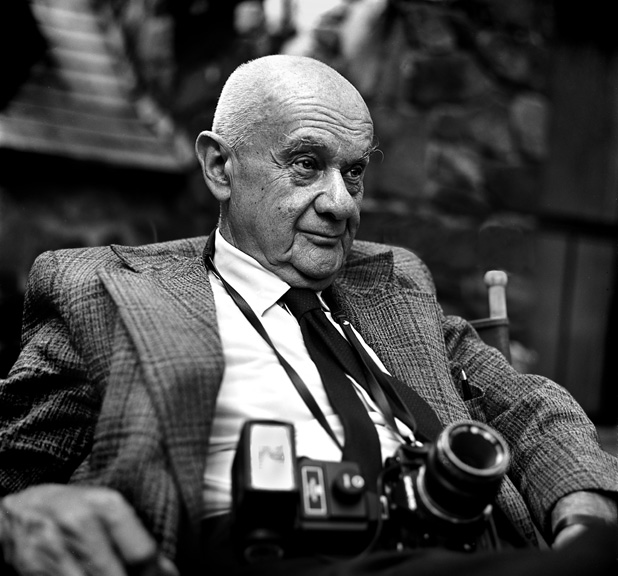
Roman Vishniac (/ˈvɪʃniæk/; Russian: Рома́н Соломо́нович Вишня́к; August 19, 1897 – January 22, 1990) was a Russian-American photographer, best known for capturing on film the culture of Jews in Central and Eastern Europe before the Holocaust. A major archive of his work was housed at the International Center of Photography until 2018, when Vishniac's daughter, Mara Vishniac Kohn, donated it to The Magnes Collection of Jewish Art and Life at the University of California, Berkeley.
Vishniac was a versatile photographer, an accomplished biologist, an art collector and teacher of art history. He also made significant scientific contributions to photomicroscopy and time-lapse photography. Vishniac was very interested in history, especially that of his ancestors, and strongly attached to his Jewish roots; he was a Zionist later in life.
Roman Vishniac won international acclaim for his photos of shtetlach and Jewish ghettos, celebrity portraits, and microscopic biology. His book A Vanished World, published in 1983, made him famous and is one of the most detailed pictorial documentations of Jewish culture in Eastern Europe in the 1930s. Vishniac was also remembered for his humanism and respect for life, sentiments that can be seen in all aspects of his work.
In 2013, Vishniac's daughter Mara (Vishniac) Kohn donated to the International Center of Photography the images and accompanying documents comprising ICP's "Roman Vishniac Rediscovered" traveling exhibition.
In October 2018, Kohn donated the Vishniac archive of an estimated 30,000 items, including photo negatives, prints, documents and other memorabilia that had been housed at ICP to The Magnes Collection of Jewish Art and Life, a unit of the University of California at Berkeley's library system.
Vishniac was born in his grandparents' dacha outside Saint Petersburg, in the town of Pavlovsk, and grew up in Moscow. To live in this city was a right granted to few Jews but the Vishniac family lived there because Solomon Vishniac, Roman's father, was a wealthy manufacturer of umbrellas, and his mother, Manya, was the daughter of affluent diamond dealers. Vishniac also had a sister, Katja. During the summer months, the Vishniac family left Moscow, as it became uncomfortably hot, and they retreated to a dacha a few miles outside the city.
As a child, Vishniac was fascinated by biology and photography, and his room was filled with "plants, insects, fish and small animals". On his seventh birthday, he got a microscope from his grandmother, to which he promptly hooked up a camera, and by which he photographed the muscles in a cockroach's leg at 150 times magnification. Young Vishniac used this microscope extensively, viewing and photographing everything he could find, from dead insects to animal scales, to pollen and protozoa.
Until the age of ten, Vishniac was homeschooled; from ten to seventeen, he attended a private school at which he earned a gold medal for scholarship. Beginning in 1914, he spent six years at the Shanyavsky Moscow City People's University (now Russian State University for the Humanities) in Moscow. At the institute he studied zoology. As a graduate student, he worked with prestigious biologist Nikolai Koltzoff, experimenting with inducing metamorphosis in axolotl, a species of aquatic salamander. While his experiments were a success, Vishniac was not able to publish a paper detailing his findings due to the chaos in Russia and his results were eventually independently duplicated. In spite of this, he went on to take a three-year course in medicine.
Hub AI
Roman Vishniac AI simulator
(@Roman Vishniac_simulator)
Roman Vishniac
Roman Vishniac (/ˈvɪʃniæk/; Russian: Рома́н Соломо́нович Вишня́к; August 19, 1897 – January 22, 1990) was a Russian-American photographer, best known for capturing on film the culture of Jews in Central and Eastern Europe before the Holocaust. A major archive of his work was housed at the International Center of Photography until 2018, when Vishniac's daughter, Mara Vishniac Kohn, donated it to The Magnes Collection of Jewish Art and Life at the University of California, Berkeley.
Vishniac was a versatile photographer, an accomplished biologist, an art collector and teacher of art history. He also made significant scientific contributions to photomicroscopy and time-lapse photography. Vishniac was very interested in history, especially that of his ancestors, and strongly attached to his Jewish roots; he was a Zionist later in life.
Roman Vishniac won international acclaim for his photos of shtetlach and Jewish ghettos, celebrity portraits, and microscopic biology. His book A Vanished World, published in 1983, made him famous and is one of the most detailed pictorial documentations of Jewish culture in Eastern Europe in the 1930s. Vishniac was also remembered for his humanism and respect for life, sentiments that can be seen in all aspects of his work.
In 2013, Vishniac's daughter Mara (Vishniac) Kohn donated to the International Center of Photography the images and accompanying documents comprising ICP's "Roman Vishniac Rediscovered" traveling exhibition.
In October 2018, Kohn donated the Vishniac archive of an estimated 30,000 items, including photo negatives, prints, documents and other memorabilia that had been housed at ICP to The Magnes Collection of Jewish Art and Life, a unit of the University of California at Berkeley's library system.
Vishniac was born in his grandparents' dacha outside Saint Petersburg, in the town of Pavlovsk, and grew up in Moscow. To live in this city was a right granted to few Jews but the Vishniac family lived there because Solomon Vishniac, Roman's father, was a wealthy manufacturer of umbrellas, and his mother, Manya, was the daughter of affluent diamond dealers. Vishniac also had a sister, Katja. During the summer months, the Vishniac family left Moscow, as it became uncomfortably hot, and they retreated to a dacha a few miles outside the city.
As a child, Vishniac was fascinated by biology and photography, and his room was filled with "plants, insects, fish and small animals". On his seventh birthday, he got a microscope from his grandmother, to which he promptly hooked up a camera, and by which he photographed the muscles in a cockroach's leg at 150 times magnification. Young Vishniac used this microscope extensively, viewing and photographing everything he could find, from dead insects to animal scales, to pollen and protozoa.
Until the age of ten, Vishniac was homeschooled; from ten to seventeen, he attended a private school at which he earned a gold medal for scholarship. Beginning in 1914, he spent six years at the Shanyavsky Moscow City People's University (now Russian State University for the Humanities) in Moscow. At the institute he studied zoology. As a graduate student, he worked with prestigious biologist Nikolai Koltzoff, experimenting with inducing metamorphosis in axolotl, a species of aquatic salamander. While his experiments were a success, Vishniac was not able to publish a paper detailing his findings due to the chaos in Russia and his results were eventually independently duplicated. In spite of this, he went on to take a three-year course in medicine.