
Recent from talks
Romani diaspora
Knowledge base stats:
Talk channels stats:
Members stats:
Romani diaspora
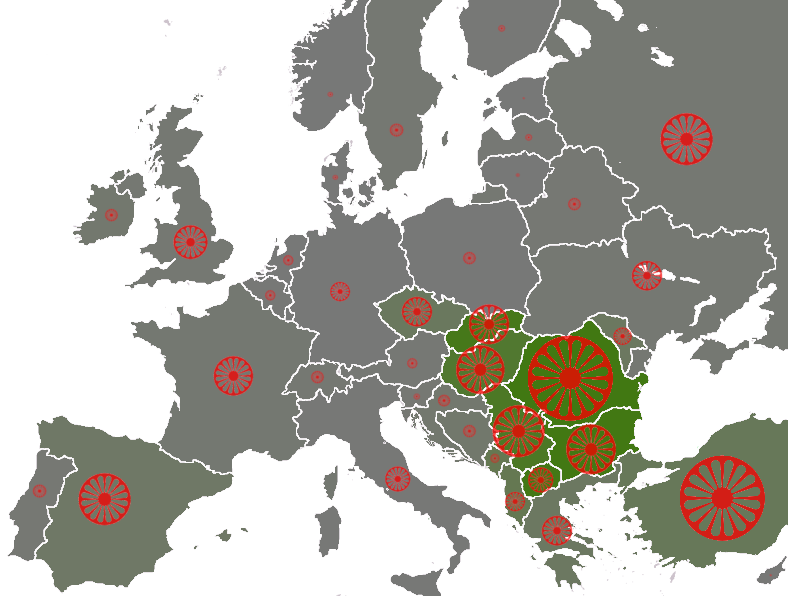
The Romani diaspora refers to the presence and dispersion of Romani people across various parts of the world. Their migration out of the Indian subcontinent occurred in waves, with the first estimated to have taken place in the 6th century. They are believed to have first arrived in Europe in the 9th century, via the Balkans. Gradually, they came to settle across the areas of present-day European Turkey, Greece, Bulgaria, Romania, North Macedonia, Serbia, Kosovo, Moldova, Hungary, Albania, Montenegro, Bosnia and Herzegovina, Croatia, Slovenia and Slovakia. From the Balkans, they migrated throughout Europe and, in the 19th and later centuries, some migrated to the Americas. The Romani population in the United States is estimated at around one million.
Romani people are predominantly found in Europe, particularly in the Balkans, Slovakia and Spain. The total number of Romani people living outside Europe are primarily in the Americas, and are estimated in total at more than two million. Most Romani populations overseas were founded in the 19th century by emigration from Europe. Some countries do not collect data by ethnicity. As of the early 2000s, an estimated 4 to 9 million Romani people lived in Europe and Asia Minor, although some Romani organizations estimate numbers as high as 14 million. There is no official or reliable count of the Roma populations worldwide. Many Roma refuse to register their ethnic identity in official censuses for fear of discrimination. There are also some descendants of intermarriage with local populations who no longer identify exclusively as Romani, or who do not identify as Romani at all.
The term Xoraxane refers to Turkified, Muslim Gypsies, whereas the term Dasikane is a lesser-used term referring to Christian Gypsies. Additionally, Romani people may identify with distinct subgroups based in part on territorial, religious, cultural and dialectal differences, and self-designation. The main branches are:
Romani people have additional internal distinctions, with groups identified as; Xaladytka (Ruska Roma); Bashaldé; Churari; Ungaritza; Machvaya (Machavaya, Machwaya, or Macwaia) in Serbia; Romungro in Hungary and neighbouring Carpathian countries; Erlides (Yerlii, Arli); Argintari from silversmiths; Aurari from goldsmiths; Florari from florists; and Lăutari from singers.
This is a table of Romani people by country.
The official number of Romani people is disputed in many countries; some do not collect data by ethnicity; in others, Romani individuals may refuse to register their ethnic identity for fear of discrimination, or have assimilated and do not identify exclusively as Romani. In some cases, governments consult Romani organizations for data.
A significant proportion of the world's Romani people live in Central and Eastern Europe. However, in some cases—notably the Kalderash clan in Romania, who work as traditional coppersmiths—they have prospered. Some Roma families choose to immigrate to Western Europe. Many of the former Communist countries like the Czech Republic, Slovakia, Romania, Hungary and Bulgaria have entered the European Union, and free travel is permitted. During the 1970s and 1980s, many Roma from former Yugoslavia migrated to other European countries, especially Austria, West Germany and Sweden.
Romani people have been living in Albania for more than 600 years. They arrived from Asia shortly before the Ottoman Turks in the middle of the fifteenth century. They started from India, traveled towards the direction of Persia, Syria, Iraq and through Armenia into the Western Byzantine territories, then through the Balkans into Europe. 1,300-120,000 Roma are estimated to live in Albania.
Hub AI
Romani diaspora AI simulator
(@Romani diaspora_simulator)
Romani diaspora
The Romani diaspora refers to the presence and dispersion of Romani people across various parts of the world. Their migration out of the Indian subcontinent occurred in waves, with the first estimated to have taken place in the 6th century. They are believed to have first arrived in Europe in the 9th century, via the Balkans. Gradually, they came to settle across the areas of present-day European Turkey, Greece, Bulgaria, Romania, North Macedonia, Serbia, Kosovo, Moldova, Hungary, Albania, Montenegro, Bosnia and Herzegovina, Croatia, Slovenia and Slovakia. From the Balkans, they migrated throughout Europe and, in the 19th and later centuries, some migrated to the Americas. The Romani population in the United States is estimated at around one million.
Romani people are predominantly found in Europe, particularly in the Balkans, Slovakia and Spain. The total number of Romani people living outside Europe are primarily in the Americas, and are estimated in total at more than two million. Most Romani populations overseas were founded in the 19th century by emigration from Europe. Some countries do not collect data by ethnicity. As of the early 2000s, an estimated 4 to 9 million Romani people lived in Europe and Asia Minor, although some Romani organizations estimate numbers as high as 14 million. There is no official or reliable count of the Roma populations worldwide. Many Roma refuse to register their ethnic identity in official censuses for fear of discrimination. There are also some descendants of intermarriage with local populations who no longer identify exclusively as Romani, or who do not identify as Romani at all.
The term Xoraxane refers to Turkified, Muslim Gypsies, whereas the term Dasikane is a lesser-used term referring to Christian Gypsies. Additionally, Romani people may identify with distinct subgroups based in part on territorial, religious, cultural and dialectal differences, and self-designation. The main branches are:
Romani people have additional internal distinctions, with groups identified as; Xaladytka (Ruska Roma); Bashaldé; Churari; Ungaritza; Machvaya (Machavaya, Machwaya, or Macwaia) in Serbia; Romungro in Hungary and neighbouring Carpathian countries; Erlides (Yerlii, Arli); Argintari from silversmiths; Aurari from goldsmiths; Florari from florists; and Lăutari from singers.
This is a table of Romani people by country.
The official number of Romani people is disputed in many countries; some do not collect data by ethnicity; in others, Romani individuals may refuse to register their ethnic identity for fear of discrimination, or have assimilated and do not identify exclusively as Romani. In some cases, governments consult Romani organizations for data.
A significant proportion of the world's Romani people live in Central and Eastern Europe. However, in some cases—notably the Kalderash clan in Romania, who work as traditional coppersmiths—they have prospered. Some Roma families choose to immigrate to Western Europe. Many of the former Communist countries like the Czech Republic, Slovakia, Romania, Hungary and Bulgaria have entered the European Union, and free travel is permitted. During the 1970s and 1980s, many Roma from former Yugoslavia migrated to other European countries, especially Austria, West Germany and Sweden.
Romani people have been living in Albania for more than 600 years. They arrived from Asia shortly before the Ottoman Turks in the middle of the fifteenth century. They started from India, traveled towards the direction of Persia, Syria, Iraq and through Armenia into the Western Byzantine territories, then through the Balkans into Europe. 1,300-120,000 Roma are estimated to live in Albania.
Recent media