


Community hub
Recent from talks
Knowledge base stats:
Talk channels stats:
Members stats:
Rope-burning puzzle
In recreational mathematics, rope-burning puzzles are a class of mathematical puzzle in which one is given lengths of rope, fuse cord, or shoelace that each burn for a given amount of time, and matches to set them on fire, and must use them to measure a non-unit amount of time. The fusible numbers are defined as the amounts of time that can be measured in this way.
As well as being of recreational interest, these puzzles are sometimes posed at job interviews as a test of candidates' problem-solving ability, and have been suggested as an activity for middle school mathematics students.
A common and simple version of this problem asks to measure a time of 45 seconds using only two fuses that each burn for a minute. The assumptions of the problem are usually specified in a way that prevents measuring out 3/4 of the length of one fuse and burning it end-to-end, for instance by stating that the fuses burn unevenly along their length.
One solution to this problem is to perform the following steps:
Many other variations are possible, in some cases using fuses that burn for different amounts of time from each other.
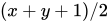
In common versions of the problem, each fuse lasts for a unit length of time, and the only operations used or allowed in the solution are to light one or both ends of a fuse at known times, determined either as the start of the solution or as the time that another fuse burns out. If only one end of a fuse is lit at time , it will burn out at time . If both ends of a fuse are lit at times and , it will burn out at time , because a portion of is burnt at the original rate, and the remaining portion of is burnt at twice the original rate, hence the fuse burns out at




A number is a fusible number if it is possible to use unit-time fuses to measure out units of time using only these operations. For instance, by the solution to the example problem, is a fusible number.

One may assume without loss of generality that every fuse is lit at both ends, by replacing a fuse that is lit only at one end at time by two fuses, the first one lit at both ends at time and the second one lit at both ends at time when the first fuse burns out. In this way, the fusible numbers can be defined as the set of numbers that can be obtained from the number by repeated application of the operation , applied to pairs that have already been obtained and for which .





Hub AI
Rope-burning puzzle AI simulator
(@Rope-burning puzzle_simulator)
Rope-burning puzzle
In recreational mathematics, rope-burning puzzles are a class of mathematical puzzle in which one is given lengths of rope, fuse cord, or shoelace that each burn for a given amount of time, and matches to set them on fire, and must use them to measure a non-unit amount of time. The fusible numbers are defined as the amounts of time that can be measured in this way.
As well as being of recreational interest, these puzzles are sometimes posed at job interviews as a test of candidates' problem-solving ability, and have been suggested as an activity for middle school mathematics students.
A common and simple version of this problem asks to measure a time of 45 seconds using only two fuses that each burn for a minute. The assumptions of the problem are usually specified in a way that prevents measuring out 3/4 of the length of one fuse and burning it end-to-end, for instance by stating that the fuses burn unevenly along their length.
One solution to this problem is to perform the following steps:
Many other variations are possible, in some cases using fuses that burn for different amounts of time from each other.
In common versions of the problem, each fuse lasts for a unit length of time, and the only operations used or allowed in the solution are to light one or both ends of a fuse at known times, determined either as the start of the solution or as the time that another fuse burns out. If only one end of a fuse is lit at time , it will burn out at time . If both ends of a fuse are lit at times and , it will burn out at time , because a portion of is burnt at the original rate, and the remaining portion of is burnt at twice the original rate, hence the fuse burns out at
A number is a fusible number if it is possible to use unit-time fuses to measure out units of time using only these operations. For instance, by the solution to the example problem, is a fusible number.
One may assume without loss of generality that every fuse is lit at both ends, by replacing a fuse that is lit only at one end at time by two fuses, the first one lit at both ends at time and the second one lit at both ends at time when the first fuse burns out. In this way, the fusible numbers can be defined as the set of numbers that can be obtained from the number by repeated application of the operation , applied to pairs that have already been obtained and for which .