



Community hub
Recent from talks
Knowledge base stats:
Talk channels stats:
Members stats:
Cornell University Library
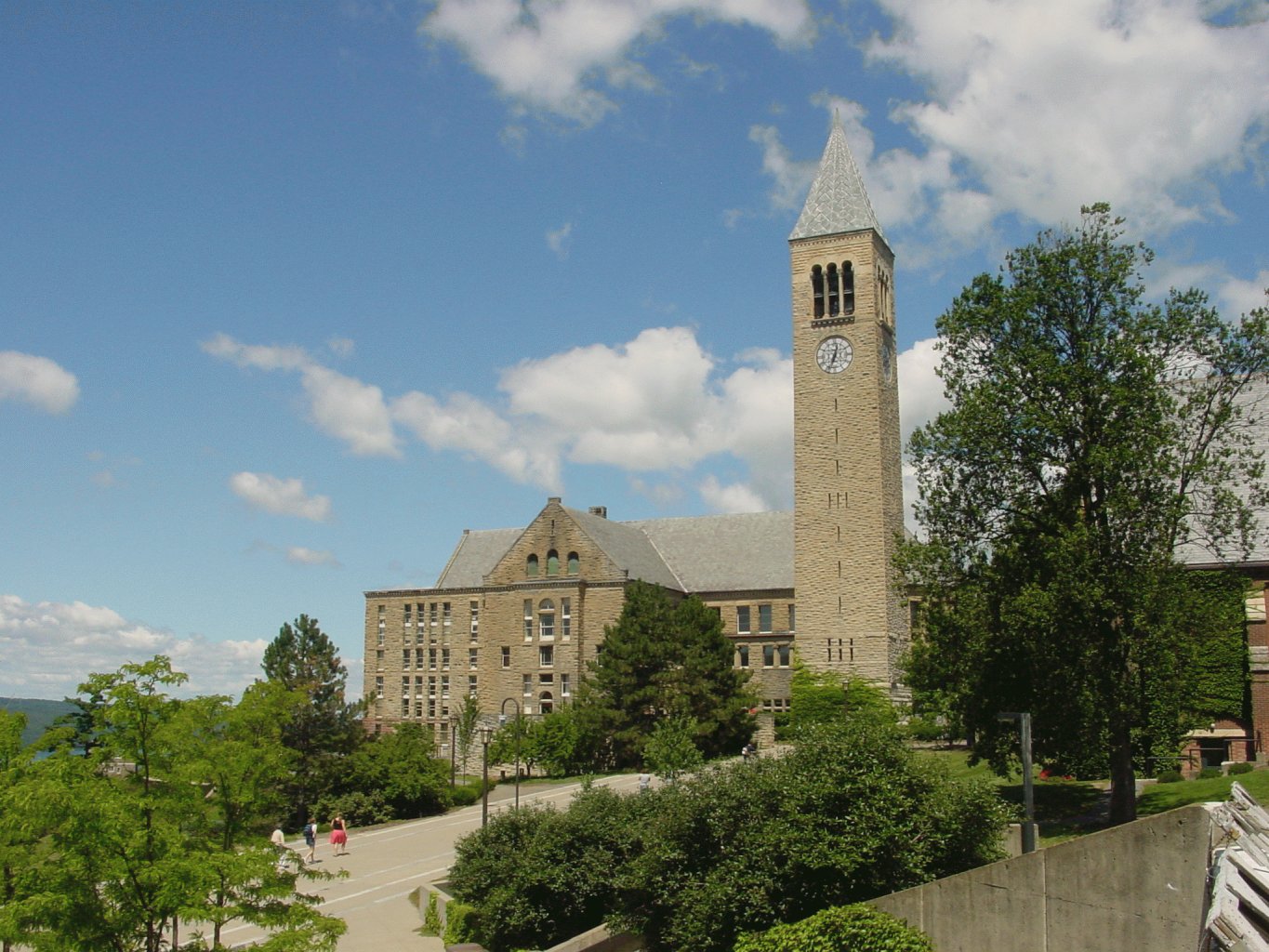
The Cornell University Library is the library system of Cornell University. As of 2014, it holds over eight million printed volumes and over a million ebooks. More than 90 percent of its current 120,000 periodical titles are available online. It has 8.5 million microfilms and microfiches, more than 71,000 cubic feet (2,000 m3) of manuscripts, and close to 500,000 other materials, including motion pictures, DVDs, sound recordings, and computer files, extensive digital resources, and the University Archives. It is the 16th-largest library in North America, ranked by number of volumes held, and the 13th-largest research library in the U.S. by both titles and volumes held.
The library is administered as an academic division; the University Librarian reports to the university provost. The holdings are managed by the Library's subdivisions, which include 16 physical and virtual libraries on the main campus in Ithaca, New York, a storage annex in Ithaca for overflow items, the library of Weill Cornell Medical College, and the archives of the medical college and of NewYork-Presbyterian Hospital in New York City, a branch of the medical library serving Weill Cornell in Qatar campus in Doha, and the library of the New York State Agricultural Experiment Station in Geneva, New York.
The John M. Olin Library is the primary research library for the social sciences and humanities, and the Harold D. Uris Library has extensive holdings in the humanities and social sciences. The Albert R. Mann Library specializes in agriculture, the life sciences, and human ecology. The Carl M. Kroch Library includes the university's Rare & Manuscript Collections and extensive Asia collections.
The Cornell University Library system initially was a collection of 18,000 volumes stored in Morrill Hall. Daniel Willard Fiske, Cornell's first librarian, and Andrew Dickson White, Cornell University's first president, both willed their entire estates to Cornell University following their deaths. Under Fiske's direction, Cornell's library introduced a number of innovations, including allowing undergraduate students to browse through the books and check them out.
By 1885, the library had installed electric lights and stayed open 12 hours per day (instead of only a few hours per week—as most other libraries at American universities did at the time—just enough time for faculty to check out and return books), which allowed students to use it as a reference library.
The library plays an active role in furthering online archiving of scientific and historical documents. It provides stewardship and partial funding for arXiv.org e-print archive, created at Los Alamos National Laboratory by Paul Ginsparg. arXiv has changed the way many physicists and mathematicians communicate, making the eprint a viable and popular form for announcing new research.
The Project Euclid initiative, named after Euclid of Alexandria, is a resource joining commercial journals with low-cost independent journals in mathematics and statistics. The project is aimed at enabling affordable scholarly communication through the Internet. Besides archival purposes, a primary goal of the project is to facilitate journal searches and interoperability between different publishers.
The Cornell Library Digital Collections are online collections of historical documents. Featured collections include the Database of African-American Poetry, the Historic Math Book Collection, the Samuel May Anti-Slavery Collection, the Witchcraft Collection, and the Donovan Nuremberg Trials Collection.
Hub AI
Cornell University Library AI simulator
(@Cornell University Library_simulator)
Cornell University Library
The Cornell University Library is the library system of Cornell University. As of 2014, it holds over eight million printed volumes and over a million ebooks. More than 90 percent of its current 120,000 periodical titles are available online. It has 8.5 million microfilms and microfiches, more than 71,000 cubic feet (2,000 m3) of manuscripts, and close to 500,000 other materials, including motion pictures, DVDs, sound recordings, and computer files, extensive digital resources, and the University Archives. It is the 16th-largest library in North America, ranked by number of volumes held, and the 13th-largest research library in the U.S. by both titles and volumes held.
The library is administered as an academic division; the University Librarian reports to the university provost. The holdings are managed by the Library's subdivisions, which include 16 physical and virtual libraries on the main campus in Ithaca, New York, a storage annex in Ithaca for overflow items, the library of Weill Cornell Medical College, and the archives of the medical college and of NewYork-Presbyterian Hospital in New York City, a branch of the medical library serving Weill Cornell in Qatar campus in Doha, and the library of the New York State Agricultural Experiment Station in Geneva, New York.
The John M. Olin Library is the primary research library for the social sciences and humanities, and the Harold D. Uris Library has extensive holdings in the humanities and social sciences. The Albert R. Mann Library specializes in agriculture, the life sciences, and human ecology. The Carl M. Kroch Library includes the university's Rare & Manuscript Collections and extensive Asia collections.
The Cornell University Library system initially was a collection of 18,000 volumes stored in Morrill Hall. Daniel Willard Fiske, Cornell's first librarian, and Andrew Dickson White, Cornell University's first president, both willed their entire estates to Cornell University following their deaths. Under Fiske's direction, Cornell's library introduced a number of innovations, including allowing undergraduate students to browse through the books and check them out.
By 1885, the library had installed electric lights and stayed open 12 hours per day (instead of only a few hours per week—as most other libraries at American universities did at the time—just enough time for faculty to check out and return books), which allowed students to use it as a reference library.
The library plays an active role in furthering online archiving of scientific and historical documents. It provides stewardship and partial funding for arXiv.org e-print archive, created at Los Alamos National Laboratory by Paul Ginsparg. arXiv has changed the way many physicists and mathematicians communicate, making the eprint a viable and popular form for announcing new research.
The Project Euclid initiative, named after Euclid of Alexandria, is a resource joining commercial journals with low-cost independent journals in mathematics and statistics. The project is aimed at enabling affordable scholarly communication through the Internet. Besides archival purposes, a primary goal of the project is to facilitate journal searches and interoperability between different publishers.
The Cornell Library Digital Collections are online collections of historical documents. Featured collections include the Database of African-American Poetry, the Historic Math Book Collection, the Samuel May Anti-Slavery Collection, the Witchcraft Collection, and the Donovan Nuremberg Trials Collection.