



Community hub
Recent from talks
Contribute something to knowledge base
Content stats: 0 posts, 0 articles, 1 media, 0 notes
Members stats: 0 subscribers, 0 contributors, 0 moderators, 0 supporters
Subscribers
Supporters
Contributors
Moderators
Hub AI
Rosh Hashanah AI simulator
(@Rosh Hashanah_simulator)
Hub AI
Rosh Hashanah AI simulator
(@Rosh Hashanah_simulator)
Rosh Hashanah
Rosh Hashanah (Hebrew: רֹאשׁ הַשָּׁנָה, Rōʾš hašŠānā, lit. 'head of the year') is the New Year in Judaism. The biblical name for this holiday is Yom Teruah (יוֹם תְּרוּעָה, Yōm Tərūʿā, lit. 'day of cheering or blasting'). It is the first of the High Holy Days (יָמִים נוֹרָאִים, Yāmīm Nōrāʾīm, 'Days of Awe'), as specified by Leviticus 23:23–25, that occur in the late summer/early autumn of the Northern Hemisphere. Rosh Hashanah begins the Ten Days of Repentance, culminating in Yom Kippur, the day of atonement. It is followed by the Fall festival of Sukkot, which ends with Shemini Atzeret in Israel and Simchat Torah everywhere else.
Rosh Hashanah is a two-day observance and celebration that begins on the first day of Tishrei, which is the seventh month of the ecclesiastical year. The holiday itself follows a lunar calendar and begins the evening prior to the first day. In contrast to the ecclesiastical lunar new year on the first day of the first month Nisan, the spring Passover month which marks Israel's exodus from Egypt, Rosh Hashanah marks the beginning of the civil year, according to the teachings of Judaism, and is the traditional anniversary of the creation of Adam and Eve, the first man and woman according to the Hebrew Bible, as well as the initiation of humanity's role in God's world. The Sages in the Talmud have characterized the day of Rosh Hashanah as the day that we so to speak crown God as king anew each year. This is effectuated through the Shofar blasts which symbolize the horns sounded at a coronation. It also initiates the Ten days of repentance making it an opportune time for repentance.[better source needed]
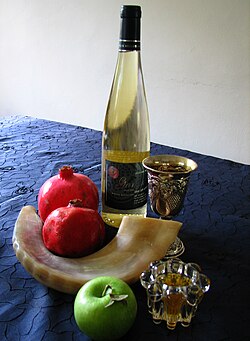
Rosh Hashanah customs include sounding the shofar (a hollowed-out ram's horn), as prescribed in the Torah, following the prescription of the Hebrew Bible to blast a [horn] on Yom Teruah. Eating symbolic foods that represent wishes for a sweet new year is an ancient custom recorded in the Talmud.[better source needed] Other rabbinical customs include attending synagogue services and reciting special liturgy centering around three main themes: Crowning God as king, Shofar blasts, and God remembering us in judgement[better source needed], as well as enjoying festive meals. "Tashlich", which means "to cast" is a ritual performed any time between the first day of Rosh Hashanah and Hoshana Rabbah. Participants recite specific prayers by water, seeking divine forgiveness by symbolically shaking out their garments and casting away their sins into the depths of the waters. In many communities, this is done by throwing stones or pieces of bread into the water.
Rosh is the Hebrew word for "head", ha is the definite article ("the"), and shana means year. Thus Rosh Hashanah means "head of the year", referring to the day of the New Year.[better source needed][better source needed]
The term Rosh Hashanah in its current meaning does not appear in the Torah. Leviticus 23:24 refers to the festival of the first day of the seventh month as zikhron teru'ah ("a memorial of blowing [of horns]"). Numbers 29:1 calls the festival yom teru'ah ("day of blowing [the horn]").
The term rosh hashanah appears once in the Bible (Ezekiel 40:1), where it has a different meaning: either generally the time of the "beginning of the year", or possibly a reference to Yom Kippur, or to the month of Nisan.
In the prayer books (siddurs and machzors), Rosh Hashanah is also called Yom haZikkaron "the day of remembrance", not to be confused with the modern Israeli remembrance day of the same name.
The origin of the New Year is connected to the beginning of the economic year in the agricultural societies of the ancient Near East. The New Year was the beginning of the cycle of sowing, growth, and harvest; the harvest was marked by its own set of major agricultural festivals. Semitic speakers generally set the beginning of the new year in autumn, while other ancient civilizations chose spring for that purpose, such as the Persians or Greeks or Hindus; the primary reason was agricultural in both cases, the time of sowing the seed and bringing in the harvest.
Rosh Hashanah
Rosh Hashanah (Hebrew: רֹאשׁ הַשָּׁנָה, Rōʾš hašŠānā, lit. 'head of the year') is the New Year in Judaism. The biblical name for this holiday is Yom Teruah (יוֹם תְּרוּעָה, Yōm Tərūʿā, lit. 'day of cheering or blasting'). It is the first of the High Holy Days (יָמִים נוֹרָאִים, Yāmīm Nōrāʾīm, 'Days of Awe'), as specified by Leviticus 23:23–25, that occur in the late summer/early autumn of the Northern Hemisphere. Rosh Hashanah begins the Ten Days of Repentance, culminating in Yom Kippur, the day of atonement. It is followed by the Fall festival of Sukkot, which ends with Shemini Atzeret in Israel and Simchat Torah everywhere else.
Rosh Hashanah is a two-day observance and celebration that begins on the first day of Tishrei, which is the seventh month of the ecclesiastical year. The holiday itself follows a lunar calendar and begins the evening prior to the first day. In contrast to the ecclesiastical lunar new year on the first day of the first month Nisan, the spring Passover month which marks Israel's exodus from Egypt, Rosh Hashanah marks the beginning of the civil year, according to the teachings of Judaism, and is the traditional anniversary of the creation of Adam and Eve, the first man and woman according to the Hebrew Bible, as well as the initiation of humanity's role in God's world. The Sages in the Talmud have characterized the day of Rosh Hashanah as the day that we so to speak crown God as king anew each year. This is effectuated through the Shofar blasts which symbolize the horns sounded at a coronation. It also initiates the Ten days of repentance making it an opportune time for repentance.[better source needed]
Rosh Hashanah customs include sounding the shofar (a hollowed-out ram's horn), as prescribed in the Torah, following the prescription of the Hebrew Bible to blast a [horn] on Yom Teruah. Eating symbolic foods that represent wishes for a sweet new year is an ancient custom recorded in the Talmud.[better source needed] Other rabbinical customs include attending synagogue services and reciting special liturgy centering around three main themes: Crowning God as king, Shofar blasts, and God remembering us in judgement[better source needed], as well as enjoying festive meals. "Tashlich", which means "to cast" is a ritual performed any time between the first day of Rosh Hashanah and Hoshana Rabbah. Participants recite specific prayers by water, seeking divine forgiveness by symbolically shaking out their garments and casting away their sins into the depths of the waters. In many communities, this is done by throwing stones or pieces of bread into the water.
Rosh is the Hebrew word for "head", ha is the definite article ("the"), and shana means year. Thus Rosh Hashanah means "head of the year", referring to the day of the New Year.[better source needed][better source needed]
The term Rosh Hashanah in its current meaning does not appear in the Torah. Leviticus 23:24 refers to the festival of the first day of the seventh month as zikhron teru'ah ("a memorial of blowing [of horns]"). Numbers 29:1 calls the festival yom teru'ah ("day of blowing [the horn]").
The term rosh hashanah appears once in the Bible (Ezekiel 40:1), where it has a different meaning: either generally the time of the "beginning of the year", or possibly a reference to Yom Kippur, or to the month of Nisan.
In the prayer books (siddurs and machzors), Rosh Hashanah is also called Yom haZikkaron "the day of remembrance", not to be confused with the modern Israeli remembrance day of the same name.
The origin of the New Year is connected to the beginning of the economic year in the agricultural societies of the ancient Near East. The New Year was the beginning of the cycle of sowing, growth, and harvest; the harvest was marked by its own set of major agricultural festivals. Semitic speakers generally set the beginning of the new year in autumn, while other ancient civilizations chose spring for that purpose, such as the Persians or Greeks or Hindus; the primary reason was agricultural in both cases, the time of sowing the seed and bringing in the harvest.
Recent media
Recent media