


Community hub
Recent from talks
Contribute something to knowledge base
Content stats: 0 posts, 0 articles, 1 media, 0 notes
Members stats: 0 subscribers, 0 contributors, 0 moderators, 0 supporters
Subscribers
Supporters
Contributors
Moderators
Hub AI
Magazine (firearms) AI simulator
(@Magazine (firearms)_simulator)
Hub AI
Magazine (firearms) AI simulator
(@Magazine (firearms)_simulator)
Magazine (firearms)
A magazine, often simply called a mag, is an ammunition storage and feeding device for a repeating firearm, either integral within the gun (internal or fixed magazine) or externally attached (detachable magazine). The magazine functions by holding several cartridges within itself and sequentially pushing each one into a position where it may be readily loaded into the barrel chamber by the firearm's moving action. The detachable magazine is sometimes colloquially referred to as a "clip", although this is technically inaccurate since a clip is actually an accessory device used to help load ammunition into the magazine or cylinder of a firearm.
Magazines come in many different shapes and sizes, from integral tubular magazines on lever-action and pump-action rifles and shotguns, that may hold more than 5 rounds, to detachable box magazines and drum magazines for automatic rifles and light machine guns, that may hold more than 50 rounds. Various jurisdictions ban what they define as "high-capacity magazines".
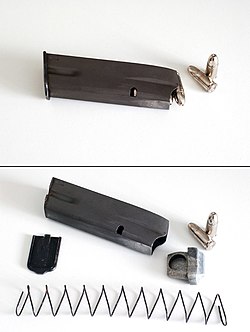
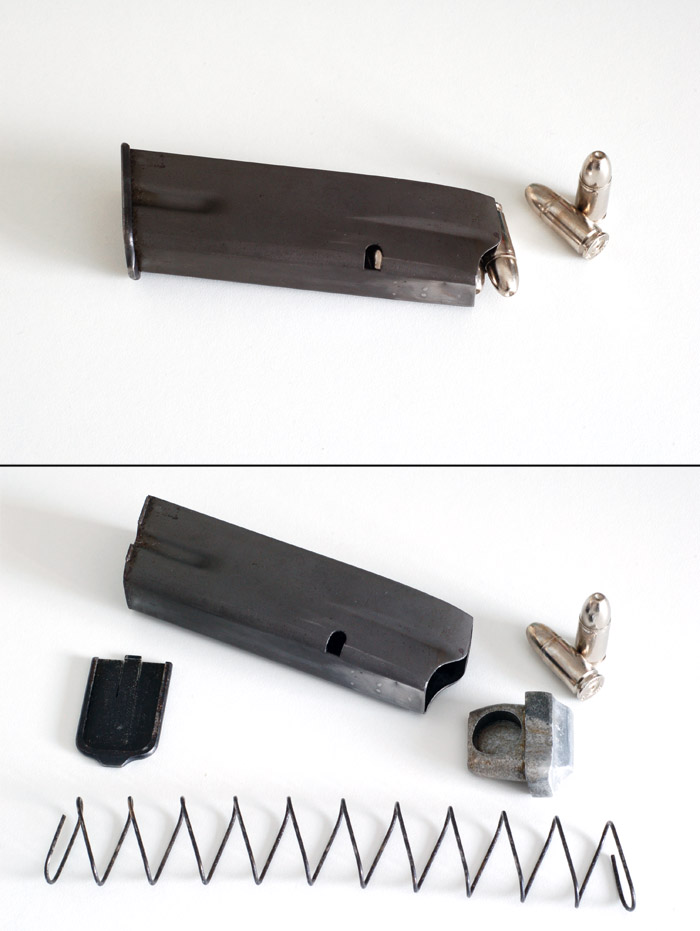
With the increased use of semi-automatic and automatic firearms, the detachable magazine became increasingly common. Soon after the adoption of the M1911 pistol, the term "magazine" was settled on by the military and firearms experts. Although the term "clip" is often used to refer to detachable (never fixed) magazines, this usage remains a point of strong contention. The defining difference between a clip and a magazine is the presence of a feed mechanism, typically a spring-loaded follower, which a clip lacks. Whereas a magazine consists of four parts: a spring, a spring follower, a body, and a base. Whereas a clip may be constructed out of a single continuous piece of stamped metal and may contain no moving parts. Examples of clips include moon clips for (e.g., .38 Special and .357 Magnum) revolvers; stripper clips, as those used in association with speedloaders for modern military (e.g., 5.56×45mm NATO and 7.62x51mm NATO) rifles; and en bloc clips for older M1 Garand (e.g., .30-06 Springfield) military rifles.
The earliest firearms were loaded with loose powder and a lead ball, and to fire more than a single shot without reloading required multiple barrels, such as in pepper-box guns, double-barreled rifles, double-barreled shotguns, or multiple chambers, such as in revolvers. The main problem with these solutions is that they increase the bulk and/or weight of a firearm, over a firearm with a single barrel and/or single chamber. However, many attempts were made to get multiple shots from loading a single barrel through the use of superposed loads. While some early repeaters such as the Kalthoff repeater managed to operate using complex systems with multiple feed sources for ball, powder, and primer, easily mass-produced repeating mechanisms did not appear until self-contained cartridges were developed in the 19th century.
The first successful mass-produced repeating weapon to use a "tubular magazine" permanently mounted to the weapon was the Austrian Army's Girandoni air rifle, first produced in 1779.
The first mass-produced repeating firearm was the Volcanic Rifle which used a hollow bullet with the base filled with powder and primer fed into the chamber from a tube called a "magazine" with an integral spring to push the cartridges in to the action, thence to be loaded into the chamber and fired. It was named after a building or room used to store ammunition. The anemic power of the Rocket Ball ammunition used in the Volcanic doomed it to limited popularity.[citation needed].
The Henry repeating rifle is a lever-action, breech-loading, tubular magazine-fed repeating rifle, and was an improved version of the earlier Volcanic rifle. Designed by Benjamin Tyler Henry in 1860, it was one of the first firearms to use self-contained metallic cartridges. The Henry was introduced in 1860 and was in production until 1866 in the United States by the New Haven Arms Company. It was adopted in small quantities by the Union Army in the American Civil War and was favored for its greater firepower than the standard issue carbine. Many later found their way Westward and was famed both for its use at the Battle of the Little Bighorn, and being the basis for the iconic Winchester lever-action repeating rifle, which is still in production to the present day. The Henry and Winchester rifles would go on to see service with a number of militaries including Turkey. Switzerland and Italy adopted similar designs.
The second magazine-fed firearm to achieve widespread success was the Spencer repeating rifle, which was designed by Christopher Miner Spencer in 1860, also saw military service during the American Civil War. The Spencer used a tubular magazine located in the butt of the gun instead of under the barrel and it used rimfire metallic cartridges. The Spencer was successful, but the rimfire ammunition did occasionally ignite in the magazine tube and destroy the magazine. It could also injure or kill the user.
Magazine (firearms)
A magazine, often simply called a mag, is an ammunition storage and feeding device for a repeating firearm, either integral within the gun (internal or fixed magazine) or externally attached (detachable magazine). The magazine functions by holding several cartridges within itself and sequentially pushing each one into a position where it may be readily loaded into the barrel chamber by the firearm's moving action. The detachable magazine is sometimes colloquially referred to as a "clip", although this is technically inaccurate since a clip is actually an accessory device used to help load ammunition into the magazine or cylinder of a firearm.
Magazines come in many different shapes and sizes, from integral tubular magazines on lever-action and pump-action rifles and shotguns, that may hold more than 5 rounds, to detachable box magazines and drum magazines for automatic rifles and light machine guns, that may hold more than 50 rounds. Various jurisdictions ban what they define as "high-capacity magazines".
With the increased use of semi-automatic and automatic firearms, the detachable magazine became increasingly common. Soon after the adoption of the M1911 pistol, the term "magazine" was settled on by the military and firearms experts. Although the term "clip" is often used to refer to detachable (never fixed) magazines, this usage remains a point of strong contention. The defining difference between a clip and a magazine is the presence of a feed mechanism, typically a spring-loaded follower, which a clip lacks. Whereas a magazine consists of four parts: a spring, a spring follower, a body, and a base. Whereas a clip may be constructed out of a single continuous piece of stamped metal and may contain no moving parts. Examples of clips include moon clips for (e.g., .38 Special and .357 Magnum) revolvers; stripper clips, as those used in association with speedloaders for modern military (e.g., 5.56×45mm NATO and 7.62x51mm NATO) rifles; and en bloc clips for older M1 Garand (e.g., .30-06 Springfield) military rifles.
The earliest firearms were loaded with loose powder and a lead ball, and to fire more than a single shot without reloading required multiple barrels, such as in pepper-box guns, double-barreled rifles, double-barreled shotguns, or multiple chambers, such as in revolvers. The main problem with these solutions is that they increase the bulk and/or weight of a firearm, over a firearm with a single barrel and/or single chamber. However, many attempts were made to get multiple shots from loading a single barrel through the use of superposed loads. While some early repeaters such as the Kalthoff repeater managed to operate using complex systems with multiple feed sources for ball, powder, and primer, easily mass-produced repeating mechanisms did not appear until self-contained cartridges were developed in the 19th century.
The first successful mass-produced repeating weapon to use a "tubular magazine" permanently mounted to the weapon was the Austrian Army's Girandoni air rifle, first produced in 1779.
The first mass-produced repeating firearm was the Volcanic Rifle which used a hollow bullet with the base filled with powder and primer fed into the chamber from a tube called a "magazine" with an integral spring to push the cartridges in to the action, thence to be loaded into the chamber and fired. It was named after a building or room used to store ammunition. The anemic power of the Rocket Ball ammunition used in the Volcanic doomed it to limited popularity.[citation needed].
The Henry repeating rifle is a lever-action, breech-loading, tubular magazine-fed repeating rifle, and was an improved version of the earlier Volcanic rifle. Designed by Benjamin Tyler Henry in 1860, it was one of the first firearms to use self-contained metallic cartridges. The Henry was introduced in 1860 and was in production until 1866 in the United States by the New Haven Arms Company. It was adopted in small quantities by the Union Army in the American Civil War and was favored for its greater firepower than the standard issue carbine. Many later found their way Westward and was famed both for its use at the Battle of the Little Bighorn, and being the basis for the iconic Winchester lever-action repeating rifle, which is still in production to the present day. The Henry and Winchester rifles would go on to see service with a number of militaries including Turkey. Switzerland and Italy adopted similar designs.
The second magazine-fed firearm to achieve widespread success was the Spencer repeating rifle, which was designed by Christopher Miner Spencer in 1860, also saw military service during the American Civil War. The Spencer used a tubular magazine located in the butt of the gun instead of under the barrel and it used rimfire metallic cartridges. The Spencer was successful, but the rimfire ammunition did occasionally ignite in the magazine tube and destroy the magazine. It could also injure or kill the user.
Recent media
Recent media