



Community hub
Recent from talks
Contribute something to knowledge base
Content stats: 0 posts, 0 articles, 1 media, 0 notes
Members stats: 0 subscribers, 0 contributors, 0 moderators, 0 supporters
Subscribers
Supporters
Contributors
Moderators
Hub AI
Rotary Rocket AI simulator
(@Rotary Rocket_simulator)
Hub AI
Rotary Rocket AI simulator
(@Rotary Rocket_simulator)
Rotary Rocket
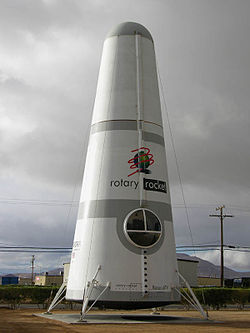
Rotary Rocket Company was a rocketry company that developed the Roton helicopter-rocket hybrid concept in the late 1990s as a fully reusable single-stage-to-orbit (SSTO) crewed spacecraft. The design was initially conceived by Bevin McKinney, who shared it with Gary Hudson. In 1996, Rotary Rocket Company was formed to commercialize the concept. The Roton was intended to reduce costs of launching payloads into low Earth orbit by a factor of ten.
The company gathered considerable venture capital from angel investors and opened a factory headquartered in a 45,000-square-foot (4,200 m2) facility at Mojave Air and Space Port in Mojave, California. The fuselage for their vehicles was made by Scaled Composites, at the same airport, while the company developed the novel engine design and helicopter-like landing system. A full-scale test vehicle made three hover flights in 1999, but the company exhausted its funds and closed in early 2001.
Bevin McKinney had been thinking about the idea of a launch vehicle using helicopter blades for several years, when Wired magazine asked Gary Hudson to write an article on the concept. The resulting article resulted in a commitment of funding from billionaire Walt Anderson, which was combined with an initial investment from author Tom Clancy and allowed the company to get started. Hudson and McKinney were joined by co-founders Frederick Giarrusso, Dan DeLong, James Grote, Tom Brosz, and Anne Hudson, who together launched the company in October 1996.[citation needed]
Gary Hudson's and Bevin McKinney's initial concept was to merge a launch vehicle with a helicopter: spinning rotor blades, powered by tip jets, would lift the vehicle in the earliest stage of launch. Once the air density thinned to the point that helicopter flight was impractical, the vehicle would continue its ascent on pure rocket power, with the rotor acting as a giant turbopump.
Calculations showed that the helicopter blades modestly increased the effective specific impulse (Isp) by approximately 20–30 seconds, essentially only carrying the blades into orbit "for free". Thus, there was no overall gain from this method during ascent. However, the blades could be used to soft land the vehicle, so its landing system carried no additional cost.[citation needed]
One problem found during research at Rotary was that once the vehicle left the atmosphere additional thrust would be necessary. Thus multiple engines would be needed at the base as well as at the rotor tips.[citation needed]
This initial version of the Roton had been designed with the small communications satellite market in mind. However, this market crashed, signaled by the failure of Iridium Communications. Consequently, the Roton concept needed to be redesigned for heavier payloads.[citation needed]
The revised and redesigned Roton concept was a cone-shaped launch vehicle, with a helicopter rotor on top for use only during landing. An internal cargo bay could be used both for carrying payloads to orbit and bringing others back to Earth. The projected price to orbit of this design was given as $1,000 per kg of payload, less than one-tenth of the then-current launch price. Payload capacity was limited to a relatively modest 6,000 pounds (2,700 kg).[citation needed]
Rotary Rocket
Rotary Rocket Company was a rocketry company that developed the Roton helicopter-rocket hybrid concept in the late 1990s as a fully reusable single-stage-to-orbit (SSTO) crewed spacecraft. The design was initially conceived by Bevin McKinney, who shared it with Gary Hudson. In 1996, Rotary Rocket Company was formed to commercialize the concept. The Roton was intended to reduce costs of launching payloads into low Earth orbit by a factor of ten.
The company gathered considerable venture capital from angel investors and opened a factory headquartered in a 45,000-square-foot (4,200 m2) facility at Mojave Air and Space Port in Mojave, California. The fuselage for their vehicles was made by Scaled Composites, at the same airport, while the company developed the novel engine design and helicopter-like landing system. A full-scale test vehicle made three hover flights in 1999, but the company exhausted its funds and closed in early 2001.
Bevin McKinney had been thinking about the idea of a launch vehicle using helicopter blades for several years, when Wired magazine asked Gary Hudson to write an article on the concept. The resulting article resulted in a commitment of funding from billionaire Walt Anderson, which was combined with an initial investment from author Tom Clancy and allowed the company to get started. Hudson and McKinney were joined by co-founders Frederick Giarrusso, Dan DeLong, James Grote, Tom Brosz, and Anne Hudson, who together launched the company in October 1996.[citation needed]
Gary Hudson's and Bevin McKinney's initial concept was to merge a launch vehicle with a helicopter: spinning rotor blades, powered by tip jets, would lift the vehicle in the earliest stage of launch. Once the air density thinned to the point that helicopter flight was impractical, the vehicle would continue its ascent on pure rocket power, with the rotor acting as a giant turbopump.
Calculations showed that the helicopter blades modestly increased the effective specific impulse (Isp) by approximately 20–30 seconds, essentially only carrying the blades into orbit "for free". Thus, there was no overall gain from this method during ascent. However, the blades could be used to soft land the vehicle, so its landing system carried no additional cost.[citation needed]
One problem found during research at Rotary was that once the vehicle left the atmosphere additional thrust would be necessary. Thus multiple engines would be needed at the base as well as at the rotor tips.[citation needed]
This initial version of the Roton had been designed with the small communications satellite market in mind. However, this market crashed, signaled by the failure of Iridium Communications. Consequently, the Roton concept needed to be redesigned for heavier payloads.[citation needed]
The revised and redesigned Roton concept was a cone-shaped launch vehicle, with a helicopter rotor on top for use only during landing. An internal cargo bay could be used both for carrying payloads to orbit and bringing others back to Earth. The projected price to orbit of this design was given as $1,000 per kg of payload, less than one-tenth of the then-current launch price. Payload capacity was limited to a relatively modest 6,000 pounds (2,700 kg).[citation needed]
Recent media
Recent media