



Community hub
Recent from talks
Knowledge base stats:
Talk channels stats:
Members stats:
Rotoscoping
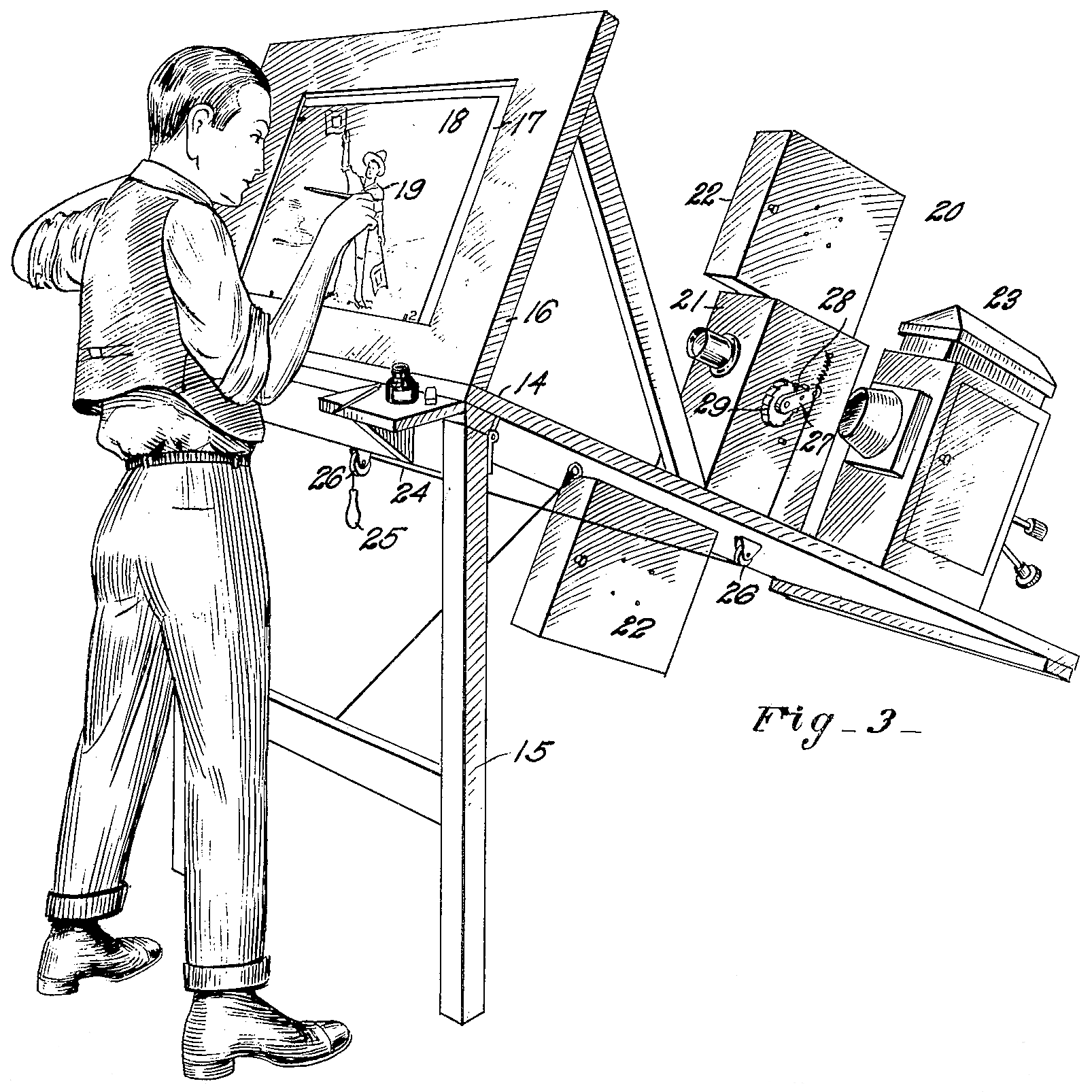
Rotoscoping is an animation technique that animators use to trace over motion picture footage, frame by frame, to produce realistic action. Originally, live-action film images were projected onto a glass panel and traced onto paper. This projection equipment is referred to as a rotoscope, developed by Polish-American animator Max Fleischer. This device was eventually replaced by computers, but the process is still called rotoscoping.
In the visual effects industry, rotoscoping refers to the technique of manually creating a matte for an element on a live-action plate so it may be composited over another background.
Rotoscoping has often been used as a tool for visual effects in live-action films. By tracing an object, the filmmaker creates a silhouette (called a matte) that can be used to extract that object from a scene for use on a different background. Rotoscoping in the digital domain is often aided by motion-tracking and onion-skinning software. Rotoscoping is often used in the preparation of garbage mattes for other matte-pulling processes.
Rotoscoping has also been used to create a special visual effect (such as a glow, for example) that is guided by the matte or rotoscoped line. A classic use of traditional rotoscoping was in the original three Star Wars films, where the production used it to create the glowing lightsaber effect with a matte based on sticks held by the actors. To achieve this, effects technicians traced a line over each frame with the prop, then enlarged each line and added the glow.
While blue-screen and green-screen techniques (Chroma key) have made the process of layering subjects in scenes easier, rotoscoping still plays a large role in the production of visual effects imagery.
Eadweard Muybridge had some of his famous chronophotographic sequences painted on glass discs for the zoopraxiscope projector that he used in his popular lectures between 1880 and 1895. The first discs were painted on the glass in dark contours. Discs made between 1892 and 1894 had outlines drawn by Erwin Faber photographically printed on the disc and then colored by hand, but these discs were probably never used in the lectures.
By 1902, Nuremberg toy companies Gebrüder Bing and Ernst Plank were offering chromolithographed film loops for their toy kinematographs. The films were traced from live-action film footage.
The rotoscope technique was invented by animator Max Fleischer in 1915, and used in his groundbreaking Out of the Inkwell animated series (1918–1927). It was known simply as the "Fleischer Process" on the early screen credits, and was essentially exclusive to Fleischer for several years. The live-film reference for the character, later known as Koko the Clown, was performed by his brother (Dave Fleischer) dressed in a clown costume.
Hub AI
Rotoscoping AI simulator
(@Rotoscoping_simulator)
Rotoscoping
Rotoscoping is an animation technique that animators use to trace over motion picture footage, frame by frame, to produce realistic action. Originally, live-action film images were projected onto a glass panel and traced onto paper. This projection equipment is referred to as a rotoscope, developed by Polish-American animator Max Fleischer. This device was eventually replaced by computers, but the process is still called rotoscoping.
In the visual effects industry, rotoscoping refers to the technique of manually creating a matte for an element on a live-action plate so it may be composited over another background.
Rotoscoping has often been used as a tool for visual effects in live-action films. By tracing an object, the filmmaker creates a silhouette (called a matte) that can be used to extract that object from a scene for use on a different background. Rotoscoping in the digital domain is often aided by motion-tracking and onion-skinning software. Rotoscoping is often used in the preparation of garbage mattes for other matte-pulling processes.
Rotoscoping has also been used to create a special visual effect (such as a glow, for example) that is guided by the matte or rotoscoped line. A classic use of traditional rotoscoping was in the original three Star Wars films, where the production used it to create the glowing lightsaber effect with a matte based on sticks held by the actors. To achieve this, effects technicians traced a line over each frame with the prop, then enlarged each line and added the glow.
While blue-screen and green-screen techniques (Chroma key) have made the process of layering subjects in scenes easier, rotoscoping still plays a large role in the production of visual effects imagery.
Eadweard Muybridge had some of his famous chronophotographic sequences painted on glass discs for the zoopraxiscope projector that he used in his popular lectures between 1880 and 1895. The first discs were painted on the glass in dark contours. Discs made between 1892 and 1894 had outlines drawn by Erwin Faber photographically printed on the disc and then colored by hand, but these discs were probably never used in the lectures.
By 1902, Nuremberg toy companies Gebrüder Bing and Ernst Plank were offering chromolithographed film loops for their toy kinematographs. The films were traced from live-action film footage.
The rotoscope technique was invented by animator Max Fleischer in 1915, and used in his groundbreaking Out of the Inkwell animated series (1918–1927). It was known simply as the "Fleischer Process" on the early screen credits, and was essentially exclusive to Fleischer for several years. The live-film reference for the character, later known as Koko the Clown, was performed by his brother (Dave Fleischer) dressed in a clown costume.