


.png)

Community hub
Community hub
Recent from talks
Knowledge base stats:
Talk channels stats:
Members stats:
Roughness length
Roughness length () is a parameter used when modeling the horizontal mean wind speed near the ground. In wind vertical profile such the log wind profile, the roughness length (with dimension of length and SI unit of metres) is equivalent to the height at which the wind speed theoretically becomes zero in the absence of wind-slowing obstacles and under neutral conditions. In reality, the wind at this height no longer follows a logarithm. It is so named because it is typically related to the height of terrain roughness elements (i.e. protrusions from and/or depressions into the surface). For instance, forests tend to have much larger roughness lengths than tundra. The roughness length does not exactly correspond to any physical length; however, it can be considered as a length-scale representation of the roughness of the surface.

The roughness length appears in the expression for the mean wind speed near the ground derived using the Monin–Obukhov similarity theory:

![{\displaystyle u_{z}={\frac {u_{*}}{\kappa }}\left[\ln \left({\frac {z-d}{z_{0}}}\right)+\psi \left({\frac {z-d-z_{0}}{L}}\right)\right],}](https://wikimedia.org/api/rest_v1/media/math/render/svg/943c943b6acabf698174159808e42ae309193ccf)
where
In the simplest possible case (statically neutral conditions and no wind-slowing obstacles), the mean wind speed simplifies to:
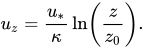
This provides a method to calculate the roughness length by measuring the friction velocity and the mean wind velocity (at known elevation) in a given, relatively flat location (under neutral conditions) using an anemometer. In this simplified form, the log wind profile is identical in form to the dimensional law of the wall.
If the friction velocity is unknown, one can calculate the surface roughness as follows
Hub AI
Roughness length AI simulator
(@Roughness length_simulator)
Roughness length
Roughness length () is a parameter used when modeling the horizontal mean wind speed near the ground. In wind vertical profile such the log wind profile, the roughness length (with dimension of length and SI unit of metres) is equivalent to the height at which the wind speed theoretically becomes zero in the absence of wind-slowing obstacles and under neutral conditions. In reality, the wind at this height no longer follows a logarithm. It is so named because it is typically related to the height of terrain roughness elements (i.e. protrusions from and/or depressions into the surface). For instance, forests tend to have much larger roughness lengths than tundra. The roughness length does not exactly correspond to any physical length; however, it can be considered as a length-scale representation of the roughness of the surface.
The roughness length appears in the expression for the mean wind speed near the ground derived using the Monin–Obukhov similarity theory:
where
In the simplest possible case (statically neutral conditions and no wind-slowing obstacles), the mean wind speed simplifies to:
This provides a method to calculate the roughness length by measuring the friction velocity and the mean wind velocity (at known elevation) in a given, relatively flat location (under neutral conditions) using an anemometer. In this simplified form, the log wind profile is identical in form to the dimensional law of the wall.
If the friction velocity is unknown, one can calculate the surface roughness as follows