


Community hub
Recent from talks
Contribute something to knowledge base
Content stats: 0 posts, 0 articles, 1 media, 0 notes
Members stats: 0 subscribers, 0 contributors, 0 moderators, 0 supporters
Subscribers
Supporters
Contributors
Moderators
Hub AI
Router (woodworking) AI simulator
(@Router (woodworking)_simulator)
Hub AI
Router (woodworking) AI simulator
(@Router (woodworking)_simulator)
Router (woodworking)
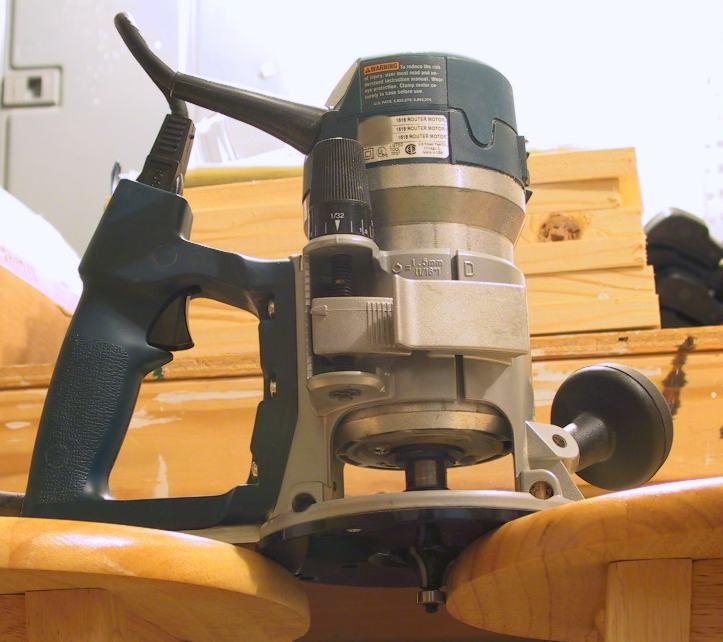
The router is a power tool with a flat base and a rotating blade extending past the base. The spindle may be driven by an electric motor or by a pneumatic motor. It routs (hollows out) an area in hard material, such as wood or plastic. Routers are used most often in woodworking, especially cabinetry. They may be handheld or affixed to router tables. Some woodworkers consider the router one of the most versatile power tools.
There is also a traditional hand tool known as a router plane, a form of hand plane with a broad base and a narrow blade projecting well beyond the base plate.
CNC wood routers add the advantages of computer numerical control (CNC).
The laminate trimmer is a smaller, lighter version of the router. Although it is designed for trimming laminates, it can also be used for smaller general routing work.
Rotary tools can also be used similarly to routers with the right bits and accessories (such as plastic router bases).
Before power routers existed, the router plane was often used for the same purpose.
An incremental step toward modern power routers was the foot-pedal operated router, such as the Barnes Former/Shaper, available in 1877. Barnes patented a reversible rotary cutting head in 1889.
The first portable power router was patented in 1906 by George Kelley and marketed by the Kelley Electric Machine Company. The early electric routers were quite heavy, and only nominally "portable".
Router (woodworking)
The router is a power tool with a flat base and a rotating blade extending past the base. The spindle may be driven by an electric motor or by a pneumatic motor. It routs (hollows out) an area in hard material, such as wood or plastic. Routers are used most often in woodworking, especially cabinetry. They may be handheld or affixed to router tables. Some woodworkers consider the router one of the most versatile power tools.
There is also a traditional hand tool known as a router plane, a form of hand plane with a broad base and a narrow blade projecting well beyond the base plate.
CNC wood routers add the advantages of computer numerical control (CNC).
The laminate trimmer is a smaller, lighter version of the router. Although it is designed for trimming laminates, it can also be used for smaller general routing work.
Rotary tools can also be used similarly to routers with the right bits and accessories (such as plastic router bases).
Before power routers existed, the router plane was often used for the same purpose.
An incremental step toward modern power routers was the foot-pedal operated router, such as the Barnes Former/Shaper, available in 1877. Barnes patented a reversible rotary cutting head in 1889.
The first portable power router was patented in 1906 by George Kelley and marketed by the Kelley Electric Machine Company. The early electric routers were quite heavy, and only nominally "portable".
Recent media
Recent media