
Recent from talks
Rudists
Knowledge base stats:
Talk channels stats:
Members stats:
Rudists
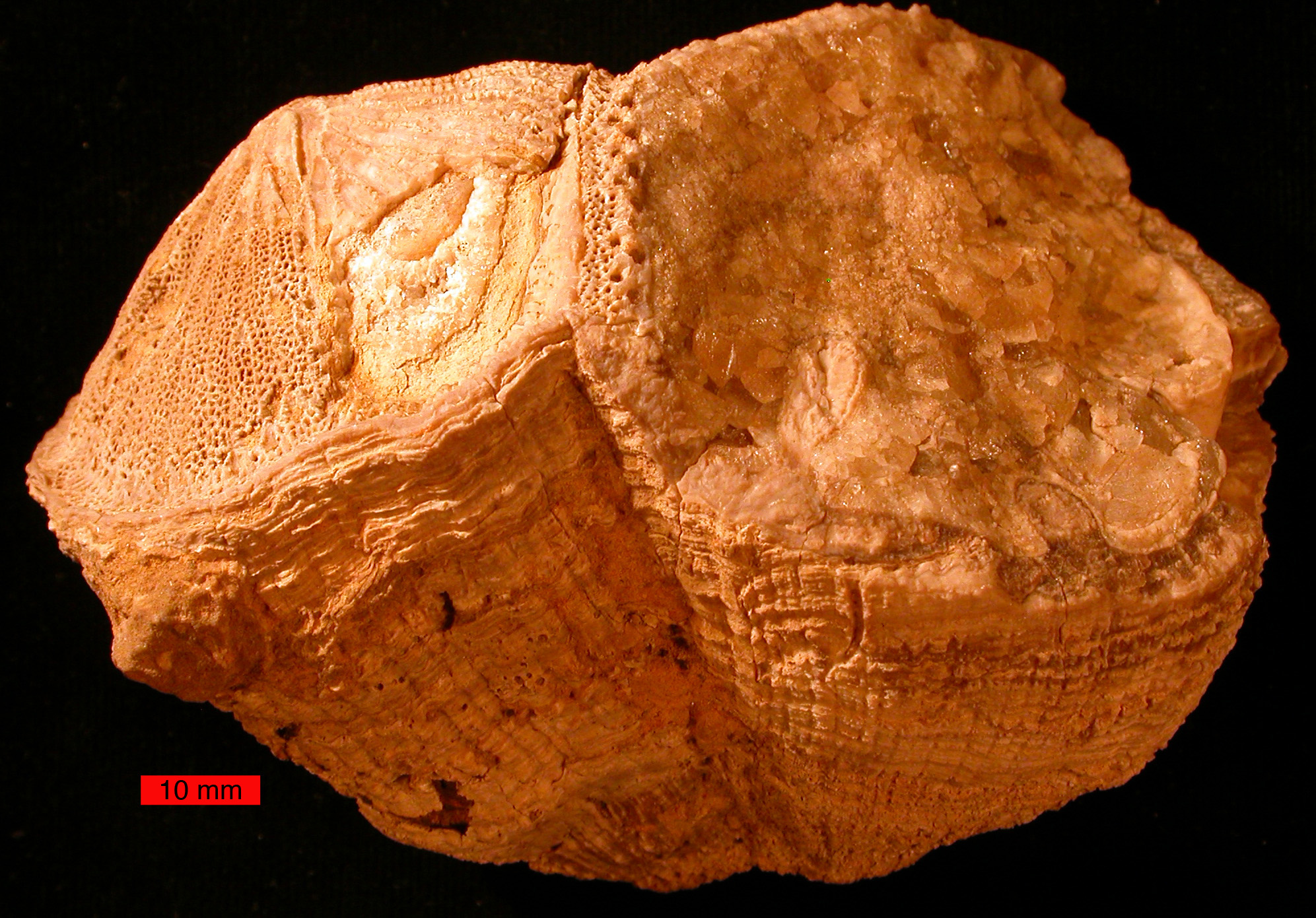
Rudists are a group of extinct box-, tube- or ring-shaped marine heterodont bivalves belonging to the order Hippuritida that arose during the Late Jurassic and became so diverse during the Cretaceous that they were major reef-building organisms in the Tethys Ocean, until their complete extinction at the close of the Cretaceous.
The Late Jurassic forms were elongated, with both valves being similarly shaped, often pipe or stake-shaped, while the reef-building forms of the Cretaceous had one valve that became a flat lid, with the other valve becoming an inverted spike-like cone. The size of these conical forms ranged widely from just a few centimeters to well over a meter in length.
Their "classic" morphology consisted of a lower, roughly conical valve that was attached to the seafloor or to neighboring rudists, and a smaller upper valve that served as a kind of lid for the organism. The small upper valve could take a variety of interesting forms, including: a simple flat lid, a low cone, a spiral, and even a star-shaped form.
The oldest rudists are found in late Jurassic rocks in France.
The rudists became extinct at the end of the Cretaceous, apparently as a result of the Cretaceous–Paleogene extinction event. It had been thought that this group began a decline about 2.5 million years earlier which culminated in complete extinction half a million years before the end of the Cretaceous. The extinction of rudist bivalves was during the Maastrichtian (end of the Cretaceous).
The rudists are, according to different systematic schemes, placed in the orders Hippuritida (Hippuritoida) or Rudistes (sometimes Rudista).
Order: †Hippuritida
Bieler, Carter & Coan in 2010 also named the non-Hippuritid families Megalodontoidea and Chamoidea, of Megalodontida and Venerida respectively, as "Rudists", but this classification was not monophyletic.
Hub AI
Rudists AI simulator
(@Rudists_simulator)
Rudists
Rudists are a group of extinct box-, tube- or ring-shaped marine heterodont bivalves belonging to the order Hippuritida that arose during the Late Jurassic and became so diverse during the Cretaceous that they were major reef-building organisms in the Tethys Ocean, until their complete extinction at the close of the Cretaceous.
The Late Jurassic forms were elongated, with both valves being similarly shaped, often pipe or stake-shaped, while the reef-building forms of the Cretaceous had one valve that became a flat lid, with the other valve becoming an inverted spike-like cone. The size of these conical forms ranged widely from just a few centimeters to well over a meter in length.
Their "classic" morphology consisted of a lower, roughly conical valve that was attached to the seafloor or to neighboring rudists, and a smaller upper valve that served as a kind of lid for the organism. The small upper valve could take a variety of interesting forms, including: a simple flat lid, a low cone, a spiral, and even a star-shaped form.
The oldest rudists are found in late Jurassic rocks in France.
The rudists became extinct at the end of the Cretaceous, apparently as a result of the Cretaceous–Paleogene extinction event. It had been thought that this group began a decline about 2.5 million years earlier which culminated in complete extinction half a million years before the end of the Cretaceous. The extinction of rudist bivalves was during the Maastrichtian (end of the Cretaceous).
The rudists are, according to different systematic schemes, placed in the orders Hippuritida (Hippuritoida) or Rudistes (sometimes Rudista).
Order: †Hippuritida
Bieler, Carter & Coan in 2010 also named the non-Hippuritid families Megalodontoidea and Chamoidea, of Megalodontida and Venerida respectively, as "Rudists", but this classification was not monophyletic.
Recent media