Recent from talks
Nothing was collected or created yet.
Ruhpolding
View on Wikipedia
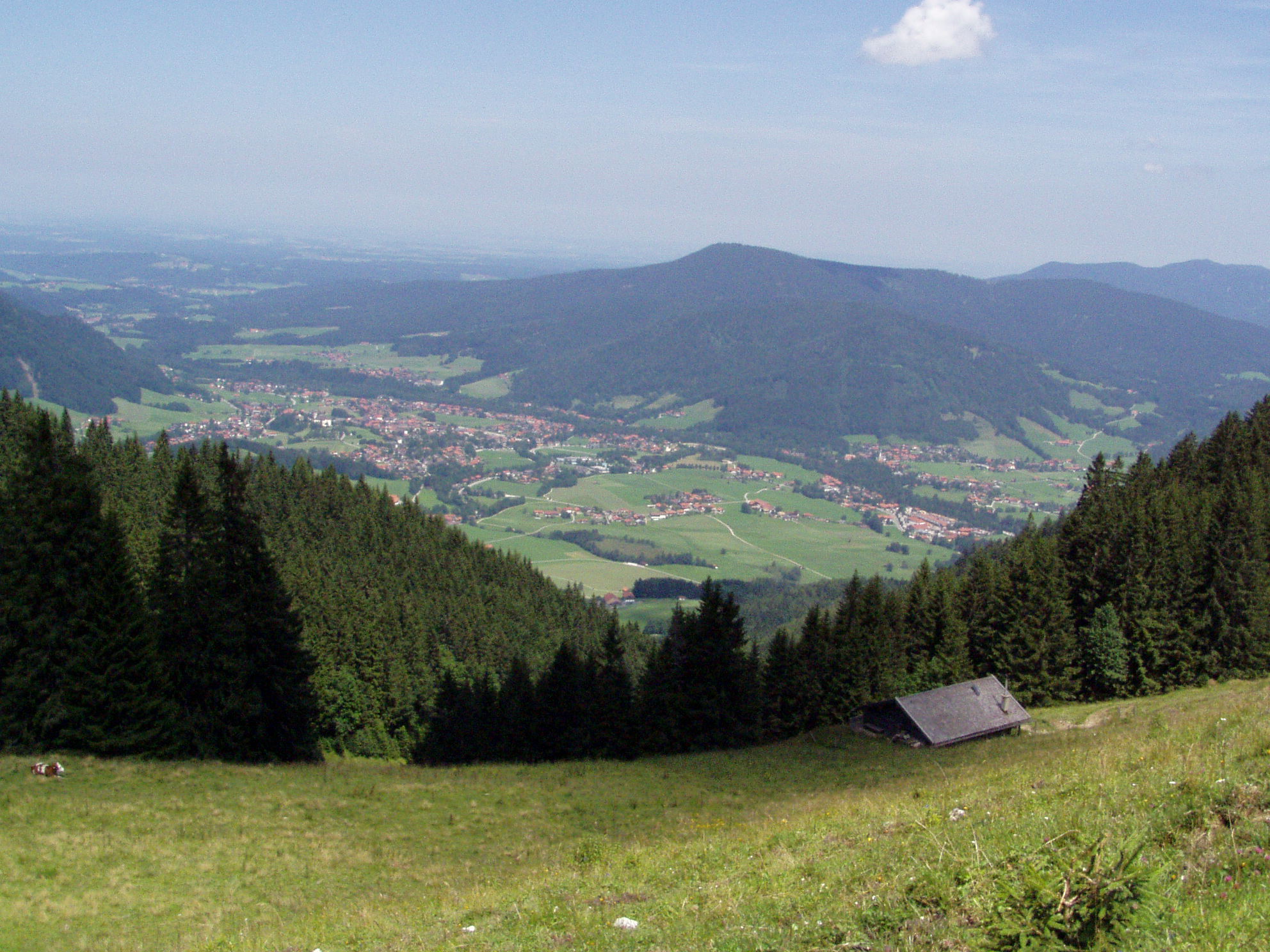
Ruhpolding (German pronunciation: [ˈʁuːpɔldɪŋ]) is the municipality with the biggest area of the Traunstein district in southeastern Bavaria, Germany. It is situated in the south of the Chiemgau region in the Alps and next to the Austrian border.
Key Information
The economy is based on tourism and sports. Major winter sports held in the district include biathlon and Ski jumping. Other sports which are possible for tourists and residents are golf, mountainbiking, shooting, hiking, fly fishing and skiing.
History
[edit]The name "Ruhpolding" originates from the Bavarian word Rupoltingin and means "the people of the strong famous one". The town is mentioned as Ruhpoldingen for the first time in 1193.
It was connected to the railway in 1895. Since 1948, Ruhpolding has been a famous spa and tourist resort, especially for winter sports. The accommodation figures were 600,000 overnight stays per year in the mid-1950s, which increased to 1,122,732 overnight stays per year in 1991.
Sport
[edit]Winter Sports
[edit]Ruhpolding has a biathlon track. It hosted the 1979, 1985, 1996 and 2012 Biathlon World Championships. It also has a ski jumping hill, Große Zirmbergschanze, where one World Cup event has taken place, in the 1992–93 season. In January of 2023, the Winter Maccabiah Games were held in Ruhpolding.
Mountain Bikes
[edit]In the year 2007, the Mountainbike 24h Race World Championships took place in the Chiemgau Arena.
Speedway
[edit]Ruhpolding Speedway was a former motorcycle speedway team called MSC Ruhpolding and a venue called the Ruhpoldinger Speedway Stadion, off Zeller Straße, held important events. These included a qualifying round of the 1970 Speedway World Team Cup[3] and a qualifying round of the Speedway World Championship in 1969 and 1983.[4][5]
People
[edit]- Ferdinand Max Bredt German Orientalist painter.
- Andreas Wellinger, Olympic champion in ski jumping
- Georg von Hertling, the German Chancellor from 1917 to 1918, died here
- Vanessa Hinz, German biathlete
- Wolfgang Pichler, biathlon coach
- Ilse Braun, sister of Eva and Gretl Braun.
Mayors
[edit]- ?–1893: Anton Pointner
- 1893–1906: Mathias Huber (BBB)
- 1906–1919: Georg Eisenberger (BBB)
- 1919–1933: Bartholomäus Schmucker
- 1933 until the end of war: Anton Kreidl, Josef Wallner, Karl Huber
- 1945 and 1946: Alois Rappl, Valentin Plenk, Fritz Grübl
- 1946–1966: Josef Mayer (CSU)
- 1966–1970: Leonhard Schmucker (CSU)
- 1970–1972: Anton Stengel (UW)
- 1972–1978: Franz Schneider (SPD)
- 1978–1996: Herbert Ohl (CSU)
- 1996–2002: Gerhard Hallweger (SPD)
- 2002–2008: Andreas Hallweger (CSU)
- 2008–2020: Claus Pichler (SPD)
- since 2020: Justus Pfeifer (CSU)
References
[edit]- ^ Liste der ersten Bürgermeister/Oberbürgermeister in kreisangehörigen Gemeinden, Bayerisches Landesamt für Statistik, 15 July 2021.
- ^ "Alle politisch selbständigen Gemeinden mit ausgewählten Merkmalen am 31.12.2023" (in German). Federal Statistical Office of Germany. 28 October 2024. Retrieved 16 November 2024.
- ^ "1970 Speedway World Cup". International Speedway. Retrieved 28 January 2024.
- ^ "1969 World Championship". Metal Speedway. Retrieved 28 January 2024.
- ^ "1969 World Championship". Speedway.org. Retrieved 28 January 2024.
External links
[edit]
Media related to Ruhpolding at Wikimedia Commons
Ruhpolding
View on GrokipediaGeography and Environment
Location and Topography
Ruhpolding is situated at coordinates 47°46′N 12°39′E in the southeastern part of Bavaria, within the Traunstein district and the Chiemgau region, approximately 10 km from the Austrian border and at the northern edge of the Alps.[5][6] The municipality encompasses an area of 147.83 km², rendering it the largest by land area in the Traunstein district and the fourth largest in all of Bavaria.[7] Its topography is characterized by a valley floor at an elevation of 625 m, ascending through rolling hills and alpine foothills to a maximum height of 1,961 m at the Sonntagshorn, the highest peak in the Chiemgau Alps; prominent features include the Unternberg and Rauschberg mountains.[7][1] Ruhpolding shares borders with the neighboring municipalities of Inzell to the east and Reit im Winkl to the west, as well as with the Austrian municipality of Unken in the state of Salzburg to the south.[8][9] The municipality comprises 72 localities, including the central town of Ruhpolding and various hamlets such as Au, Bacherwinkl, and Bibelöd.[7]Climate and Hydrology
Ruhpolding experiences a humid continental climate (Köppen Dfb) with distinct alpine influences due to its position in the Chiemgau Alps, characterized by cold winters and mild summers moderated by elevation and surrounding mountains.[10] The average annual temperature is approximately 8.7°C (based on 1961–1990 normals from nearby Berchtesgaden station as a proxy for the region's valley conditions), with monthly averages ranging from -0.7°C in January to 18.1°C in July.[11] Winter lows can drop to around -6°C in January, while summer highs reach up to 23°C in July, reflecting seasonal variations influenced by föhn winds and topographic effects that create microclimates.[12] Precipitation is abundant, totaling about 1,665 mm annually (1961–1990 normals), with the highest amounts in summer months (e.g., 195 mm in July and 193 mm in August) due to convective storms, while winter snowfall is significant, contributing to average snow depths of 100-150 cm during peak season.[13][14] The hydrological features of Ruhpolding are shaped by its alpine setting, featuring a three-lake landscape known as "Little Canada" including the Lödensee, Mittersee, and Weitsee, with Lödensee within the municipality.[15] The Tiroler Ache river flows through the area, draining the Chiemgau Alps and supporting local water resources, while notable waterfalls such as the Staubfall in the Heutal valley cascade down steep terrains, fed by meltwater and rainfall.[16] These water bodies and streams contribute to a dynamic hydrological cycle, with high annual inflows sustaining wetlands and influencing seasonal flooding risks in lower elevations. Protected areas within the Chiemgau Alps, including nature reserves encompassing Ruhpolding's subrange, safeguard biodiversity hotspots such as diverse forests, alpine meadows, and habitats for species like red deer and rare plants.[17] The alpine climate enhances this ecological richness by promoting seasonal biodiversity cycles, while also supporting traditional agriculture through reliable water availability for pastures and impacting tourism via consistent winter snow cover and summer greenery.[18]History
Early Settlement and Medieval Period
The earliest evidence of settlement in the Ruhpolding area dates to the 9th and 10th centuries, when Bavarian (Bajuwaren) migrants established small agrarian communities in the Chiemgau region, drawn by the fertile valleys and protective forests amid the alpine topography.[19] These pioneers, possibly originating from nearby Inzell, relied on alpine farming practices, cultivating crops and raising livestock suited to the mountainous terrain, while utilizing local woodlands for basic timber needs in construction and fuel.[19] The name "Ruhpolding" derives from the Old Bavarian "Ruhpoldingen," meaning "at the estate of the people of Ruhpold," referring to a personal name combining elements for "famous" (Ru or Rud) and "bold" or "strong" (pold).[19] The first documented mention of "Ruhpoldingen" appears in 1193, when the noble widow Ricardis von Nußdorf donated the estate to the canons of Salzburg for their benefit, marking the formal recognition of the core settlement.[19] An earlier record from 924 notes the nearby district of Buchschachen (as "Puochskeho") being gifted to the Archbishop of Salzburg, indicating pre-existing ties to ecclesiastical authority in the region.[19] During the medieval period, Ruhpolding fell under the jurisdiction of the Bishopric of Salzburg, whose influence extended across the Chiemgau to the Inn River near Wasserburg, fostering small-scale agrarian economies centered on family farms and seasonal herding.[20] The abundant local forests supported the nascent timber trade, with wood harvested for regional use and early transport via streams, laying the groundwork for later exploitation while sustaining isolated settlements.[19] Significant shifts in land ownership occurred between the 13th and 15th centuries, as the region transitioned from Salzburg's control to Bavarian dominion through noble and ducal agreements. In 1254 and 1275, a pact between the Duke of Bavaria and the Archbishop of Salzburg ceded the Chiemgau, including Ruhpolding territories, to Bavarian oversight, integrating local estates into the holdings of Bavarian nobility and establishing administrative units like the ducal office in nearby Miesenbach under Pfarrkirchen.[19] Around 1000, Archbishop Thimo of Salzburg consecrated an early church on the site of the present Bergfriedhof, symbolizing ecclesiastical consolidation, while the parish of St. Valentin in Zell traces its Romanesque structure to the 12th century, with Gothic elements added by circa 1400, serving as a focal point for medieval community life.[19][21][20] Archaeological evidence, though sparse, supports the presence of early alpine farming through historical records of Bajuwaren land clearance and herding patterns, complemented by indications of trade routes linking Ruhpolding's forests to Austrian passes for timber and goods exchange.[19]Modern Development and Tourism Growth
The connection of Ruhpolding to the railway network in 1895, via the line to Traunstein, significantly enhanced accessibility and laid the groundwork for early tourism by facilitating easier travel to the Bavarian Alps.[4] This infrastructure milestone spurred initial spa developments, with the town's natural healing climate and mineral springs attracting visitors seeking restorative retreats, though large-scale exploitation began later in the early 20th century.[3] Following World War II, Ruhpolding transitioned into a prominent health and leisure destination focused on climatic therapy and winter activities. The post-war era saw a rapid tourism boom, driven by innovative package tours organized by travel entrepreneur Carl Degener, who had first promoted the area in 1933; by the mid-1950s, annual overnight stays reached 600,000, reflecting the influx of domestic and international guests to the expanding guesthouses and hotels.[4] This growth continued through the late 20th century, culminating in a peak of 1,122,732 overnight stays in 1991, as the town solidified its reputation for wellness and outdoor recreation.[4] Key infrastructure investments further propelled Ruhpolding's development, including the construction of the Chiemgau Arena biathlon center in 1977–1978, which hosted the first Biathlon World Championships in 1979 and established the venue as a global hub for Nordic sports.[22] In the post-2000 period, sustainable tourism initiatives emphasized environmental preservation alongside expansion, notably through modernization of biathlon facilities to handle larger crowds and promote year-round events, contributing to balanced economic growth without overburdening local resources.[23] The hosting of the 2023 Winter Maccabiah Games, the first such international Jewish winter sports event in nearly 90 years, underscored Ruhpolding's role in fostering inclusive tourism and cultural exchange, drawing over 350 athletes and enhancing the town's profile as a versatile alpine destination.[24] Sports events like these have served as vital drivers for seasonal visitor surges, complementing the spa heritage while supporting community vitality.[3]Demographics and Society
Population and Density
As of June 30, 2025, Ruhpolding has a population of 6,777 residents.[25] The municipality covers an area of 147.8 km², resulting in a population density of approximately 45.9 inhabitants per km².[26] The population has grown significantly over the past century, from 3,537 inhabitants in 1900 to more than double that figure by the late 20th century, driven by tourism development.[27] It reached a peak of 7,058 in 2021, with overall growth from the 1990s (6,370 in 1990) until a decline to 6,101 in the 2022 census, reflecting adjustments in rural population estimates in Bavaria, followed by a modest recovery.[28][26] Tourism contributes to seasonal population increases, with temporary swells from visitors boosting the effective resident count during peak periods.[26] Demographically, Ruhpolding has an aging population, with a median age of about 47 years, higher than the Bavarian average of around 43.[29] The gender distribution is nearly balanced, with females comprising 51.4% (3,481) and males 48.6% (3,291) of the population.[30] The proportion of foreign citizens stands at approximately 12%, lower than urban Bavarian centers but indicative of a predominantly local demographic.[31] Socioeconomically, employment is heavily oriented toward services, including tourism and hospitality, which account for a substantial share of the roughly 1,700 social insurance-covered jobs in the municipality.[26] Education levels exceed the Bavarian average, supported by local schools serving over 1,700 students, contributing to a skilled workforce in the service sector.[26]Localities and Community
Ruhpolding is administratively divided into 72 localities, known as Ortsteile, which include the main town center and numerous hamlets and isolated farms scattered across its expansive 147.83 km² area.[7] These subdivisions encompass rural settlements such as Aschenau, Bachenwinkl, Bibelöd, Egg, and Vordereben, reflecting the municipality's dispersed, alpine character with many small clusters of homes amid forests and meadows.[7] The main town of Ruhpolding proper serves as the central hub, while the hamlets maintain a traditional rural lifestyle integrated with the surrounding Chiemgau landscape. Community life in Ruhpolding revolves around strong local traditions rooted in Bavarian alpine culture, including volunteer-driven initiatives that foster social cohesion. The Freiwillige Feuerwehr Ruhpolding, a volunteer fire department established in 1873, exemplifies this engagement, with over 150 active members providing emergency services and community support across the localities.[32] Education is centered in the town, where the Grund- und Mittelschule Ruhpolding offers primary and secondary schooling for approximately 10 elementary and 5 middle school classes, accommodating local children and promoting an alpine-oriented curriculum.[33] Tourism workers, many of whom are seasonal residents, integrate through these community structures, participating in family-focused activities that emphasize outdoor recreation and regional customs. Social services support the alpine lifestyle, with healthcare provided through specialized facilities like the former Krankenhaus Vinzentinum, now operating as a pain management center and outpatient clinic under Kliniken Südostbayern AG, alongside nearby regional hospitals in Traunstein.[34] Community centers, including the municipal Rathaus and sports halls, host family-oriented events that highlight the area's emphasis on wellness and intergenerational bonds. The population is predominantly Bavarian German-speaking, with a small seasonal influx of international visitors contributing to the social fabric without altering the core local identity.[7]Government and Administration
Municipal Structure
Ruhpolding functions as a municipality within the Bavarian administrative system, governed by a municipal council (Gemeinderat) comprising 20 elected members alongside the first mayor (Erster Bürgermeister), who serves as the executive head and chairs council meetings.[35] The council term lasts six years, with members representing local interests in decision-making on budgets, infrastructure, and community services.[35] The most recent council election occurred in March 2020, establishing the current legislative period running until 2026, during which the Christian Social Union (CSU) maintains dominance in local politics, securing a majority of seats through strong voter support.[36][37] This political alignment influences priorities such as community development and regional integration within the Traunstein district. Administrative operations are centralized at the Rathaus (town hall) on Rathausplatz 1 in the heart of Ruhpolding, which coordinates daily governance despite ongoing renovations that have temporarily relocated some services to nearby facilities.[38] Key departments include the main administration handling citizen services and registry, the financial administration overseeing budgets and taxes, the municipal building office (Gemeindebauamt) managing urban planning and construction permits, and municipal enterprises (Gemeindebetriebe) supporting operational needs like waste management.[39] Specialized units address environmental protection and tourism coordination, ensuring compliance with regional standards. Municipal policies prioritize sustainability and alpine preservation, integrating measures to safeguard the Chiemgau Alps' ecosystems amid tourism pressures. A dedicated nature protection concept guides forest management to preserve native mixed woodlands and biodiversity.[40] Tourism regulation focuses on sustainable practices, including a 2021 council decision to restructure promotional efforts for balanced growth that minimizes environmental impact.[41] These initiatives align with Bavaria's broader Alpine Convention commitments for landscape conservation.[42] The first mayor plays a pivotal role in implementing these policies, acting as the primary liaison between the council, administration, and residents.Mayors and Elections
The current mayor of Ruhpolding is Justus Pfeifer of the Christian Social Union (CSU) and the Ruhpolding Citizens' Association (VRB), who has held office since May 2020.[43] His election marked a shift from the previous SPD administration, as he secured 66.06% of the valid votes in the first round of the 2020 municipal election, defeating incumbent Claus Pichler (SPD) with 27.88% and Sepp Hohlweger (Bündnis 90/Die Grünen) with 6.06%.[44] Pfeifer's six-year term runs until 2026, during which he oversees the municipal council of 20 members elected proportionally. As of 2025, Pfeifer has been renominated by the CSU for the 2026 election and received cross-party support, though other candidates, such as from the Freien Wähler, have also announced their bids.[43][45][46][47] Ruhpolding's mayoral history dates to the unification of local communities in 1882, with records maintained by the municipal administration.[43] The position has seen a mix of long tenures and short interim appointments, particularly during the post-World War II transition. Below is a chronological list of mayors since 1882:| Term | Mayor | Party/Affiliation |
|---|---|---|
| 1882–1893 | Anton Pointner | Independent |
| 1893–1905 | Mathias Huber | Independent |
| 1906–1919 | Georg Eisenberger | Independent |
| 1919–1933 | Bartholomäus Schmucker | Independent |
| 1933–1937 | Anton Kreidl | NSDAP |
| 1937–1942 | Josef Schmucker | NSDAP |
| 1943–1945 | Karl Huber | NSDAP |
| May–June 1945 | Alois Rappl | Independent |
| June–Aug. 1945 | Valentin Plenk | Independent |
| Aug. 1945–Jan. 1946 | Fritz Grübl | Independent |
| 1946–1966 | Josef Mayer | CSU |
| 1966–1970 | Leonhard Schmucker | CSU |
| 1970–1972 | Anton Stengl | UW |
| 1972–1978 | Franz Schneider | SPD |
| 1978–1996 | Herbert Ohl | CSU |
| 1996–2002 | Gerhard Hallweger | SPD |
| 2002–2008 | Andreas Hallweger | CSU |
| 2008–2020 | Claus Pichler | SPD |
| 2020–present | Justus Pfeifer | CSU/VRB |
Economy
Primary Industries
Ruhpolding's primary industries are rooted in its natural landscape, with forestry and agriculture forming the traditional economic backbone. Forestry, managed primarily by the Bayerische Staatsforsten, covers approximately 67.7% of the municipality's 147.96 km² area (10,014 hectares) and emphasizes sustainable, near-natural practices to ensure long-term regeneration. Two-thirds of these forests serve protective functions against erosion and avalanches, while annual timber harvests—part of Bavaria's broader 5 million cubic meters—support local sales to sawmills, paper industries, and firewood markets, contributing to the regional economy through wood and game products. Historically significant since the medieval era, modern forestry prioritizes mixed, climate-resilient species like fir and broadleaf trees over dominant spruce monocultures.[51][52] Agriculture remains small-scale and grassland-focused, utilizing 1,694 hectares (about 11.5% of the total area) for meadows and pastures suited to the valley's poor soils and climate. Around 66 farms, mostly part-time operations, specialize in cattle rearing for dairy production, breeding, and fattening, with extensive flower-rich hay meadows preserving biodiversity and supporting local food chains. This sector, concentrated in the valleys and alpine pastures, integrates with environmental protections like FFH-designated areas to balance production and conservation.[26][52] In modern terms, manufacturing is limited, with 12 businesses in the processing sector employing 36 workers and generating modest gross wages. Service sectors, including education and healthcare, account for a significant portion of the workforce, employing 1,743 workers as of 2021. Overall, there were 2,579 employed persons in Ruhpolding as of 2021, with an annual average of 140 registered unemployed, corresponding to an unemployment rate of about 5%. Though many commute, reflecting commuter connections to nearby Traunstein, where approximately 600 residents travel daily for work.[26][53]Tourism and Hospitality
Tourism constitutes the cornerstone of Ruhpolding's economy, serving as the primary driver of local employment and revenue generation. In 2019, trade, transport, and hospitality employed 542 individuals out of a total workforce of 2,455, highlighting tourism's substantial role in sustaining community livelihoods.[54] The industry supports diverse visitor segments, including leisure travelers, families, and business groups, with seasonal emphases on winter sports and summer outdoor pursuits contributing to economic stability. Ruhpolding's tourism infrastructure is robust, featuring over 230 accommodation establishments, including 22 hotels, 22 guesthouses, and 171 holiday apartments that cater to varying guest preferences from luxury stays to self-catering options.[55] Spa facilities, established since 1948 as part of the town's development into a recognized health and wellness destination, include wellness centers integrated into hotels offering treatments focused on relaxation and recovery.[56] Conference centers, often linked to sports venues like the Chiemgau Arena, provide versatile spaces for meetings and events, accommodating up to several hundred participants and bolstering the business tourism segment, which comprises about 35% of overall visitor activity in the region.[57] The economic footprint of tourism is evident in its contributions to municipal finances and local commerce, with revenues from accommodations, dining, and related services forming 11.66% of the town budget in 2020, equivalent to approximately €2.34 million.[58] Annual visitor arrivals reached 33,957 in 2019 (in registered accommodations), generating 409,445 overnight stays, while the 2019/2020 season recorded 427,656 overnight stays and 78,758 arrivals.[54][58] Seasonality drives fluctuations, with winter periods dominating; for instance, the 2024/2025 winter season saw 58,328 arrivals, a 7.9% increase from the prior year, underscoring robust recovery and demand for alpine experiences.[59] Sustainability efforts in Ruhpolding's tourism sector have intensified since the early 2000s, emphasizing eco-friendly practices to mitigate environmental pressures in the alpine setting. Key initiatives include the introduction of a free local shuttle service (Dorflinie) to reduce vehicle emissions, digital booking systems to minimize paper usage, and the adoption of GOTS-certified eco-merchandise for promotional items, all aimed at promoting responsible visitor behavior and preserving natural resources.[58] These measures align with broader regional goals in the Chiemgau area, where tourism operations increasingly prioritize low-impact operations to balance growth with ecological integrity.[60]Sports and Recreation
Winter Sports
Ruhpolding serves as a prominent hub for winter sports in the Bavarian Alps, primarily through the Chiemgau Arena, a multifaceted venue dedicated to Nordic disciplines including biathlon, cross-country skiing, ski jumping, and Nordic combined. Established as a federal training center for biathlon in the 1960s, the arena underwent significant development in the 1970s to support elite-level competitions and training, evolving into an official Olympic performance center that hosts national teams year-round.[61][22][62] The facility's infrastructure, including shooting ranges and ski loops, provides optimal conditions for athletes, with the arena capable of accommodating up to 15,000 spectators in the main grandstands during major events.[22] The Chiemgau Arena has been a key site for international biathlon competitions, hosting the Biathlon World Championships on four occasions: in 1979, 1985, 1996, and 2012. These events have drawn global attention to Ruhpolding, showcasing the venue's challenging 3-kilometer loop and precise 50-meter shooting range amid the surrounding mountains. Additionally, the arena annually hosts a stop on the Biathlon World Cup circuit, attracting top athletes and fostering a vibrant atmosphere for fans.[61][63][64] Beyond biathlon, the Chiemgau Arena includes ski jumping facilities, such as the historic Große Zirmbergschanze large hill, which supported Nordic combined events and hosted a FIS Ski Jumping World Cup in 1992, though the jumps are currently out of active competition use. The area boasts an extensive network of over 130 kilometers of groomed cross-country trails suitable for all skill levels, integrated with the arena's infrastructure for training and recreational skiing. Nearby, the Unternberg ski area offers a compact alpine skiing experience with 2.5 kilometers of slopes serviced by three lifts, reaching an elevation of 1,417 meters and catering primarily to families and intermediate skiers.[22][65][14][66] Ruhpolding's winter sports prominence extends to diverse events, including the inaugural Maccabi Germany Winter Games in January 2023, which featured alpine skiing, snowboarding, and figure skating for Jewish athletes—the first such games in Germany since 1936. The venue continues to serve as a primary training base for international teams, with annual camps enhancing its role in Olympic preparation and contributing to local tourism through increased visitor influx during competitions.[67][62]Summer Sports
Ruhpolding offers a diverse array of summer sports, emphasizing endurance cycling and motorsport alongside outdoor pursuits like hiking, golf, and angling, all set against the Chiemgau Alps' rugged terrain.[3] The region's facilities, including multi-use arenas and dedicated tracks, support both recreational and competitive activities, drawing athletes from across Europe.[22] Cycling dominates Ruhpolding's warm-weather athletic scene, with an extensive network of over 130 mountain bike routes spanning the Chiemgau Alps, ranging from beginner-friendly paths to technical singletracks like the 30-kilometer Chiemgau Trail.[68] These trails, maintained by local tourism boards, feature varied elevations from 600 to 1,961 meters and integrate with broader Bavarian networks for multi-day tours.[69] The area hosted the 24 Hours Mountain Bike World Championships in 2007 at the Chiemgau Arena, where teams competed in endurance relays, with winners like the Race-Team Vierermix covering over 1,000 kilometers in the team category.[70] Facilities include bike parks with flow trails such as Brandler Single Trail and secure storage at local hotels, enabling annual events that attract international competitors.[71][72] Motorsports, particularly speedway racing, have deep roots in Ruhpolding through the MSC Ruhpolding club, which competed in the German Team Speedway Championship, securing second place in 1974. The Ruhpoldinger Speedway Stadion, an oval track off Zeller Straße, hosted significant international events, including a qualifying round for the 1970 Speedway World Team Cup and rounds of the Speedway World Championship in 1969 and 1983. The club's history reflects the track's role as a hub for national competitions in the 1970s and 1980s, though it now serves primarily as a historical site. Beyond cycling and speedway, hiking encompasses over 240 kilometers of marked trails suitable for all levels, with more than 20 dedicated routes including the challenging 10-kilometer Hörndlwand Mountain Tour, which ascends to 1,684 meters for panoramic views of the Chiemsee and Berchtesgaden Alps.[73][74] Golf enthusiasts utilize the 18-hole Golfclub Ruhpolding e.V., founded in 1991 and spanning 84 hectares amid alpine scenery, with holes overlooking the Sonntagshorn peak and powered by 100% renewable hydropower.[75] Fly fishing thrives in local waters like the 1.6-kilometer Weisse Traun "Zauberwald" stretch, an exclusive fly-only zone stocked with brown and rainbow trout in rushing pools amid forested banks, accessible via guided permits.[76] These activities leverage off-season use of winter venues like the Chiemgau Arena for trail access.[77]Culture and Attractions
Cultural Heritage and Museums
Ruhpolding's cultural heritage reflects its deep roots in the Chiemgau region's Alpine traditions, emphasizing the preservation of historical practices tied to forestry, craftsmanship, and religious customs. The town's institutions safeguard artifacts and narratives from its past as a key area for timber production and early settlement. These elements are maintained through dedicated museums and sites that highlight the evolution of community life in the Bavarian Alps.[78] The Holzknechtmuseum, established in 1988, serves as a central repository for the history of timber workers in southern Chiemgau, documenting their daily lives and tools from the medieval period through the 20th century. Housed in a series of wooden structures, the museum features exhibits on forestry equipment, including axes, saws, and transport devices used in the saltworks era, alongside interactive displays that recreate wood processing methods. Visitors can engage with demonstrations of traditional woodcraft, such as log splitting and carving, underscoring the economic importance of forestry to Ruhpolding's development.[79][78][80] Complementing this is the Heimatmuseum, located in the former ducal hunting lodge, which preserves Ruhpolding's local history through exhibits on alpine folk art, traditional costumes, military contributions, and artifacts such as a 15th-century sword and early skis. This museum provides insight into the town's forested surroundings and Alpine heritage.[81][82] Key heritage sites include the St. Valentin Church, dating to around 1200 and recognized as the oldest building in Ruhpolding and the valley, featuring Gothic elements and frescoes that exemplify early religious architecture in the area. Surrounding hamlets like Vachenau showcase traditional Bavarian architecture, with farmhouses characterized by steep gabled roofs, wooden balconies, and facade paintings that preserve the region's rustic aesthetic and building techniques passed down through generations.[83][84] Ruhpolding upholds Alpine traditions through events like the annual Georgiritt, a procession on the first Sunday in September that dates to the 16th century and involves around 200 decorated horses accompanying a church service to St. Valentin, celebrating St. George with blessings for livestock and community. Woodcraft demonstrations at the Holzknechtmuseum further maintain these customs, allowing participants to learn hands-on techniques rooted in Chiemgau forestry practices. Efforts to preserve Chiemgau dialects and customs include local cultural programs that promote traditional music, dance, and storytelling in the Bavarian dialect, ensuring the linguistic and folk heritage remains vibrant amid modernization.[85][86][79][18] Notable figures associated with Ruhpolding's heritage include timber industry contributors from the 19th century, such as local foresters who pioneered sustainable logging methods in the Chiemgau Alps to support salt production. In the biathlon scene, Herbert Fritzenwenger, born in Ruhpolding in 1962, stands out as an Olympic participant in 1988, competing in biathlon and cross-country skiing while embodying the town's enduring connection to winter traditions.[87]Natural and Recreational Sites
Ruhpolding's natural landscapes are characterized by its position in the Chiemgau Alps, offering accessible alpine scenery for outdoor enthusiasts. The Rauschberg mountain, rising to 1,671 meters, provides panoramic views of the surrounding peaks and valleys, reachable via the Rauschberg cable car, known as the fastest mountain railway in Germany at the time of its opening in 1953.[3][88] Visitors can explore well-signposted hiking paths from the summit, enjoying clear-weather vistas that extend across the Bavarian countryside.[88] Nearby, the Staubfall waterfalls in the Heutal valley form a dramatic 200-meter cascade, marking the Austria-Germany border and accessible via a 15-minute hike from the parking area.[89][90] This site exemplifies the region's thundering alpine water features, integrated into broader trail networks for nature immersion.[3] The Three Lakes Area, including Lödensee, Mittersee, and Weitsee—often called "Little Canada"—features idyllic, clear waters ideal for swimming and relaxation, with family-oriented bathing spots amid forested surroundings.[91][92] Recreational facilities enhance Ruhpolding's appeal as a leisure destination. The Freizeitpark Ruhpolding, nestled in the Chiemgau Alps' forests, spans over 60 attractions including boat slides, a mountain roller coaster, and animatronic exhibits, designed for all ages with self-operated rides and water features.[93][94] Vita Alpina serves as a wellness center with thermal baths, indoor and outdoor pools, and spa amenities, though its facilities reflect older infrastructure suited for relaxation after outdoor pursuits.[95] The Chiemgau Coaster offers year-round alpine tobogganing on a rail-guided track reaching speeds up to 40 km/h, providing thrilling descents through scenic Bavarian terrain for families.[96][97] A variety of activities cater to casual recreation amid these sites. Hiking trails like the Auf den Zellerberg loop cover 3.9 miles with 1,463 feet of elevation gain, taking 2.5 to 3 hours and rewarding hikers with alpine meadows and viewpoints.[98] Extensive biking paths, including mountain bike routes on platforms like Komoot and Trailforks, traverse the valley and hills, suitable for leisurely tours or more challenging rides.[3][99] Summer luge experiences, primarily via the Chiemgau Coaster, add adrenaline to warm-weather visits.[96] Ruhpolding's proximity to the Chiemgau Alps facilitates easy day trips to higher peaks, while its family-friendly setups—such as cable car access, gentle lake shores, and inclusive parks—make it ideal for multi-generational outings. The region's pure mountain air supports these activities year-round, particularly in summer for optimal outdoor enjoyment.[3][100][101]References
- https://www.wikidata.org/wiki/Q73532


