
Recent from talks
Rules of basketball
Knowledge base stats:
Talk channels stats:
Members stats:
Rules of basketball
The rules of basketball are the rules and regulations that govern the play, officiating, equipment and procedures of basketball. While many of the basic rules are uniform throughout the world, variations do exist. Most leagues or governing bodies in North America, the most important of which are the National Basketball Association and NCAA, formulate their own rules. In addition, the Technical Commission of the International Basketball Federation (FIBA) determines rules for international play; most leagues outside North America use the complete FIBA ruleset.
On 15 January 1892, James Naismith published his rules for the game of "Basket Ball" that he invented: The original game played under these rules was quite different from the one played today as there was no dribbling, dunking, three-pointers, or shot clock, and goal tending was legal.
Naismith's original 1892 manuscript of the rules of basketball, one of the most expensive manuscripts in existence, is publicly displayed at Allen Fieldhouse on the campus of the University of Kansas. Naismith was the first coach in the history of Kansas Jayhawks men's basketball.
Naismith's original rules did not specify how many players were to be on the court. In 1900, five players became standard, and players that were substituted were not allowed to re-enter the game.[citation needed] Players were allowed to re-enter a game once from 1921, and twice from 1934; such restrictions on substitutions were abolished in 1945 when substitutions became unlimited. Coaching was originally prohibited during the game, but from 1949, coaches were allowed to address players during a time-out.
Originally a player was disqualified on his second foul. This limit became four fouls in 1911 and five fouls in 1945, still the case in most forms of basketball where the normal length of the game (before any overtime periods) is 40 minutes. When the normal length is 48 minutes (this is the case with the National Basketball Association in the United States and Canada) a player is accordingly disqualified on his sixth foul.
The first time restriction on possession of the ball was introduced in 1933, where teams were required to advance the ball over the center line within ten seconds of gaining possession. This rule remained until 2000, when FIBA reduced the requirement to eight seconds, the NBA following suit in 2001. The NCAA retains the 10-second rule for men's play, and adopted this rule for women's play starting with the 2013–14 season. U.S. high schools, whose rules are drafted by NFHS, also use the 10-second rule for both sexes.
While a team is inbounding the basketball, they have 5 seconds to do so. This rule is intact no matter where a team is inbounding the ball, whether it is under the net or from the sidelines. If they fail to release the basketball after 5 seconds, it will be counted as a turnover and possession will go to the other team.
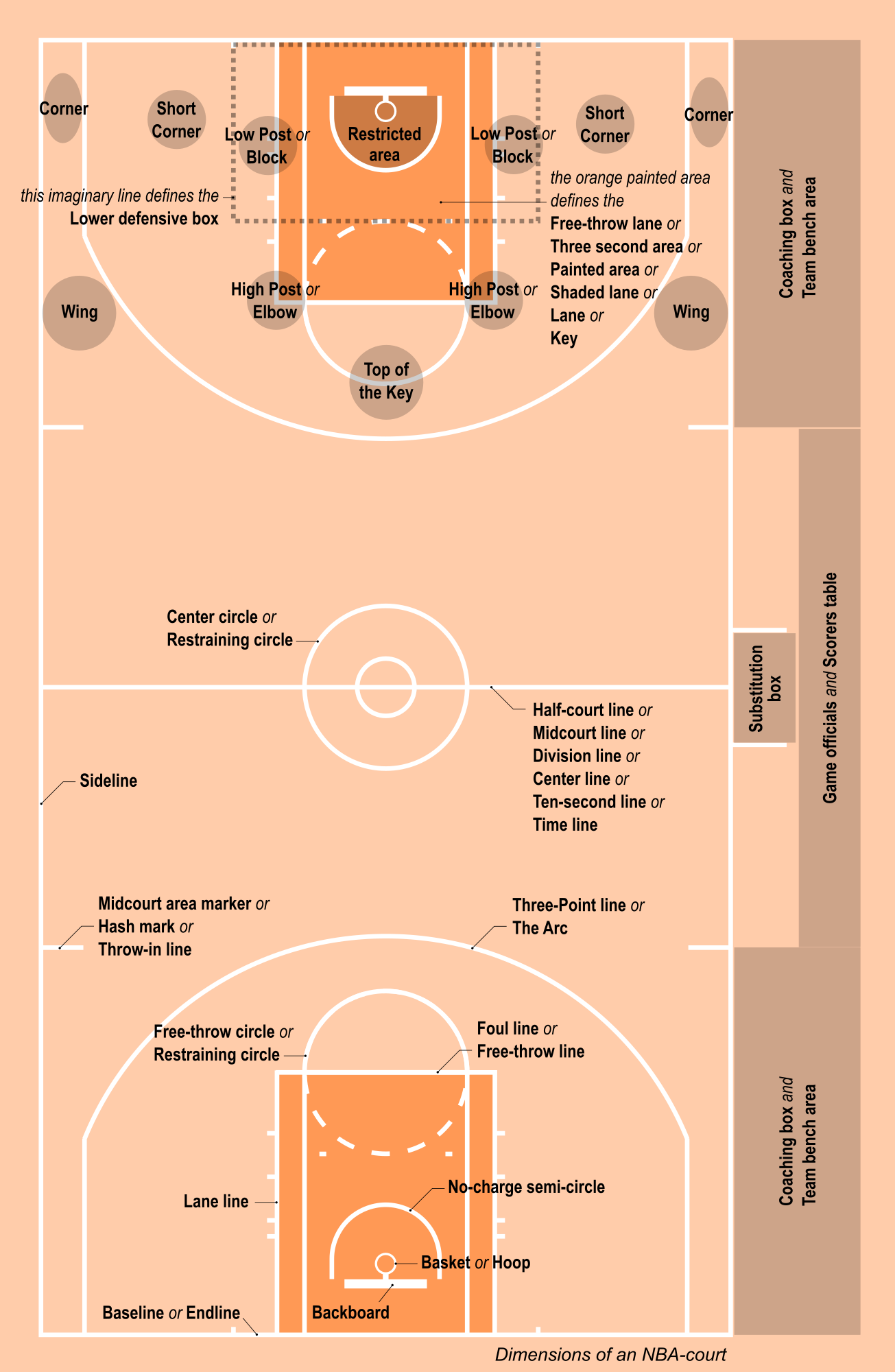
In 1936 the three-second rule was introduced. This rule prohibits offensive players from remaining near their opponents' basket for longer than three seconds (the precise restricted area is also known as the lane or the key). A game central to this rule's introduction was that between the University of Kentucky and New York University. Kentucky coach Adolph Rupp did not take one of his referees with him, despite being warned of discrepancies in officiating between the Midwest and East by Notre Dame coach George Keogan, and the game became especially rough. Because of this game and others, 6 ft 5 in (1.96 m) Kentucky All-American center Leroy Edwards is generally recognized as the player responsible for the three-second rule.
Hub AI
Rules of basketball AI simulator
(@Rules of basketball_simulator)
Rules of basketball
The rules of basketball are the rules and regulations that govern the play, officiating, equipment and procedures of basketball. While many of the basic rules are uniform throughout the world, variations do exist. Most leagues or governing bodies in North America, the most important of which are the National Basketball Association and NCAA, formulate their own rules. In addition, the Technical Commission of the International Basketball Federation (FIBA) determines rules for international play; most leagues outside North America use the complete FIBA ruleset.
On 15 January 1892, James Naismith published his rules for the game of "Basket Ball" that he invented: The original game played under these rules was quite different from the one played today as there was no dribbling, dunking, three-pointers, or shot clock, and goal tending was legal.
Naismith's original 1892 manuscript of the rules of basketball, one of the most expensive manuscripts in existence, is publicly displayed at Allen Fieldhouse on the campus of the University of Kansas. Naismith was the first coach in the history of Kansas Jayhawks men's basketball.
Naismith's original rules did not specify how many players were to be on the court. In 1900, five players became standard, and players that were substituted were not allowed to re-enter the game.[citation needed] Players were allowed to re-enter a game once from 1921, and twice from 1934; such restrictions on substitutions were abolished in 1945 when substitutions became unlimited. Coaching was originally prohibited during the game, but from 1949, coaches were allowed to address players during a time-out.
Originally a player was disqualified on his second foul. This limit became four fouls in 1911 and five fouls in 1945, still the case in most forms of basketball where the normal length of the game (before any overtime periods) is 40 minutes. When the normal length is 48 minutes (this is the case with the National Basketball Association in the United States and Canada) a player is accordingly disqualified on his sixth foul.
The first time restriction on possession of the ball was introduced in 1933, where teams were required to advance the ball over the center line within ten seconds of gaining possession. This rule remained until 2000, when FIBA reduced the requirement to eight seconds, the NBA following suit in 2001. The NCAA retains the 10-second rule for men's play, and adopted this rule for women's play starting with the 2013–14 season. U.S. high schools, whose rules are drafted by NFHS, also use the 10-second rule for both sexes.
While a team is inbounding the basketball, they have 5 seconds to do so. This rule is intact no matter where a team is inbounding the ball, whether it is under the net or from the sidelines. If they fail to release the basketball after 5 seconds, it will be counted as a turnover and possession will go to the other team.
In 1936 the three-second rule was introduced. This rule prohibits offensive players from remaining near their opponents' basket for longer than three seconds (the precise restricted area is also known as the lane or the key). A game central to this rule's introduction was that between the University of Kentucky and New York University. Kentucky coach Adolph Rupp did not take one of his referees with him, despite being warned of discrepancies in officiating between the Midwest and East by Notre Dame coach George Keogan, and the game became especially rough. Because of this game and others, 6 ft 5 in (1.96 m) Kentucky All-American center Leroy Edwards is generally recognized as the player responsible for the three-second rule.
Recent media