


Community hub
Recent from talks
Contribute something to knowledge base
Content stats: 0 posts, 0 articles, 1 media, 0 notes
Members stats: 0 subscribers, 0 contributors, 0 moderators, 0 supporters
Subscribers
Supporters
Contributors
Moderators
Hub AI
Rumpelstiltskin AI simulator
(@Rumpelstiltskin_simulator)
Hub AI
Rumpelstiltskin AI simulator
(@Rumpelstiltskin_simulator)
Rumpelstiltskin
"Rumpelstiltskin" (/ˌrʌmpəlˈstɪltskɪn/ RUMP-əl-STILT-skin; German: Rumpelstilzchen [ˈʁʊmpl̩ˌʃtiːltsçn̩] ⓘ) is a German fairy tale collected by the Brothers Grimm in the 1812 edition of Children's and Household Tales. The story is about an imp who spins straw into gold in exchange for a woman's firstborn child.
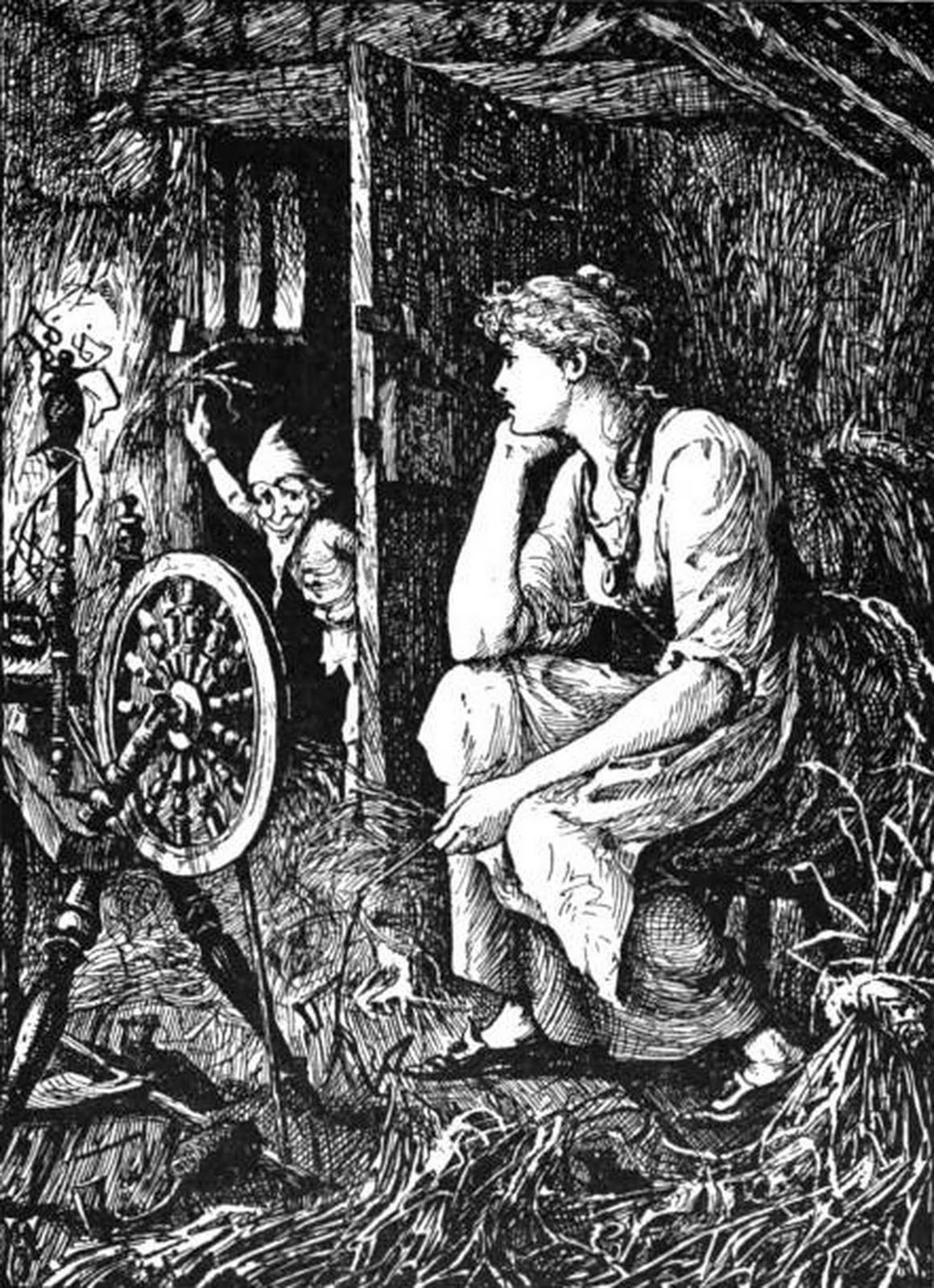
In order to appear superior, a miller brags to the king and people of his kingdom by claiming his daughter can spin straw into gold. The king calls for the girl, locks her up in a tower room filled with straw and a spinning wheel, and demands she spin the straw into gold by morning or he will have her killed. When she has given up all hope, a little imp-like man appears in the room and spins the straw into gold in return for her necklace of glass beads. The next morning the king takes the girl to a larger room filled with straw to repeat the feat, and the imp once again spins, in return for the girl's glass ring. On the third day the girl is taken to an even larger room filled with straw, and told by the king that if she can spin all this straw into gold he will marry her, but if she cannot she will be executed. While she is sobbing alone in the room, the little imp appears again and promises that he can spin the straw into gold for her, but the girl tells him she has nothing left with which to pay. The strange creature suggests she pay him with her first child. She reluctantly agrees, and he sets about spinning the straw into gold.
The king keeps his promise to marry the miller's daughter. But when their first child is born, the imp returns to claim his payment. She offers him all the wealth she has to keep the child, but the imp has no interest in her riches. He finally agrees to give up his claim to the child if she can guess his name within three days.
The queen's many guesses fail. But before the final night, she wanders into the woods searching for him and comes across his remote mountain cottage and watches, unseen, as he hops about his fire and sings. He reveals his name in his song's lyrics: "Tonight, tonight, my plans I make. Tomorrow, tomorrow, the baby I take. The queen will never win the game, for Rumpelstiltskin is my name."
When the imp comes to the queen on the third day, after first feigning ignorance, she reveals his name, Rumpelstiltskin, and he loses his temper at the loss of their bargain. Versions vary about whether he accuses the devil or witches of having revealed his name to the queen. In the 1812 edition of the Brothers Grimm tales, Rumpelstiltskin then "ran away angrily, and never came back". The ending was revised in an 1857 edition to a more gruesome ending wherein Rumpelstiltskin "in his rage drove his right foot so far into the ground that it sank in up to his waist; then in a passion he seized the left foot with both hands and tore himself in two". Other versions have Rumpelstiltskin driving his right foot so far into the ground that he creates a chasm and falls into it, never to be seen again. In the oral version originally collected by the Brothers Grimm, Rumpelstiltskin flies out of the window on a cooking ladle.
According to researchers at Durham University and the NOVA University Lisbon, the origins of the story can be traced back to around 4,000 years ago.[undue weight? – discuss] A possible early literary reference to the tale appears in Dionysius of Halicarnassus's Roman Antiquities, in the 1st century AD.
The same story pattern appears in numerous other cultures: Tom Tit Tot in the United Kingdom (from English Fairy Tales, 1890, by Joseph Jacobs); Whuppity Stoorie in Scotland (from Robert Chambers's Popular Rhymes of Scotland, 1826); Gilitrutt in Iceland.
In Celtic fairytales, the Cornish tale of Duffy and the Devil plays out an essentially similar plot featuring a "devil" named Terry-top.The Lazy Beauty and her Aunts in Ireland (from The Fireside Stories of Ireland, 1870 by Patrick Kennedy), though subsequent research has revealed an earlier published version called The White Hen by Ellen Fitzsimon. Two tales in Welsh folklore feature magical creatures with secret names, the Gwarwyn-a-throt must conceal their own name in order to preserve their power, but are as often caught out in a careless moment. The Gwarwyn-a-throt is undone by foolishly repeating his own name to himself, until he is overheard by his intended victim. John Rhys recorded another Welsh tale where possession of a fairy maiden's name constrains her to marry the man who discovers it.
Rumpelstiltskin
"Rumpelstiltskin" (/ˌrʌmpəlˈstɪltskɪn/ RUMP-əl-STILT-skin; German: Rumpelstilzchen [ˈʁʊmpl̩ˌʃtiːltsçn̩] ⓘ) is a German fairy tale collected by the Brothers Grimm in the 1812 edition of Children's and Household Tales. The story is about an imp who spins straw into gold in exchange for a woman's firstborn child.
In order to appear superior, a miller brags to the king and people of his kingdom by claiming his daughter can spin straw into gold. The king calls for the girl, locks her up in a tower room filled with straw and a spinning wheel, and demands she spin the straw into gold by morning or he will have her killed. When she has given up all hope, a little imp-like man appears in the room and spins the straw into gold in return for her necklace of glass beads. The next morning the king takes the girl to a larger room filled with straw to repeat the feat, and the imp once again spins, in return for the girl's glass ring. On the third day the girl is taken to an even larger room filled with straw, and told by the king that if she can spin all this straw into gold he will marry her, but if she cannot she will be executed. While she is sobbing alone in the room, the little imp appears again and promises that he can spin the straw into gold for her, but the girl tells him she has nothing left with which to pay. The strange creature suggests she pay him with her first child. She reluctantly agrees, and he sets about spinning the straw into gold.
The king keeps his promise to marry the miller's daughter. But when their first child is born, the imp returns to claim his payment. She offers him all the wealth she has to keep the child, but the imp has no interest in her riches. He finally agrees to give up his claim to the child if she can guess his name within three days.
The queen's many guesses fail. But before the final night, she wanders into the woods searching for him and comes across his remote mountain cottage and watches, unseen, as he hops about his fire and sings. He reveals his name in his song's lyrics: "Tonight, tonight, my plans I make. Tomorrow, tomorrow, the baby I take. The queen will never win the game, for Rumpelstiltskin is my name."
When the imp comes to the queen on the third day, after first feigning ignorance, she reveals his name, Rumpelstiltskin, and he loses his temper at the loss of their bargain. Versions vary about whether he accuses the devil or witches of having revealed his name to the queen. In the 1812 edition of the Brothers Grimm tales, Rumpelstiltskin then "ran away angrily, and never came back". The ending was revised in an 1857 edition to a more gruesome ending wherein Rumpelstiltskin "in his rage drove his right foot so far into the ground that it sank in up to his waist; then in a passion he seized the left foot with both hands and tore himself in two". Other versions have Rumpelstiltskin driving his right foot so far into the ground that he creates a chasm and falls into it, never to be seen again. In the oral version originally collected by the Brothers Grimm, Rumpelstiltskin flies out of the window on a cooking ladle.
According to researchers at Durham University and the NOVA University Lisbon, the origins of the story can be traced back to around 4,000 years ago.[undue weight? – discuss] A possible early literary reference to the tale appears in Dionysius of Halicarnassus's Roman Antiquities, in the 1st century AD.
The same story pattern appears in numerous other cultures: Tom Tit Tot in the United Kingdom (from English Fairy Tales, 1890, by Joseph Jacobs); Whuppity Stoorie in Scotland (from Robert Chambers's Popular Rhymes of Scotland, 1826); Gilitrutt in Iceland.
In Celtic fairytales, the Cornish tale of Duffy and the Devil plays out an essentially similar plot featuring a "devil" named Terry-top.The Lazy Beauty and her Aunts in Ireland (from The Fireside Stories of Ireland, 1870 by Patrick Kennedy), though subsequent research has revealed an earlier published version called The White Hen by Ellen Fitzsimon. Two tales in Welsh folklore feature magical creatures with secret names, the Gwarwyn-a-throt must conceal their own name in order to preserve their power, but are as often caught out in a careless moment. The Gwarwyn-a-throt is undone by foolishly repeating his own name to himself, until he is overheard by his intended victim. John Rhys recorded another Welsh tale where possession of a fairy maiden's name constrains her to marry the man who discovers it.
Recent media
Recent media