
Recent from talks
Brothers Grimm
Knowledge base stats:
Talk channels stats:
Members stats:
Brothers Grimm
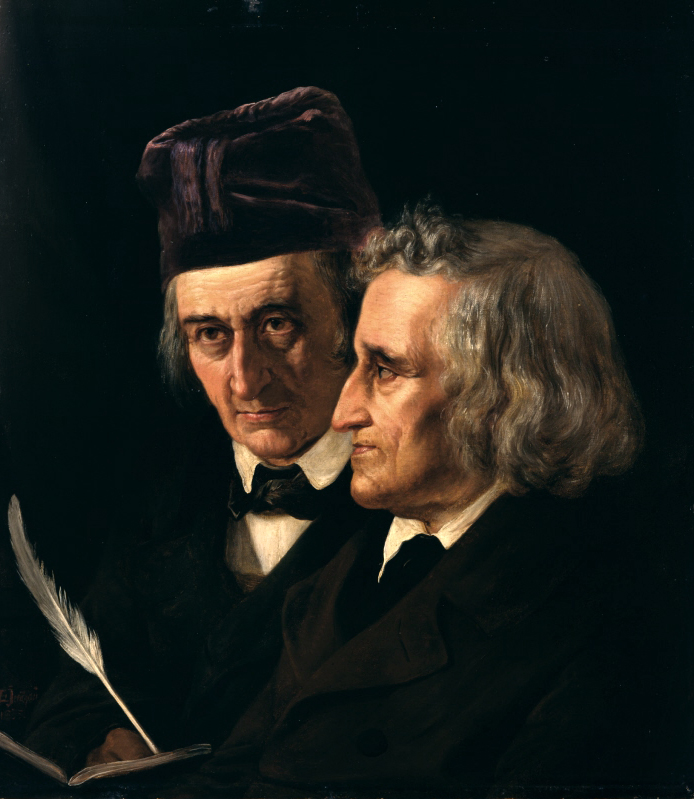
The Brothers Grimm (German: die Brüder Grimm or die Gebrüder Grimm), Jacob (1785–1863) and Wilhelm (1786–1859), were German academics who together collected and published folklore. The brothers are among the best-known storytellers of folktales, popularizing stories such as "Cinderella" ("Aschenputtel"), "The Frog Prince" ("Der Froschkönig"), "Hansel and Gretel" ("Hänsel und Gretel"), "Town Musicians of Bremen" ("Die Bremer Stadtmusikanten"), "Little Red Riding Hood" ("Rotkäppchen"), "Rapunzel", "Rumpelstiltskin" ("Rumpelstilzchen"), "Sleeping Beauty" ("Dornröschen"), and "Snow White" ("Schneewittchen"). Their first collection of folktales, Children's and Household Tales (Kinder- und Hausmärchen), was first published in 1812.
The Brothers Grimm spent their formative years in the town of Hanau in the Landgraviate of Hesse-Kassel. Their father's death in 1796 (when Jacob was 11 and Wilhelm 10) caused great poverty for the family and greatly affected the brothers throughout their lives. Both brothers attended Marburg University, where they developed a curiosity about German folklore, which grew into a lifelong dedication to collecting German folktales.
The rise of Romanticism in 19th-century Europe revived interest in traditional folk stories, which to the Brothers Grimm represented a pure form of national literature and culture. With the goal of researching a scholarly treatise on folktales, they established a methodology for collecting and recording folk stories that became the basis for folklore studies. Between 1812 and 1857 their first collection was revised and republished many times, growing from 86 stories to more than 200. In addition to writing and modifying folktales, the brothers wrote collections of well-respected Germanic and Scandinavian mythologies, and in 1838 they began writing a definitive German dictionary (Deutsches Wörterbuch), which they were unable to finish.
The popularity of the Grimms' collected folktales has endured. They are available in more than 100 translations and have been adapted by renowned filmmakers, including Lotte Reiniger and Walt Disney, in films such as Snow White and the Seven Dwarfs. In the mid-20th century, Nazi Germany weaponized the tales for propaganda; later in the 20th century, psychologists such as Bruno Bettelheim reaffirmed the work's value despite the sexuality, cruelty, and violence in some of the tales' original versions, which were eventually censored by the Grimms themselves.
Jacob Ludwig Karl Grimm and Wilhelm Carl Grimm were born on 4 January 1785 and 24 February 1786, respectively, in Hanau in the Landgraviate of Hesse-Kassel, within the Holy Roman Empire (present-day Germany), to Philipp Wilhelm Grimm, a jurist, and Dorothea Grimm (née Zimmer), daughter of a Kassel city councilman. They were the second- and third-eldest surviving siblings in a family of nine children, three of whom died in infancy. In 1791 the family moved to the countryside town of Steinau during Philipp's employment there as a district magistrate (Amtmann). The family became prominent members of the community, residing in a large home surrounded by fields. Biographer Jack Zipes writes that the brothers were happy in Steinau and "clearly fond of country life". The children were educated at home by private tutors, receiving strict instruction as Lutherans, which instilled in both a lifelong religious faith. Later, they attended local schools.
In 1796 Philipp Grimm died of pneumonia, causing great poverty for the large family. Dorothea was forced to relinquish the brothers' servants and large house, depending on financial support from her father and sister, who was then the first lady-in-waiting at the court of William I, Elector of Hesse. Jacob was the eldest living son, forced at age 11 to assume adult responsibilities (shared with Wilhelm) for the next two years. The two brothers then followed the advice of their grandfather, who continually exhorted them to be industrious.
The brothers left Steinau and their family in 1798 to attend the Friedrichsgymnasium in Kassel, which had been arranged and paid for by their aunt. By then they were without a male provider (their grandfather died that year), forcing them to rely entirely on each other and become exceptionally close. The two brothers differed in temperament—Jacob was introspective and Wilhelm was outgoing (although he often suffered from ill health)—but shared a strong work ethic and excelled in their studies. In Kassel they became acutely aware of their inferior social status relative to "high-born" students who received more attention. Each brother graduated at the head of his class, Jacob in 1803 and Wilhelm in 1804 (he missed a year of school due to scarlet fever).
After graduation from the Friedrichsgymnasium, the brothers attended Marburg University. The university was small with about 200 students, and there they became painfully aware that students of lower social status were not treated equally. They were disqualified from admission because of their social standing and had to request a dispensation to study law. Wealthier students received stipends, but the brothers were excluded even from tuition aid. Their poverty kept them from student activities or university social life, but their outsider status worked in their favor and they pursued their studies with extra vigor.
Hub AI
Brothers Grimm AI simulator
(@Brothers Grimm_simulator)
Brothers Grimm
The Brothers Grimm (German: die Brüder Grimm or die Gebrüder Grimm), Jacob (1785–1863) and Wilhelm (1786–1859), were German academics who together collected and published folklore. The brothers are among the best-known storytellers of folktales, popularizing stories such as "Cinderella" ("Aschenputtel"), "The Frog Prince" ("Der Froschkönig"), "Hansel and Gretel" ("Hänsel und Gretel"), "Town Musicians of Bremen" ("Die Bremer Stadtmusikanten"), "Little Red Riding Hood" ("Rotkäppchen"), "Rapunzel", "Rumpelstiltskin" ("Rumpelstilzchen"), "Sleeping Beauty" ("Dornröschen"), and "Snow White" ("Schneewittchen"). Their first collection of folktales, Children's and Household Tales (Kinder- und Hausmärchen), was first published in 1812.
The Brothers Grimm spent their formative years in the town of Hanau in the Landgraviate of Hesse-Kassel. Their father's death in 1796 (when Jacob was 11 and Wilhelm 10) caused great poverty for the family and greatly affected the brothers throughout their lives. Both brothers attended Marburg University, where they developed a curiosity about German folklore, which grew into a lifelong dedication to collecting German folktales.
The rise of Romanticism in 19th-century Europe revived interest in traditional folk stories, which to the Brothers Grimm represented a pure form of national literature and culture. With the goal of researching a scholarly treatise on folktales, they established a methodology for collecting and recording folk stories that became the basis for folklore studies. Between 1812 and 1857 their first collection was revised and republished many times, growing from 86 stories to more than 200. In addition to writing and modifying folktales, the brothers wrote collections of well-respected Germanic and Scandinavian mythologies, and in 1838 they began writing a definitive German dictionary (Deutsches Wörterbuch), which they were unable to finish.
The popularity of the Grimms' collected folktales has endured. They are available in more than 100 translations and have been adapted by renowned filmmakers, including Lotte Reiniger and Walt Disney, in films such as Snow White and the Seven Dwarfs. In the mid-20th century, Nazi Germany weaponized the tales for propaganda; later in the 20th century, psychologists such as Bruno Bettelheim reaffirmed the work's value despite the sexuality, cruelty, and violence in some of the tales' original versions, which were eventually censored by the Grimms themselves.
Jacob Ludwig Karl Grimm and Wilhelm Carl Grimm were born on 4 January 1785 and 24 February 1786, respectively, in Hanau in the Landgraviate of Hesse-Kassel, within the Holy Roman Empire (present-day Germany), to Philipp Wilhelm Grimm, a jurist, and Dorothea Grimm (née Zimmer), daughter of a Kassel city councilman. They were the second- and third-eldest surviving siblings in a family of nine children, three of whom died in infancy. In 1791 the family moved to the countryside town of Steinau during Philipp's employment there as a district magistrate (Amtmann). The family became prominent members of the community, residing in a large home surrounded by fields. Biographer Jack Zipes writes that the brothers were happy in Steinau and "clearly fond of country life". The children were educated at home by private tutors, receiving strict instruction as Lutherans, which instilled in both a lifelong religious faith. Later, they attended local schools.
In 1796 Philipp Grimm died of pneumonia, causing great poverty for the large family. Dorothea was forced to relinquish the brothers' servants and large house, depending on financial support from her father and sister, who was then the first lady-in-waiting at the court of William I, Elector of Hesse. Jacob was the eldest living son, forced at age 11 to assume adult responsibilities (shared with Wilhelm) for the next two years. The two brothers then followed the advice of their grandfather, who continually exhorted them to be industrious.
The brothers left Steinau and their family in 1798 to attend the Friedrichsgymnasium in Kassel, which had been arranged and paid for by their aunt. By then they were without a male provider (their grandfather died that year), forcing them to rely entirely on each other and become exceptionally close. The two brothers differed in temperament—Jacob was introspective and Wilhelm was outgoing (although he often suffered from ill health)—but shared a strong work ethic and excelled in their studies. In Kassel they became acutely aware of their inferior social status relative to "high-born" students who received more attention. Each brother graduated at the head of his class, Jacob in 1803 and Wilhelm in 1804 (he missed a year of school due to scarlet fever).
After graduation from the Friedrichsgymnasium, the brothers attended Marburg University. The university was small with about 200 students, and there they became painfully aware that students of lower social status were not treated equally. They were disqualified from admission because of their social standing and had to request a dispensation to study law. Wealthier students received stipends, but the brothers were excluded even from tuition aid. Their poverty kept them from student activities or university social life, but their outsider status worked in their favor and they pursued their studies with extra vigor.
Recent media