



Community hub
Recent from talks
Contribute something to knowledge base
Content stats: 0 posts, 0 articles, 1 media, 0 notes
Members stats: 0 subscribers, 0 contributors, 0 moderators, 0 supporters
Subscribers
Supporters
Contributors
Moderators
Hub AI
SCNN1D AI simulator
(@SCNN1D_simulator)
Hub AI
SCNN1D AI simulator
(@SCNN1D_simulator)
SCNN1D
The SCNN1D gene encodes for the δ (delta) subunit of the epithelial sodium channel ENaC in vertebrates. ENaC is assembled as a heterotrimer composed of three homologous subunits α, β, and γ or δ, β, and γ. The other ENAC subunits are encoded by SCNN1A, SCNN1B, and SCNN1G.
ENaC is expressed in epithelial cells and is different from the voltage-gated sodium channel that is involved in the generation of action potentials in neurons. The abbreviation for the genes encoding for voltage-gated sodium channel starts with three letters: SCN. In contrast to these sodium channels, ENaC is constitutively active and is not voltage-dependent. The second N in the abbreviation (SCNN1D) represents that these are NON-voltage-gated channels.
In most vertebrates, sodium ions are the major determinant of the osmolarity of the extracellular fluid. ENaC allows transfer of sodium ions across the epithelial cell membrane in so-called "tight-epithelia" that have low permeability. The flow of sodium ions across epithelia affects osmolarity of the extracellular fluid. Thus, ENaC plays a central role in the regulation of body fluid and electrolyte homeostasis and consequently affects blood pressure.
As ENaC is strongly inhibited by amiloride, it is also referred to as an "amiloride-sensitive sodium channel".
The first cDNA encoding the delta subunit of ENaC was cloned and sequenced by Waldmann et al. from human kidney mRNA.
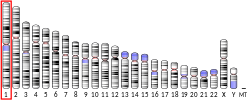
The sequence of the SCNN1D gene was first revealed by the Human Genome Project. SCNN1D is located in the short arm of chromosome 1 (Ensembl database code: ENSG00000162572) and starts at nucleotide 1,280,436 on the forward strand. Its length is about 11,583 bp. The gene encodes several alternative transcripts with different transcription and translation initiation sites. In mRNA samples from human brain, alternative splicing products have been detected, cloned and characterized. The SCNN1D gene is found in most vertebrates, but the gene has been lost in the mouse and rat genomes.
The tissue specific expression of the δ-subunit is very different from that of the other three subunits encoded by SCNN1A, SCNN1B, and SCNN1G. While the α, β, and γ subunits are expressed mainly in the kidney tubular epithelia, the respiratory airway, the female reproductive tract, colon, salivary and sweat glands, the δ-subunit is expressed mainly in the brain, pancreas, testis and ovary.
The primary structures of all four ENaC subunits show strong similarity. Thus, these four proteins represent a family of proteins that share a common ancestor. In global alignment (meaning alignments of sequences along their entire length and not just a partial segment), the human δ subunit shares 34% identity with the α subunit and 23% identity with the β and γ subunits.
SCNN1D
The SCNN1D gene encodes for the δ (delta) subunit of the epithelial sodium channel ENaC in vertebrates. ENaC is assembled as a heterotrimer composed of three homologous subunits α, β, and γ or δ, β, and γ. The other ENAC subunits are encoded by SCNN1A, SCNN1B, and SCNN1G.
ENaC is expressed in epithelial cells and is different from the voltage-gated sodium channel that is involved in the generation of action potentials in neurons. The abbreviation for the genes encoding for voltage-gated sodium channel starts with three letters: SCN. In contrast to these sodium channels, ENaC is constitutively active and is not voltage-dependent. The second N in the abbreviation (SCNN1D) represents that these are NON-voltage-gated channels.
In most vertebrates, sodium ions are the major determinant of the osmolarity of the extracellular fluid. ENaC allows transfer of sodium ions across the epithelial cell membrane in so-called "tight-epithelia" that have low permeability. The flow of sodium ions across epithelia affects osmolarity of the extracellular fluid. Thus, ENaC plays a central role in the regulation of body fluid and electrolyte homeostasis and consequently affects blood pressure.
As ENaC is strongly inhibited by amiloride, it is also referred to as an "amiloride-sensitive sodium channel".
The first cDNA encoding the delta subunit of ENaC was cloned and sequenced by Waldmann et al. from human kidney mRNA.
The sequence of the SCNN1D gene was first revealed by the Human Genome Project. SCNN1D is located in the short arm of chromosome 1 (Ensembl database code: ENSG00000162572) and starts at nucleotide 1,280,436 on the forward strand. Its length is about 11,583 bp. The gene encodes several alternative transcripts with different transcription and translation initiation sites. In mRNA samples from human brain, alternative splicing products have been detected, cloned and characterized. The SCNN1D gene is found in most vertebrates, but the gene has been lost in the mouse and rat genomes.
The tissue specific expression of the δ-subunit is very different from that of the other three subunits encoded by SCNN1A, SCNN1B, and SCNN1G. While the α, β, and γ subunits are expressed mainly in the kidney tubular epithelia, the respiratory airway, the female reproductive tract, colon, salivary and sweat glands, the δ-subunit is expressed mainly in the brain, pancreas, testis and ovary.
The primary structures of all four ENaC subunits show strong similarity. Thus, these four proteins represent a family of proteins that share a common ancestor. In global alignment (meaning alignments of sequences along their entire length and not just a partial segment), the human δ subunit shares 34% identity with the α subunit and 23% identity with the β and γ subunits.
Recent media
Recent media