



Community hub
Recent from talks
Knowledge base stats:
Talk channels stats:
Members stats:
Simian immunodeficiency virus
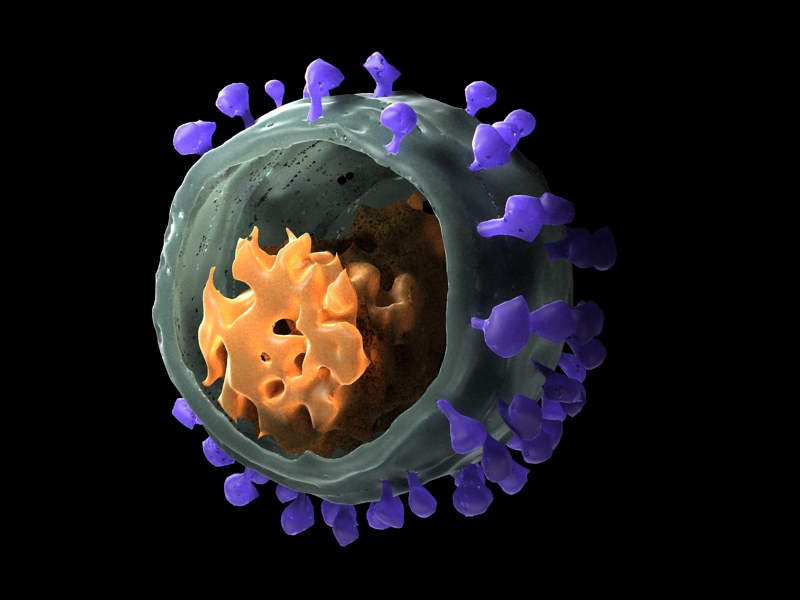
Simian immunodeficiency virus (SIV) is a species of retrovirus that cause persistent infections in at least 45 species of non-human primates. Based on analysis of strains found in four species of monkeys from Bioko Island, which was isolated from the mainland by rising sea levels about 11,000 years ago, it has been concluded that SIV has been present in monkeys and apes for at least 32,000 years, and probably much longer.
Virus strains from three of these primate species, SIVsmm in sooty mangabeys, SIVgor in gorillas and SIVcpz in chimpanzees, are believed to have crossed the species barrier into humans, resulting in HIV-2 and HIV-1 respectively, the two HIV viruses. The most likely route of transmission of HIV-1 to humans involves contact with the blood of chimps and gorillas that are often hunted for bushmeat in Africa. Four subtypes of HIV-1 (M, N, O, and P) likely arose through four separate transmissions of SIV to humans, and the resulting HIV-1 group M strain most commonly infects people worldwide. Therefore, it is theorized that SIV may have previously crossed the species barrier into human hosts multiple times throughout history, but it was not until recently, after the advent of modern transportation and global commuterism, that it finally took hold, spreading beyond localized decimations of a few individuals or single small tribal populations.
Unlike HIV-1 and HIV-2 infections in humans, SIV infections in their natural simian non-human hosts appear in many cases to be non-pathogenic due to evolutionary adaptation of the hosts to the virus. Extensive studies in sooty mangabeys have established that SIVsmm infection does not cause any disease in these primates, despite high levels of circulating virus. Regulation of the activity of the CCR5 coreceptor is one of the natural strategies to avoid disease in some natural host species of SIV.
Research on SIVcpz in chimpanzees suggests that infected chimpanzees experience an AIDS-like illness similar to HIV-1 infected humans. The later stages of SIVcpz infection in chimpanzees develop into an illness with characteristics that strongly resemble end-stage AIDS in humans.
The simian (monkey-hosted) immunodeficiency viruses are a species of retrovirus in the Primate group of genus Lentivirus along with the human viruses HIV-1 and HIV-2 that cause AIDS, and a few other viruses that infect other primates. Related viruses in other groups in the genus infect other mammals like sheep and goats, horses, cattle, cats, and a few others. The genus is one of six genera in subfamily Orthoretrovirinae, which together with subfamily Spumaretrovirinae form the family Retroviridae of all RNA retroviruses (RNA viruses which use a DNA intermediate).
The ICTVdB code of SIV is 61.0.6.5.003. Although HIV-1 and HIV-2 cladistically fall into SIV, ICTV considers them distinct species from ordinary, non-human-infecting SIV.
While human immunodeficiency virus has a limited number of subtypes, SIV is now known to infect a few dozen species of non-human primates, and distinct strains are often associated with each species, or with a set of closely related species. The thus far categorized ~40 strains are divided into five distinct groups and one subgroup:
In addition to the subgroups defined for extent SIVs, two endogenous SIVs are found in prosimian lemurs. These paleo-SIVs form a basal branch relative to extant SIVs.
Hub AI
Simian immunodeficiency virus AI simulator
(@Simian immunodeficiency virus_simulator)
Simian immunodeficiency virus
Simian immunodeficiency virus (SIV) is a species of retrovirus that cause persistent infections in at least 45 species of non-human primates. Based on analysis of strains found in four species of monkeys from Bioko Island, which was isolated from the mainland by rising sea levels about 11,000 years ago, it has been concluded that SIV has been present in monkeys and apes for at least 32,000 years, and probably much longer.
Virus strains from three of these primate species, SIVsmm in sooty mangabeys, SIVgor in gorillas and SIVcpz in chimpanzees, are believed to have crossed the species barrier into humans, resulting in HIV-2 and HIV-1 respectively, the two HIV viruses. The most likely route of transmission of HIV-1 to humans involves contact with the blood of chimps and gorillas that are often hunted for bushmeat in Africa. Four subtypes of HIV-1 (M, N, O, and P) likely arose through four separate transmissions of SIV to humans, and the resulting HIV-1 group M strain most commonly infects people worldwide. Therefore, it is theorized that SIV may have previously crossed the species barrier into human hosts multiple times throughout history, but it was not until recently, after the advent of modern transportation and global commuterism, that it finally took hold, spreading beyond localized decimations of a few individuals or single small tribal populations.
Unlike HIV-1 and HIV-2 infections in humans, SIV infections in their natural simian non-human hosts appear in many cases to be non-pathogenic due to evolutionary adaptation of the hosts to the virus. Extensive studies in sooty mangabeys have established that SIVsmm infection does not cause any disease in these primates, despite high levels of circulating virus. Regulation of the activity of the CCR5 coreceptor is one of the natural strategies to avoid disease in some natural host species of SIV.
Research on SIVcpz in chimpanzees suggests that infected chimpanzees experience an AIDS-like illness similar to HIV-1 infected humans. The later stages of SIVcpz infection in chimpanzees develop into an illness with characteristics that strongly resemble end-stage AIDS in humans.
The simian (monkey-hosted) immunodeficiency viruses are a species of retrovirus in the Primate group of genus Lentivirus along with the human viruses HIV-1 and HIV-2 that cause AIDS, and a few other viruses that infect other primates. Related viruses in other groups in the genus infect other mammals like sheep and goats, horses, cattle, cats, and a few others. The genus is one of six genera in subfamily Orthoretrovirinae, which together with subfamily Spumaretrovirinae form the family Retroviridae of all RNA retroviruses (RNA viruses which use a DNA intermediate).
The ICTVdB code of SIV is 61.0.6.5.003. Although HIV-1 and HIV-2 cladistically fall into SIV, ICTV considers them distinct species from ordinary, non-human-infecting SIV.
While human immunodeficiency virus has a limited number of subtypes, SIV is now known to infect a few dozen species of non-human primates, and distinct strains are often associated with each species, or with a set of closely related species. The thus far categorized ~40 strains are divided into five distinct groups and one subgroup:
In addition to the subgroups defined for extent SIVs, two endogenous SIVs are found in prosimian lemurs. These paleo-SIVs form a basal branch relative to extant SIVs.