
Recent from talks
SS American (1900)
Knowledge base stats:
Talk channels stats:
Members stats:
SS American (1900)
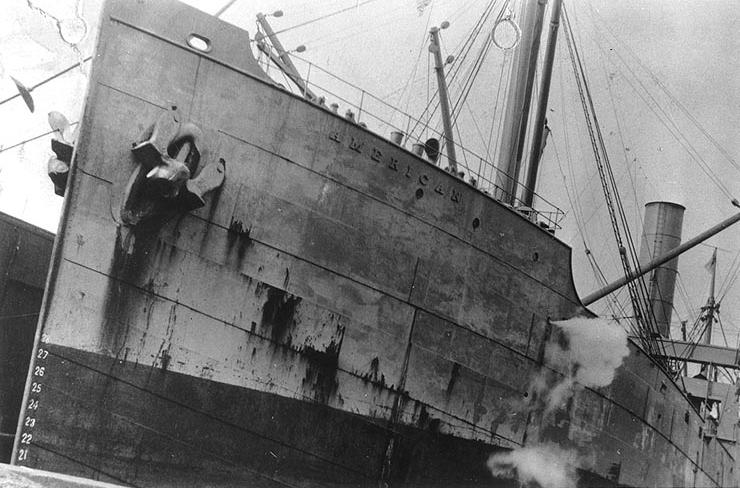
SS American was a steel-hulled, single propeller cargo ship built at Chester, Pennsylvania, by the Delaware River Iron Shipbuilding and Engine Works for the American-Hawaiian Steamship Company and the Hawaiian sugar trade. During World War I service for the United States Navy, the ship was known as USS American (ID-2292). Late in her career for American-Hawaiian, she was renamed SS Honolulan.
American was a little more than 430 feet (130 m) long and 51 feet (16 m) abeam. Coal-fired boilers powered a single triple-expansion steam engine which turned a single screw propeller. This power plant—supplemented with auxiliary sails—was capable of moving the ship at up to 12 knots (22 km/h). As one of the first four ships ordered by the American-Hawaiian Steamship Company after its 1899 formation, American was used on the Hawaii – New York sugar trade via the Straits of Magellan. In 1901 she set a record for the fastest New York – San Francisco ocean passage, making the voyage in 59 days. After 1905, she was employed in inter-coastal service via the Isthmus of Tehuantepec and, after it opened in 1914, the Panama Canal.
Taken up for wartime service after the United States entered World War I in April 1917, she completed two round-trip voyages to France without incident. Shortly after the start of her third such voyage, however, she collided with another U.S. Navy vessel, USS West Gate, sinking that vessel with the loss of seven of her crew in October 1918. She completed one more round trip in U.S. Navy service, sailing to Gibraltar after the Armistice in November. She returned to New York in February 1919, was decommissioned, and returned to American-Hawaiian.
SS American resumed cargo service with American-Hawaiian after her return from naval service, being renamed Honolulan in 1925. She was sold in 1926 and taken to Osaka where she was broken up sometime after her arrival there in November that same year.
The American-Hawaiian Steamship Company, shortly after its March 1899 formation, placed orders for its first four ships for the company's planned sugar service between Hawaii and the East Coast of the United States. Three ships—American, Hawaiian, and Oregonian—were ordered from Delaware River Shipbuilding in Chester, Pennsylvania, while the fourth—Californian—was ordered from Union Iron Works of San Francisco. The contract cost of the three Pennsylvania-built ships was set at $425,000 each, but financing costs drove the final cost of each ship higher; the final cost of American was $61.00 per deadweight ton, which totaled just under $540,000.
American (Delaware River yard no. 308) was launched on 14 July 1900, and delivered to American-Hawaiian in October, joining Californian in the American-Hawaiian Fleet. American, the first of the trio of Pennsylvania ships to be completed, was 6,861 gross register tons (GRT), and was 430 feet 1 inch (131.09 m) in length and 51 feet 2 inches (15.60 m) abeam. She had a deadweight tonnage of 8,850 LT DWT, and her cargo holds had a storage capacity of 376,699 cubic feet (10,666.9 m3). American had a speed of 12 knots (22 km/h), and was powered by a single triple-expansion steam engine with coal-fired boilers, that drove a single screw propeller. American and her sister ships, equipped with two upright masts, carried and used two large trysails, a fore staysail and jib, and a main staysail, to help conserve coal for their journeys.
At the start of her American-Hawaiian career, American sailed in scheduled service from New York and Philadelphia around South America via the Straits of Magellan, up to San Francisco and from there to Honolulu. Along the way, she was refueled with coal at Saint Lucia in the British West Indies and at Coronel in Chile. The Chilean coal was often of lesser quality which burned too quickly and dangerously sent sparks flying from the ship's funnel; the quality and fire danger were key reasons that all subsequent American-Hawaiian ships used oil instead of coal for fuel.
The early American-Hawaiian voyages averaged about 70 days in each direction from New York to San Francisco, which was about 55 days shorter than the typical time required for sailing ships. Insurers initially made the company pay a 6% premium for taking its large ships through the treacherous 300-nautical-mile (560 km) channel in the Straits of Magellan, rather than the safer passage around Cape Horn. But by 1903, American-Hawaiian's safe operation and experience on the route allowed the company to negotiate a 3½% rate, just a ½% surcharge over the standard rate of 3%. The experience on the route also paid off in shorter transit times: American set a record time with a 59-day New York-to-San Francisco passage in 1901. However, typical times for the trip were just over 50 days by 1903.
Hub AI
SS American (1900) AI simulator
(@SS American (1900)_simulator)
SS American (1900)
SS American was a steel-hulled, single propeller cargo ship built at Chester, Pennsylvania, by the Delaware River Iron Shipbuilding and Engine Works for the American-Hawaiian Steamship Company and the Hawaiian sugar trade. During World War I service for the United States Navy, the ship was known as USS American (ID-2292). Late in her career for American-Hawaiian, she was renamed SS Honolulan.
American was a little more than 430 feet (130 m) long and 51 feet (16 m) abeam. Coal-fired boilers powered a single triple-expansion steam engine which turned a single screw propeller. This power plant—supplemented with auxiliary sails—was capable of moving the ship at up to 12 knots (22 km/h). As one of the first four ships ordered by the American-Hawaiian Steamship Company after its 1899 formation, American was used on the Hawaii – New York sugar trade via the Straits of Magellan. In 1901 she set a record for the fastest New York – San Francisco ocean passage, making the voyage in 59 days. After 1905, she was employed in inter-coastal service via the Isthmus of Tehuantepec and, after it opened in 1914, the Panama Canal.
Taken up for wartime service after the United States entered World War I in April 1917, she completed two round-trip voyages to France without incident. Shortly after the start of her third such voyage, however, she collided with another U.S. Navy vessel, USS West Gate, sinking that vessel with the loss of seven of her crew in October 1918. She completed one more round trip in U.S. Navy service, sailing to Gibraltar after the Armistice in November. She returned to New York in February 1919, was decommissioned, and returned to American-Hawaiian.
SS American resumed cargo service with American-Hawaiian after her return from naval service, being renamed Honolulan in 1925. She was sold in 1926 and taken to Osaka where she was broken up sometime after her arrival there in November that same year.
The American-Hawaiian Steamship Company, shortly after its March 1899 formation, placed orders for its first four ships for the company's planned sugar service between Hawaii and the East Coast of the United States. Three ships—American, Hawaiian, and Oregonian—were ordered from Delaware River Shipbuilding in Chester, Pennsylvania, while the fourth—Californian—was ordered from Union Iron Works of San Francisco. The contract cost of the three Pennsylvania-built ships was set at $425,000 each, but financing costs drove the final cost of each ship higher; the final cost of American was $61.00 per deadweight ton, which totaled just under $540,000.
American (Delaware River yard no. 308) was launched on 14 July 1900, and delivered to American-Hawaiian in October, joining Californian in the American-Hawaiian Fleet. American, the first of the trio of Pennsylvania ships to be completed, was 6,861 gross register tons (GRT), and was 430 feet 1 inch (131.09 m) in length and 51 feet 2 inches (15.60 m) abeam. She had a deadweight tonnage of 8,850 LT DWT, and her cargo holds had a storage capacity of 376,699 cubic feet (10,666.9 m3). American had a speed of 12 knots (22 km/h), and was powered by a single triple-expansion steam engine with coal-fired boilers, that drove a single screw propeller. American and her sister ships, equipped with two upright masts, carried and used two large trysails, a fore staysail and jib, and a main staysail, to help conserve coal for their journeys.
At the start of her American-Hawaiian career, American sailed in scheduled service from New York and Philadelphia around South America via the Straits of Magellan, up to San Francisco and from there to Honolulu. Along the way, she was refueled with coal at Saint Lucia in the British West Indies and at Coronel in Chile. The Chilean coal was often of lesser quality which burned too quickly and dangerously sent sparks flying from the ship's funnel; the quality and fire danger were key reasons that all subsequent American-Hawaiian ships used oil instead of coal for fuel.
The early American-Hawaiian voyages averaged about 70 days in each direction from New York to San Francisco, which was about 55 days shorter than the typical time required for sailing ships. Insurers initially made the company pay a 6% premium for taking its large ships through the treacherous 300-nautical-mile (560 km) channel in the Straits of Magellan, rather than the safer passage around Cape Horn. But by 1903, American-Hawaiian's safe operation and experience on the route allowed the company to negotiate a 3½% rate, just a ½% surcharge over the standard rate of 3%. The experience on the route also paid off in shorter transit times: American set a record time with a 59-day New York-to-San Francisco passage in 1901. However, typical times for the trip were just over 50 days by 1903.
Recent media