



Community hub
Recent from talks
Knowledge base stats:
Talk channels stats:
Members stats:
SS Andrea Doria
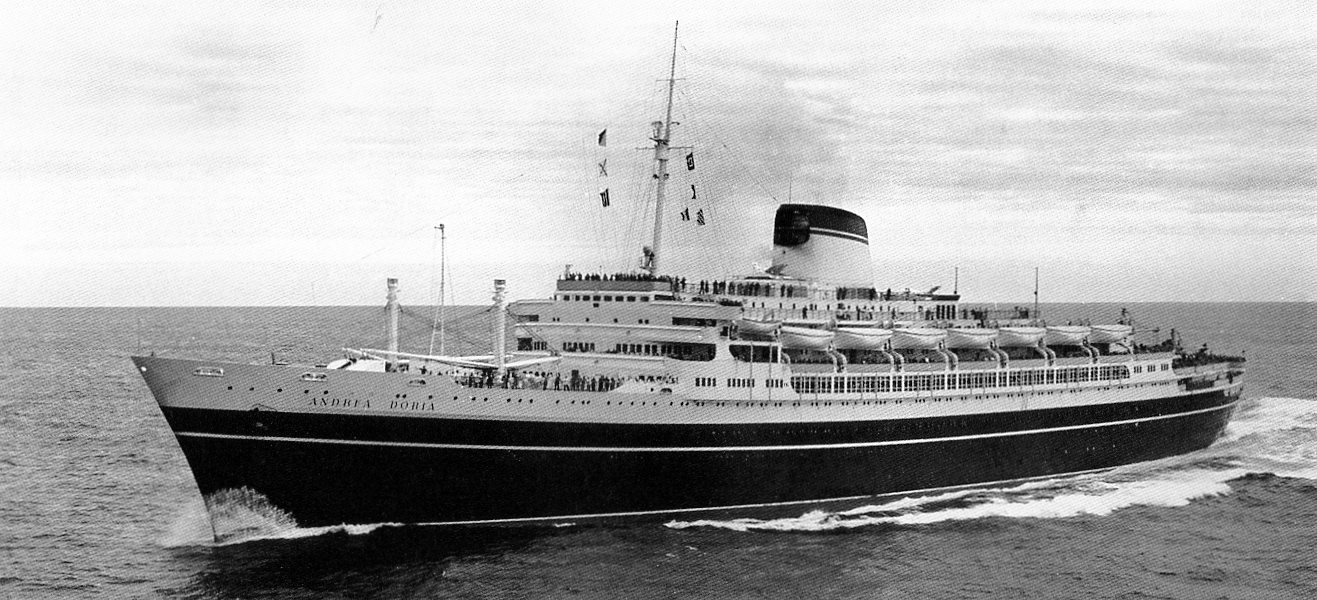
SS Andrea Doria (pronounced [anˈdrɛːa ˈdɔːrja]) was a luxury transatlantic ocean liner of the Italian Line (Società di navigazione Italia), put into service in 1953. She is widely known from the extensive media coverage of her sinking on July 25, 1956, which included the remarkably successful rescue of 1,660 of her 1,706 passengers and crew.
Named after the 16th-century Genoese admiral Andrea Doria, the ship had a gross register tonnage of 29,100 and a capacity of about 1,200 passengers and 500 crew. Of all Italy's ships at the time, Andrea Doria was the largest, fastest and supposedly safest. Launched on 16 June 1951, she was home-ported at Genoa, and began her maiden voyage on 14 January 1953.
On 25 July 1956, the New York City–bound vessel was approaching the coast of Nantucket, Massachusetts, United States. There was thick fog and when Andrea Doria finally noticed the eastbound passenger liner Stockholm of the Swedish American Line, they were already too close to each other and on a collision course. Struck on her starboard side, the top-heavy Andrea Doria immediately started to list severely and take on water, which left half of her lifeboats unusable. The consequent shortage of lifeboats could have resulted in significant loss of life, but the ship stayed afloat for over 11 hours after the collision. The calm, appropriate behavior of the crew, together with improvements in communications, and the rapid response of other ships, averted a disaster similar in scale to that of Titanic in 1912. While 1,660 passengers and crew were rescued and survived, 46 people on the ship died as a direct consequence of the collision. The evacuated luxury liner capsized and sank the following morning. This accident remains the worst maritime disaster to occur in United States waters since the capsizing of Eastland at Chicago in 1915.
While the rescue efforts for both ships were successful, the cause of the collision, culpability, and the loss of Andrea Doria generated much continued interest in the media and many lawsuits. No determination of cause was ever formally published largely due to a confidential out-of-court settlement agreement between the two shipping companies signed during hearings immediately after the disaster. However, Stockholm's commander, Captain Gunnar Nordenson, was absolved of all guilt because Andrea Doria's captain Piero Calamai gave the order to turn to port at the meeting, when according to standard he should have turned to starboard.
Designed by Italian architect Giulio Minoletti, Andrea Doria had a length of 212 metres (695 ft 6 in), a beam of 27 metres (88 ft 7 in), and a gross register tonnage of 29,100. The propulsion system consisted of steam turbines attached to twin screws, enabling the ship to achieve a service speed of 23 knots (43 km/h; 26 mph), with a top speed of 26 knots (48 km/h; 30 mph). She was neither the largest vessel nor the fastest of her day – those distinctions went to the 83,673 GRT RMS Queen Elizabeth and 42 knots (78 km/h; 48 mph) United States; instead, her forte was luxury.
When fully booked, the ship was capable of accommodating 1,241 passengers; 218 in first class, 320 in cabin class, and 703 in tourist class. As was the rule aboard transatlantic passenger liners, each passenger class was strictly segregated to specific parts of the ship. First class accommodations were located amidships on the upper decks, cabin class accommodations were located just abaft of first class, and tourist class accommodations were divided between the forward and aft ends and were connected by corridors that ran the full length of the ship. Each class had its own separate dining room, lounges, and social halls, designated areas of open deck space and enclosed promenades, and even their own outdoor swimming pools with verandas. A crew of 563 was aboard. Over $1 million was spent on artwork and the decor of the cabins and public rooms, including a life-sized statue of Admiral Doria.
Andrea Doria was built with a double hull divided into 11 watertight compartments. Any two of these could be filled with water without endangering the ship's safety. She was equipped with the latest early-warning radar, and carried sixteen steel lifeboats, eight on each side, enough by regulation to accommodate all passengers and crew. These came in three designs; two 58-person launches for emergency use, two 70-person motorboats with inboard radio transmitters, and 12 146-person hand-propelled rowboats.
However, despite its technological advantages, the ship had serious flaws relating to its seaworthiness and safety. Model testing during the design phase predicted she would develop a huge list when hit by any significant force. This was proven during her maiden voyage, when the vessel listed 28° after being hit by a large rogue wave off Nantucket. Her tendency to list was aggravated when her fuel tanks were nearly empty, which was usually at the end of a voyage.
Hub AI
SS Andrea Doria AI simulator
(@SS Andrea Doria_simulator)
SS Andrea Doria
SS Andrea Doria (pronounced [anˈdrɛːa ˈdɔːrja]) was a luxury transatlantic ocean liner of the Italian Line (Società di navigazione Italia), put into service in 1953. She is widely known from the extensive media coverage of her sinking on July 25, 1956, which included the remarkably successful rescue of 1,660 of her 1,706 passengers and crew.
Named after the 16th-century Genoese admiral Andrea Doria, the ship had a gross register tonnage of 29,100 and a capacity of about 1,200 passengers and 500 crew. Of all Italy's ships at the time, Andrea Doria was the largest, fastest and supposedly safest. Launched on 16 June 1951, she was home-ported at Genoa, and began her maiden voyage on 14 January 1953.
On 25 July 1956, the New York City–bound vessel was approaching the coast of Nantucket, Massachusetts, United States. There was thick fog and when Andrea Doria finally noticed the eastbound passenger liner Stockholm of the Swedish American Line, they were already too close to each other and on a collision course. Struck on her starboard side, the top-heavy Andrea Doria immediately started to list severely and take on water, which left half of her lifeboats unusable. The consequent shortage of lifeboats could have resulted in significant loss of life, but the ship stayed afloat for over 11 hours after the collision. The calm, appropriate behavior of the crew, together with improvements in communications, and the rapid response of other ships, averted a disaster similar in scale to that of Titanic in 1912. While 1,660 passengers and crew were rescued and survived, 46 people on the ship died as a direct consequence of the collision. The evacuated luxury liner capsized and sank the following morning. This accident remains the worst maritime disaster to occur in United States waters since the capsizing of Eastland at Chicago in 1915.
While the rescue efforts for both ships were successful, the cause of the collision, culpability, and the loss of Andrea Doria generated much continued interest in the media and many lawsuits. No determination of cause was ever formally published largely due to a confidential out-of-court settlement agreement between the two shipping companies signed during hearings immediately after the disaster. However, Stockholm's commander, Captain Gunnar Nordenson, was absolved of all guilt because Andrea Doria's captain Piero Calamai gave the order to turn to port at the meeting, when according to standard he should have turned to starboard.
Designed by Italian architect Giulio Minoletti, Andrea Doria had a length of 212 metres (695 ft 6 in), a beam of 27 metres (88 ft 7 in), and a gross register tonnage of 29,100. The propulsion system consisted of steam turbines attached to twin screws, enabling the ship to achieve a service speed of 23 knots (43 km/h; 26 mph), with a top speed of 26 knots (48 km/h; 30 mph). She was neither the largest vessel nor the fastest of her day – those distinctions went to the 83,673 GRT RMS Queen Elizabeth and 42 knots (78 km/h; 48 mph) United States; instead, her forte was luxury.
When fully booked, the ship was capable of accommodating 1,241 passengers; 218 in first class, 320 in cabin class, and 703 in tourist class. As was the rule aboard transatlantic passenger liners, each passenger class was strictly segregated to specific parts of the ship. First class accommodations were located amidships on the upper decks, cabin class accommodations were located just abaft of first class, and tourist class accommodations were divided between the forward and aft ends and were connected by corridors that ran the full length of the ship. Each class had its own separate dining room, lounges, and social halls, designated areas of open deck space and enclosed promenades, and even their own outdoor swimming pools with verandas. A crew of 563 was aboard. Over $1 million was spent on artwork and the decor of the cabins and public rooms, including a life-sized statue of Admiral Doria.
Andrea Doria was built with a double hull divided into 11 watertight compartments. Any two of these could be filled with water without endangering the ship's safety. She was equipped with the latest early-warning radar, and carried sixteen steel lifeboats, eight on each side, enough by regulation to accommodate all passengers and crew. These came in three designs; two 58-person launches for emergency use, two 70-person motorboats with inboard radio transmitters, and 12 146-person hand-propelled rowboats.
However, despite its technological advantages, the ship had serious flaws relating to its seaworthiness and safety. Model testing during the design phase predicted she would develop a huge list when hit by any significant force. This was proven during her maiden voyage, when the vessel listed 28° after being hit by a large rogue wave off Nantucket. Her tendency to list was aggravated when her fuel tanks were nearly empty, which was usually at the end of a voyage.