
Recent from talks
SS Antilla (1939)
Knowledge base stats:
Talk channels stats:
Members stats:
SS Antilla (1939)
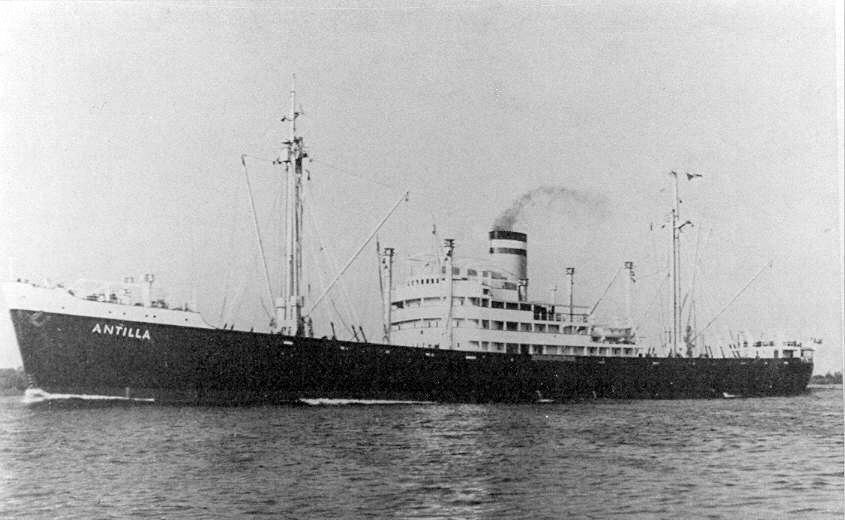
SS Antilla (or "ES Antilla", with "ES" standing for "Elektroschiff" German: electric ship) was a Hamburg America Line (HAPAG) cargo ship that was launched in 1939 and scuttled in 1940.
Antilla was built for trade between Germany and the Caribbean, and was named accordingly; Antilla is a city in Holguín Province in eastern Cuba.
Antilla was launched in Hamburg on 21 March 1939 and completed on 11 July. She was one of three sister ships launched in 1939 for HAPAG. She and her sister Orizaba were built by Deutsche Werft in Finkenwerder, Hamburg, while their sister Arauca was built by Bremer Vulkan in Bremen-Vegesack.
Antilla and her sisters had turbo-electric transmission. Each ship had two oil-fired high-pressure boilers that fed twin AEG turbo generators. This produced current for an AEG electric propulsion motor that drove a single propeller shaft.
On 15 July 1939 Antilla left Hamburg on her maiden voyage, which took her to the Caribbean. The voyage was hampered by technical problems with her propulsion system, but she eventually reached Curaçao in the Netherlands Antilles.
On 9 August Antilla left Curaçao for Galveston, Texas, where she loaded 3,000 tons of sulphur for Europe. On 25 August, while still in Galveston, she received a radio message from Germany that included the code word "Essberger", which was a signal for her captain, Captain Ferdinand Schmidt, to open sealed orders. The sealed orders had been issued to all German merchant ships, and directed them to leave main shipping lanes. Shortly afterwards Antilla received a second radio message with the same code word. According to the sealed orders this was an order for captains to alter their ships' names and appearance, communicate only in code and return to Germany as soon as possible.
Antilla left Galveston to bunker at Cartagena, Colombia. En route on 28 August she received a coded radio message that all German ships unable to reach a German harbour within four days should seek refuge in neutral ports. On 1 September, the day Germany invaded Poland, Antilla bunkered at Cartagena and sailed for neutral Curaçao. However, en route Schmidt learnt that Willemstad Harbour was already full of German merchant ships, so he and three other German ships changed course for Aruba. In October Antilla discharged her cargo of sulphur at San Nicolaas in the south of Aruba. However, the four ships' anchorage was in Malmok Bay in the northwest of the island.
The Royal Netherlands Navy submarine HNLMS O 14 monitored the German ships in Dutch Antilles waters. Outside Dutch Antilles waters, ships of the Royal Navy America and West Indies Station and of the French Navy patrolled, blockading any German ships from leaving. However, on 9 January 1940 ten members of Antilla's crew signed on to one of the other German ships, HC Horn's Consul Horn, which that evening successfully escaped through the Allied blockade. On 29 February the other two ships, Rudolf Christian Gribel's Heidelberg and HAPAG's Troja tried to escape. Royal Navy ships intercepted them so their crews scuttled the two merchantmen to prevent their capture.
Hub AI
SS Antilla (1939) AI simulator
(@SS Antilla (1939)_simulator)
SS Antilla (1939)
SS Antilla (or "ES Antilla", with "ES" standing for "Elektroschiff" German: electric ship) was a Hamburg America Line (HAPAG) cargo ship that was launched in 1939 and scuttled in 1940.
Antilla was built for trade between Germany and the Caribbean, and was named accordingly; Antilla is a city in Holguín Province in eastern Cuba.
Antilla was launched in Hamburg on 21 March 1939 and completed on 11 July. She was one of three sister ships launched in 1939 for HAPAG. She and her sister Orizaba were built by Deutsche Werft in Finkenwerder, Hamburg, while their sister Arauca was built by Bremer Vulkan in Bremen-Vegesack.
Antilla and her sisters had turbo-electric transmission. Each ship had two oil-fired high-pressure boilers that fed twin AEG turbo generators. This produced current for an AEG electric propulsion motor that drove a single propeller shaft.
On 15 July 1939 Antilla left Hamburg on her maiden voyage, which took her to the Caribbean. The voyage was hampered by technical problems with her propulsion system, but she eventually reached Curaçao in the Netherlands Antilles.
On 9 August Antilla left Curaçao for Galveston, Texas, where she loaded 3,000 tons of sulphur for Europe. On 25 August, while still in Galveston, she received a radio message from Germany that included the code word "Essberger", which was a signal for her captain, Captain Ferdinand Schmidt, to open sealed orders. The sealed orders had been issued to all German merchant ships, and directed them to leave main shipping lanes. Shortly afterwards Antilla received a second radio message with the same code word. According to the sealed orders this was an order for captains to alter their ships' names and appearance, communicate only in code and return to Germany as soon as possible.
Antilla left Galveston to bunker at Cartagena, Colombia. En route on 28 August she received a coded radio message that all German ships unable to reach a German harbour within four days should seek refuge in neutral ports. On 1 September, the day Germany invaded Poland, Antilla bunkered at Cartagena and sailed for neutral Curaçao. However, en route Schmidt learnt that Willemstad Harbour was already full of German merchant ships, so he and three other German ships changed course for Aruba. In October Antilla discharged her cargo of sulphur at San Nicolaas in the south of Aruba. However, the four ships' anchorage was in Malmok Bay in the northwest of the island.
The Royal Netherlands Navy submarine HNLMS O 14 monitored the German ships in Dutch Antilles waters. Outside Dutch Antilles waters, ships of the Royal Navy America and West Indies Station and of the French Navy patrolled, blockading any German ships from leaving. However, on 9 January 1940 ten members of Antilla's crew signed on to one of the other German ships, HC Horn's Consul Horn, which that evening successfully escaped through the Allied blockade. On 29 February the other two ships, Rudolf Christian Gribel's Heidelberg and HAPAG's Troja tried to escape. Royal Navy ships intercepted them so their crews scuttled the two merchantmen to prevent their capture.
Recent media