


Community hub
Recent from talks
Contribute something to knowledge base
Content stats: 0 posts, 0 articles, 1 media, 0 notes
Members stats: 0 subscribers, 0 contributors, 0 moderators, 0 supporters
Subscribers
Supporters
Contributors
Moderators
Hub AI
SS Haverford AI simulator
(@SS Haverford_simulator)
Hub AI
SS Haverford AI simulator
(@SS Haverford_simulator)
SS Haverford
SS Haverford was a British transatlantic liner built in 1901 for the American Line on the route from Southampton to New York, then on the route from Liverpool to Boston and Philadelphia. During her early years, this ship, mainly designed to transport migrants and goods, was the victim of several incidents. Her company was integrated into the International Mercantile Marine Co. (IMM) in 1902 and she was used by other companies within the trust, the Dominion Line and the Red Star Line.
The start of World War I did not stop her civilian service. It was not until January 1915 that she was requisitioned as a troop transport. During the conflict, she was attacked on several occasions by German submarines, one of them succeeding in torpedoing her on June 12, 1917. Although eight people died, the ship was beached and then repaired. After the war, she resumed, from 1919, her service to Philadelphia.
In 1921, another company within the IMM, White Star Line, took over the Philadelphia route previously operated by American Line, as well as the Haverford. Contrary to the usual practice of the company, the ship was not renamed, and continued to serve Philadelphia. From 1922, she returned to her original company for several crossings from Hamburg, then joined the White Star again. In 1924, worn out, the ship was sold to Italian shipbreakers, and scrapped the following year.
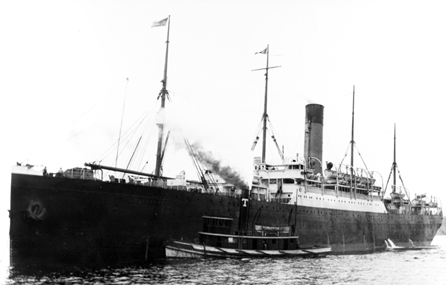
Haverford was a medium-sized ocean liner, with tonnages of 11,635 gross register tons (GRT) and 7,493 NRT. She was 531.0 feet (161.8 m) long by 59.2 feet (18.0 m) beam. She had one funnel and four masts along the centerline. Her propulsion was provided by triple-expansion engines, allowing her to reach an average speed of 14 knots (26 km/h; 16 mph), rather slow for the time on the transatlantic route. This low speed was explained by the purpose of the ship, which was intended to transport large quantities of emigrants (1,700 third-class passengers), as well as a few second-class passengers (150 at the start). This capacity was subsequently modified, and the ship carried 1,308 third- and 216 second-class passengers during the end of her career. Besides these passengers, the ship was also designed to carry a significant amount of cargo. She had seven holds, and her hull was divided into eleven watertight compartments.
SS Haverford was constructed by John Brown & Company of Clydebank, Scotland and funded by Clement Griscom Director of the International Navigation Company. After her launch on 4 May 1901, she was completed during the following August. The plans of her company were modified and the Haverford finally made her maiden voyage on an experimental basis on the route from Southampton to New York via Cherbourg. After this rotation, the ship was loaned to the Red Star Line (the two companies belonging to the International Navigation Company) which used her on the route from Antwerp to New York from 9 November 1901 to 8 March 1902.
The Haverford and her sister ship, Merion were identical in design and named after two suburbs on the Philadelphia Main Line just west of Pennsylvania's largest city. The ships were designed for a single passenger classification with accommodations called "Second Cabin" considered equal to first class on other ships. Haverford was launched six months prior to Merion.
After briefly serving the Southampton to New York route, Haverford was transferred to the Liverpool – Philadelphia route by 1903. The ship also occasionally was used by other companies within the trust International Mercantile Marine Company serving for the Red Star Line (Antwerp-New York route) and Dominion Line (Liverpool-Halifax-Portland).
On 14 June 1906 an explosion occurred aboard Haverford, killing 13 people at Liverpool docks. The explosion was attributed to explosive fumes produced by a load of 45 tons of Fels-Naptha soap in its cargo. The ship's owners attempted to sue the manufacturers of the soap, but the case was rejected by the United States District Court as adequate ventilation was not provided aboard the ship to deal with the known hazards of Naptha fumes.
SS Haverford
SS Haverford was a British transatlantic liner built in 1901 for the American Line on the route from Southampton to New York, then on the route from Liverpool to Boston and Philadelphia. During her early years, this ship, mainly designed to transport migrants and goods, was the victim of several incidents. Her company was integrated into the International Mercantile Marine Co. (IMM) in 1902 and she was used by other companies within the trust, the Dominion Line and the Red Star Line.
The start of World War I did not stop her civilian service. It was not until January 1915 that she was requisitioned as a troop transport. During the conflict, she was attacked on several occasions by German submarines, one of them succeeding in torpedoing her on June 12, 1917. Although eight people died, the ship was beached and then repaired. After the war, she resumed, from 1919, her service to Philadelphia.
In 1921, another company within the IMM, White Star Line, took over the Philadelphia route previously operated by American Line, as well as the Haverford. Contrary to the usual practice of the company, the ship was not renamed, and continued to serve Philadelphia. From 1922, she returned to her original company for several crossings from Hamburg, then joined the White Star again. In 1924, worn out, the ship was sold to Italian shipbreakers, and scrapped the following year.
Haverford was a medium-sized ocean liner, with tonnages of 11,635 gross register tons (GRT) and 7,493 NRT. She was 531.0 feet (161.8 m) long by 59.2 feet (18.0 m) beam. She had one funnel and four masts along the centerline. Her propulsion was provided by triple-expansion engines, allowing her to reach an average speed of 14 knots (26 km/h; 16 mph), rather slow for the time on the transatlantic route. This low speed was explained by the purpose of the ship, which was intended to transport large quantities of emigrants (1,700 third-class passengers), as well as a few second-class passengers (150 at the start). This capacity was subsequently modified, and the ship carried 1,308 third- and 216 second-class passengers during the end of her career. Besides these passengers, the ship was also designed to carry a significant amount of cargo. She had seven holds, and her hull was divided into eleven watertight compartments.
SS Haverford was constructed by John Brown & Company of Clydebank, Scotland and funded by Clement Griscom Director of the International Navigation Company. After her launch on 4 May 1901, she was completed during the following August. The plans of her company were modified and the Haverford finally made her maiden voyage on an experimental basis on the route from Southampton to New York via Cherbourg. After this rotation, the ship was loaned to the Red Star Line (the two companies belonging to the International Navigation Company) which used her on the route from Antwerp to New York from 9 November 1901 to 8 March 1902.
The Haverford and her sister ship, Merion were identical in design and named after two suburbs on the Philadelphia Main Line just west of Pennsylvania's largest city. The ships were designed for a single passenger classification with accommodations called "Second Cabin" considered equal to first class on other ships. Haverford was launched six months prior to Merion.
After briefly serving the Southampton to New York route, Haverford was transferred to the Liverpool – Philadelphia route by 1903. The ship also occasionally was used by other companies within the trust International Mercantile Marine Company serving for the Red Star Line (Antwerp-New York route) and Dominion Line (Liverpool-Halifax-Portland).
On 14 June 1906 an explosion occurred aboard Haverford, killing 13 people at Liverpool docks. The explosion was attributed to explosive fumes produced by a load of 45 tons of Fels-Naptha soap in its cargo. The ship's owners attempted to sue the manufacturers of the soap, but the case was rejected by the United States District Court as adequate ventilation was not provided aboard the ship to deal with the known hazards of Naptha fumes.
Recent media
Recent media