



Community hub
Recent from talks
Knowledge base stats:
Talk channels stats:
Members stats:
Sabkha
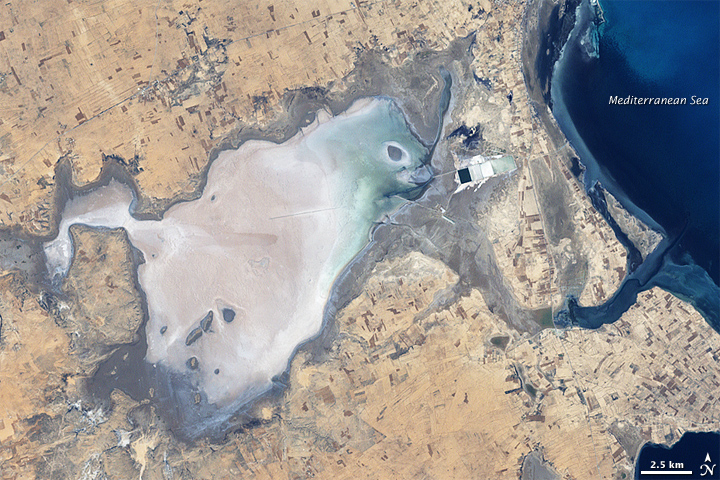
A sabkha (Arabic: سبخة) is a predominately coastal, supratidal mudflat or sandflat in which evaporite-saline minerals accumulate as the result of a semiarid to arid climate. Sabkhas are gradational between land and intertidal zone within restricted coastal plains just above normal high-tide level. Within a sabkha, evaporite-saline mineral sediments typically accumulate below the surface of mudflats or sandflats. Evaporite-saline minerals, tidal-flood, and aeolian deposits characterize many sabkhas found along modern coastlines. The accepted type locality for a sabkha is at the southern coast of the Persian Gulf, in the United Arab Emirates. Evidence of clastic sabkhas are found in the geological record of many areas, including the UK and Ireland. Sabkha is a phonetic transliteration of the Arabic word sabaka used to describe any form of salt flat, including salt marshes and salt swamps. A sabkha is also known as a sabkhah, sebkha, or coastal sabkha.
The term sabkha has been used as a general term for any flat area, coastal or interior, where, as the result of evaporation, salt and other evaporite minerals precipitate near or at the surface. The term continental sabkha is used for such environments found within deserts. Because of the confusion created by using sabkha for salt flats and playas, it has been proposed that the usage of this term be abandoned for playas and other intracontinental basins and flats.
The origin and progression of coastal sabkha development at the southern shore of the Persian Gulf was first discussed in detail in the seminal paper by Evans et al. 1969. The southern shoreline of the Persian Gulf is a shallow, low-angle carbonate ramp characterised by an evaporitic supratidal system passing offshore, via a broad carbonate–evaporite intertidal environment, into a carbonate-dominated subtidal system. This is a low-energy setting with a small tidal range (1–2 m (3.3–6.6 ft)) and low wave energy as a result of the limited fetch. High rates of evaporation result in salinities of 45–46 g l−1 along the open-marine coast of Abu Dhabi and up to 89 g l−1 in more-restricted lagoons. The coast of Abu Dhabi is locally protected from open-marine conditions by a number of peninsulas and offshore shoals and islands associated with the east–west trending Great Pearl Bank.
Groundwater plays a key role in the formation of sabkhas. The phenomenon of groundwater discharging to the surface doesn't always result in visible open water. Instead, the water evaporates upon reaching the surface, leading to the formation of salt deposits. The salt flats of Abu Dhabi are a typical example of this, with the evaporation of water occurring from the capillary fringe – a subsurface layer where groundwater seeps up from a water table – which intersects the surface. This activity has contributed to the creation of an expansive salt flat, covering approximately 36,000 km2 (14,000 sq mi).
Much of the chemical content in these flats is attributed to groundwater that seeps to the surface. This seepage results in a concentration of these dissolved substances, which is estimated to be about ten times that found in seawater. The arid conditions of such regions are often characterized by sparse or even completely absent vegetation. This lack of plant cover allows aeolian processes to interact with the phreatic surface to form unique landforms, such as sabkhas.
Due to the minimal vegetation, aeolian activity has the capacity to cause deep erosion into the surface sediments. However, it's unable to displace material below the capillary zone due to the full saturation of this zone preventing its uplift by the wind. As a result, the Earth’s surface in such regions tends to mimic the shape and slope of the underlying water table. The resultant surfaces evolve into vast, flat, discharge areas where the process of evaporation leads to the accumulation of salts. Over time, these accumulations form crusts of a salty nature, characterizing the unique landscape of these regions.
In the khor-lagoon-sabkha model, an initial rise in sea-level floods coastal areas and creates shallow water features. If the features silt up, or the land rises, or the sea level falls, then the trapped water evaporates, leaving a flat salt pan, or sabkha. If the coastal region has irregular topography, then the flooding creates large independent creeks, or khors. A khor is a shallow, subtidal flat or tidal inlet. The inlet may host grey mangroves, depending on whether less saline water is available from wadis or groundwater. As sediment begins to accumulate, the khors become more shallow and form a lagoon, or intertidal flat. The lagoons continue to fill until the lagoon floor is exposed at low tide, and the sabkha begins to form. A sabkha may be inundated during higher than normal spring tides, after rainstorms, or when driving winds push seawater onshore to a depth of a few centimeters. Mature sabkhas are only flooded after heavy rainstorms and may eventually coalesce to form a sabkha coastal plain. These coastal plains are very flat, with reliefs between 10–50 cm (3.9–19.7 in), and their seaward slope can be as little as 1:1,000.
These environments can be found laterally contemporaneous in parallel belts to the coast as well. Coral reefs, barrier islands, and oolite shoals form the barrier with the open shelf. These types of deposits are indicative of higher energy and protect the khor-lagoon environments, allowing for the growth of mangrove swamps and algal and cyano-bacterial mats that prefer the more closed, lower energy environment. Inland of this are the supratidal sabkhas. The sabkhas can be as wide as 15 km (9.3 mi) when seaward of dune fields supplying large amounts of sediment. Sabkhas seaward of low outcrops of Miocene carbonate-evaporites or alluvial fans off the Oman fold and thrust belt can be as narrow as several hundred meters.
Hub AI
Sabkha AI simulator
(@Sabkha_simulator)
Sabkha
A sabkha (Arabic: سبخة) is a predominately coastal, supratidal mudflat or sandflat in which evaporite-saline minerals accumulate as the result of a semiarid to arid climate. Sabkhas are gradational between land and intertidal zone within restricted coastal plains just above normal high-tide level. Within a sabkha, evaporite-saline mineral sediments typically accumulate below the surface of mudflats or sandflats. Evaporite-saline minerals, tidal-flood, and aeolian deposits characterize many sabkhas found along modern coastlines. The accepted type locality for a sabkha is at the southern coast of the Persian Gulf, in the United Arab Emirates. Evidence of clastic sabkhas are found in the geological record of many areas, including the UK and Ireland. Sabkha is a phonetic transliteration of the Arabic word sabaka used to describe any form of salt flat, including salt marshes and salt swamps. A sabkha is also known as a sabkhah, sebkha, or coastal sabkha.
The term sabkha has been used as a general term for any flat area, coastal or interior, where, as the result of evaporation, salt and other evaporite minerals precipitate near or at the surface. The term continental sabkha is used for such environments found within deserts. Because of the confusion created by using sabkha for salt flats and playas, it has been proposed that the usage of this term be abandoned for playas and other intracontinental basins and flats.
The origin and progression of coastal sabkha development at the southern shore of the Persian Gulf was first discussed in detail in the seminal paper by Evans et al. 1969. The southern shoreline of the Persian Gulf is a shallow, low-angle carbonate ramp characterised by an evaporitic supratidal system passing offshore, via a broad carbonate–evaporite intertidal environment, into a carbonate-dominated subtidal system. This is a low-energy setting with a small tidal range (1–2 m (3.3–6.6 ft)) and low wave energy as a result of the limited fetch. High rates of evaporation result in salinities of 45–46 g l−1 along the open-marine coast of Abu Dhabi and up to 89 g l−1 in more-restricted lagoons. The coast of Abu Dhabi is locally protected from open-marine conditions by a number of peninsulas and offshore shoals and islands associated with the east–west trending Great Pearl Bank.
Groundwater plays a key role in the formation of sabkhas. The phenomenon of groundwater discharging to the surface doesn't always result in visible open water. Instead, the water evaporates upon reaching the surface, leading to the formation of salt deposits. The salt flats of Abu Dhabi are a typical example of this, with the evaporation of water occurring from the capillary fringe – a subsurface layer where groundwater seeps up from a water table – which intersects the surface. This activity has contributed to the creation of an expansive salt flat, covering approximately 36,000 km2 (14,000 sq mi).
Much of the chemical content in these flats is attributed to groundwater that seeps to the surface. This seepage results in a concentration of these dissolved substances, which is estimated to be about ten times that found in seawater. The arid conditions of such regions are often characterized by sparse or even completely absent vegetation. This lack of plant cover allows aeolian processes to interact with the phreatic surface to form unique landforms, such as sabkhas.
Due to the minimal vegetation, aeolian activity has the capacity to cause deep erosion into the surface sediments. However, it's unable to displace material below the capillary zone due to the full saturation of this zone preventing its uplift by the wind. As a result, the Earth’s surface in such regions tends to mimic the shape and slope of the underlying water table. The resultant surfaces evolve into vast, flat, discharge areas where the process of evaporation leads to the accumulation of salts. Over time, these accumulations form crusts of a salty nature, characterizing the unique landscape of these regions.
In the khor-lagoon-sabkha model, an initial rise in sea-level floods coastal areas and creates shallow water features. If the features silt up, or the land rises, or the sea level falls, then the trapped water evaporates, leaving a flat salt pan, or sabkha. If the coastal region has irregular topography, then the flooding creates large independent creeks, or khors. A khor is a shallow, subtidal flat or tidal inlet. The inlet may host grey mangroves, depending on whether less saline water is available from wadis or groundwater. As sediment begins to accumulate, the khors become more shallow and form a lagoon, or intertidal flat. The lagoons continue to fill until the lagoon floor is exposed at low tide, and the sabkha begins to form. A sabkha may be inundated during higher than normal spring tides, after rainstorms, or when driving winds push seawater onshore to a depth of a few centimeters. Mature sabkhas are only flooded after heavy rainstorms and may eventually coalesce to form a sabkha coastal plain. These coastal plains are very flat, with reliefs between 10–50 cm (3.9–19.7 in), and their seaward slope can be as little as 1:1,000.
These environments can be found laterally contemporaneous in parallel belts to the coast as well. Coral reefs, barrier islands, and oolite shoals form the barrier with the open shelf. These types of deposits are indicative of higher energy and protect the khor-lagoon environments, allowing for the growth of mangrove swamps and algal and cyano-bacterial mats that prefer the more closed, lower energy environment. Inland of this are the supratidal sabkhas. The sabkhas can be as wide as 15 km (9.3 mi) when seaward of dune fields supplying large amounts of sediment. Sabkhas seaward of low outcrops of Miocene carbonate-evaporites or alluvial fans off the Oman fold and thrust belt can be as narrow as several hundred meters.