



Community hub
Recent from talks
Contribute something to knowledge base
Content stats: 0 posts, 0 articles, 1 media, 0 notes
Members stats: 0 subscribers, 0 contributors, 0 moderators, 0 supporters
Subscribers
Supporters
Contributors
Moderators
Hub AI
Sacagawea dollar AI simulator
(@Sacagawea dollar_simulator)
Hub AI
Sacagawea dollar AI simulator
(@Sacagawea dollar_simulator)
Sacagawea dollar
The Sacagawea dollar (also known as the "golden dollar") is a United States dollar coin introduced in 2000, but subsequently minted only for niche circulation from 2002 onward. The coin generally failed to meet consumer and business demands but it is still generally accepted in circulation.
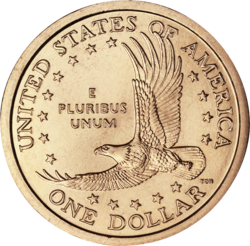
These coins have a copper core clad by manganese brass, giving them a distinctive golden color. The coin features an obverse designed by Glenna Goodacre of Sacagawea, the Shoshone guide of the Lewis and Clark Expedition, carrying her child. From 2000 to 2008, the reverse featured an eagle design by Thomas D. Rogers. Since 2009, the reverse of the Sacagawea dollar has been changed yearly, with each design in the series depicting a different aspect of Native American cultures. These coins are marketed as "Native American dollars".
The coin was introduced as a replacement for the Susan B. Anthony dollar, which proved useful for vending machine operators and mass transit systems despite being unpopular with the public. The Statue of Liberty was originally proposed as the design subject, but Sacagawea was eventually chosen.
The new dollar coin was heavily marketed by the Mint in a series of print, radio, and television advertisements, as well as Mint partnerships with Walmart and Cheerios. However, the Sacagawea dollar did not prove popular with the public, and mintage dropped sharply in the second year of production. Production of Sacagawea dollars continued, from 2007 to 2016, in parallel with the U.S. Presidential dollars. In 2012, mintage numbers were reduced by over 90%, in line with a similar reduction for the even less popular Presidential Dollars, because of large stockpiles of unused coins from that series.
The Mint planned to issue the Sacagawea design in 22-karat gold as well, but this idea was quickly abandoned after the Mint's authority to strike the coins was questioned, and the Mint has retained ownership of the few such coins produced. Soon after initial production of the dollar, it was noticed that a few of the dollar coins were erroneously struck with the obverse of a state quarter and the normal reverse. These coins, 2000 Sacagawea dollar – Washington quarter mules, are a rare example of a genuine accidental mule coin produced by the US Mint.
Because of the limited circulation of the cumbersome Eisenhower dollar, it was decided in 1977 that a smaller dollar coin might see improved circulation and prove more useful to the public. On September 26, 1978, Congress approved legislation to provide for a smaller dollar coin to be minted, which would depict Susan B. Anthony, a prominent American suffragette. These new dollars also proved unpopular, due in large part to their similarity in size and metallic composition to the quarter-dollar. Since there was little interest in the coin as a circulating medium, most were placed in United States Mint and Federal Reserve vaults throughout the country, and mintage ceased after 1981.
Despite their initial lack of popularity, by the mid-1990s the Treasury's supply of Anthony dollars began to dwindle due to their widespread use in vending machines (including more than 9,000 stamp machines situated in post offices across the United States) and increasing usage in mass transit systems throughout the country. Beginning in 1997, several bills were introduced to Congress with the intent of resuming mintage of small-sized dollar coins to keep up with demand. On March 20 of that year, Arizona Republican Representative Jim Kolbe introduced legislation calling for more dollar coins to be minted. Four months later, on July 24, Republican Representative Michael Castle of Delaware, a member of the House Subcommittee on Domestic and International Monetary Policy, also introduced legislation, calling for the Statue of Liberty to be the subject of the design. On October 21, Minnesota Republican Rod Grams introduced a bill in the Senate, also calling for the mintage of a newly designed dollar coin. The final legislation authorizing the design and production of a new dollar coin was based on Grams' bill. Also on October 21, in a hearing before the House Financial Services Subcommittee on Domestic and International Monetary Policy, Trade, and Technology, Treasury Department officials gave their support for a new dollar coin, recommending that it be gold-colored with a distinctive edge, to make it easily distinguishable from the quarter-dollar. During this hearing, Philip N. Diehl, then Director of the Mint, estimated that it would take thirty months to begin production of the new coin.
The United States Senate approved the necessary legislation on November 9, 1997, and the House of Representatives did the same on November 13. On December 1 President Bill Clinton signed the 50 States Commemorative Coin Program Act, which became Public Law 105–124. Section four of the act, which is entitled "United States $1 Coin Act of 1997", provided for a new dollar coin to be struck, stating in part: "The dollar coin shall be golden in color, have a distinctive edge, have tactile and visual features that make the denomination of the coin readily discernible". The act also gave authority to the Secretary of the Treasury to resume production of the Susan B. Anthony dollar to fill the demand for dollar coins until production could begin on the newly designed golden dollar. In total, more than 41 million Susan B. Anthony dollars were struck bearing the date 1999.
Sacagawea dollar
The Sacagawea dollar (also known as the "golden dollar") is a United States dollar coin introduced in 2000, but subsequently minted only for niche circulation from 2002 onward. The coin generally failed to meet consumer and business demands but it is still generally accepted in circulation.
These coins have a copper core clad by manganese brass, giving them a distinctive golden color. The coin features an obverse designed by Glenna Goodacre of Sacagawea, the Shoshone guide of the Lewis and Clark Expedition, carrying her child. From 2000 to 2008, the reverse featured an eagle design by Thomas D. Rogers. Since 2009, the reverse of the Sacagawea dollar has been changed yearly, with each design in the series depicting a different aspect of Native American cultures. These coins are marketed as "Native American dollars".
The coin was introduced as a replacement for the Susan B. Anthony dollar, which proved useful for vending machine operators and mass transit systems despite being unpopular with the public. The Statue of Liberty was originally proposed as the design subject, but Sacagawea was eventually chosen.
The new dollar coin was heavily marketed by the Mint in a series of print, radio, and television advertisements, as well as Mint partnerships with Walmart and Cheerios. However, the Sacagawea dollar did not prove popular with the public, and mintage dropped sharply in the second year of production. Production of Sacagawea dollars continued, from 2007 to 2016, in parallel with the U.S. Presidential dollars. In 2012, mintage numbers were reduced by over 90%, in line with a similar reduction for the even less popular Presidential Dollars, because of large stockpiles of unused coins from that series.
The Mint planned to issue the Sacagawea design in 22-karat gold as well, but this idea was quickly abandoned after the Mint's authority to strike the coins was questioned, and the Mint has retained ownership of the few such coins produced. Soon after initial production of the dollar, it was noticed that a few of the dollar coins were erroneously struck with the obverse of a state quarter and the normal reverse. These coins, 2000 Sacagawea dollar – Washington quarter mules, are a rare example of a genuine accidental mule coin produced by the US Mint.
Because of the limited circulation of the cumbersome Eisenhower dollar, it was decided in 1977 that a smaller dollar coin might see improved circulation and prove more useful to the public. On September 26, 1978, Congress approved legislation to provide for a smaller dollar coin to be minted, which would depict Susan B. Anthony, a prominent American suffragette. These new dollars also proved unpopular, due in large part to their similarity in size and metallic composition to the quarter-dollar. Since there was little interest in the coin as a circulating medium, most were placed in United States Mint and Federal Reserve vaults throughout the country, and mintage ceased after 1981.
Despite their initial lack of popularity, by the mid-1990s the Treasury's supply of Anthony dollars began to dwindle due to their widespread use in vending machines (including more than 9,000 stamp machines situated in post offices across the United States) and increasing usage in mass transit systems throughout the country. Beginning in 1997, several bills were introduced to Congress with the intent of resuming mintage of small-sized dollar coins to keep up with demand. On March 20 of that year, Arizona Republican Representative Jim Kolbe introduced legislation calling for more dollar coins to be minted. Four months later, on July 24, Republican Representative Michael Castle of Delaware, a member of the House Subcommittee on Domestic and International Monetary Policy, also introduced legislation, calling for the Statue of Liberty to be the subject of the design. On October 21, Minnesota Republican Rod Grams introduced a bill in the Senate, also calling for the mintage of a newly designed dollar coin. The final legislation authorizing the design and production of a new dollar coin was based on Grams' bill. Also on October 21, in a hearing before the House Financial Services Subcommittee on Domestic and International Monetary Policy, Trade, and Technology, Treasury Department officials gave their support for a new dollar coin, recommending that it be gold-colored with a distinctive edge, to make it easily distinguishable from the quarter-dollar. During this hearing, Philip N. Diehl, then Director of the Mint, estimated that it would take thirty months to begin production of the new coin.
The United States Senate approved the necessary legislation on November 9, 1997, and the House of Representatives did the same on November 13. On December 1 President Bill Clinton signed the 50 States Commemorative Coin Program Act, which became Public Law 105–124. Section four of the act, which is entitled "United States $1 Coin Act of 1997", provided for a new dollar coin to be struck, stating in part: "The dollar coin shall be golden in color, have a distinctive edge, have tactile and visual features that make the denomination of the coin readily discernible". The act also gave authority to the Secretary of the Treasury to resume production of the Susan B. Anthony dollar to fill the demand for dollar coins until production could begin on the newly designed golden dollar. In total, more than 41 million Susan B. Anthony dollars were struck bearing the date 1999.
Recent media
Recent media