
Recent from talks
Sacred Heart
Knowledge base stats:
Talk channels stats:
Members stats:
Sacred Heart
The Most Sacred Heart of Jesus (Latin: Cor Jesu Sacratissimum) is one of the most widely practised and well-known Catholic devotions, wherein the heart of Jesus Christ is viewed as a symbol of "God's boundless and passionate love for mankind". This devotion to Christ is predominantly used in the Catholic Church, followed by high church Anglicans, and some Western Rite Orthodox. In the Latin Church, the liturgical Solemnity of the Most Sacred Heart of Jesus is celebrated on the third Friday after Pentecost. The 12 promises of the Most Sacred Heart of Jesus are also popular.
The devotion is especially concerned with what the church deems to be the long-suffering love and compassion of the heart of Christ towards humanity. The popularization of this devotion in its modern form is derived from a Roman Catholic nun from France, Margaret Mary Alacoque, who said she learned the devotion from Jesus during a series of apparitions to her between 1673 and 1675, and later, in the 19th century, from the mystical revelations of another Catholic nun in Portugal, Mary of the Divine Heart, a religious sister of the congregation of the Good Shepherd, who requested in the name of Christ that Pope Leo XIII consecrate the entire world to the Sacred Heart of Jesus. Predecessors to the modern devotion arose unmistakably in the Middle Ages in various facets of Catholic mysticism, particularly with Gertrude the Great.
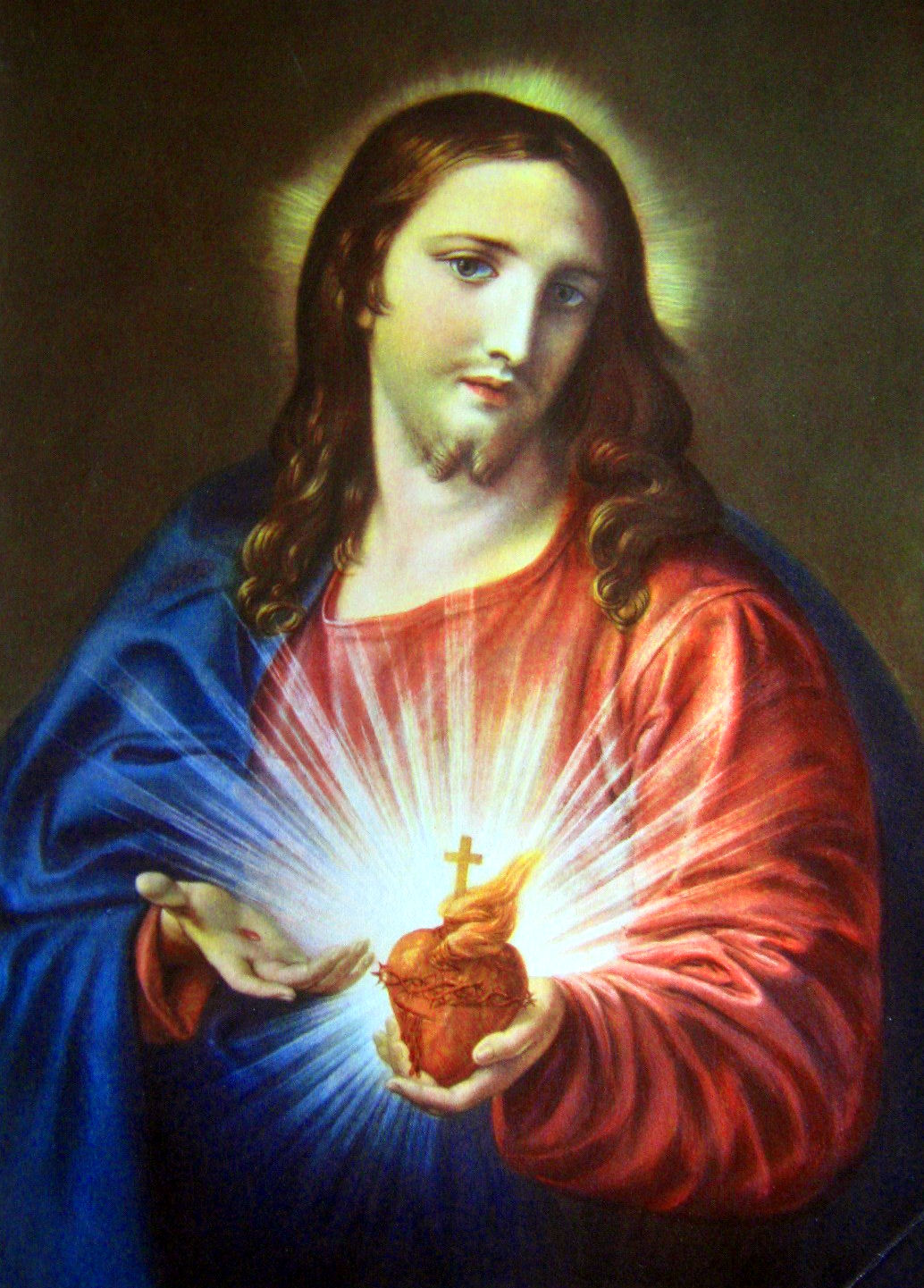
The Sacred Heart is often depicted in Christian art as a flaming heart shining with divine light, pierced by the lance-wound, encircled by the crown of thorns, surmounted by a cross, and bleeding. Sometimes, the image is shown shining within the bosom of Christ with his wounded hands pointing at the heart. The wounds and crown of thorns allude to the manner of Christ's passion, while the flames represent a furnace of ardent love.
Historically, the devotion to the Sacred Heart is an outgrowth of devotion to what is believed to be Christ's sacred humanity. During the first ten centuries of Christianity, there is nothing to indicate that any worship was rendered to the wounded Heart of Jesus. The revival of religious life and the zealous activity of Bernard of Clairvaux and Francis of Assisi in the twelfth and thirteenth centuries, together with the enthusiasm of the Crusaders returning from the Holy Land, gave a rise to devotion to the Passion of Jesus Christ and particularly to practices in honour of the Sacred Wounds.
Devotion to the Sacred Heart developed out of the devotion to the Holy Wounds, in particular to the Sacred Wound in the side of Jesus. The first indications of devotion to the Sacred Heart are found in the eleventh and twelfth centuries in the fervent atmosphere of the Benedictine or Cistercian monasteries. It is impossible to say with certainty what were its first texts or who were its first devotees.
Bernard of Clairvaux (d. 1153) said that the piercing of Christ's side revealed his goodness and the charity of his heart for humanity. The earliest known hymn to the Sacred Heart, "Summi Regis Cor Aveto", is believed to have been written by the Norbertine Herman Joseph (d. 1241) of Cologne, Germany. The hymn begins: "I hail Thee kingly Heart most high."
From the 13th to the 16th centuries, the devotion was propagated but it did not seem to have been embellished. It was everywhere practised by individuals and by different religious congregations, such as the Franciscans, Dominicans, and Carthusians. Among the Franciscans the devotion to the Sacred Heart of Jesus has its champions in Bonaventure (d. 1274) in his Vitis Mystica ("Mystic Vine") and John de la Verna. Bonaventure wrote: "Who is there who would not love this wounded heart? Who would not love in return Him, who loves so much?" It was, nevertheless, a private, individual devotion of the mystical order. Nothing of a general movement had been inaugurated, except for similarities found in the devotion to the Five Holy Wounds by the Franciscans, in which the wound in Jesus's heart figured most prominently.
Bonaventure's Opusculum 3, Lignum vitae (a part from which is the reading for the Divine Office on the Solemnity of the Sacred Heart) refers to the heart as the fountain from which God's love poured into one's life:
Hub AI
Sacred Heart AI simulator
(@Sacred Heart_simulator)
Sacred Heart
The Most Sacred Heart of Jesus (Latin: Cor Jesu Sacratissimum) is one of the most widely practised and well-known Catholic devotions, wherein the heart of Jesus Christ is viewed as a symbol of "God's boundless and passionate love for mankind". This devotion to Christ is predominantly used in the Catholic Church, followed by high church Anglicans, and some Western Rite Orthodox. In the Latin Church, the liturgical Solemnity of the Most Sacred Heart of Jesus is celebrated on the third Friday after Pentecost. The 12 promises of the Most Sacred Heart of Jesus are also popular.
The devotion is especially concerned with what the church deems to be the long-suffering love and compassion of the heart of Christ towards humanity. The popularization of this devotion in its modern form is derived from a Roman Catholic nun from France, Margaret Mary Alacoque, who said she learned the devotion from Jesus during a series of apparitions to her between 1673 and 1675, and later, in the 19th century, from the mystical revelations of another Catholic nun in Portugal, Mary of the Divine Heart, a religious sister of the congregation of the Good Shepherd, who requested in the name of Christ that Pope Leo XIII consecrate the entire world to the Sacred Heart of Jesus. Predecessors to the modern devotion arose unmistakably in the Middle Ages in various facets of Catholic mysticism, particularly with Gertrude the Great.
The Sacred Heart is often depicted in Christian art as a flaming heart shining with divine light, pierced by the lance-wound, encircled by the crown of thorns, surmounted by a cross, and bleeding. Sometimes, the image is shown shining within the bosom of Christ with his wounded hands pointing at the heart. The wounds and crown of thorns allude to the manner of Christ's passion, while the flames represent a furnace of ardent love.
Historically, the devotion to the Sacred Heart is an outgrowth of devotion to what is believed to be Christ's sacred humanity. During the first ten centuries of Christianity, there is nothing to indicate that any worship was rendered to the wounded Heart of Jesus. The revival of religious life and the zealous activity of Bernard of Clairvaux and Francis of Assisi in the twelfth and thirteenth centuries, together with the enthusiasm of the Crusaders returning from the Holy Land, gave a rise to devotion to the Passion of Jesus Christ and particularly to practices in honour of the Sacred Wounds.
Devotion to the Sacred Heart developed out of the devotion to the Holy Wounds, in particular to the Sacred Wound in the side of Jesus. The first indications of devotion to the Sacred Heart are found in the eleventh and twelfth centuries in the fervent atmosphere of the Benedictine or Cistercian monasteries. It is impossible to say with certainty what were its first texts or who were its first devotees.
Bernard of Clairvaux (d. 1153) said that the piercing of Christ's side revealed his goodness and the charity of his heart for humanity. The earliest known hymn to the Sacred Heart, "Summi Regis Cor Aveto", is believed to have been written by the Norbertine Herman Joseph (d. 1241) of Cologne, Germany. The hymn begins: "I hail Thee kingly Heart most high."
From the 13th to the 16th centuries, the devotion was propagated but it did not seem to have been embellished. It was everywhere practised by individuals and by different religious congregations, such as the Franciscans, Dominicans, and Carthusians. Among the Franciscans the devotion to the Sacred Heart of Jesus has its champions in Bonaventure (d. 1274) in his Vitis Mystica ("Mystic Vine") and John de la Verna. Bonaventure wrote: "Who is there who would not love this wounded heart? Who would not love in return Him, who loves so much?" It was, nevertheless, a private, individual devotion of the mystical order. Nothing of a general movement had been inaugurated, except for similarities found in the devotion to the Five Holy Wounds by the Franciscans, in which the wound in Jesus's heart figured most prominently.
Bonaventure's Opusculum 3, Lignum vitae (a part from which is the reading for the Divine Office on the Solemnity of the Sacred Heart) refers to the heart as the fountain from which God's love poured into one's life:
Recent media