Hubbry Logo
Sacred HeartSacred HeartMain
Open search
Sacred Heart
Community hub
Sacred Heart
logo
8 pages, 0 posts
0 subscribers
Be the first to start a discussion here.
Contribute something
Sacred Heart
Sacred Heart
from Wikipedia
Sacred Heart of Jesus, Church of Saint-Gervais-et-Saint-Protais, Paris, France

Key Information

The Most Sacred Heart of Jesus (Latin: Cor Jesu Sacratissimum) is one of the most widely practised and well-known Catholic devotions, wherein the heart of Jesus Christ is viewed as a symbol of "God's boundless and passionate love for mankind".[1] This devotion to Christ is predominantly used in the Catholic Church, followed by high church Anglicans, and some Western Rite Orthodox. In the Latin Church, the liturgical Solemnity of the Most Sacred Heart of Jesus is celebrated on the third Friday after Pentecost.[2] The 12 promises of the Most Sacred Heart of Jesus are also popular.

The devotion is especially concerned with what the church deems to be the long-suffering love and compassion of the heart of Christ towards humanity. The popularization of this devotion in its modern form is derived from a Roman Catholic nun from France, Margaret Mary Alacoque, who said she learned the devotion from Jesus during a series of apparitions to her between 1673 and 1675,[3] and later, in the 19th century, from the mystical revelations of another Catholic nun in Portugal, Mary of the Divine Heart, a religious sister of the congregation of the Good Shepherd, who requested in the name of Christ that Pope Leo XIII consecrate the entire world to the Sacred Heart of Jesus. Predecessors to the modern devotion arose unmistakably in the Middle Ages in various facets of Catholic mysticism, particularly with Gertrude the Great.[4]

Description

[edit]
Holy card depicting the Sacred Heart of Jesus, c. 1880. Auguste Martin collection, University of Dayton Libraries

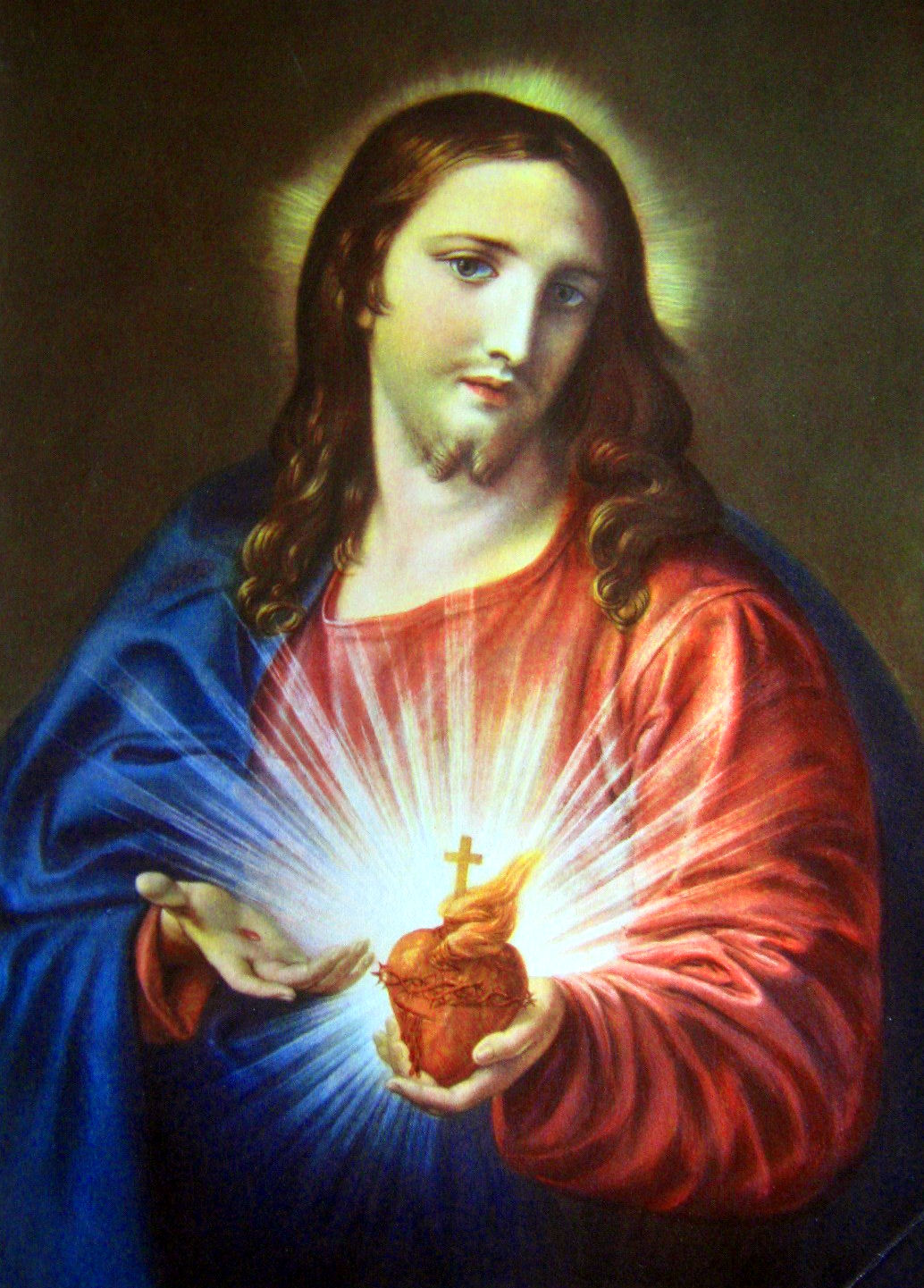
The Sacred Heart is often depicted in Christian art as a flaming heart[5] shining with divine light, pierced by the lance-wound, encircled by the crown of thorns, surmounted by a cross, and bleeding. Sometimes, the image is shown shining within the bosom of Christ with his wounded hands pointing at the heart. The wounds and crown of thorns allude to the manner of Christ's passion, while the flames represent a furnace of ardent love.[6]

History of the devotion

[edit]
Sacred Heart of Jesus, Portuguese painting from the 19th century

Early devotion

[edit]

Historically, the devotion to the Sacred Heart is an outgrowth of devotion to what is believed to be Christ's sacred humanity.[7] During the first ten centuries of Christianity, there is nothing to indicate that any worship was rendered to the wounded Heart of Jesus.[8] The revival of religious life and the zealous activity of Bernard of Clairvaux and Francis of Assisi in the twelfth and thirteenth centuries, together with the enthusiasm of the Crusaders returning from the Holy Land, gave a rise to devotion to the Passion of Jesus Christ and particularly to practices in honour of the Sacred Wounds.[9]

Devotion to the Sacred Heart developed out of the devotion to the Holy Wounds, in particular to the Sacred Wound in the side of Jesus. The first indications of devotion to the Sacred Heart are found in the eleventh and twelfth centuries in the fervent atmosphere of the Benedictine or Cistercian monasteries.[10] It is impossible to say with certainty what were its first texts or who were its first devotees.

Bernard of Clairvaux (d. 1153) said that the piercing of Christ's side revealed his goodness and the charity of his heart for humanity. The earliest known hymn to the Sacred Heart, "Summi Regis Cor Aveto", is believed to have been written by the Norbertine Herman Joseph (d. 1241) of Cologne, Germany. The hymn begins: "I hail Thee kingly Heart most high."

From the 13th to the 16th centuries, the devotion was propagated but it did not seem to have been embellished. It was everywhere practised by individuals and by different religious congregations, such as the Franciscans, Dominicans, and Carthusians. Among the Franciscans the devotion to the Sacred Heart of Jesus has its champions in Bonaventure (d. 1274) in his Vitis Mystica ("Mystic Vine") and John de la Verna.[11] Bonaventure wrote: "Who is there who would not love this wounded heart? Who would not love in return Him, who loves so much?"[12] It was, nevertheless, a private, individual devotion of the mystical order. Nothing of a general movement had been inaugurated, except for similarities found in the devotion to the Five Holy Wounds by the Franciscans, in which the wound in Jesus's heart figured most prominently.

Bonaventure's Opusculum 3, Lignum vitae (a part from which is the reading for the Divine Office on the Solemnity of the Sacred Heart) refers to the heart as the fountain from which God's love poured into one's life:

Take thought now, redeemed man, and consider how great and worthy is he who hangs on the cross for you. His death brings the dead to life, but at his passing heaven and earth are plunged into mourning and hard rocks are split asunder. It was a divine decree that permitted one of the soldiers to open his sacred side with a lance. This was done so that the Church might be formed from the side of Christ as he slept the sleep of death on the cross, and so that the Scripture might be fulfilled: 'They shall look on him whom they pierced'. The blood and water, which poured out at that moment, were the price of our salvation. Flowing from the secret abyss of our Lord's heart as from a fountain, this stream gave the sacraments of the Church the power to confer the life of grace, while for those already living in Christ it became a spring of living water welling up to life everlasting.[13]

Lutgarde

[edit]

According to Thomas Merton, Lutgarde (d. 1246), a Cistercian mystic of Aywieres, Belgium, was one of the great precursors of the devotion to the Sacred Heart of Jesus. A contemporary of Francis of Assisi, she "entered upon the mystical life with a vision of the pierced Heart of the Saviour, and had concluded her mystical espousals with the Incarnate Word by an exchange of hearts with Him."[14] Sources say that Christ came in a visitation to Lutgarde, offering her whatever gift of grace she should desire; she asked for a better grasp of Latin, that she might better understand the word of God and sing God's praise. Christ granted her request and Lutgarde's mind was flooded with the riches of psalms, antiphons, readings, and responsories. However, a painful emptiness persisted. She returned to Christ, asking to return his gift, and wondering if she might, just possibly, exchange it for another. "And for what would you exchange it?" Christ asked. "Lord, I would exchange it for your Heart." Christ then reached into Lutgarde and, removing her heart, replaced it with his own, at the same time hiding her heart within his breast.[15]

Mechtilde

[edit]

Mechtilde of Helfta (d. 1298) became an ardent devotee and promoter of Jesus' heart after it was the subject of many of her visions. The idea of hearing the heartbeat of God was very important to medieval saints who nurtured devotion to the Sacred Heart.[16] Mechtilde reported that Jesus appeared to her in a vision and commanded her to love him ardently, and to honor his sacred heart in the Blessed Sacrament as much as possible. He gave her his heart as a pledge of his love, as a place of refuge during her life and as her consolation at the hour of her death. From this time Mechtilde had an extraordinary devotion for the Sacred Heart, and said that if she had to write down all the favors and all the blessings which she had received by means of this devotion, a large book would not contain them.[17]

Gertrude

[edit]
Mystic Ecstasy of St. Gertrude the Great – worshipper of the Sacred Heart of Jesus Christ (picture by Pietro Liberi, at the Abbey of Santa Giustina, Padua, Italy)

Gertrude the Great was an early devotee of the Sacred Heart of Jesus.[18] Book 2 of the Herald of Divine Love (Latin: Legatus divinæ pietatis) vividly describes Gertrude's visions, which show a considerable elaboration on the hitherto ill-defined veneration of Christ's heart. Bernard articulated this in his commentary on the Song of Songs. The women of Helfta – Gertrude foremost, who surely knew Bernard's commentary, and to a somewhat lesser extent the two Mechthildes – experienced this devotion centrally in their mystical visions.[19]

In the 16th century, the devotion passed from the domain of mysticism into that of Christian asceticism. It was established as a devotion with prayers already formulated and special exercises, found in the writings of Lanspergius (d. 1539) of the Carthusians of Cologne, the Benedictine Louis de Blois (d. 1566) Abbot of Liessies in Hainaut, John of Avila (d. 1569), and Francis de Sales (d. 1622).

The historical record from that time shows an early bringing to light of the devotion. Ascetic writers spoke of it, especially those of the Society of Jesus (Jesuits). The image of the Sacred Heart of Jesus was everywhere in evidence, largely due to the Franciscan devotion to the Five Wounds and to the Jesuits placing the image on the title-page of their books and on the walls of their churches.

The first to establish the theological basis for the devotion was Polish Jesuit Kasper Drużbicki (1590–1662) in his book Meta cordium – Cor Jesu (The goal of hearts – Heart of Jesus). Not much later John Eudes wrote an office, and promoted a feast for it. John Eudes is regarded as "tireless apostle of the devotion of the Sacred Hearts",[20] entitling him as 'Father', doctor and apostle of the liturgical cult of the hearts of Jesus and Mary.[21]

Little by little, the devotion to the Sacred Hearts became distinct, and on 31 August 1670 the first feast of the Sacred Heart of Jesus was celebrated in the Grand Seminary of Rennes. Coutances followed suit on October 20, a day with which the Eudist feast was from then on to be connected. The feast soon spread to other dioceses, and the devotion was likewise adopted in various religious communities. It gradually came into contact with the devotion begun by Margaret Mary Alacoque at Paray-le-Monial, and the two merged.

Margaret Mary Alacoque

[edit]
Picture of the Sacred Heart being adored by Margaret Mary Alacoque and Mary of the Divine Heart

The most significant source for the devotion to the Sacred Heart in the form it is known today was Margaret Mary Alacoque (1647–1690), a nun of the Order of the Visitation of Holy Mary, who claimed to have received Sacred Heart revelations from Jesus Christ between 1673 and 1675 in the Burgundian French village of Paray-le-Monial.

The first apparition took place on 27 December 1673, the day of the feast of Saint John the Evangelist, during which Jesus allowed Margaret Mary to rest her head upon his heart, telling her that he wanted to make his love known to all mankind and that he had chosen her to spread the devotion to his Sacred Heart. Right after this, she had a vision of his heart with a crown of thorns, surrounded by flames and above which a cross was planted.[22] This representation will become the popular image of the Sacred Heart which Margaret Mary used to propagate the devotion.

Between 1674 and 1675, other apparitions followed in which Jesus Christ revealed to Alacoque different forms of devotion to the Sacred Heart. The First Fridays Devotion, which is the reception of Holy Communion on nine first Fridays of each month, was revealed to her through a "Great Promise" of final penance granted to those who practice this act of reparation.[23] Margaret Mary also said that she was instructed to spend an hour every Thursday night, from eleven to midnight, to pray and meditate on Jesus' agony in the Garden of Gethsemane. Her prayers intended to ask mercy for sinners as well as to make reparation for the abandonment Jesus felt from his apostles in the garden. This practice is now known as the "Holy Hour"[24] and is also frequently performed during an hour of Eucharistic adoration.

During the octave of Corpus Christi in 1675, probably on June 16, the vision known as the "great revelation" reportedly took place, where Jesus said: "Behold the heart which has so loved men that it has spared nothing, even to exhausting and consuming itself, in order to testify its love; and in return, I receive from the greater part only ingratitude, by their irreverence and sacrilege, and by the coldness and contempt they have for me in this sacrament of love."[25] He then asked Margaret Mary for a feast of reparation of the Friday after the octave of Corpus Christi, bidding her consult her confessor Claude de la Colombière, then superior of the small Jesuit house at Paray-le-Monial.[26] This request was transmitted and the feast of the Sacred Heart was progressively instituted throughout the Church. The feast later became a solemnity in the liturgical calendar, a feast of the highest rank, celebrated eight days after the Feast of Corpus Christi just as Jesus requested. On 21 June 1675, following that apparition, Claude consecrated himself to the Sacred Heart, making him the first person to be consecrated to the Sacred Heart of Jesus after Margaret Mary, and began spreading the devotion.[27][28]

De la Colombière directed her to write an account of the apparitions, which he discreetly circulated in France and England. After his death on 15 February 1682, his journal of spiritual retreats was found to contain a copy in his handwriting of the account that he had requested of Margaret Mary, together with a few reflections on the usefulness of the devotion. This journal, including the account – an "offering" to the Sacred Heart in which the devotion was explained – was published at Lyon in 1684. The little book was widely read, especially at Paray-le-Monial. Margaret Mary reported feeling "dreadful confusion" over the book's contents, but resolved to make the best of it, approving of the book for the spreading of her cherished devotion. Along with the Visitandines, priests, religious, and laymen espoused the devotion, particularly the Capuchins. The reported apparitions served as a catalyst for the promotion of the devotion to the Sacred Heart.[29] In 1691 Jesuit priest John Croiset wrote a book called De la Dévotion au Sacré Cœur, and Joseph de Gallifet promoted the devotion. The mission of propagating the new devotion was especially confided to the religious of the Visitation and to the priests of the Society of Jesus.

Promises Given to Margaret Mary Alacoque

[edit]

Alacoque said that in her apparitions Jesus promised specific blessings to those who practice devotion to his Sacred Heart. The last promise, also called the "Great Promise", is a promise of final penance granted to those who practice the First Fridays Devotion.

  1. I will give them all the graces necessary for their state of life.
  2. I will give peace in their families.
  3. I will console them in all their troubles.
  4. I will be their refuge in life and especially in death.
  5. I will abundantly bless all their undertakings.
  6. Sinners shall find in my Heart the source and infinite ocean of mercy.
  7. Tepid souls shall become fervent.
  8. Fervent souls shall rise speedily to great perfection.
  9. I will bless those places wherein the image of My Sacred Heart shall be exposed and venerated.
  10. I will give to priests the power to touch the most hardened hearts.
  11. Persons who propagate this devotion shall have their names eternally written in my Heart.
  12. In the excess of the mercy of my Heart, I promise you that my all powerful love will grant to all those who will receive Communion on the first Friday, for nine consecutive months, the grace of final repentance: they will not die in my displeasure, nor without receiving the sacraments; and my Heart will be their secure refuge in that last hour.

Mary of the Divine Heart

[edit]

Another source for the devotion to the Sacred Heart of Jesus was Mary of the Divine Heart (1863–1899), a religious sister from the Congregation of Our Lady of Charity of the Good Shepherd, who reported to have received several interior locutions and visions of Jesus Christ. The first interior locution Mary of the Divine Heart reported was during her youth spent with the family in the Castle of Darfeld [de], near Münster, Germany, and the last vision and private revelation was reported during her presence as mother superior in the Convent of the Sisters of the Good Shepherd in Porto, Portugal.

Based on the messages she said she received in her revelations of Christ, on 10 June 1898 her confessor at the Good Shepherd monastery wrote to Pope Leo XIII stating that Mary of the Divine Heart had received a message from Christ, requesting the pope to consecrate the entire world to the Sacred Heart. The pope initially attached no credence to it and took no action. However, on 6 January 1899 she sent another letter asking that in addition to the consecration, the first Fridays of the month be observed in honor of the Sacred Heart.

Mary of the Divine Heart died in her monastery in Portugal when the church was singing the first vespers of the Sacred Heart of Jesus on 8 June 1899. The following day, in Annum sacrum, Pope Leo XIII consecrated the entire world to the Sacred Heart of Jesus.

Church of the Sacred Heart of Jesus

[edit]

Mary of the Divine Heart said that in her mystical experiences Jesus Christ inspired her to build a shrine dedicated to his Sacred Heart. According to the writings of Sister Mary of the Divine Heart, Jesus said: "I will make it a place of graces. I will distribute copiously graces to all who live in this house [the convent], those who live here now, those who will live here after, and even to their relatives."[30]

She did not live to see this come to fruition. The imposing Church of the Sacred Heart of Jesus (also referred as Church of the Good Shepherd or Sanctuary of the Sacred Heart of Jesus) was built between 14 July 1957 and 21 April 1966, in the civil parish of Ermesinde in north Portugal, and consecrated to the Heart of Christ in fulfillment of the vow made by the nun. She is buried in the Church of the Sacred Heart of Jesus in Ermesinde.

Papal approval

[edit]
Jesus embracing all
The Sacred Heart of Jesus with the Jesuit priest Bernardo de Hoyos

In 1353, Pope Innocent VI instituted a Mass honoring the mystery of the Sacred Heart.[29]

In 1693 the Holy See imparted indulgences to the Confraternities of the Sacred Heart, and in 1697 granted the feast to the Visitandines with the Mass of the Five Wounds, but refused a feast common to all, with special Mass and Office. The devotion spread, particularly in religious communities. The Marseille plague in 1720 furnished perhaps the first occasion for a solemn consecration and public worship outside of religious communities. Other cities of southern Europe followed the example of Marseille.

After Pope Leo XIII received correspondence from Mary of the Divine Heart asking him to consecrate the entire world to the Sacred Heart of Jesus, he commissioned a group of theologians to examine the petition on the basis of revelation and sacred tradition. The outcome of this investigation was positive, and in 1899 he decreed that the consecration of the entire human race to the Sacred Heart of Jesus should take place on 11 June 1899. The encyclical letter also encouraged the entire Roman Catholic episcopate to promote the First Friday Devotions, established June as the Month of the Sacred Heart, and included the Prayer of Consecration to the Sacred Heart.[31] The idea of this act, which Leo XIII called "the great act" of his pontificate.

Pope Pius X decreed that the consecration of the human race performed by Leo XIII be renewed each year. Pius X also granted a Pontifical decree for the imposition of a golden crown to the lowly foot of a statue of the Sacred Heart of Jesus in the Nevers Cathedral on 9 July 1908 (via the Archbishop of Nevers and Besancon, Francois Leon Gauthey, both signed and notarized by the Sacred Congregation of Rites).

Pope Pius XI affirmed the church's position with respect to Margaret Mary Alacoque's visions of Jesus Christ by stating that Jesus had "manifested Himself" to Alacoque and had "promised her that all those who rendered this honor to his Heart would be endowed with an abundance of heavenly graces".[32] His encyclical letter Miserentissimus Redemptor (1928) reaffirmed the importance of consecration and reparation to the Sacred Heart of Jesus.

By inserting the "Great Promise" of the First Fridays Devotion into the Bull of Canonization of Margaret Mary Alacoque on 13 May 1920, Pope Benedict XV encouraged the practice of this act of reparation of the first nine fridays in honor of the Sacred Heart.[33]

Pope Pius XII, on the occasion of the 100th anniversary of Pius IX's institution of the feast, instructed the entire Latin Church at length on the devotion to the Sacred Heart in his encyclical letter Haurietis aquas of 15 May 1956. On 15 May 2006, the 50th anniversary of that encyclical, Pope Benedict XVI sent a letter to Peter Hans Kolvenbach, the Superior General of the Society of Jesus, reaffirming the importance of the devotion to the Sacred Heart of Jesus. On 24 October 2024, Pope Francis published his fourth encyclical, the 28,000-word Dilexit nos ("He loved us"), which reflects on the philosophical and theological meaning of "the heart" and addresses the importance of the devotion to the Sacred Heart in a contemporary context.[34][35]

Worship and devotion

[edit]
Sacred Heart at the centre of a rose window, Parish of the Immaculate Conception, São Paulo, Brazil
Stained-glass window with the Sacred Heart of Jesus in a parish church in Southern Germany

Worship of the Sacred Heart mainly consists of several devotions, practices, consecrations, hymns, the salutation of the Sacred Heart, and the Litany of the Sacred Heart. It is common in Roman Catholic services.

Since c. 1850, groups, congregations, and countries have consecrated themselves to the Sacred Heart.

By a law voted on 24 July 1873, the Basilica of the Sacred Heart of Montmartre known as National Vow, is declared of public utility by the National Assembly of 1871. On 16 June 1875, the Archbishop of Paris, Cardinal Guibert laid the first stone of the basilica, honoring after two hundred years the fourth request of Jesus reported by Margaret Mary Alacoque from 16 June 1675.[36]

On 25 March 1874, by petition of president Gabriel García Moreno and archbishop José Ignacio Checa y Barba, Ecuador was the first country in the world to be consecrated to the Sacred Heart by legislative decree.[37][38][39][40] Since then, more than twenty countries have followed and consecrated themselves either by decree or at the initiative of their respective national Church, some of which renewed their consecration a few times.[41][42] On 22 June 1902, Colombia was consecrated by decree with the agreement of president José Manuel Marroquín.[43][44][45] On 30 May 1919, Spain was officially consecrated to the Sacred Heart by King Alfonso XIII.[46][47][48][49]

Statue of the Sacred Heart of Jesus in the Sanctuary of the Apparitions of Pontevedra

In the Catholic tradition, the Sacred Heart has been closely associated with Acts of Reparation to Jesus Christ. In his encyclical Miserentissimus Redemptor, Pope Pius XI stated: "The spirit of expiation or reparation has always had the first and foremost place in the worship given to the Most Sacred Heart of Jesus."[50] The Golden Arrow Prayer directly refers to the Sacred Heart.

Feast day

[edit]

The Feast of the Sacred Heart is a solemnity in the liturgical calendar of the Latin Church. It is celebrated on the third Friday after Pentecost, which was up until the changes in the General Roman Calendar of Pope Pius XII referred to as the Friday after the octave of Corpus Christi. It is the last feast day of the year that is dependent on the date of Easter. The acts of consecration, reparation, and devotion were introduced when the feast of the Sacred Heart was declared. Some Anglican Franciscans keep the feast under the name (The) Divine Compassion of Christ.[51]

Month of the Sacred Heart

[edit]

The month of June is traditionally devoted in a special way to the veneration of the Sacred Heart.[52][53][54] Masses, novenas, and the recitation of devotional prayers in honor of the Sacred Heart are traditionally observed.

Act of Consecration to the Sacred Heart

[edit]

A personal prayer of consecration to the Sacred Heart was written by Saint Margaret Mary Alacoque,[55] allegedly under the inspiration of Jesus, which she sent to the priest John Croiset, recommending that he include it in the book he was to publish about her revelations, claiming "It comes from Him [Jesus], and He would not agree to its omission."[56]

On 25 May 1899, Pope Leo XIII wrote an Act of Consecration of the Human Race to the Sacred Heart in his encyclical letter Annum sacrum,[57] with the influence of Mary of the Divine Heart and in response to demands received over 25 years.

On 19 May 1908, a particular family consecration prayer known as the Act of Consecration of the Family to the Sacred Heart was approved and granted with an indulgence by Pope Pius X.[58][59]

First Fridays Devotion

[edit]

The First Fridays Devotion is a devotion to offer reparations for sins to the Eucharist and in honor of the Sacred Heart, which had its origin in the apparitions of Christ reported by Margaret Mary Alacoque. This devotion to the Sacred Heart of Jesus was fully approved by the Catholic Church[33] and a "Great Promise" of final penance was made to those who practice the First Fridays Devotion. The devotion consists of several practices that are performed on the first Fridays of nine consecutive months. On these days, a person is to attend Mass and receive the Eucharist. If the need arises, in order to receive communion in a state of grace, a person should also make use of the sacrament of penance before attending Mass.[60]

Holy Hour

[edit]

Alacoque stated that she received a vision of Jesus in which she was instructed to spend an hour every Thursday night as a reparation and to pray and meditate on his agony in the Garden of Gethsemane.[61] This practice later became widespread among Catholics and became the devotion of the Holy Hour, a devotional tradition of spending an hour in prayers or in Eucharistic adoration in the presence of the Eucharist.

Enthronement of the Sacred Heart of Jesus

[edit]

The act of enthroning the Sacred Heart entails placing an image of the Sacred Heart of Jesus in a place of honor in the home after a time of prayerful preparation.[62] Many families will also place an image of the Immaculate Heart of Mary in tandem with the Sacred Heart image.[63][a]

The practice of the home enthronement of the Sacred Heart was started by R. Mateo Crawley-Boevey, a priest of the Congregation of the Sacred Hearts of Jesus and Mary, in 1907, having visited the apparition chapel in Paray-le-Monial.[66]

Enthronement of the Sacred Heart is promoted by the National Enthronement Center in Fairhaven, Massachusetts,[67] the Sacred Heart Apostolate of Knoxville, Tennessee, Sacred Heart Columbus in Columbus, Ohio,[68] and the Sacred Heart Enthronement Network, a 501(c)(3) located in Columbus, Ohio.[69] It is also endorsed by the World Apostolate of Fátima.

Scapular of the Sacred Heart

[edit]
Model of the Scapular of the Sacred Heart revealed by the Virgin Mary to Estelle Faguette in Pellevoisin

The Scapular of the Sacred Heart and the Scapular of the Sacred Hearts of Jesus and Mary are devotional articles worn by some Catholics.[70]

An early form of the Scapular of the Sacred Heart were cloth badges bearing an image of the Heart of Jesus. made and distributed by Margaret Mary Alacoque.[70] Following the claims by Estelle Faguette that the Virgin Mary had appeared to her at Pellevoisin in 1876 and requested a scapular of the Sacred Heart of Jesus, a scapular of the proposed design was approved by the Congregation of Rites in 1900. It bears the representation of the Sacred Heart of Jesus on one side and that of the Virgin Mary under the title of Mother of Mercy on the other side.[71]

Prayers

[edit]

The Litany of the Sacred Heart of Jesus is common in Roman Catholic services and occasionally is found in Anglican services.

There is also a Morning offering to the Sacred Heart.

Alliance with the Immaculate Heart

[edit]
John Eudes defended the mystical unity of the Sacred Heart of Jesus and Immaculate Heart of Mary.

The "Alliance of the Hearts of Jesus and Mary" is a phrase coined by Pope John Paul II during his Angelus Address of September 15, 1985 when he mentioned that devotion to the Sacred Heart of Jesus and to the Immaculate Heart of Mary, "...though distinct, they are interrelated...."[72] symposia were held on the concept during the 1980s and 1990s.[73]

It was not until the seventeenth century when devotion to the Immaculate Heart of Mary was popularized by John Eudes. Although Eudes always associated the two Hearts, he began his devotional teachings with the Heart of Mary, and then extended it to the Sacred Heart of Jesus.[74]

In the eighteenth and nineteenth centuries both devotions grew, particularly through the popularity of the Miraculous Medal, depicting the Heart of Jesus thorn-crowned and the Heart of Mary pierced with a sword.[75] The devotions and associated prayers grew into the twentieth century through the reported messages of Our Lady of Fátima saying that the Heart of Jesus wishes to be honored together with the Heart of Mary.[76] In the 1956 encyclical Haurietis aquas, Pope Pius XII encouraged both devotions.

The Sacred Heart crowned with thorns, appearing on the Miraculous Medal

Sacred Heart imagery

[edit]

The Sacred Heart crowned with thorns is depicted on the reverse side of the Miraculous Medal,[77]

The Carillon-Sacré-Coeur flag has been adopted by the Société Saint-Jean-Baptiste in Québec.

Religious imagery depicting the Sacred Heart is frequently featured in homes. Ireland was consecrated to the Sacred Heart on Passion Sunday 1873 by the bishops of Ireland, which led to the Sacred Heart lamp becoming a common devotional object in Irish homes.[78] Sometimes the image is part of a set, along with the Immaculate Heart of Mary. However, the Sacred Congregation of Rites stated in 1879 that images of the hearts of Jesus or Mary were not appropriate for being placed on the altar for Mass, although are appropriate for "private devotion".[79]

Institutions and religious congregations

[edit]

Sacred Heart is a name used for many Catholic institutions, including schools, colleges, and hospitals in many countries. It is also the name of many Catholic parishes, and religious congregations.

Peter Coudrin of France founded the Congregation of the Sacred Hearts of Jesus and Mary on 24 December 1800. A religious order of the Latin Church, the order carried out missionary work in Hawaii.[80] Clelia Merloni from Forlì (Italy) founded the Congregation of the Apostles of the Sacred Heart of Jesus in Viareggio, Italy, on 30 May 1894.[81] There are numerous other religious orders named after or inspired by the Sacred Heart: Pope Francis acknowledges that it would be "an endless undertaking" to list them all.[82]

[edit]

In Eastern Catholicism

[edit]

Devotion to the Sacred Heart may be found in some Eastern Catholic Churches, particularly the Ukrainian.[83] Others see it as an example of liturgical Latinisation. Many Eastern churches observe a comparable feast of "Jesus, Lover of Mankind", celebrated on July 17.

See also

[edit]

Notes

[edit]

References

[edit]

Sources

[edit]
  • Bainvel, Jean Vincent (1910). "Devotion to the Heart of Jesus" . In Herbermann, Charles (ed.). Catholic Encyclopedia. Vol. 7. New York: Robert Appleton Company.
  • Chasle, Louis; Sister Mary of the Divine Heart Droste zu Vischering, religious of the Good Shepherd, 1863–1899. Burns & Oates, London, 1906.

Further reading

[edit]
[edit]
Revisions and contributorsEdit on WikipediaRead on Wikipedia
from Grokipedia
The of refers to the physical heart of Christ as a of his divine and for humanity, encompassing his merciful , sacrificial redemption, and invitation to reciprocal . In , it represents the core of ' person, where his humanity and divinity unite, serving as a "natural sign and of his boundless " that draws believers into deeper union with . This devotion emphasizes , reparation for sins, and imitation of Christ's charity, fostering spiritual renewal amid suffering. The devotion has deep roots in Scripture and early Christian tradition, evolving through meditation on Christ's wounds and passion, as seen in the writings of and medieval mystics like St. Gertrude the Great in the 13th century. It gained prominence in the 17th century through the visions of St. Margaret Mary Alacoque, who received private revelations from 1673 to 1675 promoting practices such as First Friday devotions and the Twelve Promises of the Sacred Heart, including graces for those who honor it. St. John Eudes further advanced its liturgical expression by composing offices and masses in its honor around 1670. The Church formally extended the feast to the universal calendar in 1856 under Blessed Pope Pius IX, establishing it as a celebrated on the Friday following the octave of Corpus Christi. Papal teachings have continually underscored its doctrinal importance, with Pope Leo XIII consecrating the world to the Sacred Heart in 1899 and Pope Pius XII issuing the encyclical Haurietis Aquas in 1956 to commemorate its centennial, affirming it as a remedy for modern spiritual ailments through and neighbor. More recently, ' 2024 encyclical Dilexit Nos renews the devotion for contemporary challenges, portraying the Sacred Heart as a source of consolation in a world marked by war, indifference, and alienation, calling for its integration into evangelization and to build a "civilization of ." This enduring practice, recognized in the (CCC 2669), invites the faithful to encounter Christ's threefold —divine, spiritual, and human—through prayer, , and acts of mercy.

Description and Theological Foundations

Core Description

The Sacred Heart of Jesus refers to the physical heart of Christ as a profound of his divine and human love for humanity, embodying boundless and that flows from the Incarnate Word. In , it represents the unified and man within , serving as the chief sign of the Redeemer's charity toward the Father and all people, pierced for sins and . This devotion honors the Heart as a "natural sign and " of infinite love, inviting contemplation of Christ's self-emptying gift. Iconographically, the Sacred Heart is typically depicted as a flaming heart, signifying ardent love, pierced by a to recall the Passion, encircled by a representing suffering, and surmounted by a emblematic of redemptive , often radiating to denote divine glory. These elements collectively portray the Heart as a "fiery furnace" and source of grace, wounded yet alive with . The term "Sacred Heart," from the Latin Cor Sacratissimum, draws its origins from scriptural imagery, particularly :34, where a soldier's pierces ' side, releasing blood and water as symbols of the sacraments and the Church born from his love. Unlike other Christological devotions such as the Five Wounds, which emphasize the physical marks of the Passion, or the Holy Face, focusing on Christ's visage, the Sacred Heart uniquely highlights the heart as the seat of emotions, affections, and the intimate unity of divine and human natures in Christ. This focus underscores its role within Catholic as the expressive core of God's merciful outreach.

Theological Significance

The devotion to the Sacred Heart of Jesus draws its primary scriptural foundations from both the Old and New Testaments, emphasizing themes of divine renewal, sacrifice, and merciful love. In the Old Testament, Ezekiel 36:26 prophesies God's promise to remove the heart of stone and give a heart of flesh, symbolizing spiritual transformation and the infusion of divine love through the Holy Spirit. This imagery finds fulfillment in the New Testament, particularly in John 19:37, which cites Zechariah 12:10 to describe the piercing of Jesus' side on the cross, from which blood and water flow as signs of redemption and the birth of the Church. Similarly, Revelation 1:7 echoes this piercing, portraying Christ as the one whom all will see, underscoring the universal visibility of his sacrificial love. Theologically, the Sacred Heart symbolizes God's infinite love, understood as —a selfless, divine charity that culminates in Christ's passion and offers to humanity. This devotion highlights the , wherein Christ's human heart, united inseparably with his divine nature, manifests the Incarnate Word's self-emptying () and amid suffering, bridging the gap between God and humankind. It also emphasizes reparation for sins, inviting believers to unite their offerings with Christ's sacrifice to atone for offenses against divine love and restore communion with God. Early laid interpretive groundwork for these themes, viewing the pierced heart as the origin of the Church and its sacraments. St. Augustine, in his commentary on John, described the lance's thrust into Christ's side as opening the "gate of life," from which the sacraments of (water) and (blood) flow, establishing the Church as born from this wound. St. Bernard of Clairvaux further developed this by portraying the pierced side as revealing Christ's heart—a refuge of charity and the dwelling place for the faithful—linking it directly to the as the font of grace and spiritual nourishment. The Sacred Heart integrates seamlessly with core Catholic doctrines, particularly the , where God's assumption of human nature reveals love's tangible depth; the Redemption, as Christ's universal counters sin's rupture; and the theology of , offering abundant grace for salvation despite human frailty. This devotion emerged historically to counter Jansenism's rigorist denial of and sufficient grace, affirming instead God's tender, inclusive love that empowers all to respond freely.

Historical Development

Early Devotions in the Middle Ages

The devotion to the Sacred Heart emerged in the within Benedictine and Cistercian monastic circles, particularly in regions like the and , as part of the broader movement of affective that emphasized emotional engagement with Christ's humanity and suffering. This style of devotion, influenced by bridal mysticism portraying the soul's intimate union with Christ as a , fostered contemplative practices focused on the heart as a symbol of divine love and . Pioneering figures in these orders laid the groundwork through personal visions, drawing on earlier Cistercian emphases on Christ's Passion seen in writers like . One of the earliest recorded instances occurred with St. Lutgarde of Aywières (1182–1246), a Cistercian in modern-day , who experienced a vision around 1200 in which Christ offered her his heart in exchange for hers, symbolizing a mystical union of love. This exchange, detailed in her vita by Thomas of Cantimpré, marked her as a foundational promoter of heart-centered devotion, influencing subsequent mystics and emphasizing reparation through affective prayer. Lutgarde's experiences, including ecstasies and , integrated the heart into her contemplative life, portraying it as a refuge of divine affection amid personal trials. At the Benedictine convent of Helfta in 13th-century , St. Mechtilde of Hackeborn (1241–1298) received visions documented in The Book of Special Grace, where Christ's heart appeared as a "furnace of charity" radiating love and inviting specific prayers for spiritual purification. Similarly, St. Gertrude the Great (1256–1302), her contemporary at Helfta, described in The Herald of Divine Love the heart as the inexhaustible source of divine graces, including a prayer of reparation for sins that invoked its merciful outpouring. These revelations, shared among the nuns, highlighted the heart's role in Eucharistic devotion and personal sanctification, blending bridal imagery with calls for heartfelt . While primarily private and mystical, these devotions began appearing in liturgical precursors during the , with references to the heart integrated into some monastic missals and gradually adopted in personal prayer books like for contemplative use. Such inclusions, often in Cistercian and Benedictine contexts, reflected a slow permeation from visionary experiences into communal worship aids, though without formalized feasts.

Revival Through Key Mystics

The revival of devotion to the Sacred Heart in the 17th and 18th centuries was profoundly shaped by several key figures, beginning with St. John Eudes (1601–1680), a French priest and founder of the Congregation of Jesus and Mary (Eudists). Eudes promoted the devotion through his theological writings and preaching, composing the first liturgical office for the Sacred Heart in 1648 and a mass around 1669. He established local feast days in several French dioceses by 1672, earning the title "Apostle of the Sacred Heart" for integrating the devotion into parish life and emphasizing its role in reparation and liturgical worship. Building on this foundation, the visions of St. Margaret Mary Alacoque, a Visitation at the in , , further propelled the devotion. Between December 1673 and 1675, she experienced a series of apparitions from Jesus Christ, who revealed His Sacred Heart as a symbol of divine love wounded by human ingratitude. The most significant of these, known as the Great Apparition on June 16, 1675, depicted Christ's Heart as a blazing furnace encircled by thorns, from which flames emanated to signify His boundless mercy. During this vision, Christ promised special graces to devotees, outlining 12 promises that included bestowing peace upon families who honor the Sacred Heart and granting the grace of final perseverance at the hour of death. St. Margaret Mary's confessor, St. Claude de la Colombière, a serving at the Visitation from 1675 to 1676, played a crucial role in validating and disseminating these revelations. Recognizing the authenticity of her experiences through discernment and , he became her spiritual director and publicly endorsed the devotion as a divine call to reparation for sins against Christ's love. Colombière promoted the messages through his preaching and writings, establishing practices such as a special feast on the Friday after the octave of Corpus Christi and , while laying foundational work for the Apostleship of Prayer, a global network of prayer intentions later formalized by the to foster daily union with Christ's Heart. The devotion spread rapidly through the networks of the Visitation Sisters and the Society of , who integrated it into their spiritual apostolate. Margaret Mary's revelations were shared among Visitation communities across , inspiring communal practices and publications that reached and alike. , including Colombière's successors, championed the cause internationally; in 1729, Jesuit Father Joseph Gallifet established the first of the Sacred Heart of in at the Church of the Gesu, which received papal approval and grew into an archconfraternity promoting reparation and eucharistic devotion worldwide. In the late 19th century, Blessed (Maria Droste zu Vischering), a sister in , , further revitalized the movement through her own mystical experiences. From the 1890s onward, she received visions in which Christ urged the universal consecration of the world to His Sacred Heart and the establishment of a dedicated feast, communicating these requests directly to via letters in 1898 and 1899. Her appeals influenced the pope's Annum Sacrum (May 25, 1899), which proclaimed the consecration of humankind to the Sacred Heart as an act of allegiance to Christ's sovereignty, performed publicly on June 11, 1899, to counter and renew Christian society.

Expansion in the Modern Era

The early 20th century marked a period of renewed institutional promotion for the devotion to the Sacred Heart, significantly influenced by papal encyclicals that emphasized reparation and biblical foundations. Pope Pius XI's 1928 encyclical Miserentissimus Redemptor called for acts of reparation to console Christ's heart for human ingratitude, building on prior consecrations and fostering growth through practices like the Communion of Reparation and the , which spread via confraternities and liturgical observances. This document reinforced the devotion's role in countering spiritual apathy, leading to increased participation in and beyond during the . Complementing this, Pope Pius XII's 1956 encyclical Haurietis Aquas underscored the biblical roots of the devotion, drawing from imagery of living waters ( 12:3) and revelations of Christ's pierced heart (:34), positioning it as a scriptural antidote to modern errors and promoting its expansion through publications and the Apostleship of Prayer. Following the Second Vatican Council, adaptations integrated the devotion more deeply into the Church's liturgical framework, reflecting a shift toward communal and scriptural emphases. The 1969 reform of the , promulgated by , elevated the Feast of the Sacred Heart to a solemnity of the Lord, celebrated universally on the after the of Corpus Christi, ensuring its prominence in the alongside other core mysteries of faith. This integration aligned with Vatican II's call for active participation in worship (, no. 14), while post-conciliar documents highlighted the devotion's social dimensions, such as mercy as a force for evangelization and justice, encouraging its application to contemporary issues like human dignity and global solidarity. In the late 20th and 21st centuries, the devotion experienced revival amid cultural shifts, including charismatic renewal movements that emphasized personal encounters with Christ's love, and responses to through renewed focus on . Popes John Paul II and Francis have prominently linked it to mercy, with John Paul II describing the Sacred Heart as the source from which mercy flows in his 2001 for St. , and Francis's 2024 Dilexit nos portraying it as a synthesis of Gospel love for missionary outreach and social healing. Globally, the devotion remains widespread, with millions of adherents, particularly surging in and through missionary congregations like the , who have established local churches and promoted it in regions of rapid Church growth.

Ecclesiastical Approvals and Liturgical Integration

Papal Endorsements

The devotion to the Sacred Heart received its first significant papal endorsement in 1765 when approved the writings of St. Margaret Mary Alacoque, the 17th-century Visitation nun who received private revelations promoting the devotion, and authorized a and in its honor for specific locations. This approval marked an initial ecclesiastical validation, though the feast remained localized until later expansions. In 1856, extended the Feast of the Sacred Heart to the universal Church, making it obligatory and signifying the devotion's growing acceptance as a vital expression of Christ's redemptive love. Pope provided the most extensive papal promotion in the late , issuing numerous documents, including several s in the 1890s that emphasized reparation and consecration to the Sacred Heart as remedies for modern societal ills. His landmark Annum Sacrum (1899) called for the consecration of the entire human race to the Sacred Heart, an act performed publicly on of that year, portraying it as a source of spiritual renewal amid industrialization and . Leo XIII also established the of the Sacred Heart in homes and institutions as a practical devotion to foster family and rooted in divine love. In the 20th century, popes continued to affirm the devotion's centrality. , amid , promoted the Sacred Heart as a of and , dating key documents to its feast and later canonizing St. Margaret Mary Alacoque in , which implicitly elevated the devotion's status. Pope Pius XII's Haurietis Aquas (1956), issued on the centenary of the universal feast, declared devotion to the Sacred Heart the most effective "school of divine love," summarizing Christ's boundless charity and urging its practice as essential to Christian life. renewed the consecration of humanity to the Sacred Heart in a 1999 letter marking the centenary of , emphasizing its role in countering individualism and fostering communion with God's merciful love, especially among youth. Subsequent popes have continued to highlight the devotion's relevance. , in various homilies and addresses, such as those during the feast days, presented the Sacred Heart as a of God's compassionate love, integrating it into his teachings on and . , in his 2024 Dilexit Nos, further renewed the devotion for the , describing the Sacred Heart as a source of amid global conflicts, indifference, and alienation, and calling for its role in evangelization and building a "civilization of love." The devotion's canonical status was further solidified through indulgences, such as the plenary indulgence granted by in the 1880s for the First Fridays practice of reparation, encouraging nine consecutive Communions in honor of the Sacred Heart. This integrates into the Church's penitential tradition, with ongoing plenary indulgences available under usual conditions for related acts. The affirms the theological foundation, stating in paragraph 478 that the Sacred Heart, pierced for humanity's salvation, symbolizes Christ's personal love for each person, and in paragraph 2669, linking it to the prayer of the heart as participation in Christ's own filial prayer to the Father.

Establishment of Feasts and Rites

The Feast of the Sacred Heart originated in 1672 when St. John Eudes composed the first liturgical office and Mass for it, celebrating the feast on October 20 in the communities of his order, though he placed it on the Friday after the Octave of Corpus Christi to emphasize its connection to the . extended the feast to the universal Church in 1856, establishing it as a double of on the Friday after the Second Sunday after . In 1928, elevated it further through his Miserentissimus Redemptor, granting it an octave and approving proper Mass prayers and an office, including the Introit "Haurietis aquas in gaudio de fontibus Salvatoris" drawn from 12:3, symbolizing the outpouring of divine mercy. The approved liturgical texts feature sequences and hymns such as "Cor Arca Legem Continens," a hymn that depicts Christ's Heart as the ark of the , containing not the old law of servitude but the grace of and redemption. These elements underscore themes of reparation and , integrating the devotion into the . The month of became dedicated to the Sacred Heart in the late 19th century, with promoting daily Masses, novenas, and acts of reparation through indulgences and his 1899 Annum Sacrum, which called for worldwide consecration on June 11. Liturgical variations occurred over time; in 1955, Pope Pius XII suppressed the octave of the Sacred Heart amid broader calendar reforms reducing privileged octaves to preserve the centrality of Easter, Christmas, and Pentecost. Following the Second Vatican Council, the 1969 revision of the Roman Calendar simplified the observance, retaining the feast as a Solemnity of the Lord on its traditional date but without an octave or elaborate proper texts, aligning it with the renewed emphasis on scriptural readings and brevity in the Ordinary Form.

Devotional Practices

Liturgical and Seasonal Observances

The of the Sacred Heart is a principal feast in the Roman Catholic liturgical calendar, observed on the Friday following the second Sunday after , typically in June. This celebration centers on the love and mercy of Christ's Sacred Heart, with the liturgical structure drawing from Scripture to emphasize divine election and fraternal charity. The first reading from Deuteronomy 7:6-11 highlights God's covenantal love for as a , paralleling the devotion's theme of God's electing grace. The second reading, from 1 John 4:7-16, underscores that " is love" and that perfect love casts out fear, inviting believers to abide in divine charity. The Gospel acclamation from Matthew 11:29ab proclaims ' invitation to take his yoke upon us, culminating in the Gospel from Matthew 11:25-30, where reveals the Father's will and offers rest to the weary. The invitation to communal consecration to the Sacred Heart often occurs during the . Rituals during the often include public acts of consecration, where parishes or dioceses renew dedication to the Sacred Heart, echoing Pope Leo XIII's 1899 Annum Sacrum, which extended this practice worldwide. These consecrations typically occur at the end of the , with prayers invoking Christ's heart as a source of reparation for sins against love. The feast also integrates elements like the of the Sacred Heart, approved by the Church, recited communally to honor the heart's attributes of , , and zeal. June is designated as the Month of the Sacred Heart in Catholic tradition, fostering intensified communal observances tied to the feast's timing within the octave of Corpus Christi. This period encourages daily recitations of the Litany of the Sacred Heart in parishes, often followed by processions carrying images of the Sacred Heart through streets to symbolize public reparation and evangelization. Home altars dedicated to the Sacred Heart are also promoted, where families display blessed images and offer acts of love, such as the Enthronement of the Sacred Heart rite, to consecrate households. These practices stem from the Church's liturgical calendar, which links the month to the Eucharistic focus of Corpus Christi, reinforcing the Sacred Heart's connection to the Blessed Sacrament. The , a key observance in Sacred Heart devotion, was instituted by St. in 1674 following a vision of requesting hourly adoration to console his heart for humanity's ingratitude. Observed particularly on Thursdays from 11 PM to midnight, it commemorates the , meditating on the sorrowful heart of as described in the Gospels (e.g., Luke 22:44, where his sweat became like drops of blood). Participants engage in silent prayer, scripture reflection, and the , focusing on reparation for sins; this practice received ecclesiastical approval in the 1680s and was later propagated by the Apostleship of Prayer. The First Fridays Devotion involves receiving Holy Communion on the first Friday of each month for nine consecutive months, rooted in Alacoque's 1673-1675 visions where Christ promised graces, including the grace of final perseverance at the hour of death (the fourth promise). This monthly rhythm aligns with the liturgical emphasis on Friday as a day of recalling the Passion, and it is integrated into schedules with special Masses or hours. The devotion's structure promotes habitual reliance on the Sacred Heart's mercy, with the nine-month duration symbolizing spiritual gestation toward eternal life, as endorsed in papal writings like Pius XI's Miserentissimus Redemptor (1928).

Personal and Communal Pious Acts

Devotees of the Sacred Heart engage in various personal and communal pious acts that emphasize reparation, consecration, and daily spiritual commitment outside of formal liturgical settings. These practices foster a direct, with the heart of , often extending to family and community life. Among the most prominent is the Act of Consecration to the Sacred Heart, promulgated by in his 1899 Annum Sacrum. This prayer pledges the individual, family, or broader entities like nations to the Sacred Heart as an act of reparation for sins and indifference toward Christ's love. The original text, intended for the consecration of the entire human race, reads in part: "Most sweet Jesus, Redeemer of the human race, look down upon us humbly prostrate before Thine . We are Thine, and Thine we wish to be; but to be more surely united with Thee, behold each one of us freely consecrates himself today to Thy most Sacred Heart." Variations adapt this for personal use, familial dedication, or worldwide reparation, encouraging daily recitation to renew fidelity and seek graces for conversion. The Enthronement of the Sacred Heart in the home represents another key communal act, formalized in a protocol developed by Fr. Mateo Crawley-Boevey, SS.CC., a Peruvian priest of the Congregation of the Sacred Hearts of Jesus and Mary. Beginning his apostolate around 1907 and receiving papal encouragement from Benedict XV in 1915, Fr. Mateo promoted this rite as a means to establish the social reign of the Sacred Heart within families and society. The ceremony involves selecting a prominent place in the home for an image or statue of the Sacred Heart, followed by a priestly blessing, recitation of the Act of Consecration, and a commitment to honor the Heart through prayer, reparation, and virtuous living. Annual renewal ceremonies, often on the Feast of the Sacred Heart, reinforce this dedication, with promises attributed to Christ including peace in the family, blessings on endeavors, and consolation in trials. This practice has been widely adopted, with protocols outlined in official booklets for home use. The of the Sacred Heart serves as a personal sacramental emblem of devotion, originating from apparitions of the Virgin Mary to Estelle Faguette in Pellevoisin, , in 1876. In these visions, Mary presented a white scapular bearing an image of the Sacred Heart of , promising special protection against sudden death and other graces for wearers who venerate her Immaculate Heart alongside Christ's. Approved by the local bishop in 1877 and later granted indulgences by in 1900, this scapular (distinct from the Carmelite brown scapular) features the Sacred Heart image on one panel and Mary's Immaculate Heart on the other. Enrollment requires a and imposition rite, similar to other scapulars, followed by daily wearing as a reminder of reparation and reliance on . Indulgences include partial remission of temporal punishment for devout use, particularly on First Fridays. In August 2024, the for the of the issued a recognizing the supernatural character of the Pellevoisin apparitions. Practices linking devotions to the Sacred Heart and the Immaculate Heart, such as the Alliance of the Hearts of Jesus and Mary, emphasize joint reparative acts and emerged in the 1980s through Pope John Paul II's teachings, building on earlier Two Hearts devotions from St. John Eudes in the . This spiritual exercise promotes united novenas, such as nine-day prayers alternating focus on Christ's Passion and Mary's co-redemptive suffering, to console both Hearts for offenses against divine love. Participants undertake personal penances, like acts of charity or fasting, tied to the Seven Sorrows of Mary as reflections of wounds to the Sacred Heart. This alliance underscores theological unity between the two devotions, fostering communal prayer groups or observances for reparation and conversion.

Iconography and Symbolism

Visual Representations

The visual representations of the Sacred Heart began to take distinctive form in 17th-century during the era, heavily influenced by the private revelations received by Saint Margaret Mary Alacoque between 1673 and 1675, in which Christ appeared with his exposed heart radiating divine love. Early paintings from this period, such as those capturing the visionary encounters, portrayed the heart as an anatomically realistic organ encircled by a , surmounted by a , emitting flames of ardor, and marked by a lance wound from the Passion, emphasizing emotional intensity and dramatic light typical of style. These depictions, often commissioned by the Visitation Order associated with Alacoque, marked a shift from earlier medieval imagery of Christ's wounded side to a more explicit focus on the heart itself as a central devotional motif. By the , iconographic standards for Sacred Heart imagery had solidified, drawing directly from Alacoque's descriptions and receiving approval through papal endorsements, with further clarification in early 20th-century liturgical documents that reinforced core elements. Standard representations feature the flaming heart wreathed in thorns, pierced by a from which drops of blood flow, topped by a , and emitting golden rays of light to signify boundless mercy and love, often set against a backdrop of divine radiance. In the 19th century, visual representations proliferated through affordable popular prints and holy cards, which frequently incorporated the Twelve Promises of the Sacred Heart revealed to Alacoque, making the devotion accessible to the laity amid widespread Catholic renewal movements. These lithographic prints, produced in Europe and distributed globally, typically showed Christ pointing to his exposed heart with accompanying text of the promises, such as protection for devotees and graces at death, blending pious instruction with vivid, colorful iconography. By the 20th century, artistic variations emerged in modernist churches, where abstract interpretations abstracted the heart into geometric forms or luminous symbols integrated into architectural designs, as seen in works by artists like Maurice Denis that emphasized symbolic light over realism. Global adaptations of Sacred Heart imagery reflect cultural , particularly in , where 19th- and 20th-century incorporates indigenous motifs such as vibrant floral encrustations, milagros (votive offerings), and native textile patterns around the heart, as evident in Mexican retablos and tinware devotional pieces. In Eastern Christian contexts, especially among Byzantine Catholics, representations appear in metalwork and tiles, adapting the Western motif to traditional iconographic techniques with gold-leaf accents and stylized flames, as displayed in Eastern-rite churches in regions like and the .

Symbolic Elements and Interpretations

The flame emerging from the symbolizes the burning charity of Christ and the transformative of the , as described in the scriptural imagery of Acts 2:3 where tongues of represent divine love and purification. In the visions of St. Margaret Mary Alacoque, this flame appeared as a brilliant encircling the Heart, signifying ' ardent desire to enkindle love in human souls and to consume through . The flame thus interprets the Heart not merely as an organ but as the seat of infinite, self-sacrificing love that seeks to draw believers into union with God. The crown of thorns encircling the Sacred Heart evokes the Passion of Christ, particularly the mocking during his , and represents the piercing pains inflicted by humanity's sins upon his loving heart. In Alacoque's apparitions, the thorns explicitly signified "the pricks our sins caused Him," underscoring the theme of reparation where devotees are called to console the Heart wounded by ingratitude and offense. This element interprets the Heart as a symbol of , inviting of how personal and collective transgressions contribute to Christ's ongoing agony out of love. The lance wound in the Sacred Heart recalls the soldier's piercing of ' side on the (:34), from which blood and water flowed, symbolizing the birth of the Church and the sacraments of and as streams of grace. Alacoque described this "adorable wound" in her visions as the visible mark of Christ's sacrifice, emphasizing its role in pouring forth divine favors upon the faithful. Theologically, it interprets the Heart as an "open wound" through which graces flow unceasingly, transforming human weakness into pathways for mercy and healing. The cross surmounting the Sacred Heart signifies victory over death and the consummation of Christ's redemptive love, positioning the Passion as the ultimate expression of the Heart's charity. In Alacoque's revelations, the cross atop the Heart indicated that "the sacrifices made by the Heart of Jesus were the source of all His other sufferings," linking it directly to the salvific mystery of Calvary. This motif interprets the Heart as the motivational core of the cross, where divine love willingly embraces suffering to reconcile humanity with God. The Sacred Heart's connection to the portrays the bleeding wound as prefiguring the of the , where Christ's self-offering in the Upper Room (Luke 22:20) becomes a perpetual of . The imagery of blood flowing from the Heart into a symbolizes the institution of the , making the Eucharistic presence a tangible outpouring of the Heart's for the world's nourishment and sanctification. In mystical interpretations, particularly through Alacoque's lens, the Sacred Heart emerges as an "open wound" emblematic of inexhaustible graces, where the symbols collectively reveal Christ's vulnerability as the means of divine intimacy and reparation for . Modern ecumenical readings extend this to a universal symbol of , transcending denominational boundaries to emphasize God's inclusive amid human division, as reflected in contemporary papal teachings on charity's unifying power. These elements together foster a devotion centered on transformative , urging believers to respond with and amendment of life.

Institutions and Cultural Impact

Religious Congregations and Orders

Several religious congregations and orders dedicated to the Sacred Heart have emerged since the late , each integrating the devotion's emphasis on divine love, reparation, and apostolic mission into their foundational charisms. These groups, often founded amid social upheavals like the , focus on , evangelization, and service as expressions of the Sacred Heart's compassionate outreach. Their structures vary from clerical societies to mixed communities, but all prioritize fostering personal and communal union with Christ's heart. The Society of the Priests of the Sacred Heart of , commonly known as the Dehonians, was founded on June 28, 1878, by Venerable Leo John Dehon in Saint-Quentin, . This clerical congregation centers its spirituality on devotion to the Sacred Heart, viewing it as a source of mercy and social transformation. Members commit to apostolic works, including missionary outreach to the poor, Catholic education in seminaries, and advocacy for , aiming to build a "kingdom of the Heart of " through reconciliation and service. Today, the Dehonians operate in over 40 countries, adapting their heart-centered approach to contemporary issues like inequality and spiritual renewal. The Congregation of the Sacred Hearts of and Mary, referred to as the Picpus Fathers, traces its origins to 1800 in , when Father Pierre-Joseph Coudrin pronounced vows to the Sacred Hearts amid the French Revolution's restrictions on religious life. Co-founded with Henriette Aymer de la Chevalerie, the congregation emphasizes missionary evangelization, with members taking special vows to propagate the love of the Sacred Hearts through adoration and active ministry. Known for pioneering missions in the Pacific, including starting in 1827, they established parishes, schools, and the Cathedral of in , enduring persecution to spread the devotion globally. The Picpus Fathers continue their work in over 30 countries, combining with for diverse communities. The Daughters of the Heart of Mary, an apostolic congregation of women, was established on August 18, 1790, in by Jesuit Father Pierre Joseph de Clorivière and laywoman Marie Adélaïde de Cicé, during the height of revolutionary suppression of religious orders. Designed for a contemplative-active life without distinctive habits, the society promotes reparation to the Sacred Heart through interior prayer, , and discreet service to the marginalized, such as founding orphanages and aiding the poor. Clorivière envisioned members as "hidden apostles" adaptable to any social milieu, announcing of love while fostering community bonds inspired by Mary. Approved in 1825, the Daughters now serve worldwide, blending contemplation with apostolic engagement in education, healthcare, and . The Religious of the Sacred Heart of Jesus (RSCJ), founded in 1800 by St. Madeleine Sophie Barat in , , is an international congregation of women religious dedicated to making known God's love through the Heart of Christ. Emphasizing as a primary , the RSCJ integrate the devotion into holistic formation, promoting intellectual, spiritual, and social development to build a world of and . From humble beginnings during the post-Revolutionary era, the society expanded globally, establishing schools and ministries that embody the Sacred Heart's merciful . Today, the RSCJ serve in over 50 countries, continuing their founder's vision of as a path to encountering divine love. The Missionaries of the Sacred Heart (MSC), established on August 8, 1854, by Jules Chevalier in Issoudun, France, focus on proclaiming the gentleness and compassion of Christ's Heart through missionary work and evangelization. This clerical congregation, inspired by the devotion's call to reparation and universal love, engages in parishes, missions, and social services, particularly among the poor and marginalized. Chevalier's charism emphasizes healing divisions and fostering reconciliation as expressions of the Sacred Heart. The MSC have a strong presence in Oceania, Africa, and beyond, operating in numerous countries with commitments to education, healthcare, and inculturation of the faith. The Apostleship of Prayer, a lay and clerical prayer movement closely tied to the , was founded on December 3, 1844, by Father François-Xavier Gautrelet, SJ, at the Jesuit novitiate in Vals, . Inspired by the need to sustain missionary zeal amid 19th-century challenges, it promotes daily offerings of one's , works, joys, and sufferings to the Sacred Heart in union with the Pope's intentions, sanctifying ordinary life as apostolic service. Originally a Jesuit initiative for , it evolved into a global league, now the Pope's Worldwide Prayer Network, with millions of members encouraging devotion through the and monthly prayer focuses. This network underscores the Sacred Heart's role in uniting personal piety with the Church's evangelizing mission across cultures.

Notable Churches and Global Influence

The Basilique du Sacré-Cœur in stands as one of the most prominent churches dedicated to the Sacred Heart, with construction spanning from 1875 to 1914 as a national act of penance in response to France's defeat in the (1870–1871) and the upheavals of the . Architect Paul Abadie designed the structure in a Romano-Byzantine style, utilizing white stone from Château-Landon that naturally bleaches in sunlight, creating a luminous facade symbolizing spiritual purity and national reconciliation. The basilica's interior highlights include the apse's monumental , the largest in at 475 square meters, crafted by Luc-Olivier Merson and portraying Christ enthroned with his Sacred Heart emanating golden rays of mercy. Beyond , the Sacred Heart Cathedral in , , exemplifies the devotion's reach during colonial expansion, with its foundation stone laid in 1905 and consecration in 1907 under British rule. Designed by Belgian architect Edouard Dobbeleers in a Romanesque Revival style, the cathedral features twin spires and serves as the of the Roman Catholic Archdiocese of , accommodating a diverse congregation of local amid 's multicultural and predominantly Muslim . The devotion's global influence emerged prominently in 19th-century Europe, intertwining with nationalist sentiments; for instance, the Basilica of the Sacred Heart in was initiated in 1905 by King Leopold II to mark the 75th anniversary of Belgian , blending religious symbolism with civic pride in an monument that became one of the world's largest churches. In the 20th century, Catholic efforts extended the devotion to and , with the establishing outposts in from 1882 onward and in the starting in 1924, fostering local communities through evangelization and social services. Culturally, the Sacred Heart devotion shapes annual festivals, particularly the Solemnity of the Sacred Heart observed on the Friday after the Octave of Corpus Christi, featuring worldwide processions, Eucharistic adorations, and acts of reparation that draw communal participation. In literature, it resonates through Catholic writers like , whose novel (1936) portrays a cleric's spiritual struggles and encounters with divine love, echoing the devotion's emphasis on compassionate suffering. Educationally, networks such as the maintain over 150 schools in 41 countries, prioritizing values like intellectual pursuit, community building, and personal faith formation to impact more than 12,000 students annually. In contemporary times, the devotion sustains through tourism, with the basilica attracting around 10 million visitors each year, surpassing even the in footfall and promoting reflection on its historical and artistic significance. It also adapts to interfaith contexts, as seen in Sacred Heart institutions like the schools in , where curricula integrate inclusive to encourage dialogue, tolerance, and cooperation across faiths.

Perspectives in Eastern Christianity

Byzantine Catholic Traditions

In the Byzantine Catholic Churches, veneration of the of represents an adaptation of a Western devotion to Eastern liturgical and spiritual contexts, particularly among Ukrainian and Greek Catholics, where it emphasizes Christ's compassionate love for humanity as expressed in the and personal . This devotion highlights the heart as a symbol of and the believer's response in reciprocal love, aligning with the Eastern focus on theosis through contemplative practices rather than isolated affective . Historically, the devotion was introduced through Western influences in the amid unions with , but Ukrainian Greek Catholics adapted it to their Byzantine heritage, with efforts to integrate or de-emphasize Latin elements while fostering liturgical renewal. By the early , it had become a means to "Byzantinize" such practices, blending them with local theologies of divine-human communion. Liturgically, the feast is observed on the Western date of the Friday after the octave of Corpus Christi, but with Byzantine adaptations such as troparia and kontakia composed in the that invoke Christ's heart as the source of salvation within the of St. . In Ukrainian Greek Catholic communities, it is often celebrated as the Feast of Christ, the Lover of Us All, during June, incorporating Eastern-style processions, litanies, and of icons depicting the heart within Christ's bosom to symbolize holistic divine love rather than an isolated organ. Communal acts include first Friday receptions of Holy Communion and enthronement of sacred images in homes, fostering a between personal and the communal eucharistic life. In modern practice, post-Vatican II developments have emphasized ecumenical dimensions, with Byzantine Catholics promoting icons and prayers that bridge Latin and Eastern expressions of the Sacred Heart to advance unity with Orthodox brethren, as encouraged by the Council's on Eastern Churches. These include contemporary compositions of troparia that draw on patristic themes of Christ's incarnate love, observed in parishes worldwide to highlight shared Christian heritage.

Oriental Catholic Expressions

In Oriental Catholic Churches, which encompass traditions such as the Maronite, Chaldean, Armenian, Syriac, Coptic, Ethiopian, Syro-Malabar, and Syro-Malankara rites, the devotion to the Sacred Heart of Jesus has been adopted to limited degrees in some communities, often through local parishes and congregations reflecting Western missionary influences from the 19th and 20th centuries, though not as centrally as in the . While the devotion originated in the through visions to St. Margaret Mary Alacoque in the , its reception has been shaped by historical contacts, particularly from French and Jesuit sources. Among the , the of the Sacred Heart is formally observed as a celebration of divine love and , with liturgical emphases on reparation for sins and emulation of Christ's through acts of and charity. The Church's official resources highlight the Sacred Heart as a inviting believers to respond to ' boundless love by integrating it into daily spiritual life, including communal prayers and adorations. Similarly, parishes like Sacred Heart Chaldean Catholic Church in conduct regular Masses and devotions centered on this feast, underscoring its role in fostering communal unity and personal conversion. In the , which maintains a West Syriac tradition, the devotion is prominently expressed through dedicated parishes and liturgical observances, such as at Heart of Jesus Catholic Church in Fort Lauderdale, where the Twelve Promises of the —reputedly revealed to St. Margaret Mary—are invoked in prayer services to invoke graces for peace, comfort, and blessings in family life. Maronite communities also incorporate the devotion into reflections on Christ's human heart as a source of infinite mercy, aligning it with the rite's emphasis on divine-human union in the Eucharistic Qurbana. St. Ephrem Maronite Catholic Church in , for instance, dedicates to contemplating the , viewing it as a mystery of God's eternal love manifested in ' incarnate compassion. The integrates the devotion through solemn liturgies and parish events, as seen in Holy Cross Armenian Catholic Church in , which hosts Devotion of the Sacred Heart programs featuring the Way of the Cross, , and prayers to honor Christ's merciful love. The historic Armenian Catholic Church of the Sacred Heart of Jesus in , consecrated in 1938, serves as a focal point for this practice, symbolizing resilience amid persecution and emphasizing the heart as a beacon of hope for the community. St. Armenian Catholic Church in Glendale further promotes the solemnity with on its biblical roots, tracing it to scriptural imagery of God's loving heart in the Old and New Testaments. Syriac Catholic expressions include parish-based adorations and feasts, exemplified by Jesus Sacred Heart Syriac Catholic Church in North Hollywood, which offers liturgies in Syriac and English that highlight the Sacred Heart's role in interceding for in the . In the , numerous missions and congregations bear the name Sacred Heart, such as the Sacred Heart Syro-Malabar Mission in , where the devotion is woven into the Qurbana with novenas and first Friday communions to invoke protection and spiritual renewal. The Sacred Heart Congregation, a founded in 1911 within the Syro-Malabar tradition, embodies this piety through vows of love and service, promoting it via educational and charitable works in . The similarly observes the feast with dedicated celebrations, as at Sacred Heart Malankara Catholic Church in Mylapra, one of the oldest parishes in the eparchy, where communal Qurbana and processions emphasize reparation and . The Fervent Daughters of the Sacred Heart of Jesus, founded in 1981, further institutionalizes the devotion through monastic prayer and outreach, focusing on adoration as a path to interior conversion. In contrast, among Coptic and Ethiopian Catholic communities, the devotion appears less formalized, with limited liturgical integration, though occasional influences from Latin-rite missions have introduced private prayers in some settings; this aligns with broader Oriental traditions prioritizing the and hesychastic spirituality over organ-specific iconography. Overall, these expressions maintain the devotion's core as a of Christ's compassionate while adapting it to Eastern emphases on mystical union and communal , often without the prominent Western imagery of flaming hearts, instead favoring scriptural meditations and integration into the , though widespread adoption remains limited.

References

Add your contribution
Related Hubs
Contribute something
User Avatar
No comments yet.