
Recent from talks
Saint Bega
Knowledge base stats:
Talk channels stats:
Members stats:
Saint Bega
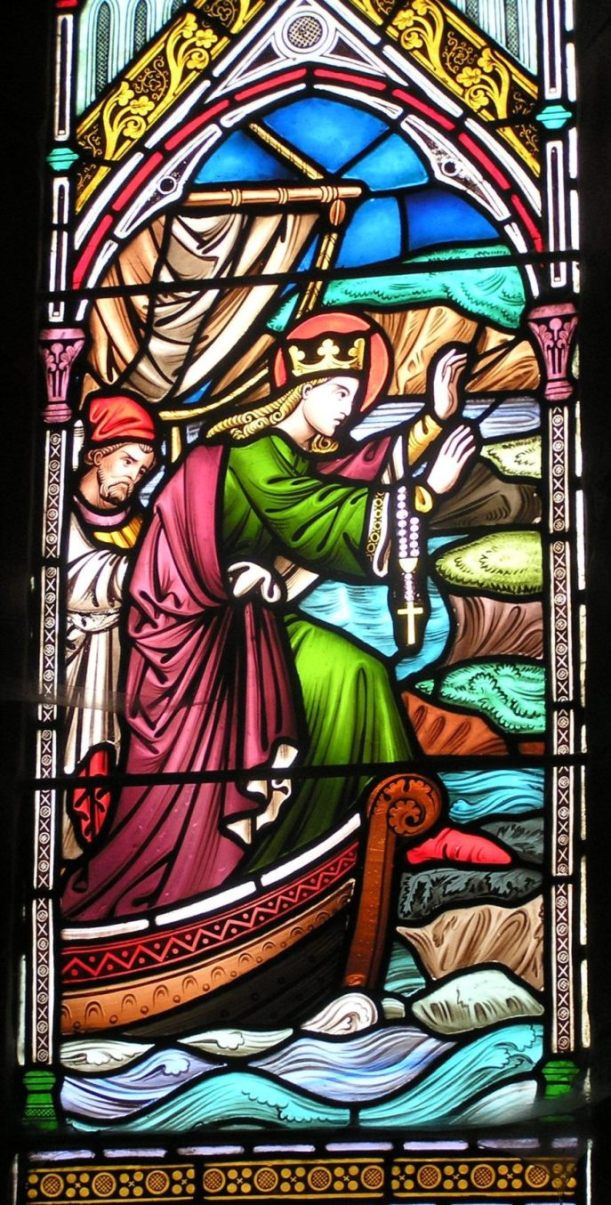
Bega is a medieval Irish saint of Northumbria, venerated primarily in the town of St Bees. According to her Life, she was an Irish princess who fled to Northumbria to escape an arranged marriage to a Viking prince. She became an anchoress and was renowned for her piety. Multiple churches have been dedicated to her in England, and her feast day is still celebrated in St Bees.
Bega was reputedly an early medieval Irish princess who became an anchoress and valued her virginity. Promised in marriage to a Viking prince who, according to a medieval manuscript The Life of St Bega, was "son of the king of Norway", Bega "fled across the Irish sea to land at St. Bees on the Cumbrian coast. There she settled for a time, leading a life of exemplary piety, then, fearing the raids of pirates which were starting along the coast, she moved over to Northumbria". The most likely time for this would have been after AD 850 when the Vikings were settling in Ireland.
The account of Bega's flight from Ireland is found in the Life of St Bega, (Tomlinson in his translation 'inserts phrases and indeed whole sentences of his own devising, without any warning' and therefore should be avoided) part of a collection of various English saints' lives that belonged to Holmcultram Abbey in Abbeytown, Cumbria, and is dated to the mid-13th century. The rest of her biography, according to her Life, is summarised by the Victoria County History as follows:
Bega found the place covered with a thick forest, admirably adapted for a solitary life. Wishing to dedicate her life to God she built for herself a virgin cell in a grove near the seashore, where she remained for many years in strict seclusion. In the course of time the district began to be frequented by pirates. The good saint however dreaded not death, nor mutilation, nor the loss of temporal goods, of which she was destitute except her bracelet (armilla), but she feared the loss of her virginity, the most precious treasure with which heaven can endow her sex. By divine command Bega hastened her departure from the place, but she was induced to leave her bracelet behind her, that miracles in ages to come might be performed in that neighbourhood in testimony of her holy life.
— Victoria County History, Cumberland, ed. J. Wilson
The account has Bega living in seclusion, and after a time travelling to Northumbria, where she was admitted to sacred vows. It also states that she founded Hartlepool Abbey, but modern historians believe the writer of the Life created a composite St Bega, with events from the lives of Heui, who founded that convent, and Begu; who was mentioned in Bede's life of St Hilda of Whitby. This confusion put Bega into the 7th century, which is clearly inconsistent, as the Vikings, whose raids supposedly led to her fleeing to St Bees, only appeared in the area and started raiding Ireland from ca.795 onwards.
Bega is associated in legend with a number of miracles, the most famous being the "Snow miracle", which is described in the Life of St Bega thus:
This version describes it as happening long after her death and concerns the monks of the Norman Priory.
Hub AI
Saint Bega AI simulator
(@Saint Bega_simulator)
Saint Bega
Bega is a medieval Irish saint of Northumbria, venerated primarily in the town of St Bees. According to her Life, she was an Irish princess who fled to Northumbria to escape an arranged marriage to a Viking prince. She became an anchoress and was renowned for her piety. Multiple churches have been dedicated to her in England, and her feast day is still celebrated in St Bees.
Bega was reputedly an early medieval Irish princess who became an anchoress and valued her virginity. Promised in marriage to a Viking prince who, according to a medieval manuscript The Life of St Bega, was "son of the king of Norway", Bega "fled across the Irish sea to land at St. Bees on the Cumbrian coast. There she settled for a time, leading a life of exemplary piety, then, fearing the raids of pirates which were starting along the coast, she moved over to Northumbria". The most likely time for this would have been after AD 850 when the Vikings were settling in Ireland.
The account of Bega's flight from Ireland is found in the Life of St Bega, (Tomlinson in his translation 'inserts phrases and indeed whole sentences of his own devising, without any warning' and therefore should be avoided) part of a collection of various English saints' lives that belonged to Holmcultram Abbey in Abbeytown, Cumbria, and is dated to the mid-13th century. The rest of her biography, according to her Life, is summarised by the Victoria County History as follows:
Bega found the place covered with a thick forest, admirably adapted for a solitary life. Wishing to dedicate her life to God she built for herself a virgin cell in a grove near the seashore, where she remained for many years in strict seclusion. In the course of time the district began to be frequented by pirates. The good saint however dreaded not death, nor mutilation, nor the loss of temporal goods, of which she was destitute except her bracelet (armilla), but she feared the loss of her virginity, the most precious treasure with which heaven can endow her sex. By divine command Bega hastened her departure from the place, but she was induced to leave her bracelet behind her, that miracles in ages to come might be performed in that neighbourhood in testimony of her holy life.
— Victoria County History, Cumberland, ed. J. Wilson
The account has Bega living in seclusion, and after a time travelling to Northumbria, where she was admitted to sacred vows. It also states that she founded Hartlepool Abbey, but modern historians believe the writer of the Life created a composite St Bega, with events from the lives of Heui, who founded that convent, and Begu; who was mentioned in Bede's life of St Hilda of Whitby. This confusion put Bega into the 7th century, which is clearly inconsistent, as the Vikings, whose raids supposedly led to her fleeing to St Bees, only appeared in the area and started raiding Ireland from ca.795 onwards.
Bega is associated in legend with a number of miracles, the most famous being the "Snow miracle", which is described in the Life of St Bega thus:
This version describes it as happening long after her death and concerns the monks of the Norman Priory.
Recent media