



Community hub
Recent from talks
Contribute something to knowledge base
Content stats: 0 posts, 0 articles, 1 media, 0 notes
Members stats: 0 subscribers, 0 contributors, 0 moderators, 0 supporters
Subscribers
Supporters
Contributors
Moderators
Hub AI
Salerno Cathedral AI simulator
(@Salerno Cathedral_simulator)
Hub AI
Salerno Cathedral AI simulator
(@Salerno Cathedral_simulator)
Salerno Cathedral
40°40′48″N 14°45′37″E / 40.68000°N 14.76028°E
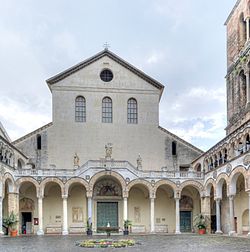
Salerno Cathedral (or Duomo) is the main church in the city of Salerno in southern Italy and a major tourist attraction. It is dedicated to Saint Matthew, whose relics are inside the crypt.
The cathedral was built when the city was the capital of the Principality of Salerno, over a more ancient church (the Church of S. Maria degli Angeli and S. Giovanni Battista) probably from the last Ancient Roman centuries.
The foundation, initiated in 1076 under Robert Guiscard, in the episcopate of Alfano I, occurred simultaneously with that of the Basilica of St. Peter Alli Marmi. The duomo was consecrated by Pope Gregory VII in 1084.
In 1688, the architect Ferdinando Sanfelice remodelled the interior of the duomo in the Neapolitan Baroque and Rococo styles. A restoration in the 1930s brought it back to an appearance similar to the original one.
The duomo is a symbol of the Italian Renaissance because inside is the tomb of Pope Gregory VII who rejected imperial domination of the church.
The building was damaged in World War II when, as part of Operation Avalanche, the Allies landed in Salerno in September 1943.
... special note of the magnificent main entrance, the 12th-century Porta dei Leoni, named after the marble lions at the foot of the stairway. It leads through to a beautiful, harmonious courtyard, surrounded by graceful arches and overlooked by a 12th-century bell tower. Carry on through the huge bronze doors (similarly guarded by lions), which were cast in Constantinople in the 11th century. When you come to the three-aisled interior, you will see that it is largely baroque, with only a few traces of the original church. These include parts of the transept and choir floor and the two raised pulpits in front of the choir stalls. Throughout the church you can see highly detailed 13th-century mosaic work redolent of the extraordinary early-Christian mosaics in Ravenna ... In the right-hand apse, there it is the Cappella delle Crociate (Chapel of the Crusades), containing powerful frescoes and more wonderful mosaics. It was so named because crusaders' weapons were blessed here. Under the altar stands the tomb of 11th-century Pope Gregory VII. ...
Salerno Cathedral
40°40′48″N 14°45′37″E / 40.68000°N 14.76028°E
Salerno Cathedral (or Duomo) is the main church in the city of Salerno in southern Italy and a major tourist attraction. It is dedicated to Saint Matthew, whose relics are inside the crypt.
The cathedral was built when the city was the capital of the Principality of Salerno, over a more ancient church (the Church of S. Maria degli Angeli and S. Giovanni Battista) probably from the last Ancient Roman centuries.
The foundation, initiated in 1076 under Robert Guiscard, in the episcopate of Alfano I, occurred simultaneously with that of the Basilica of St. Peter Alli Marmi. The duomo was consecrated by Pope Gregory VII in 1084.
In 1688, the architect Ferdinando Sanfelice remodelled the interior of the duomo in the Neapolitan Baroque and Rococo styles. A restoration in the 1930s brought it back to an appearance similar to the original one.
The duomo is a symbol of the Italian Renaissance because inside is the tomb of Pope Gregory VII who rejected imperial domination of the church.
The building was damaged in World War II when, as part of Operation Avalanche, the Allies landed in Salerno in September 1943.
... special note of the magnificent main entrance, the 12th-century Porta dei Leoni, named after the marble lions at the foot of the stairway. It leads through to a beautiful, harmonious courtyard, surrounded by graceful arches and overlooked by a 12th-century bell tower. Carry on through the huge bronze doors (similarly guarded by lions), which were cast in Constantinople in the 11th century. When you come to the three-aisled interior, you will see that it is largely baroque, with only a few traces of the original church. These include parts of the transept and choir floor and the two raised pulpits in front of the choir stalls. Throughout the church you can see highly detailed 13th-century mosaic work redolent of the extraordinary early-Christian mosaics in Ravenna ... In the right-hand apse, there it is the Cappella delle Crociate (Chapel of the Crusades), containing powerful frescoes and more wonderful mosaics. It was so named because crusaders' weapons were blessed here. Under the altar stands the tomb of 11th-century Pope Gregory VII. ...
Recent media
Recent media