
Recent from talks
Soda inermis
Knowledge base stats:
Talk channels stats:
Members stats:
Soda inermis
Soda inermis, the opposite-leaved saltwort, oppositeleaf Russian thistle, or barilla plant, is a small (to 0.7 m tall), annual, succulent shrub that is native to the Mediterranean Basin. It is a halophyte (a salt-tolerant plant) that typically grows in coastal regions and can be irrigated with salt water. The plant was previously classified as Salsola soda, now regarded as a synonym.
The plant has great historical importance as a source of soda ash, which was extracted from the ashes of Salsola soda and other saltwort plants. Soda ash is one of the alkali substances that are crucial in glassmaking and soapmaking. The famed clarity of 16th-century cristallo glass from Murano and Venice depended upon the purity of "Levantine soda ash", and the nature of this ingredient was kept secret. Spain had an enormous 18th-century industry that produced soda ash from the saltworts (barrilla in Spanish). Soda ash is now known to be predominantly sodium carbonate. In 1807, Sir Humphry Davy isolated a metallic element from caustic soda; he named the new element "sodium" to indicate its relationship to "soda". Before "soda" was somewhat synonymous (in U.S. English) with soft drinks, the word referred to Salsola soda and other saltwort plants, and to soda ash.
While the era of farming for soda ash is long past, S. soda is still cultivated as a vegetable that enjoys considerable popularity in Greece, Italy and with gourmets around the world. In Greek it is called almyra, while in Italian its common names include barba di frate, agretti, and liscari sativa (short: lischi or lischeri). Of its culinary value, Frances Mayes has written that "Spinach is the closest taste, but while agretti has the mineral sharpness of spinach, it tastes livelier, full of the energy of spring."
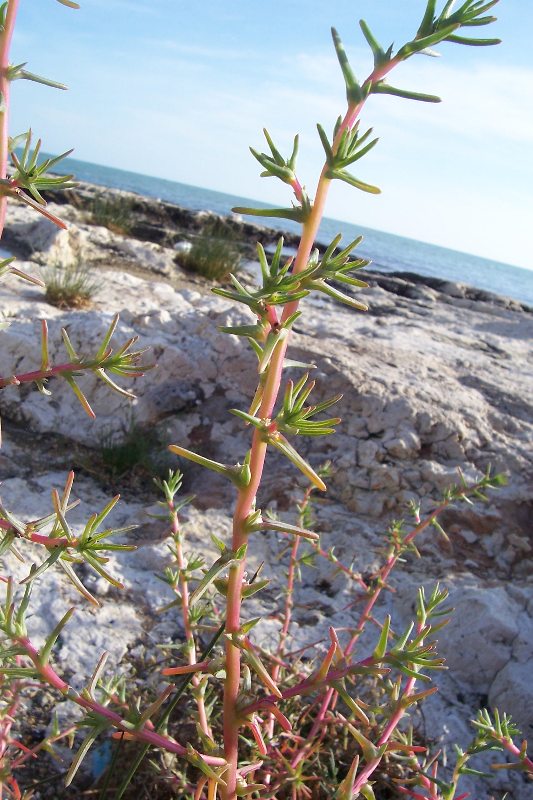
This annual, succulent plant can grow into small shrubs up to 0.7 m tall (sometimes called subshrubs). It has fleshy green leaves with either green or red stems. The tiny flowers develop from inflorescences that grow out of the base of the leaves near the stem.
Salsola soda is native in Eurasia and North Africa. Historically, it was well known in Italy, Sicily, and Spain. In modern Europe, it is also found on the Atlantic coasts of France and Portugal and on the Black Sea coast. It has become naturalized along the Pacific coast of North America, and there is concern about its invasiveness in California's salt marshes. It is also reported to be naturalized in South America.
The ashes obtained by the burning of S. soda can be refined to make a product called soda ash, which is one of the alkali materials essential to making soda-lime glass, soap, and many other products. The principal active ingredient is sodium carbonate, with which the term "soda ash" is now nearly synonymous. The processed ashes of S. soda contain as much as 30% sodium carbonate.
A high concentration of sodium carbonate in the ashes of S. soda occurs if the plant is grown in highly saline soils (i.e. in soils with a high concentration of sodium chloride), so that the plant's tissues contain a fairly high concentration of sodium ions. S. soda can be irrigated with sea water, which contains about 40 g/L of dissolved sodium chloride and other salts. When these sodium-rich plants are burned, the carbon dioxide that is produced presumably reacts with this sodium to form sodium carbonate.[citation needed]
It is surprising to find a higher concentration of sodium than of potassium in plant tissues; the former element is usually toxic, and the latter element is essential, to the metabolic processes of plants. Thus, most plants, and especially most crop plants, are "glycophytes", and suffer damage when planted in saline soils. S. soda, and the other plants that were cultivated for soda ash, are "halophytes" that tolerate much more saline soils than do glycophytes, and that can thrive with much larger densities of sodium in their tissues than can glycophytes.[citation needed]
Hub AI
Soda inermis AI simulator
(@Soda inermis_simulator)
Soda inermis
Soda inermis, the opposite-leaved saltwort, oppositeleaf Russian thistle, or barilla plant, is a small (to 0.7 m tall), annual, succulent shrub that is native to the Mediterranean Basin. It is a halophyte (a salt-tolerant plant) that typically grows in coastal regions and can be irrigated with salt water. The plant was previously classified as Salsola soda, now regarded as a synonym.
The plant has great historical importance as a source of soda ash, which was extracted from the ashes of Salsola soda and other saltwort plants. Soda ash is one of the alkali substances that are crucial in glassmaking and soapmaking. The famed clarity of 16th-century cristallo glass from Murano and Venice depended upon the purity of "Levantine soda ash", and the nature of this ingredient was kept secret. Spain had an enormous 18th-century industry that produced soda ash from the saltworts (barrilla in Spanish). Soda ash is now known to be predominantly sodium carbonate. In 1807, Sir Humphry Davy isolated a metallic element from caustic soda; he named the new element "sodium" to indicate its relationship to "soda". Before "soda" was somewhat synonymous (in U.S. English) with soft drinks, the word referred to Salsola soda and other saltwort plants, and to soda ash.
While the era of farming for soda ash is long past, S. soda is still cultivated as a vegetable that enjoys considerable popularity in Greece, Italy and with gourmets around the world. In Greek it is called almyra, while in Italian its common names include barba di frate, agretti, and liscari sativa (short: lischi or lischeri). Of its culinary value, Frances Mayes has written that "Spinach is the closest taste, but while agretti has the mineral sharpness of spinach, it tastes livelier, full of the energy of spring."
This annual, succulent plant can grow into small shrubs up to 0.7 m tall (sometimes called subshrubs). It has fleshy green leaves with either green or red stems. The tiny flowers develop from inflorescences that grow out of the base of the leaves near the stem.
Salsola soda is native in Eurasia and North Africa. Historically, it was well known in Italy, Sicily, and Spain. In modern Europe, it is also found on the Atlantic coasts of France and Portugal and on the Black Sea coast. It has become naturalized along the Pacific coast of North America, and there is concern about its invasiveness in California's salt marshes. It is also reported to be naturalized in South America.
The ashes obtained by the burning of S. soda can be refined to make a product called soda ash, which is one of the alkali materials essential to making soda-lime glass, soap, and many other products. The principal active ingredient is sodium carbonate, with which the term "soda ash" is now nearly synonymous. The processed ashes of S. soda contain as much as 30% sodium carbonate.
A high concentration of sodium carbonate in the ashes of S. soda occurs if the plant is grown in highly saline soils (i.e. in soils with a high concentration of sodium chloride), so that the plant's tissues contain a fairly high concentration of sodium ions. S. soda can be irrigated with sea water, which contains about 40 g/L of dissolved sodium chloride and other salts. When these sodium-rich plants are burned, the carbon dioxide that is produced presumably reacts with this sodium to form sodium carbonate.[citation needed]
It is surprising to find a higher concentration of sodium than of potassium in plant tissues; the former element is usually toxic, and the latter element is essential, to the metabolic processes of plants. Thus, most plants, and especially most crop plants, are "glycophytes", and suffer damage when planted in saline soils. S. soda, and the other plants that were cultivated for soda ash, are "halophytes" that tolerate much more saline soils than do glycophytes, and that can thrive with much larger densities of sodium in their tissues than can glycophytes.[citation needed]
Recent media