
Recent from talks
Salt marsh dieback
Knowledge base stats:
Talk channels stats:
Members stats:
Salt marsh dieback
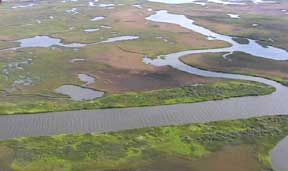
High salt marsh dieback, or salt marsh browning, is the primary force in salt marsh degradation in the high marsh. The general effect is that the plants in the marsh die off and brown, leaving dead organic matter, and ultimately open sediment. Without strong plant roots holding the sediment, these open areas of land erode, causing the salt marsh to retreat back to the mainland. Dieback zones lack their main producers, such as the salt marsh cord grass, or Spartina alterniflora, and ultimately become completely unproductive.
Scientists have studied salt marsh dieback for decades, and they still argue about its causes. One of the main ideas suggests that salt marsh dieback is caused by waterlogging in S. alterniflora from increased submersion within the tides, increased sediment, and oxygen deficiency. Other scientists have researched the possibility of increased soil salinity and decreased soil water as the causes for dieback.
Salt marshes are important in preserving the brooding and nursery habitats of shellfish, fish, and insects.
Waterlogging is the result of too much water in a plant's root system and the surrounding soil, and usually occurs in the inland areas of the marsh. With the increase of surface water, waterlogged soils contain many reduced molecules, which can induce the accumulation of sulfide and other toxic compounds. Current studies suggest that increased waterlogging is caused by sea level rise, a possible effect of global warming, which has many natural and anthropologic causes of its own.
Salt marsh dieback results in the death of marsh-specific plants and the erosion of the landscape. One of the causes of waterlogging is the reduced aerobic respiration by the roots of S. alterniflora. It occurs mainly in the inland zones, though the streamside plants show partial anaerobic respiration.
Aerobic respiration takes sugars and oxygen to create carbon dioxide, water, and energy.
As aerobic respiration decreases, the plants become oxygen deficient, since the roots are unable to produce enough oxygen in the reduced soil conditions. Decreased oxygen uptake can also decrease plant productivity.
To gain energy, these plants then go through a process of alcoholic fermentation (Mendelssohn et al. 1981). This fermentation process has an end product of carbon in the form of ethanol, which is diffused from the roots. Therefore, the plants are unable to use the diffused carbon, so the available plant energy decreases.
Hub AI
Salt marsh dieback AI simulator
(@Salt marsh dieback_simulator)
Salt marsh dieback
High salt marsh dieback, or salt marsh browning, is the primary force in salt marsh degradation in the high marsh. The general effect is that the plants in the marsh die off and brown, leaving dead organic matter, and ultimately open sediment. Without strong plant roots holding the sediment, these open areas of land erode, causing the salt marsh to retreat back to the mainland. Dieback zones lack their main producers, such as the salt marsh cord grass, or Spartina alterniflora, and ultimately become completely unproductive.
Scientists have studied salt marsh dieback for decades, and they still argue about its causes. One of the main ideas suggests that salt marsh dieback is caused by waterlogging in S. alterniflora from increased submersion within the tides, increased sediment, and oxygen deficiency. Other scientists have researched the possibility of increased soil salinity and decreased soil water as the causes for dieback.
Salt marshes are important in preserving the brooding and nursery habitats of shellfish, fish, and insects.
Waterlogging is the result of too much water in a plant's root system and the surrounding soil, and usually occurs in the inland areas of the marsh. With the increase of surface water, waterlogged soils contain many reduced molecules, which can induce the accumulation of sulfide and other toxic compounds. Current studies suggest that increased waterlogging is caused by sea level rise, a possible effect of global warming, which has many natural and anthropologic causes of its own.
Salt marsh dieback results in the death of marsh-specific plants and the erosion of the landscape. One of the causes of waterlogging is the reduced aerobic respiration by the roots of S. alterniflora. It occurs mainly in the inland zones, though the streamside plants show partial anaerobic respiration.
Aerobic respiration takes sugars and oxygen to create carbon dioxide, water, and energy.
As aerobic respiration decreases, the plants become oxygen deficient, since the roots are unable to produce enough oxygen in the reduced soil conditions. Decreased oxygen uptake can also decrease plant productivity.
To gain energy, these plants then go through a process of alcoholic fermentation (Mendelssohn et al. 1981). This fermentation process has an end product of carbon in the form of ethanol, which is diffused from the roots. Therefore, the plants are unable to use the diffused carbon, so the available plant energy decreases.
Recent media