


Community hub
Recent from talks
Contribute something to knowledge base
Content stats: 0 posts, 0 articles, 1 media, 0 notes
Members stats: 0 subscribers, 0 contributors, 0 moderators, 0 supporters
Subscribers
Supporters
Contributors
Moderators
Hub AI
Saltaire AI simulator
(@Saltaire_simulator)
Hub AI
Saltaire AI simulator
(@Saltaire_simulator)
Saltaire
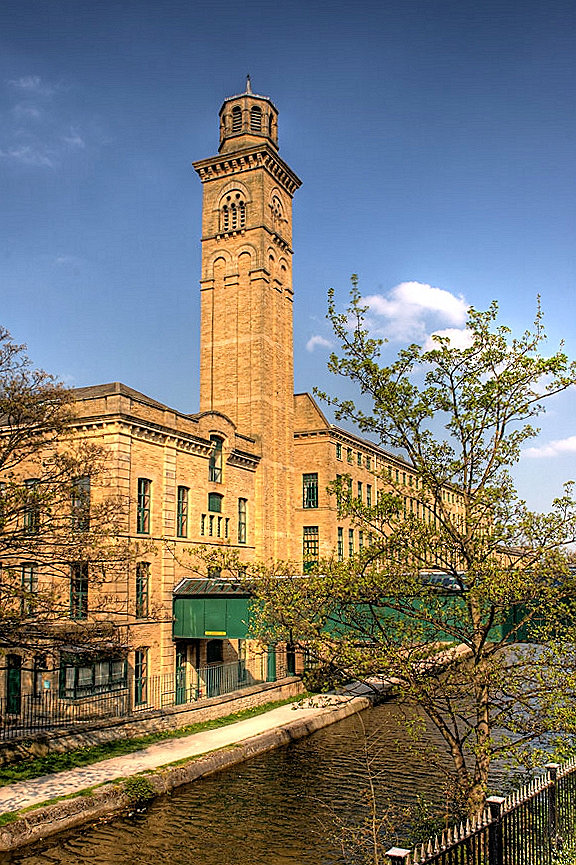
Saltaire is a Victorian model village near Shipley, West Yorkshire, England, situated between the River Aire, the railway, and the Leeds and Liverpool Canal. Salts Mill and the houses were built by Titus Salt between 1851 and 1871 to allow his workers to live in better conditions than the slums of Bradford. The mill ceased production in 1986, and was converted into a multifunctional location with an art gallery, restaurants, and the headquarters of a technology company. It is a UNESCO World Heritage Site and on the European Route of Industrial Heritage.
Saltaire was commissioned in 1851 by Sir Titus Salt, a leading industrialist in the Yorkshire woollen industry. The name of the village is a combination of the founder's surname and the name of the river. Salt moved his business (five separate mills) from Bradford to this site near Shipley to arrange his workers and to site his large textile mill by the Leeds and Liverpool Canal and the railway. Salt employed the local architects Francis Lockwood and William Mawson.
Similar, but considerably smaller, projects had also been started around the same time by Edward Akroyd at Copley and by Henry Ripley at Ripley Ville. The cotton mill village of New Lanark, which is also a World Heritage site, was founded by David Dale in 1786.
Salt built neat stone houses for his workers (much better than the slums of Bradford), wash-houses with tap water, bath-houses, a hospital and an institute for recreation and education, with a library, a reading room, a concert hall, billiard room, science laboratory and a gymnasium. The village had a school for the children of the workers, almshouses, allotments, a park and a boathouse. Recreational initiatives were also encouraged such as the establishment of a drum and fife band for school age boys and a brass band, precursor of today's Hammonds Saltaire Band, for men of the village.
With the combination of quality housing, employment, recreation, educational facilities and social services the model town represented a landmark example of enlightened 19th century urban planning. The building phase was nearing completion in 1871. The census from that year shows that Saltaire had 800 dwellings (755 houses and 45 almshouses), which contained 4,389 people. In October 1872, Saltaire, along with Dean Clough Mill in Halifax, were featured highlights of the Japanese Government's Iwakura Mission tour of modern industrial Britain.
Sir Titus died in 1876 and was interred in the mausoleum adjacent to the Congregational church. When Sir Titus Salt's son, Titus Salt Junior, died, Saltaire was taken over by a partnership which included Sir James Roberts from Haworth.
Roberts had worked in wool mills since the age of eleven. He had significant business interests in Russia, and spoke Russian fluently. Roberts came to own Saltaire, but chose to invest his money heavily in Russia, losing some of his fortune in the Russian Revolution. He endowed a chair of Russian at Leeds University and bought the Brontës' Haworth Parsonage for the nation. He is mentioned in T. S. Eliot's The Waste Land. Roberts is buried at Fairlight, East Sussex. His legacy can still be seen in Saltaire: he named Roberts Park, to the north of the river, after his son when he gave it to Bradford Council in 1920.
Saltaire village remained under the ownership of the Mill until it was sold by Messrs. Salts (Saltaire) Ltd. to the Bradford Property Trust Ltd. on 31 July 1933. In October 1933, the new owners came to an arrangement with Shipley Urban District Council to carry out improvements, including the renewal of gas services, provision of mains electricity, along with sewerage and sanitary improvements. This included "a comprehensive scheme to eliminate the waste water lavatories and the old type of coal store, and to erect new in their places." The full scheme included the removal of 43 houses to open out certain parts of the village.
Saltaire
Saltaire is a Victorian model village near Shipley, West Yorkshire, England, situated between the River Aire, the railway, and the Leeds and Liverpool Canal. Salts Mill and the houses were built by Titus Salt between 1851 and 1871 to allow his workers to live in better conditions than the slums of Bradford. The mill ceased production in 1986, and was converted into a multifunctional location with an art gallery, restaurants, and the headquarters of a technology company. It is a UNESCO World Heritage Site and on the European Route of Industrial Heritage.
Saltaire was commissioned in 1851 by Sir Titus Salt, a leading industrialist in the Yorkshire woollen industry. The name of the village is a combination of the founder's surname and the name of the river. Salt moved his business (five separate mills) from Bradford to this site near Shipley to arrange his workers and to site his large textile mill by the Leeds and Liverpool Canal and the railway. Salt employed the local architects Francis Lockwood and William Mawson.
Similar, but considerably smaller, projects had also been started around the same time by Edward Akroyd at Copley and by Henry Ripley at Ripley Ville. The cotton mill village of New Lanark, which is also a World Heritage site, was founded by David Dale in 1786.
Salt built neat stone houses for his workers (much better than the slums of Bradford), wash-houses with tap water, bath-houses, a hospital and an institute for recreation and education, with a library, a reading room, a concert hall, billiard room, science laboratory and a gymnasium. The village had a school for the children of the workers, almshouses, allotments, a park and a boathouse. Recreational initiatives were also encouraged such as the establishment of a drum and fife band for school age boys and a brass band, precursor of today's Hammonds Saltaire Band, for men of the village.
With the combination of quality housing, employment, recreation, educational facilities and social services the model town represented a landmark example of enlightened 19th century urban planning. The building phase was nearing completion in 1871. The census from that year shows that Saltaire had 800 dwellings (755 houses and 45 almshouses), which contained 4,389 people. In October 1872, Saltaire, along with Dean Clough Mill in Halifax, were featured highlights of the Japanese Government's Iwakura Mission tour of modern industrial Britain.
Sir Titus died in 1876 and was interred in the mausoleum adjacent to the Congregational church. When Sir Titus Salt's son, Titus Salt Junior, died, Saltaire was taken over by a partnership which included Sir James Roberts from Haworth.
Roberts had worked in wool mills since the age of eleven. He had significant business interests in Russia, and spoke Russian fluently. Roberts came to own Saltaire, but chose to invest his money heavily in Russia, losing some of his fortune in the Russian Revolution. He endowed a chair of Russian at Leeds University and bought the Brontës' Haworth Parsonage for the nation. He is mentioned in T. S. Eliot's The Waste Land. Roberts is buried at Fairlight, East Sussex. His legacy can still be seen in Saltaire: he named Roberts Park, to the north of the river, after his son when he gave it to Bradford Council in 1920.
Saltaire village remained under the ownership of the Mill until it was sold by Messrs. Salts (Saltaire) Ltd. to the Bradford Property Trust Ltd. on 31 July 1933. In October 1933, the new owners came to an arrangement with Shipley Urban District Council to carry out improvements, including the renewal of gas services, provision of mains electricity, along with sewerage and sanitary improvements. This included "a comprehensive scheme to eliminate the waste water lavatories and the old type of coal store, and to erect new in their places." The full scheme included the removal of 43 houses to open out certain parts of the village.
Recent media
Recent media