Hubbry Logo
Sam TotmanSam TotmanMain
Open search
Sam Totman
Community hub
Sam Totman
logo
8 pages, 0 posts
0 subscribers
Be the first to start a discussion here.
Sam Totman
Sam Totman
from Wikipedia

Key Information

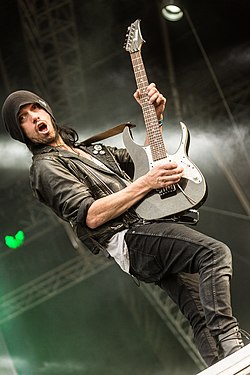
Ian Samuel Totman is a British-born New Zealand musician best known as guitarist and main songwriter for the power metal band DragonForce.

Early life

[edit]

Totman was born in England and grew up mainly in New Zealand.[1] He moved back to England around age 22 because England's music scene offered numerous shows to attend every week—an option he did not have in geographically isolated New Zealand.[1] He began playing classical guitar at the age of nine—receiving formal training for several years.[2]

Career

[edit]

In the late 80s/early 90s, Totman was the guitarist in death metal band Karnage alongside Steve Francis (now of Bulletbelt). They were based in Masterton, New Zealand and released one demo cassette "Dead". Totman was part of the black power metal band Demoniac—which also featured his future DragonForce bandmate Herman Li. During his time with Demoniac Totman was referred to as Heimdall (the Norse god of vigilance). Demoniac struggled to achieve any real fame outside of Australasia despite releasing three albums and relocating to London, UK. Demoniac split sometime in late 1999 shortly after the album The Fire and the Wind was released. Most of the members went on to form power metal band DragonHeart which later became known as DragonForce. Keyboardist Steve Williams and bassist Steve Scott left Dragonheart to form Power Quest with whom Totman recorded on their demo as well as their first album Wings of Forever. Totman also provided guest instrumentation on the band's following album Neverworld.

As the main songwriter for DragonForce, Totman has written both the music and lyrics for a majority of DragonForce's discography.

Playing style

[edit]

Totman is known for his use of double handed tapping, extensive whammy bar usage, alternate picking, rapid staccato and legato scale runs, sweeping, and many other shred-guitar techniques; both in solo parts and in harmony with fellow guitarist Herman Li. Like Li, he uses many of said techniques to emulate video game music and sounds.

References

[edit]
[edit]
Revisions and contributorsEdit on WikipediaRead on Wikipedia
from Grokipedia
Sam Totman is a British and songwriter best known as the co-founder, lead , and primary songwriter of the power metal band . Alongside fellow , whom he met through a classified ad in 1999, Totman established the band's signature style of high-speed, neoclassical solos and epic, fantasy-inspired compositions. 's sound, driven by Totman's songwriting and virtuosic playing, blends symphonic elements with blistering technical metal, earning the group a global following in the power metal genre. Totman has contributed to all of DragonForce's studio albums, beginning with their debut Valley of the Damned in 2003 and including Warp Speed Warriors in 2024. The band's commercial breakthrough arrived with the 2006 album Inhuman Rampage, particularly the track "Through the Fire and Flames," which achieved platinum certification and widespread popularity through its feature in the Guitar Hero video game series. Prior to DragonForce, Totman was involved in the New Zealand-based band Demoniac and the English power metal band Power Quest, honing his skills in the metal scene before relocating to London to form the group.

Early life

Upbringing and relocation

Ian Samuel Totman was born on 26 April 1974 in , . His relocated to when he was young, and he spent the majority of his childhood there. With limited details available on his background, Totman has described growing up in rural New Zealand, which shaped his early experiences. Seeking better prospects in the scene, Totman returned to around age 22 in the late 1990s, to access a more vibrant environment for bands and performances.

Initial musical training

Totman began his musical journey at the age of nine in , where he started formal lessons under structured instruction. This training lasted several years, providing him with a foundation in technique, including and precision, as required by his parents who encouraged him to pursue an instrument alongside other activities. In his early teens, Totman shifted his focus from classical to electric guitar, driven by exposure to heavy metal music. This transition was sparked by bands such as and , whose aggressive riffs and solos captivated him and led him to abandon the nylon-string acoustic for electric instruments to replicate their sound. Much of Totman's heavy metal proficiency developed through self-directed practice, as he lacked formal instruction in the genre. He honed basic techniques like by repeatedly listening to and transcribing solos from 1980s and early 1990s albums, including those by Metallica and , often working them out by ear from cassette tapes or using songbooks without guidance from .

Career

Early bands in New Zealand

Totman's early musical endeavors in began in the scene when he joined the band Karnage as in the early . Formed in in and later based in , Karnage blended thrash and death metal elements, with Totman contributing to their sole , the demo Dead, recorded and issued in . The band's activities were short-lived, splitting up in after a handful of local performances, during which Totman honed his skills in the underground metal community. Following Karnage's dissolution, Totman co-founded the black/power metal band in in Auckland, taking on guitar duties under the stage name . Initially rooted in the raw style prevalent in New Zealand's nascent scene, Demoniac featured vocalist/bassist Lindsay Dawson and drummer , with the group performing at local venues to build a small but dedicated following. This partnership later included future collaborator , who joined as second guitarist in 1998. The band's evolution toward a hybrid black and sound was evident in their three full-length albums: Stormblade (1996), Exile (1997), and The Fire and the Wind (1999), released through labels like Evil Omen Records and Head Not Found. Seeking greater international exposure amid the limited opportunities in New Zealand's metal landscape, Demoniac relocated to London in 1997, where they continued touring and recording their final album. Despite this move, the band struggled to break through beyond Australasia, leading to their split in late 1999 shortly after The Fire and the Wind's release, effectively concluding Totman's New Zealand-based phase and paving the way for his relocation to the UK.

Formation and contributions to DragonForce

Sam Totman co-founded in 1999 in , , alongside guitarist , after the pair relocated from following the dissolution of their previous band, . Initially operating under the name , the group recruited vocalist through a classified advertisement and added other members including and Andi Piispa, establishing a sound that fused with extreme speed elements and neoclassical influences inspired by classical composers like Bach and Paganini. The band changed its name to in 2002 due to a naming conflict with another act, releasing their debut album Valley of the Damned in 2003 on Noise Records, which featured Totman's songwriting on tracks like "Fury of the Storm." As DragonForce's primary songwriter, Totman has been responsible for the majority of the band's lyrics and music throughout their formative and mid-career years, often collaborating with Li on guitar arrangements while handling chord progressions, vocal melodies, and overall structure. He penned key contributions for subsequent albums, including Sonic Firestorm (2004), which expanded their epic fantasy themes; (2006), highlighted by the iconic single "Through the Fire and Flames" co-written by Totman and Li; (2008); The Power Within (2012); (2014); and (2017). Totman's songwriting emphasized uplifting choruses and intricate solos, with him crediting influences from 1980s for the melodic hooks, and he typically composed the bulk of each album's material during this period. Totman's contributions helped propel to commercial success, particularly with "," which achieved platinum status in the and became a staple in video games like Guitar Hero III: Legends of Rock (2007), exposing the band to a wider audience beyond metal circles. The track's demanding and fantasy narrative exemplified Totman's style of blending technical virtuosity with accessible anthems. Additionally, the band's track "Heroes of Our Time" from earned a Grammy Award nomination for Best Metal Performance at the 51st Annual Grammy Awards in 2009, marking a significant milestone for their extreme power metal approach.

Guest appearances and side projects

Totman has made notable guest appearances early in his , particularly with the power metal band Power Quest, formed by his former bandmate Steve Williams. He contributed guitars and backing vocals to Power Quest's debut release, the 2002 demo album Wings of Forever, which served as an initial recording project for the band. His involvement with Power Quest continued briefly into their full-length era, where he provided guest guitar work on the opening track "Neverworld" from the band's 2003 album of the same name, adding neoclassical flourishes to the symphonic power metal sound. These contributions occurred during a transitional period when Totman was balancing commitments with DragonForce, highlighting his role in supporting allied projects within the UK power metal scene. Beyond these early collaborations, Totman has engaged in occasional side projects, primarily through tribute performances that allow him to explore different instruments and genres. In recent years, he has performed on bass with , a UK-based band dedicated to , showcasing his versatility in nu-metal and alternative styles during live tours and appearances in 2025. This involvement underscores his willingness to participate in high-energy, one-off events outside his primary focus, though such endeavors remain sporadic. Despite opportunities, Totman has not pursued major solo projects or formed full side bands since DragonForce's inception in 1999, prioritizing the band as his central creative outlet and maintaining a selective approach to external work.

Recent activities

Since 2020, Sam Totman has continued his central role as co-founder and rhythm guitarist in DragonForce, contributing significantly to the band's songwriting and production amid evolving lineup dynamics. He co-wrote multiple tracks on the band's eighth studio album, Extreme Power Metal, released in late 2019 but marking their primary output entering the new decade, including the title track and "Cosmic Power of the Infinite Shred Machine." Totman maintained stability alongside lead guitarist Herman Li through personnel shifts, such as the departure of bassist Frédéric Leclercq in 2019 and the arrival of bassist Alicia Vigil in early 2020, while vocalist Marc Hudson has fronted the group since 2011 and drummer Gee Anzalone has held the position since 2014. In 2025, DragonForce assumed full self-management responsibilities, allowing greater creative autonomy as explained by Li in interviews. Totman's songwriting extended to the band's ninth album, Warp Speed Warriors, released on March 15, 2024, via , where he co-authored key tracks such as "Burning Heart" and handled production duties with Li and engineer Rainaud. Building on this, 2025 saw the release of alternate duet versions of select songs, including "Doomsday Party" reimagined with vocalist , premiered via music video on September 24, 2025, and "Burning Heart" featuring Arch Enemy's , accompanied by an official video on June 5, 2025—both highlighting Totman's rhythmic foundations and collaborative spirit. DragonForce's touring schedule in 2025 emphasized Totman's live presence, with the "Warp Speed Warriors" North American headline run spanning summer and fall, including co-headlining dates with Powerwolf from September 17 in Toronto to September 19 in Louisville, followed by standalone shows through October 4 at Aftershock Festival in Sacramento. A standout performance occurred at the Louder Than Life festival on September 19, 2025, in Louisville, Kentucky, where Totman and Li delivered signature guitar duels during "Fury of the Storm" as part of a set blending classics and new material. These outings underscored the band's enduring appeal, bolstered by VIP packages offering meet-and-greets that allowed fans direct access to Totman and bandmates at multiple venues, fostering personal connections amid sold-out crowds.

Musical style

Playing techniques

Sam Totman demonstrates mastery of double-handed , employing both hands to execute rapid scalar runs and arpeggios that contribute to DragonForce's signature high-speed solos. This technique allows for fluid execution of complex phrases, often integrating minor or major triads across multiple strings to create intricate melodic lines. Totman extensively incorporates whammy bar dives, pinch harmonics, and artificial harmonics to add expressiveness and aggression to his solos. Whammy bar manipulations, including dive-bombs and enhancements on natural harmonics, produce dramatic pitch shifts that heighten the theatrical intensity of performances. Pinch and artificial harmonics further emphasize sustained notes with a biting, squealing tone characteristic of shredding. His technique achieves speeds exceeding 200 beats per minute (BPM), blending attacks for rhythmic drive with phrasing via hammer-ons and pull-offs to maintain fluidity in fast passages. In neoclassical solos, Totman utilizes sweeping—also known as economy of motion picking—to navigate arpeggiated patterns across strings with minimal wrist movement, evoking classical influences in a metal context. Totman's playing often features harmonic interplay with co-guitarist , where dual-guitar lines harmonize in thirds or octaves to emulate the layered, epic sound of soundtracks. These techniques are applied in songs such as "," showcasing their precision in live and recorded settings.

Influences

Sam Totman's musical influences are deeply rooted in the power and speed metal scenes of the late 1980s and early 1990s, which informed the epic song structures and neoclassical shredding elements central to his songwriting with DragonForce. He has frequently cited Iron Maiden as a foundational influence, praising their songcraft during his formative years in metal. Similarly, Helloween's melodic intensity and anthemic style resonated strongly with Totman, as he and bandmate Herman Li have described albums like Keeper of the Seven Keys as pivotal in shaping their approach to power metal dynamics. Bands such as Stratovarius contributed to the band's appreciation for layered keyboard-guitar interplay and soaring melodies, elements that echo in DragonForce's hybrid sound. Yngwie Malmsteen's neoclassical techniques also played a role in inspiring the shred-oriented style of DragonForce, blending virtuosic speed with harmonic complexity. Totman's style further incorporates catchy, anthemic qualities drawn from , particularly soundtracks from the 8-bit and 16-bit eras, which infuse 's music with uplifting, nostalgic hooks and rhythmic drive. He has explicitly named compositions as a key influence alongside traditional metal, contributing to the band's "" identity that merges fantasy themes with high-energy melodies. elements also subtly shape his compositions, adding structural depth and exploratory solos that enhance the epic scope of tracks without overshadowing their metal core. Over time, Totman's inspirations have evolved while preserving the band's essence, as seen in his collaborative work with . In interviews from , he emphasized integrating new ideas into their dual-guitar framework to refine phrasing and innovation, yet always anchoring to the "big choruses, the speed, the guitar solos" of their origins.

Equipment

Guitars and signature models

During his time with the early band in the late 1990s, he transitioned to electric guitars, utilizing models from the series known for their fast necks and versatility in metal genres. Throughout his with , Totman has primarily relied on guitars, particularly the Iceman-shaped models in his signature STM series, which feature designs optimized for high-speed playing and stability. The , introduced in , is a neck-through-body construction with a five-piece maple/walnut Wizard II neck, 24 jumbo frets on a bound rosewood fingerboard with pearl parallelogram inlays, DiMarzio Evolution humbucking pickups for high-output tone, and an Edge III double-locking tremolo bridge, available in a white finish. The , released in 2011, builds on this with a mahogany body topped in flamed maple (sapphire blue finish), the same Wizard II neck-through design, angled block inlays, DiMarzio Evolution pickups, and Edge III tremolo for enhanced sustain and tuning stability. The STM3 model, another Iceman variant, incorporates a bolt-on Wizard III maple neck for quicker access to upper frets, a mahogany body, bound rosewood fingerboard with acrylic angled block inlays, passive Quantum humbucking pickups, and the Edge-Zero II tremolo system with ZPS3Fe stabilizer, finished in metallic gray sunburst to suit Totman's preference for durable, high-gain instruments. These signature collaborations with emphasize reinforced, thin necks suited for extended and shredding, along with reinforced hardware for live performance reliability. In addition to his Ibanez signatures, Totman has incorporated the Schecter Synyster Standard into his setup, a model endorsed by Avenged Sevenfold's Synyster Gates featuring a mahogany body with quilted maple top, set three-piece maple neck, ebony fingerboard with 24 extra-jumbo frets, EMG 81/85 active pickups for aggressive high-gain response, and a Floyd Rose 1000 series double-locking tremolo, which he used during DragonForce's Extreme Power Metal Tour and in music videos. He has also employed other Ibanez models like the RG550DY Genesis Collection in yellow for touring as of 2019 and the RG7620 in royal blue for specific rigs. As of the Warp Speed Warriors World Tour in 2025, Totman uses Kiesel Aries models, including the Tropic (light-changing finish) and Hot Pink variants, both with bolt-on laminated necks, Kiesel humbucking pickups, Floyd Rose bridges, locking tuners, and nickel frets, designed for reliable high-speed performance.

Amplifiers and effects

Sam Totman has relied on high-gain amplification setups to achieve the crunchy, aggressive tone central to DragonForce's . In the early , he primarily used the Rocktron Prophesy II preamp, valued for its versatile and built-in effects processing, paired with Peavey cabinets such as the Triple X model for live performances. By the mid-2010s, Totman transitioned to a Boss GT-100 multi-effects unit as his core processor, feeding into a 2:50 power to deliver a tighter low-end response and improved clarity under high-speed playing conditions. This setup drove Peavey 4x12 cabinets, providing the necessary headroom for arena tours. Totman's effects chain emphasizes simplicity and reliability, focusing on modulation and pitch-shifting to enhance solos without overwhelming the core tone. He incorporates the DigiTech Whammy pedal for dramatic dives and harmonies, particularly in tracks requiring octave jumps. The Boss GT-100 handles additional processing, including digital delay for ambient swells similar to the Boss DD-3 and phaser effects akin to the for subtle modulation. Preset switching is managed via the GT-100's internal system, allowing seamless transitions during complex dual-guitar arrangements. His live rig has evolved for greater durability on extended tours. In 2012, it featured multiple 4x12 cabinets—often Marshall or Peavey stacks—to project the band's neoclassical shred across large . Since around , Totman and bandmate have used the Kemper Profiler digital modeling unit for tour reliability, profiling classic amp tones while reducing setup complexity and maintenance issues during global performances.

References

Add your contribution
Related Hubs
User Avatar
No comments yet.