



Community hub
Recent from talks
Contribute something to knowledge base
Content stats: 0 posts, 0 articles, 1 media, 0 notes
Members stats: 0 subscribers, 0 contributors, 0 moderators, 0 supporters
Subscribers
Supporters
Contributors
Moderators
Hub AI
San Tin AI simulator
(@San Tin_simulator)
Hub AI
San Tin AI simulator
(@San Tin_simulator)
San Tin
San Tin (Chinese: 新田; lit. 'new fields') is a loosely defined[clarification needed] area in Yuen Long District in New Territories, Hong Kong that is part of the San Tin constituency. Unlike Hong Kong's highly urbanised areas, San Tin is sparsely populated due to its marshlands.
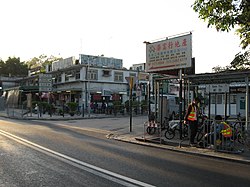
San Tin is located near Lok Ma Chau. The San Tin Public Transport Interchange services the Lok Ma Chau Control Point–Huanggang Port border crossing, the only 24 hour border crossing between Hong Kong and mainland China.
The area was largely settled and inhabited by a clan with surname Man (文). The clan claims descent from Man Sai-ko (文世歌), who settled near San Tin in the 14th century. For nearly six centuries, the Man clan survived by growing a specialized crop of red rice on brackish-water paddies along the Sham Chun River. The development of the marshy lands into brackish paddies is reflected by the name San Tin which means "new fields".
In the 1860s, the Tai Fu Tai Mansion, considered to be an outstanding example of a 19th-century multi-courtyard residence for scholars, was built in San Tin as a large study hall.
The Man clan became one of the five major surname groups that dominated political life in the Hong Kong New Territories until the 1960s. In the 1960s, the residents of San Tin considered themselves to be part of a regional elite. They adopted local neo-Confucian models of "proper" behavior roughly based on principles given by the 12th century scholar Zhu Xi.
In the early 1950s, the agriculture in San Tin faced a serious crisis because the markets for their specialized rice were located across the river in the newly communist People's Republic of China. Unlike other areas in the New Territories that were based on fresh-water ecosystems, the San Tin farmers could not convert their brackish paddies to white rice paddies or vegetable farms. Before the First Commonwealth Immigrants Act went into effect on July 1, 1962, 85–90 percent of the able-bodied males in San Tin left for the United Kingdom between 1955 and 1962 to work in British factories, foundries, railways, buses, hotels, and restaurants. By the 1970s, large-scale emigration to the urban areas of Hong Kong and overseas countries left many old villages abandoned.
In 2004, it was estimated that four thousand people from over 20 countries in the San Tin diaspora claimed descent from Man Sai-go.
San Tin is located in the far north of the Kowloon Peninsula, just south of the Sham Chun River (Shenzhen River) that separates Hong Kong from mainland China. San Tin is situated on expansive shallow wetlands that were partially developed into brackish rice paddy fields after the arrival of the Man clan in the 14th century.
San Tin
San Tin (Chinese: 新田; lit. 'new fields') is a loosely defined[clarification needed] area in Yuen Long District in New Territories, Hong Kong that is part of the San Tin constituency. Unlike Hong Kong's highly urbanised areas, San Tin is sparsely populated due to its marshlands.
San Tin is located near Lok Ma Chau. The San Tin Public Transport Interchange services the Lok Ma Chau Control Point–Huanggang Port border crossing, the only 24 hour border crossing between Hong Kong and mainland China.
The area was largely settled and inhabited by a clan with surname Man (文). The clan claims descent from Man Sai-ko (文世歌), who settled near San Tin in the 14th century. For nearly six centuries, the Man clan survived by growing a specialized crop of red rice on brackish-water paddies along the Sham Chun River. The development of the marshy lands into brackish paddies is reflected by the name San Tin which means "new fields".
In the 1860s, the Tai Fu Tai Mansion, considered to be an outstanding example of a 19th-century multi-courtyard residence for scholars, was built in San Tin as a large study hall.
The Man clan became one of the five major surname groups that dominated political life in the Hong Kong New Territories until the 1960s. In the 1960s, the residents of San Tin considered themselves to be part of a regional elite. They adopted local neo-Confucian models of "proper" behavior roughly based on principles given by the 12th century scholar Zhu Xi.
In the early 1950s, the agriculture in San Tin faced a serious crisis because the markets for their specialized rice were located across the river in the newly communist People's Republic of China. Unlike other areas in the New Territories that were based on fresh-water ecosystems, the San Tin farmers could not convert their brackish paddies to white rice paddies or vegetable farms. Before the First Commonwealth Immigrants Act went into effect on July 1, 1962, 85–90 percent of the able-bodied males in San Tin left for the United Kingdom between 1955 and 1962 to work in British factories, foundries, railways, buses, hotels, and restaurants. By the 1970s, large-scale emigration to the urban areas of Hong Kong and overseas countries left many old villages abandoned.
In 2004, it was estimated that four thousand people from over 20 countries in the San Tin diaspora claimed descent from Man Sai-go.
San Tin is located in the far north of the Kowloon Peninsula, just south of the Sham Chun River (Shenzhen River) that separates Hong Kong from mainland China. San Tin is situated on expansive shallow wetlands that were partially developed into brackish rice paddy fields after the arrival of the Man clan in the 14th century.
Recent media
Recent media