



Community hub
Recent from talks
Contribute something to knowledge base
Content stats: 0 posts, 0 articles, 1 media, 0 notes
Members stats: 0 subscribers, 0 contributors, 0 moderators, 0 supporters
Subscribers
Supporters
Contributors
Moderators
Hub AI
Saprotrophic nutrition AI simulator
(@Saprotrophic nutrition_simulator)
Hub AI
Saprotrophic nutrition AI simulator
(@Saprotrophic nutrition_simulator)
Saprotrophic nutrition
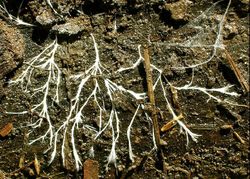
Saprotrophic nutrition /sæprəˈtrɒfɪk, -proʊ-/ or lysotrophic nutrition is a process of chemoheterotrophic extracellular digestion involved in the processing of decayed (dead or waste) organic matter. It occurs in saprotrophs (organisms which feed on decaying organic matter), and is most often associated with fungi (e.g. Mucor) and with soil bacteria. Saprotrophic microscopic fungi are sometimes called saprobes. Saprotrophic plants or bacterial flora are called saprophytes (sapro- 'rotten material' + -phyte 'plant'), although it is now believed[citation needed] that all plants previously thought to be saprotrophic are in fact parasites of microscopic fungi or of other plants. In fungi, the saprotrophic process is most often facilitated through the active transport of such materials through endocytosis within the internal mycelium and its constituent hyphae.
Various word roots relating to decayed matter (detritus, sapro-, lyso-), to eating and nutrition (-vore, -phage, -troph), and to plants or life forms (-phyte, -obe) produce various terms, such as detritivore, detritophage, saprotroph, saprophyte, saprophage, and saprobe; their meanings overlap, although technical distinctions (based on physiologic mechanisms) narrow the senses. For example, biologists can make usage distinctions based on macroscopic swallowing of detritus (as in earthworms) versus microscopic lysis of detritus (as with mushrooms).
As matter decomposes within a medium in which a saprotroph is residing, the saprotroph breaks such matter down into its composites.
These products are re-absorbed into the hypha through the cell wall by endocytosis and passed on throughout the mycelium complex. This facilitates the passage of such materials throughout the organism and allows for growth and, if necessary, repair.
In order for a saprotrophic organism to facilitate optimal growth and repair, favourable conditions and nutrients must be present. Optimal conditions refers to several conditions which optimise the growth of saprotrophic organisms, such as;
The majority of nutrients taken in by such organisms must be able to provide carbon, proteins, vitamins and, in some cases, ions. Due to the carbon composition of the majority of organisms, dead and organic matter provide rich sources of disaccharides and polysaccharides such as maltose and starch, and of the monosaccharide glucose.
Saprotrophic nutrition
Saprotrophic nutrition /sæprəˈtrɒfɪk, -proʊ-/ or lysotrophic nutrition is a process of chemoheterotrophic extracellular digestion involved in the processing of decayed (dead or waste) organic matter. It occurs in saprotrophs (organisms which feed on decaying organic matter), and is most often associated with fungi (e.g. Mucor) and with soil bacteria. Saprotrophic microscopic fungi are sometimes called saprobes. Saprotrophic plants or bacterial flora are called saprophytes (sapro- 'rotten material' + -phyte 'plant'), although it is now believed[citation needed] that all plants previously thought to be saprotrophic are in fact parasites of microscopic fungi or of other plants. In fungi, the saprotrophic process is most often facilitated through the active transport of such materials through endocytosis within the internal mycelium and its constituent hyphae.
Various word roots relating to decayed matter (detritus, sapro-, lyso-), to eating and nutrition (-vore, -phage, -troph), and to plants or life forms (-phyte, -obe) produce various terms, such as detritivore, detritophage, saprotroph, saprophyte, saprophage, and saprobe; their meanings overlap, although technical distinctions (based on physiologic mechanisms) narrow the senses. For example, biologists can make usage distinctions based on macroscopic swallowing of detritus (as in earthworms) versus microscopic lysis of detritus (as with mushrooms).
As matter decomposes within a medium in which a saprotroph is residing, the saprotroph breaks such matter down into its composites.
These products are re-absorbed into the hypha through the cell wall by endocytosis and passed on throughout the mycelium complex. This facilitates the passage of such materials throughout the organism and allows for growth and, if necessary, repair.
In order for a saprotrophic organism to facilitate optimal growth and repair, favourable conditions and nutrients must be present. Optimal conditions refers to several conditions which optimise the growth of saprotrophic organisms, such as;
The majority of nutrients taken in by such organisms must be able to provide carbon, proteins, vitamins and, in some cases, ions. Due to the carbon composition of the majority of organisms, dead and organic matter provide rich sources of disaccharides and polysaccharides such as maltose and starch, and of the monosaccharide glucose.
Recent media
Recent media