
Recent from talks
Endocytosis
Knowledge base stats:
Talk channels stats:
Members stats:
Endocytosis
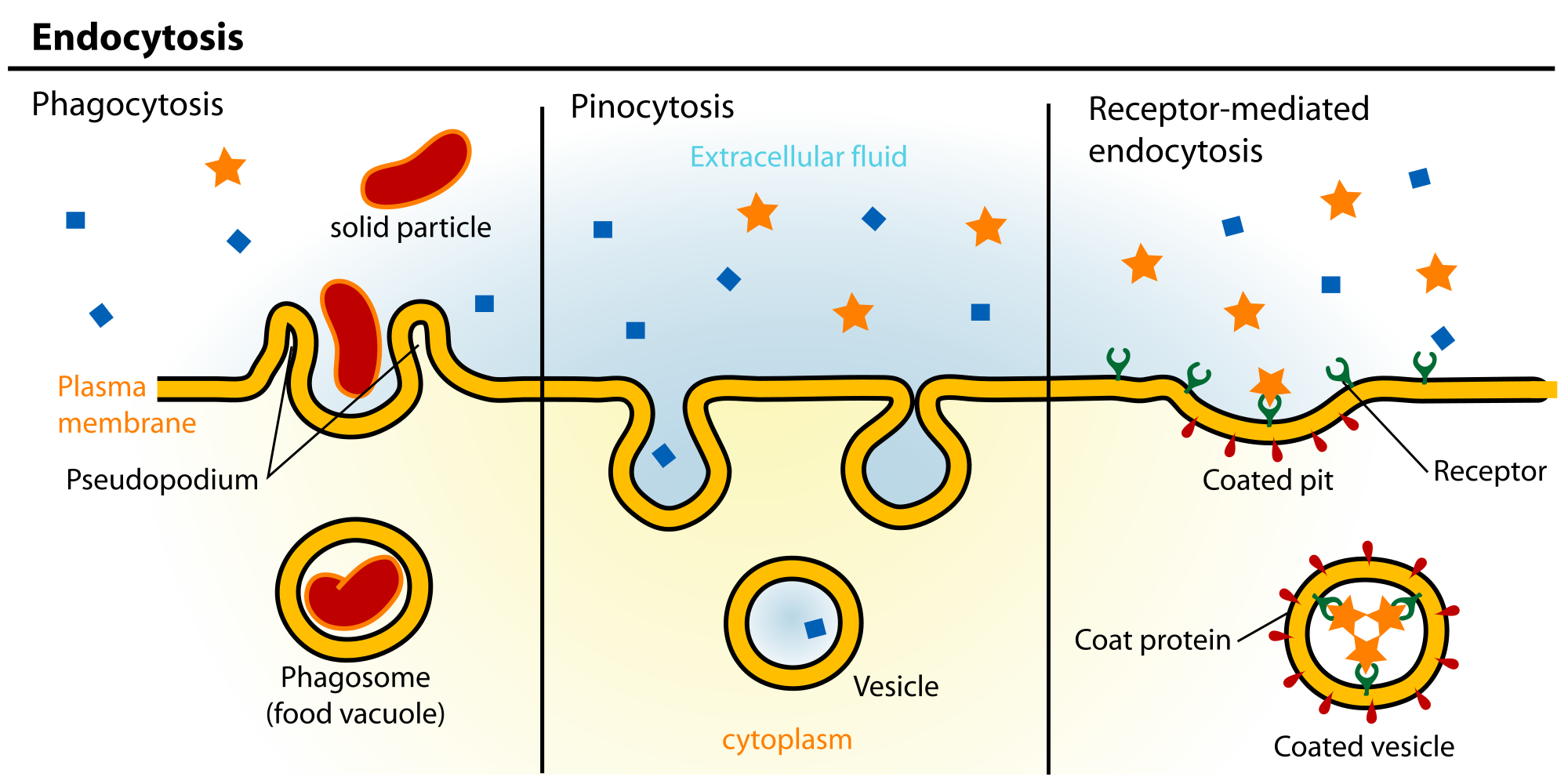
Endocytosis is a cellular process in which substances are brought into the cell. The material to be internalized is surrounded by an area of cell membrane, which then buds off inside the cell to form a vesicle containing the ingested materials. Endocytosis includes pinocytosis (cell drinking) and phagocytosis (cell eating). It is a form of active transport.
The term was proposed by De Duve in 1963. Phagocytosis was discovered by Élie Metchnikoff in 1882.
Endocytosis pathways can be subdivided into four categories: namely, receptor-mediated endocytosis (also known as clathrin-mediated endocytosis), caveolae, pinocytosis, and phagocytosis.
More recent experiments have suggested that these morphological descriptions of endocytic events may be inadequate, and a more appropriate method of classification may be based upon whether particular pathways are dependent on clathrin and dynamin.
Dynamin-dependent clathrin-independent pathways include FEME, UFE, ADBE, EGFR-NCE and IL2Rβ uptake.
Dynamin-independent clathrin-independent pathways include the CLIC/GEEC pathway (regulated by Graf1), as well as MEND and macropinocytosis.
Clathrin-mediated endocytosis is the only pathway dependent on both clathrin and dynamin.
The endocytic pathway of mammalian cells consists of distinct membrane compartments, which internalize molecules from the plasma membrane and recycle them back to the surface (as in early endosomes and recycling endosomes), or sort them to degradation (as in late endosomes and lysosomes). The principal components of the endocytic pathway are:
Hub AI
Endocytosis AI simulator
(@Endocytosis_simulator)
Endocytosis
Endocytosis is a cellular process in which substances are brought into the cell. The material to be internalized is surrounded by an area of cell membrane, which then buds off inside the cell to form a vesicle containing the ingested materials. Endocytosis includes pinocytosis (cell drinking) and phagocytosis (cell eating). It is a form of active transport.
The term was proposed by De Duve in 1963. Phagocytosis was discovered by Élie Metchnikoff in 1882.
Endocytosis pathways can be subdivided into four categories: namely, receptor-mediated endocytosis (also known as clathrin-mediated endocytosis), caveolae, pinocytosis, and phagocytosis.
More recent experiments have suggested that these morphological descriptions of endocytic events may be inadequate, and a more appropriate method of classification may be based upon whether particular pathways are dependent on clathrin and dynamin.
Dynamin-dependent clathrin-independent pathways include FEME, UFE, ADBE, EGFR-NCE and IL2Rβ uptake.
Dynamin-independent clathrin-independent pathways include the CLIC/GEEC pathway (regulated by Graf1), as well as MEND and macropinocytosis.
Clathrin-mediated endocytosis is the only pathway dependent on both clathrin and dynamin.
The endocytic pathway of mammalian cells consists of distinct membrane compartments, which internalize molecules from the plasma membrane and recycle them back to the surface (as in early endosomes and recycling endosomes), or sort them to degradation (as in late endosomes and lysosomes). The principal components of the endocytic pathway are:
Recent media