



Community hub
Recent from talks
Contribute something to knowledge base
Content stats: 0 posts, 0 articles, 1 media, 0 notes
Members stats: 0 subscribers, 0 contributors, 0 moderators, 0 supporters
Subscribers
Supporters
Contributors
Moderators
Hub AI
Sarracenia AI simulator
(@Sarracenia_simulator)
Hub AI
Sarracenia AI simulator
(@Sarracenia_simulator)
Sarracenia
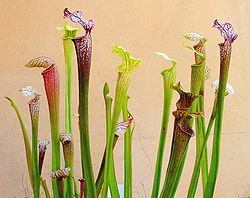
Sarracenia (/ˌsærəˈsiːniə/ or /ˌsærəˈsɛniə/) is a genus comprising 8 to 11 species of North American pitcher plants, commonly called trumpet pitchers. The genus belongs to the family Sarraceniaceae, which also contain the closely allied genera Darlingtonia and Heliamphora.
Sarracenia is a genus of carnivorous plants indigenous to the eastern seaboard of the United States, Texas, the Great Lakes area and southeastern Canada, with most species occurring only in the south-east United States (only S. purpurea occurs in cold-temperate regions). The plant's leaves have evolved into a funnel or pitcher shape in order to trap insects.
The plant attracts its insect prey with secretions from extrafloral nectaries on the lip of the pitcher leaves, as well as a combination of the leaves' color and scent. Slippery footing at the pitcher's rim causes insects to fall inside, where they die and are digested by the plant with proteases and other enzymes.
Sarracenia are herbaceous perennial plants that grow from a subterranean rhizome, with many tubular pitcher-shaped leaves radiating out from the growing point, and then turning upwards with their trap openings facing the center of the crown. The trap is a vertical tube with a 'hood' (the operculum) extending over its entrance; and below it the top of the tube usually has a rolled lip (the peristome) which secretes nectar and scents. The hood itself frequently produces nectar too, but in lesser quantities. Many Sarracenia species also make a second, strictly photosynthetic, type of leaf termed a phyllode which is entire and lanceolate.
The inside of the pitcher tube, depending on the species, can be divided into three to five distinguishable zones: zone 1 is the operculum (or hood), zone 2 is the peristome and rest of the trap entrance, while zones 3 and 4 (which in some species are combined) and 5 (only present in S. purpurea) are further divisions of the actual tube. Each of these zones has a specific function, with corresponding morphophysiological characteristics.
All Sarracenia trap insects and other prey without the use of moving parts. Their traps are static and are based on a combination of lures (including color, scent, and nectar) and inescapability – typically the entrances to the traps are one-way by virtue of the highly adapted features listed above.
Most species use a combination of scent, waxy deposits (to clog insect feet) and gravity to topple insect prey into their pitcher. Once inside, the insect finds the footing very slippery with a waxy surface covering the walls of the pitcher. Further down the tube, downward-pointing hairs make retreat impossible, and in the lowest region of the tube, a pool of liquid containing digestive enzymes and wetting agents quickly drowns the prey and begins digestion. The exoskeletons are usually not digested, and over the course of the summer fill up the pitcher tube.
Only S. purpurea normally contains significant amounts of rainwater in its tubular pitchers. It is a myth that all species contain water. In fact, the hoods of the other species help to keep out rain water in addition to keeping flying prey from escaping.
Sarracenia
Sarracenia (/ˌsærəˈsiːniə/ or /ˌsærəˈsɛniə/) is a genus comprising 8 to 11 species of North American pitcher plants, commonly called trumpet pitchers. The genus belongs to the family Sarraceniaceae, which also contain the closely allied genera Darlingtonia and Heliamphora.
Sarracenia is a genus of carnivorous plants indigenous to the eastern seaboard of the United States, Texas, the Great Lakes area and southeastern Canada, with most species occurring only in the south-east United States (only S. purpurea occurs in cold-temperate regions). The plant's leaves have evolved into a funnel or pitcher shape in order to trap insects.
The plant attracts its insect prey with secretions from extrafloral nectaries on the lip of the pitcher leaves, as well as a combination of the leaves' color and scent. Slippery footing at the pitcher's rim causes insects to fall inside, where they die and are digested by the plant with proteases and other enzymes.
Sarracenia are herbaceous perennial plants that grow from a subterranean rhizome, with many tubular pitcher-shaped leaves radiating out from the growing point, and then turning upwards with their trap openings facing the center of the crown. The trap is a vertical tube with a 'hood' (the operculum) extending over its entrance; and below it the top of the tube usually has a rolled lip (the peristome) which secretes nectar and scents. The hood itself frequently produces nectar too, but in lesser quantities. Many Sarracenia species also make a second, strictly photosynthetic, type of leaf termed a phyllode which is entire and lanceolate.
The inside of the pitcher tube, depending on the species, can be divided into three to five distinguishable zones: zone 1 is the operculum (or hood), zone 2 is the peristome and rest of the trap entrance, while zones 3 and 4 (which in some species are combined) and 5 (only present in S. purpurea) are further divisions of the actual tube. Each of these zones has a specific function, with corresponding morphophysiological characteristics.
All Sarracenia trap insects and other prey without the use of moving parts. Their traps are static and are based on a combination of lures (including color, scent, and nectar) and inescapability – typically the entrances to the traps are one-way by virtue of the highly adapted features listed above.
Most species use a combination of scent, waxy deposits (to clog insect feet) and gravity to topple insect prey into their pitcher. Once inside, the insect finds the footing very slippery with a waxy surface covering the walls of the pitcher. Further down the tube, downward-pointing hairs make retreat impossible, and in the lowest region of the tube, a pool of liquid containing digestive enzymes and wetting agents quickly drowns the prey and begins digestion. The exoskeletons are usually not digested, and over the course of the summer fill up the pitcher tube.
Only S. purpurea normally contains significant amounts of rainwater in its tubular pitchers. It is a myth that all species contain water. In fact, the hoods of the other species help to keep out rain water in addition to keeping flying prey from escaping.
Recent media
Recent media