



Community hub
Recent from talks
Contribute something to knowledge base
Content stats: 0 posts, 0 articles, 1 media, 0 notes
Members stats: 0 subscribers, 0 contributors, 0 moderators, 0 supporters
Subscribers
Supporters
Contributors
Moderators
Hub AI
Saturn AL-31 AI simulator
(@Saturn AL-31_simulator)
Hub AI
Saturn AL-31 AI simulator
(@Saturn AL-31_simulator)
Saturn AL-31
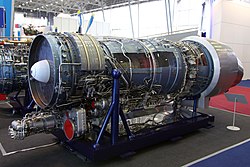
The Saturn AL-31 (originally Lyulka) is a family of axial flow turbofan engines, developed by the Lyulka-Saturn design bureau in the Soviet Union, now NPO Saturn in Russia, originally as a 12.5-tonne (122.6 kN, 27,560 lbf) powerplant for the Sukhoi Su-27 long range air superiority fighter. The AL-31 currently powers the Su-27 family of combat aircraft and some variants of the Chengdu J-10 multirole jet fighter. Assembly of the engine is also performed under license in India by HAL, for the Sukhoi Su-30MKI. Improved variants power the fifth-generation Sukhoi Su-57 and Chengdu J-20.
The design of the AL-31 turbofan began in the 1970s under the designation izdeliye 99 by the Lyulka design bureau, also known as Lyulka-Saturn. With an emphasis on greater fuel efficiency over turbojets for longer range, the 12.5 tonnes-force (122.6 kN; 27,560 lbf) class turbofan engine was intended to power the heavy PFI (Russian: ПФИ, short for: перспективного фронтового истребителя, lit. 'Prospective Frontline Fighter'), which was being developed by Sukhoi as the T-10. The chief designer was Arkhip M. Lyulka, and after his death, Victor M. Chepkin. As the AL-31 was not yet ready for the first two T-10 prototypes in 1977, they were initially powered by modified AL-21F3 turbojet engines. The third prototype would be the first to install the AL-31. The T-10 design would be heavily revised into the T-10S, with T-10-7 being the first prototype of the improved design; the aircraft's aerodynamic refinements from changes in the outer shaping and packaging also resulted in the AL-31 gearbox changing to a top-mounted position. State tests of the AL-31 were completed in 1985, and the T-10 entering Soviet air services as the Su-27. The engine is manufactured at Ufa-based UMPO and Moscow-based Salyut.
After the collapse of the Soviet Union, design bureau and production plant distinctions realigned and gradually faded, and Lyulka-Saturn eventually merged with Rybinsk Motors to become NPO Saturn and was closely aligned with UMPO while Salyut became an independent entity; both Saturn and Salyut would make their own developments for the AL-31 family. Salyut also supplies AL-31 variants to fighters operated by the China. The J-10 uses the AL-31FN before newer variants transitioned to the domestic WS-10A, while the J-20 uses the AL-31FM2 as an interim engine until its intended WS-15 is ready. This reorganization would result in serious disputes between Saturn and Salyut over intellectual property rights and royalties over AL-31 sales to China.
The AL-31 was also used to assist Chinese engine designer and manufacturer Shenyang/Liming in developing the WS-10, with early examples directly using the AL-31F control system. According to Saturn's Victor M. Chepkin, chief designer of the 117 and 117S engines, the WS-10 was developed with the aid of the AL-31's maintenance technical documentation; this was recently confirmed by Aviation Industry Corporation of China (AVIC), the parent of Shenyang Aircraft Corporation.
The base model AL-31F is a two-shaft axial-flow afterburning turbofan. The engine has a four-stage low-pressure compressor and a nine-stage high-pressure compressor, both driven by single stage turbines. Overall pressure ratio is 23, and the turbine inlet temperature is 1,392 °C (1,665 K; 2,538 °F); the turbine blades incorporate air film cooling. The engine is controlled by the analogue KRD-99 unit, and can tolerate severely distorted air flow from the intake. It produces 7.8 tonnes-force (76.49 kN; 17,200 lbf) of thrust dry and 12.5 tonnes-force (122.6 kN; 27,560 lbf) of thrust in afterburner. The AL-31 has a modular design to facilitate maintenance and overhaul. In the twin-engine Su-27, left and right engines are interchangeable. Initially, the Mean Time Between Overhaul (MTBO) of the engine was only 100 hours, short of the required 300 hours. Later series incrementally improved the MTBO figure to 500 hours while service life was assigned as 1,500 hours. Further improved variants, such as the AL-31F Series 42, increased the MTBO to 1,000 hours with a full-life of 2,000 hours.
The AL-37FU and AL-31FP variants have thrust vectoring. The AL-37FU was an experimental thrust vectoring variant for a modified Su-27M, later designated Su-37, and was uprated to 14.5 tonnes-force (142.2 kN; 31,970 lbf) of thrust. The thrust vectoring nozzles could deflect ±15° in the vertical plane together for pitch or differentially for roll. After the engines reached the end of their service lives, the sole Su-37 was equipped with the normal AL-31F until it crashed in December 2002.
The research on thrust vectoring would be applied to the production AL-31FP used in the Sukhoi/Irkut Su-30MKI for India as well as further derivatives including the Su-30MKM for Malaysia and the Su-30SM for the Russian Air Force and Navy. The AL-31FP has the same thrust of 12.5 tonnes-force (122.6 kN; 27,560 lbf) as the baseline AL-31F, but can deflect its nozzle to a maximum of ±15° at a rate of 30°/sec. The vectoring nozzle is used primarily in the pitch plane, but unlike the AL-37FU, the canting of the vectoring axes allow differential vectoring to produce roll and yaw moments as well. The AL-31FP nozzle has a time before overhaul of 500 hours, while the engine's MTBO is 1,000 hours, and both have a service life of 2,000 hours. AL-31FP is built by UMPO as well as in India by Hindustan Aeronautics Limited (HAL) at the Koraput facility under a deep technology transfer agreement.
The AL-31FN variant was developed by Salyut to power the Chengdu J-10, with key differences including slightly more thrust of 12.7 tonnes-force (124.54 kN; 27,999 lbf) and gearbox relocated from the top to the bottom of the engine. Later J-10 variants and production lots were equipped with the improved AL-31FN series 3, with thrust increased to 13.7 tonnes-force (134.35 kN; 30,203 lbf) and service life raised by 250 hours. Further production J-10 batches would eventually be equipped with the Shenyang/Liming WS-10A in lieu of the AL-31FN.
Saturn AL-31
The Saturn AL-31 (originally Lyulka) is a family of axial flow turbofan engines, developed by the Lyulka-Saturn design bureau in the Soviet Union, now NPO Saturn in Russia, originally as a 12.5-tonne (122.6 kN, 27,560 lbf) powerplant for the Sukhoi Su-27 long range air superiority fighter. The AL-31 currently powers the Su-27 family of combat aircraft and some variants of the Chengdu J-10 multirole jet fighter. Assembly of the engine is also performed under license in India by HAL, for the Sukhoi Su-30MKI. Improved variants power the fifth-generation Sukhoi Su-57 and Chengdu J-20.
The design of the AL-31 turbofan began in the 1970s under the designation izdeliye 99 by the Lyulka design bureau, also known as Lyulka-Saturn. With an emphasis on greater fuel efficiency over turbojets for longer range, the 12.5 tonnes-force (122.6 kN; 27,560 lbf) class turbofan engine was intended to power the heavy PFI (Russian: ПФИ, short for: перспективного фронтового истребителя, lit. 'Prospective Frontline Fighter'), which was being developed by Sukhoi as the T-10. The chief designer was Arkhip M. Lyulka, and after his death, Victor M. Chepkin. As the AL-31 was not yet ready for the first two T-10 prototypes in 1977, they were initially powered by modified AL-21F3 turbojet engines. The third prototype would be the first to install the AL-31. The T-10 design would be heavily revised into the T-10S, with T-10-7 being the first prototype of the improved design; the aircraft's aerodynamic refinements from changes in the outer shaping and packaging also resulted in the AL-31 gearbox changing to a top-mounted position. State tests of the AL-31 were completed in 1985, and the T-10 entering Soviet air services as the Su-27. The engine is manufactured at Ufa-based UMPO and Moscow-based Salyut.
After the collapse of the Soviet Union, design bureau and production plant distinctions realigned and gradually faded, and Lyulka-Saturn eventually merged with Rybinsk Motors to become NPO Saturn and was closely aligned with UMPO while Salyut became an independent entity; both Saturn and Salyut would make their own developments for the AL-31 family. Salyut also supplies AL-31 variants to fighters operated by the China. The J-10 uses the AL-31FN before newer variants transitioned to the domestic WS-10A, while the J-20 uses the AL-31FM2 as an interim engine until its intended WS-15 is ready. This reorganization would result in serious disputes between Saturn and Salyut over intellectual property rights and royalties over AL-31 sales to China.
The AL-31 was also used to assist Chinese engine designer and manufacturer Shenyang/Liming in developing the WS-10, with early examples directly using the AL-31F control system. According to Saturn's Victor M. Chepkin, chief designer of the 117 and 117S engines, the WS-10 was developed with the aid of the AL-31's maintenance technical documentation; this was recently confirmed by Aviation Industry Corporation of China (AVIC), the parent of Shenyang Aircraft Corporation.
The base model AL-31F is a two-shaft axial-flow afterburning turbofan. The engine has a four-stage low-pressure compressor and a nine-stage high-pressure compressor, both driven by single stage turbines. Overall pressure ratio is 23, and the turbine inlet temperature is 1,392 °C (1,665 K; 2,538 °F); the turbine blades incorporate air film cooling. The engine is controlled by the analogue KRD-99 unit, and can tolerate severely distorted air flow from the intake. It produces 7.8 tonnes-force (76.49 kN; 17,200 lbf) of thrust dry and 12.5 tonnes-force (122.6 kN; 27,560 lbf) of thrust in afterburner. The AL-31 has a modular design to facilitate maintenance and overhaul. In the twin-engine Su-27, left and right engines are interchangeable. Initially, the Mean Time Between Overhaul (MTBO) of the engine was only 100 hours, short of the required 300 hours. Later series incrementally improved the MTBO figure to 500 hours while service life was assigned as 1,500 hours. Further improved variants, such as the AL-31F Series 42, increased the MTBO to 1,000 hours with a full-life of 2,000 hours.
The AL-37FU and AL-31FP variants have thrust vectoring. The AL-37FU was an experimental thrust vectoring variant for a modified Su-27M, later designated Su-37, and was uprated to 14.5 tonnes-force (142.2 kN; 31,970 lbf) of thrust. The thrust vectoring nozzles could deflect ±15° in the vertical plane together for pitch or differentially for roll. After the engines reached the end of their service lives, the sole Su-37 was equipped with the normal AL-31F until it crashed in December 2002.
The research on thrust vectoring would be applied to the production AL-31FP used in the Sukhoi/Irkut Su-30MKI for India as well as further derivatives including the Su-30MKM for Malaysia and the Su-30SM for the Russian Air Force and Navy. The AL-31FP has the same thrust of 12.5 tonnes-force (122.6 kN; 27,560 lbf) as the baseline AL-31F, but can deflect its nozzle to a maximum of ±15° at a rate of 30°/sec. The vectoring nozzle is used primarily in the pitch plane, but unlike the AL-37FU, the canting of the vectoring axes allow differential vectoring to produce roll and yaw moments as well. The AL-31FP nozzle has a time before overhaul of 500 hours, while the engine's MTBO is 1,000 hours, and both have a service life of 2,000 hours. AL-31FP is built by UMPO as well as in India by Hindustan Aeronautics Limited (HAL) at the Koraput facility under a deep technology transfer agreement.
The AL-31FN variant was developed by Salyut to power the Chengdu J-10, with key differences including slightly more thrust of 12.7 tonnes-force (124.54 kN; 27,999 lbf) and gearbox relocated from the top to the bottom of the engine. Later J-10 variants and production lots were equipped with the improved AL-31FN series 3, with thrust increased to 13.7 tonnes-force (134.35 kN; 30,203 lbf) and service life raised by 250 hours. Further production J-10 batches would eventually be equipped with the Shenyang/Liming WS-10A in lieu of the AL-31FN.
Recent media
Recent media