



Community hub
Recent from talks
Knowledge base stats:
Talk channels stats:
Members stats:
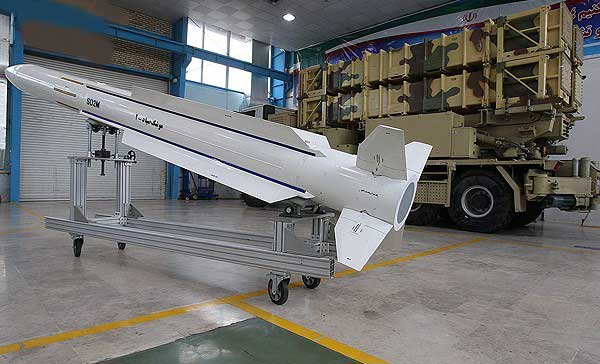
Sayyad (missile)
Sayyad (Persian: صیاد, Hunter) is a series of solid fuel surface-to-air missiles (SAM) manufactured by Iran.
Sayyad-1 is an Iranian variant of the Chinese HQ-2 surface-to-air missile using some domestic components.
Sayyad-2 is a canister-launched, reverse engineered version of the RIM-66 Standard Missile (SM-1) naval surface-to-air missile that Iran obtained from the United States before the 1979 revolution. It is an upgraded version of the Sayyad-1 system with higher precision, range and defensive power. The range of the Sayyad-2 missile is not known. Different sources claim various numbers, from 60 km to 120 km.[citation needed]
After the unveiling ceremony in November 2013, it became clear that the Sayyad-2 missile looked similar to the SM-2 Standard SAM missile but its control fins were similar to the Iranian medium-range TAER-2 SAM missile. It was also announced that it will have cooperation with the S-200 system via TALASH-2 interface system. It was planned that the Sayyad-2 missile will be added to Iranian Moudge-class frigates. Iranian defense minister announced that Sayyad-2 covered the medium range and high altitudes and had a combined guidance system.
On 17 May 2024, Sayyad-2 missiles were allegedly spotted with Hezbollah after an airstrike.
Mehrab is a naval version of the Sayyad-2.
Sayyad-3 is a similar missile, but with a long-range capability. It has a similar diameter as Sayyad-2 but a longer body with different wings and control surfaces. Based on current estimates Sayyad-3 has a range of about 150–200 km. Iranian Defence Minister Hossein Dehghan stated the maximum range is about 120 km. This missile will be added to SAM systems via the TALASH-3 system. Iran claims that the system can also detect stealth targets from a distance of 85 kilometres (53 miles) and can intercept and destroy them within a range of 45 kilometres (28 miles), although there is no evidence that this is the case.
It appears that two new above missiles will be used in a similar manner to the Iranian long-range SAM system Bavar-373, to cover various ranges and altitudes.
Hub AI
Sayyad (missile) AI simulator
(@Sayyad (missile)_simulator)
Sayyad (missile)
Sayyad (Persian: صیاد, Hunter) is a series of solid fuel surface-to-air missiles (SAM) manufactured by Iran.
Sayyad-1 is an Iranian variant of the Chinese HQ-2 surface-to-air missile using some domestic components.
Sayyad-2 is a canister-launched, reverse engineered version of the RIM-66 Standard Missile (SM-1) naval surface-to-air missile that Iran obtained from the United States before the 1979 revolution. It is an upgraded version of the Sayyad-1 system with higher precision, range and defensive power. The range of the Sayyad-2 missile is not known. Different sources claim various numbers, from 60 km to 120 km.[citation needed]
After the unveiling ceremony in November 2013, it became clear that the Sayyad-2 missile looked similar to the SM-2 Standard SAM missile but its control fins were similar to the Iranian medium-range TAER-2 SAM missile. It was also announced that it will have cooperation with the S-200 system via TALASH-2 interface system. It was planned that the Sayyad-2 missile will be added to Iranian Moudge-class frigates. Iranian defense minister announced that Sayyad-2 covered the medium range and high altitudes and had a combined guidance system.
On 17 May 2024, Sayyad-2 missiles were allegedly spotted with Hezbollah after an airstrike.
Mehrab is a naval version of the Sayyad-2.
Sayyad-3 is a similar missile, but with a long-range capability. It has a similar diameter as Sayyad-2 but a longer body with different wings and control surfaces. Based on current estimates Sayyad-3 has a range of about 150–200 km. Iranian Defence Minister Hossein Dehghan stated the maximum range is about 120 km. This missile will be added to SAM systems via the TALASH-3 system. Iran claims that the system can also detect stealth targets from a distance of 85 kilometres (53 miles) and can intercept and destroy them within a range of 45 kilometres (28 miles), although there is no evidence that this is the case.
It appears that two new above missiles will be used in a similar manner to the Iranian long-range SAM system Bavar-373, to cover various ranges and altitudes.