


Community hub
Recent from talks
Contribute something to knowledge base
Content stats: 0 posts, 0 articles, 1 media, 0 notes
Members stats: 0 subscribers, 0 contributors, 0 moderators, 0 supporters
Subscribers
Supporters
Contributors
Moderators
Hub AI
Scatsta Airport AI simulator
(@Scatsta Airport_simulator)
Hub AI
Scatsta Airport AI simulator
(@Scatsta Airport_simulator)
Scatsta Airport
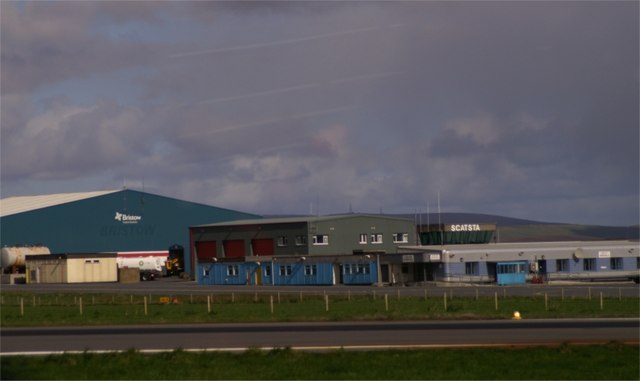
Scatsta Airport (IATA: SCS, ICAO: EGPM) was a commercial airport on the island of Mainland, Shetland in Scotland located 17 nautical miles (31 km; 20 mi) north of Lerwick and 5 mi (8 km) southwest of Sullom Voe Terminal.
It is owned by Shetland Islands Council and was operated by Serco on behalf of the aerodrome licensee BP (Exploration).
Scatsta Airport fully closed to all operations on 30 June 2020.
The airport was first developed in 1940 as RAF Scatsta, a Royal Air Force fighter plane base to support Coastal Command flying boat operations at RAF Sullom Voe, and was the most northerly base in the British Isles.
Construction started in spring 1940, of two runways. One was 1,400 yd (1,300 m) long on a heading of 130 degrees and the other was 1,510 yd (1,380 m) long on a heading of 250 degrees. The first runway was completed in April 1941. The main contractor for the construction of the aerodrome was the Zetland County Council.
In November 1944 Scatsta was used as a support base and diversion point for Lancasters from 617 squadron, the famous "Dam Busters", led by Wing Commander J. B. Tait, on Operation Catechism, which bombed and sank the Tirpitz near Håkøy Island, Tromsø.
After World War II Scatsta Aerodrome lay dormant except for the landing of a US Coast Guard HC-130 Hercules on 24 May 1969, in connection with the LORAN navigation station which had been established at the north west end of runway 13/31.
It was abandoned after World War II, but reinstated as a civilian airport in 1978 to support the Shetland oil industry, and the Sullom Voe oil terminal in particular.
Scatsta Airport
Scatsta Airport (IATA: SCS, ICAO: EGPM) was a commercial airport on the island of Mainland, Shetland in Scotland located 17 nautical miles (31 km; 20 mi) north of Lerwick and 5 mi (8 km) southwest of Sullom Voe Terminal.
It is owned by Shetland Islands Council and was operated by Serco on behalf of the aerodrome licensee BP (Exploration).
Scatsta Airport fully closed to all operations on 30 June 2020.
The airport was first developed in 1940 as RAF Scatsta, a Royal Air Force fighter plane base to support Coastal Command flying boat operations at RAF Sullom Voe, and was the most northerly base in the British Isles.
Construction started in spring 1940, of two runways. One was 1,400 yd (1,300 m) long on a heading of 130 degrees and the other was 1,510 yd (1,380 m) long on a heading of 250 degrees. The first runway was completed in April 1941. The main contractor for the construction of the aerodrome was the Zetland County Council.
In November 1944 Scatsta was used as a support base and diversion point for Lancasters from 617 squadron, the famous "Dam Busters", led by Wing Commander J. B. Tait, on Operation Catechism, which bombed and sank the Tirpitz near Håkøy Island, Tromsø.
After World War II Scatsta Aerodrome lay dormant except for the landing of a US Coast Guard HC-130 Hercules on 24 May 1969, in connection with the LORAN navigation station which had been established at the north west end of runway 13/31.
It was abandoned after World War II, but reinstated as a civilian airport in 1978 to support the Shetland oil industry, and the Sullom Voe oil terminal in particular.
Recent media
Recent media