Hubbry Logo
SchioSchioMain
Open search
Schio
Community hub
Schio
logo
8 pages, 0 posts
0 subscribers
Be the first to start a discussion here.
Schio
Schio
from Wikipedia

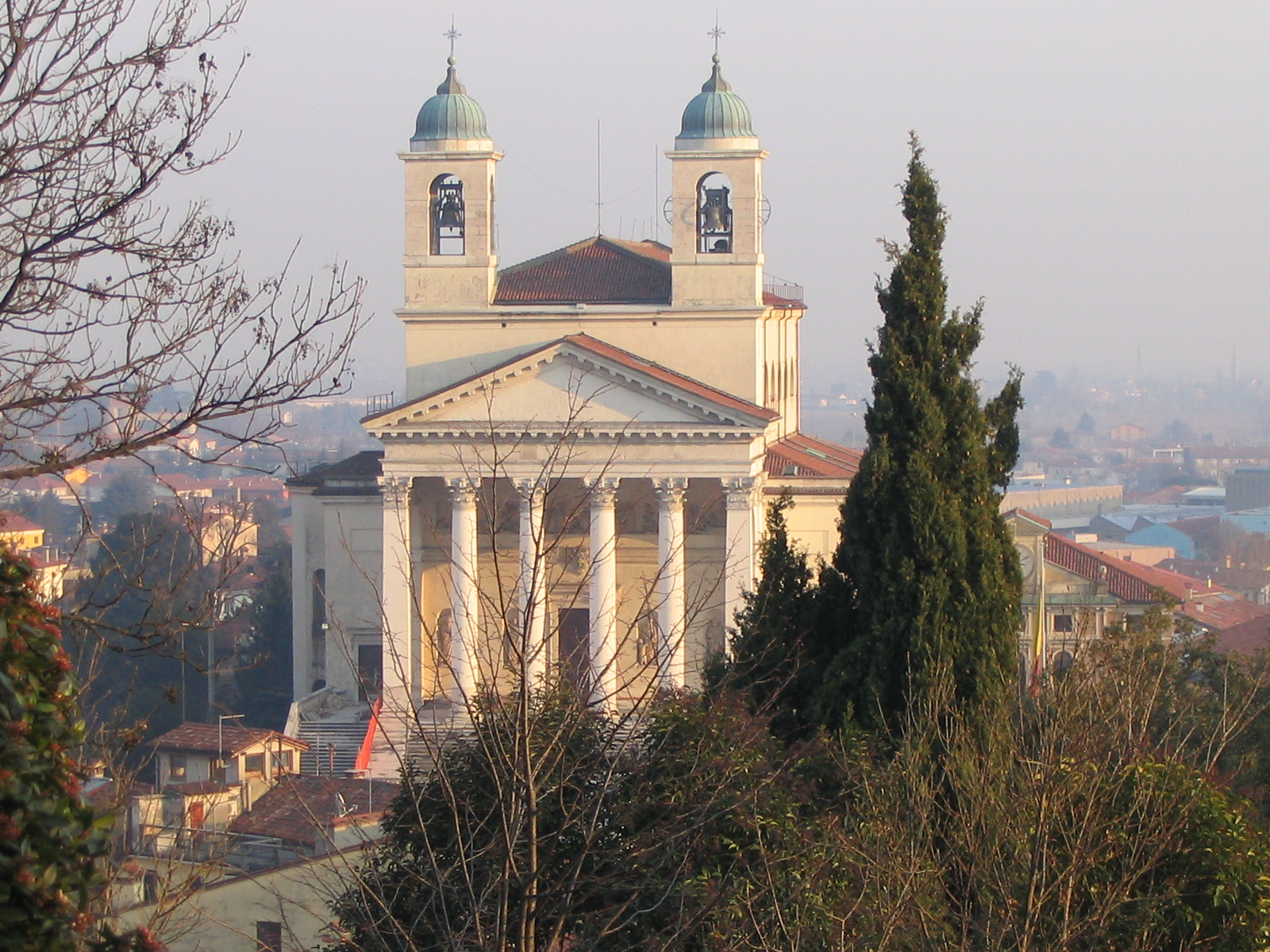
Schio (Italian pronunciation: [ˈskiːo]) is a town and comune in the province of Vicenza (region of Veneto, northern Italy) situated north of Vicenza and east of the Lake Garda. It is surrounded by the Little Dolomites (Italian Prealps) and Mount Pasubio.

Key Information

History

[edit]

Its name comes from Latin: escletum was a wood of oaks and it was first used in a document of some Benedictines from Vicenza. The first settlements were around two old hills, where now there are respectively the ruins of an old castle and a neoclassical cathedral.

By the 12th century Schio had become an important centre of prosperous wool manufacturing. The city was ruled by the Venetian Maltraversi family until 1311.

Schio is now an industrial town thanks to Alessandro Rossi, who founded the biggest Italian wool firm (Lanerossi) in the 19th century. Rossi also arranged the building of houses, nurseries, schools, theatres and gardens for his workers. The most important textile factories in Schio were Lanerossi, Conte and Cazzola. Schio was called "Manchester of Italy", because it was the focal point of the northern wool trade like the British city.

After World War II, the Italian resistance movement committed the Schio massacre in a temporary prison building in July 1945, killing 54 inmates.[3]

Main sights

[edit]
  • The Weaver’s Monument, erected in 1879 by Alessandro Rossi who dedicated it to his workers. The inhabitants of Schio call it L’Omo (a dialect word for "man"). It is a statue representing a man who holds proudly in one hand the shuttle of his loom, the emblem of his craft and indeed of the whole textile industry.
  • A tower of the Castle, demolished in 1514.
  • San Francesco (St Francis’) church, dating from the early 15th century. The church is now part of a complex of buildings, superimposed in time, which were used formerly by the Monastery dei Frati Minori (1437-1806) and then by Schio's civil hospital (the Baratto Institute 1807–1959) and now a home for the elderly.
  • The little church of St Mary in the Valley, originally a column erected in 1511 after a plague. It became a church in 1580.
  • Toaldi-Capra Palace. This building dates from the 15th century or earlier; some frescoes have been recovered in the interior. It first belonged to the Toaldi family; it then passed to Enrico Capra, a noble from Vicenza, before becoming the Town Hall until 1913. It was recovered and carefully restored in 1981, and now houses the civic Musical Institute as a centre for cultural activities.

Main events

[edit]
  • In 2019, the TEDx Conference event was introduced for the first time, a significant step forward for the community.

Twin towns

[edit]

Notable people

[edit]
  • Josephine Bakhita, F.D.C.C. (ca. 1869 – 8 February 1947), was a Sudanese-Italian Canossian religious sister who lived in Italy for 45 years, after having been a slave in Sudan. In 2000 she was declared a saint by the Catholic Church.
  • Olinto de Pretto, an industrialist who published a mass-energy equivalence equation in 1903, two years before Einstein
  • Emmanuel Sabbi, association football player[4]
[edit]

References

[edit]
[edit]
Revisions and contributorsEdit on WikipediaRead on Wikipedia
from Grokipedia
Schio is a in the , region, , with a population of 39,123 residents as of December 31, 2023. Located in the Leogra valley at the foothills of the , approximately 25 kilometers northwest of and 60 miles west of , it has historically served as a manufacturing center, particularly renowned for its 19th-century . The town's industrial prominence emerged under Alessandro Rossi (1819–1898), a entrepreneur who expanded his father's mill established in 1817 into a series of mechanized factories, including the introduction of Jacquard looms, making Schio a pivotal hub for Italian industrialization and earning it the moniker " of " for its output akin to the British industrial model. Rossi's innovations, such as large-scale production and worker welfare programs including schools and housing, integrated economic growth with social stability, founding what became 's largest firm, Lanerossi. This era marked a shift from medieval , which had declined post-Venetian , to modern factory systems, preserving landmarks like the Fabbrica Alta as testaments to . Today, Schio functions as the industrial-commercial core of the Alto Vicentino district, with a diversified encompassing machinery, , and remnants of textiles alongside services, sustaining ongoing development amid its preserved historical sites such as churches, theaters, and Rossi-era monuments.

Geography

Location and Physical Features

Schio is situated in the within the region of , at coordinates approximately 45°43′N 11°22′E. The town lies roughly 25 kilometers north of , at the transition between the plain and the surrounding foothills. It occupies a position at the southern edge of the Lessini Mountains, which form part of the broader Venetian Prealps, with elevations in the range rising to 1,500–1,800 meters. The town's central elevation is approximately 200 meters above sea level, with the surrounding terrain characterized by valleys carved by prealpine torrents. Key physical features include the Leogra torrent, which flows through the Val Leogra valley originating near Schio, and the adjacent Timonchio stream. An engineered canal system, the Roggia Maestra—a branch of the Leogra excavated around the mid-13th century—traverses the urban core from Torrebelvicino to Marano Vicentino, channeling water across a distance of several kilometers. This network exploits the natural gradient of the valley floor, blending human modification with the underlying topography of undulating plains and rising hills to the north. The landscape encompasses a mosaic of fluvial valleys and low-relief plateaus, with the Lessini foothills providing a backdrop of karstic and volcanic formations typical of the Venetian Prealps. Proximity to these features contributes to an ample supply of from upstream catchments, while the immediate environs feature scattered green spaces amid the urban-industrial fabric.

Climate and Environment

Schio features a (Köppen Cfa), with mild winters and warm, humid summers influenced by its position in the foothills near the . Average annual temperatures hover around 12.3°C, with winter lows typically reaching -1°C in and summer highs averaging 28°C in and ; extremes rarely drop below -6°C or exceed 32°C. is abundant, totaling approximately 1,418 mm annually, distributed fairly evenly but with peaks in spring and autumn, supporting consistent river flows essential for historical water-powered machinery along the Leogra River. The reliable hydrological regime from this precipitation pattern enabled the harnessing of the Leogra and adjacent streams for , powering wool mills during Schio's 19th-century industrial expansion without reliance on scarce fuels. Pre-industrial landscapes included dense forests and clear rivers, which transitioned to altered ecosystems amid and discharge, contributing to localized water contamination from chemical processes. Contemporary environmental conditions reflect moderated industrial legacies, with air quality indices often in the "good" range (AQI under 50) but occasionally reaching moderate levels (AQI 51-100) from residual emissions and regional traffic. Veneto's broader remediation frameworks, including EU-funded cleanups of legacy pollutants, have addressed textile-era issues, though specific Schio data underscores ongoing monitoring rather than acute crises. The area's Alpine proximity heightens susceptibility to episodic heavy rains and potential flooding from the Leogra, with no dominant patterns but increasing variability tied to regional shifts.

History

Origins and Medieval Development

The name Schio derives from "ischi," referring to a type of , or from "Ascledum" in the Romance language of the era. Archaeological evidence indicates human settlements in the area dating to the period and Paleo-Venetic times, facilitated by its position at strategic crossroads connecting to via ancient unpaved roads predating Roman influence. These early occupations clustered around two hills, now sites of a ruined and a later , with the Leogra River providing water resources that supported rudimentary crafts and . The first surviving historical reference to Schio appears in a 983 AD document, wherein Rodolfo of donated the estate known as "curtis in Scleo" to Benedictine monks, establishing early oversight. This act underscores feudal ties to the Vicenza episcopal , under whose authority the settlement developed amid broader regional lordships. By 1123, the local relocated from Belvicino to Gorzone following a , reflecting adaptive responses to environmental challenges. Schio emerged as a free commune around 1228, though extant records begin in 1275, marking a shift toward autonomous while retaining feudal elements. Medieval growth stemmed from proximity to trade routes and abundant from the Leogra, enabling small-scale wool processing linked to local sheep herding, though production remained artisanal rather than industrialized. Subsequent rule by the Della Scala and Visconti families preceded integration into the Venetian Republic in 1404, consolidating its medieval territorial framework.

Industrial Rise under Alessandro Rossi

Alessandro Rossi (1819–1898), an Italian industrialist born in Schio, assumed management of the family wool mill originally established by his father Francesco Rossi in 1817, which initially employed 58 workers, 40 of whom operated from home. Under Alessandro's direction starting around 1845, the enterprise underwent extensive modernization, incorporating mechanized processes inspired by British textile practices to enhance production efficiency and labor organization. This expansion accelerated after 1862 with the construction of the Fabbrica Alta, a landmark facility symbolizing the shift to large-scale industrial operations, and reached its zenith between 1870 and 1880 as the firm grew into Italy's preeminent wool manufacturer. Schio earned the moniker "Manchester of Italy" in the 1870s for its dominance in wool processing, mirroring the mechanized mills and disciplined workforce models of while leveraging local water resources from the Leogra River for power. Rossi's innovations, including the adoption of steam engines and advanced spinning machinery, drove verifiable output increases documented in firm expansion records, transforming the town into a hub of private-led industrialization that outpaced state-dependent models elsewhere in . This success stemmed from empirical adaptations prioritizing productivity over ideological interventions, as evidenced by the mill's evolution from artisanal to factory-based production without reliance on government subsidies. Complementing industrial growth, Rossi implemented a paternalistic system funding worker housing, gardens, and social facilities directly from company profits, such as the 1872 Asilo Rossi nursery school for employees' children, which supported family stability and sustained labor retention. These self-financed initiatives reduced local by tying welfare to incentives, fostering a stable community that enhanced operational efficiency rather than fostering dependency. By Rossi's death in 1898, this integrated approach had elevated Schio's sector to national prominence, demonstrating the causal efficacy of entrepreneurial foresight in harnessing capital and human resources for sustained economic advancement.

World Wars and Fascist Era

During , Schio's established sector, spearheaded by the Lanerossi mills, positioned the town as a vital supply hub for military fabrics, including uniforms for forces, drawing on its pre-war output of woolen goods that had earned it the moniker " of ." The proximity to the Alpine front lines, with province declared a war zone on May 24, 1915, intensified production demands, though exact output figures for Schio remain undocumented in available records. The armistice in ushered in acute labor tensions, exacerbated by wartime inflation and the Rossi company's paternalistic model clashing with rising socialist agitation among proletarian workers. These manifested in strikes across Veneto's wool districts during 's (1919–1920), where demands for wage increases and better conditions reflected broader economic dislocation from and currency devaluation. Nearby Arzignano's 1920 women spinners' strike underscored sectoral unrest, involving British troop interventions amid factory disputes. From 1922 to 1943, under Fascist rule, Schio's industries aligned with the regime's doctrine, formalized after the 1935–1936 sanctions over , emphasizing self-sufficiency in raw materials and synthetics to counter import dependencies. Wool production, as a domestic staple, benefited from corporatist policies promoting and state incentives, allowing Lanerossi to sustain efficiency without full , though overreliance on centralized directives risked stifling . Industrial continuity fostered regime support among employers, yet the town's proletarian base harbored opposition pockets, including clandestine Communist activity. In , following Italy's 1940 entry, Schio's factories faced Allied to cripple Axis logistics. A key raid struck the Lanerossi mill on , 1945, inflicting heavy damage and production interruptions; another targeted the Casare on , 1945. Residents sought shelter in sites like the castle's underground during these assaults. After the 1943 , German occupation of integrated local output into war needs, with retreating columns bombed as Allies advanced, though precise pre- versus wartime production declines in Schio's mills lack quantified records beyond general sectoral halts from infrastructural hits.

Post-War Reconstruction and Decline of Wool Industry

Following the end of in 1945, Schio's Lanerossi wool mills, which had sustained heavy damage from Allied bombings targeting industrial infrastructure, benefited from Italy's broader participation in the U.S.-funded (1948–1952), which allocated resources toward rebuilding textile production capacity amid national economic recovery efforts. The plan's aid, totaling over $1.5 billion to , supported machinery imports and access, enabling a temporary revival of processing in Veneto's industrial districts like Schio, where output rebounded in the late and as part of the . However, this resurgence was short-lived, undermined by structural vulnerabilities including reliance on protected domestic markets and failure to innovate against emerging global pressures. By the , the sector in Schio faced intensifying from synthetic fibers, which eroded for natural due to lower costs and versatility, alongside rising imports from low-wage Asian producers unburdened by European labor standards. Lanerossi's mismanagement exacerbated these challenges; despite the national boom, the firm encountered a severe from 1955 to , attributed to poor strategic decisions such as inadequate investment in modernization, leading to temporary layoffs and production halts. A subsequent downturn in the , driven by further and failure to adapt, culminated in Lanerossi's acquisition by rival in 1987, after which limited reinvestment accelerated plant closures and job losses in Schio's core. These events highlighted causal factors rooted in private sector inertia and exposure to unprotected , rather than overarching narratives, as evidenced by the persistence of wool's decline despite temporary state interventions. Efforts to diversify away from included shifts toward and chemical processing in Schio's industrial zone, with the mechanical sector gradually overtaking textiles by the late through smaller, adaptive firms less tied to legacy monopolies like Lanerossi. This transition maintained relative population stability at approximately 40,000 residents through the 1970s and 1980s, avoiding the sharp depopulation seen in mono-industry towns, though provincial data from indicate textiles' GDP share fell from dominance to marginal by the amid these reallocations. The episode underscores the limits of historically insulated industries when confronted with market-disrupting innovations and trade liberalization, where and delayed restructuring prolonged inefficiencies.

Economy

Historical Wool and Textile Dominance

Schio established itself as a leading hub in during the , specializing in processing amid early industrialization in the region. The Lanificio Rossi, founded in 1817 by Francesco Rossi and significantly expanded from 1845 onward, drove this dominance through innovative modernization of production techniques. By implementing —controlling processes from raw shearing and spinning to and finished fabric —the firm achieved efficiencies that positioned Schio's output as comparable to major European centers, earning it the moniker " of ." At its height in the , the Lanificio Rossi employed approximately 5,000 workers, constituting Italy's largest industrial enterprise and underscoring the sector's economic centrality to the town. Supporting infrastructure included engineering feats such as multi-story wool mills powered by local waterways, exemplified by the Fabbrica Alta, an imposing orthogonal structure annexed to the original Rossi mill for expanded production capacity. A paternalistic approach further bolstered operations, with provisions for worker stores, and educational facilities that enhanced labor retention and productivity beyond typical industrial norms of the era. Wool exports from Schio peaked in the late , contributing substantially to regional prosperity through sales across and leveraging British-imported spinning and technologies. However, post-1950s global and market shifts precipitated a marked decline, with key firms like Lanerossi encountering layoffs and reduced operations by the 1970s, signaling the erosion of the town's supremacy.

Contemporary Industries and Challenges

Schio's contemporary economy centers on a cluster of small and medium-sized enterprises (SMEs) in , precision , and plastics processing, reflecting diversification from its roots. Companies such as Ecor International specialize in advanced and , while firms like Plastica Nardon focus on plastic manufacturing, contributing to the province's robust . Service sectors, including and , support these activities, with the area's entrepreneurial culture—traced to 19th-century industrial traditions—fostering family-run businesses that prioritize innovation in niche markets. Unemployment remains low, aligning with province's rate of 3.5% as of early 2023, below the national average of 7.7%, indicative of steady demand for skilled labor in . leverages industrial heritage sites like the repurposed Fabbrica Alta, now hosting cultural and entrepreneurial events, drawing visitors and supplementing income amid fluctuations. Key challenges include fierce EU-wide competition from lower-cost producers, which pressures margins for SMEs lacking scale advantages, and an aging that hampers adaptability. Italian bureaucratic overregulation—manifest in complex permitting, high compliance burdens, and rigid labor laws—stifles growth, as evidenced by Veneto's modest GDP expansion despite its strengths, with output at €37,200 in but vulnerable to external shocks like energy costs. While local initiatives promote tech integration, empirical trends show no significant boom, underscoring causal links between regulatory and subdued dynamism in like Schio's.

Demographics

Schio's population expanded markedly from the late onward, driven by industrial development, increasing from 13,525 residents in the 1871 census to 19,755 by 1901 and 22,131 in 1911. Post-World War II growth continued, with the population reaching 30,678 in 1961 and accelerating to 35,075 by 1971 amid economic expansion in the region.
Census YearPopulation
187113,525
190119,755
193123,414
196130,678
198136,049
200137,444
201139,131
202138,533
Growth moderated after the 1970s, with the population plateauing around 36,000-37,000 through the and before a modest rise to a peak of 39,131 in 2011. By 2023, it stood at 38,752, with an estimated 38,975 as of , reflecting overall stability amid broader Italian demographic pressures. The demographic structure features an aging profile characteristic of , marked by low fertility and elevated mortality rates. In recent years, Schio recorded a of 5.8 per 1,000 inhabitants and a rate of 11.4 per 1,000, yielding negative natural increase compensated by net migration of 8.3 per 1,000. This pattern aligns with 's regional trends, where total fertility remains below replacement levels (around 1.3 children per woman), contributing to a age exceeding 45 years and projections of gradual decline without sustained inflows.

Ethnic Composition and Migration Patterns

Schio's population is predominantly composed of individuals of Italian ethnicity, with Italian citizens accounting for approximately 87.8% of residents as of January 1, 2023. Foreign nationals represent 12.2%, or 4,705 individuals, reflecting a pattern of labor-driven rather than broad diversification. The largest groups originate from (55.3%, primarily at 20.7% and at 10.8%), followed by (27.8%, led by at 5.8%), (13.4%), and the (3.5%). Historically, migration to Schio centered on internal Italian flows during the 19th-century industrial expansion under Alessandro Rossi, who developed the sector and constructed worker housing, schools, and welfare facilities to draw laborers from rural areas and nearby regions for between the 1850s and early 1900s.) This paternalistic model created a dynamic, pulling migrants via economic incentives tied to production rather than state policies. peaked alongside Italy's broader northbound shifts in the mid-20th century, sustaining the workforce through the as wool mills expanded. Post-2000 patterns shifted to international inflows, with Eastern European arrivals (e.g., and Serbs) filling low-skilled roles in and services amid labor shortages, driven by Veneto's industrial demands rather than expansive integration programs. Annual net migration balances show modest gains, with 537 inscriptions and 563 cancellations in recent years, indicating transient elements linked to job cycles. These movements align with regional trends where economic pull factors, such as Veneto's 10.3% foreign resident rate in 2023, outpace national averages without evidence of policy-orchestrated diversity.

Government and Politics

Local Governance Structure

Schio functions as a in the Italian administrative framework, governed by a directly elected (sindaco) who heads the executive giunta comunale and a city council (consiglio comunale) of 24 members responsible for legislative oversight and policy approval. The structure emphasizes decentralized service delivery, with administrative areas organized by functional competencies such as , , and , coordinated under the mayor's office and supported by specialized municipal offices. As part of the , Schio integrates provincial coordination for inter-municipal infrastructure and environmental policies, while retaining autonomy in local budgeting and operations under national laws like the Testo Unico degli Enti Locali. The current mayor, Cristina Marigo, assumed office following the June 2024 municipal elections, where she secured victory in the runoff with approximately 52% of votes on a civic list platform, reflecting a continuation of center-right electoral dominance in Schio since the 1990s. Municipal budgets prioritize infrastructure maintenance, allocating funds for road resurfacing (e.g., €100,000 in 2025 for extraordinary repairs) and public building preservation, amid efforts to balance fiscal equilibria and initiate projects. Key operations include , delegated to the Alto Vicentino Ambiente, which reported an 84% separate collection rate in 2023—exceeding Italy's national average of around 65% and aligning with regional benchmarks for efficiency. This performance supports compliance with ARERA regulations and reduces dependency, though the service transitioned to full management in September 2024 for streamlined billing and user relations. Overall, these mechanisms demonstrate operational focus on measurable outcomes, with the council approving annual performance plans tied to indicators.

Political Shifts and Local Controversies

Following , Schio's political landscape initially reflected the broader northern Italian pattern of partisan influence, with communist and socialist groups holding sway in the industrial town's working-class base due to their role in the Resistance. By the late 1940s, however, the Christian Democrats (DC) consolidated control in , including Schio, leveraging the region's entrenched Catholic networks and opposition to leftist ideologies; DC administrations dominated local through the , prioritizing social stability and economic reconstruction over radical reforms. The 1990s brought a pivotal shift with the ascent of the Northern League (Lega Nord), whose regional arm, Liga Veneta, capitalized on grievances against Rome's centralized fiscal policies and bureaucratic inefficiencies, appealing to Schio's entrepreneurs and laborers seeking greater regional autonomy. The League's platform of —advocating devolved taxation and spending powers—resonated amid Italy's economic stagnation, eroding DC remnants and fostering conservative-leaning coalitions; in elections, League-affiliated lists surged from under 5% in 1985 to over 20% by 1995, mirroring Schio's transition toward pragmatic, anti-statist governance. In recent decades, Schio has maintained conservative municipal control through civic lists aligned with principles, exemplified by Valter Orsi's tenure from to , focused on local economic priorities. The elections underscored this continuity, with Cristina Marigo—running on the civic coalition , Coraggio Schio, and Noi Cittadini—securing 60.5% in the June 24 runoff against leftist challenger Cristiano Eberle, marking Schio's first female and turnout of approximately 45% in the first round, indicative of voter emphasis on competence over partisan labels. Local controversies have centered on industrial zoning disputes, where proposals to expand zones for diversification beyond textiles have sparked debates between pro-growth advocates and environmentalists concerned over and legacies from the era. remains a flashpoint, with municipal leaders critiquing interventions—such as 2025 budget constraints under national spending rules—as undermining local ; Mayor Marigo, for instance, publicly contested federal cuts reducing municipal revenues by an estimated 10-15% annually, arguing they exacerbate Veneto's over-contribution to national coffers without equitable returns. These tensions highlight Schio's alignment with regional pushes for , though data reveals ideological pragmatism: League support in Schio's 2024 European vote fell to around 20% from 34% in 2019, with Fratelli d'Italia gaining ground at 28%, prioritizing local fiscal relief over national .

Culture and Heritage

Architectural and Industrial Sights

Schio's architectural landscape features a blend of medieval religious structures and 19th-century industrial complexes, reflecting the town's evolution from agrarian roots to prominence under Alessandro Rossi. The Fabbrica Alta, constructed between 1861 and 1862, stands as a seminal example of vertical milling, designed by Belgian Auguste Vivroux in a multi-story European model to maximize production efficiency using power from the Roggia Maestra . This six-story edifice, part of the Lanerossi complex founded in 1817 by Francesco Rossi and expanded by his son Alessandro, housed machinery for processing and symbolized Schio's industrial ascent, employing thousands in integrated facilities including worker housing and nurseries like the Asilo Infanzia Alessandro Rossi. The Teatro Civico, inaugurated on June 9, 1909, exemplifies Rossi's paternalistic vision by providing cultural amenities for mill workers; engineered by local architect Ferruccio Chemello, it features a neoclassical facade with three arched entrances leading to a staircase, a seating 500, and horseshoe-shaped balconies adorned with frescoes depicting industrial themes. Adjacent industrial relics, such as the Lanificio Conte and the Monumento al Tessitore—a statue honoring textile laborers—form part of the , preserving sites like the 1860 Cazzola Woollen Mill, which continues limited operations. These structures underscore Schio's role in Italy's 19th-century mechanization, powered by hydraulic infrastructure dating to the . Medieval architecture persists in the Chiesa di San Francesco, erected in 1424 by Franciscan friars on the town's periphery, featuring a simple Gothic with later alterations including a and 18th-century frescoes; restored for public access on the first Sunday monthly, it serves as a counterpoint to industrial edifices. The Villa Rossi park, encompassing 44,211 square meters on Mount Summano's slopes, includes a 16th-century villa acquired by Alessandro Rossi in 1865, landscaped with Romantic elements like grottos and ponds to offer recreational space for employees, emphasizing the era's model ethos. Preservation initiatives, coordinated via the local route, attract modest visitor numbers—primarily heritage enthusiasts—without significant modern overlays, maintaining authenticity amid Veneto's textile decline post-1950s.

Festivals and Traditions

Schio hosts British Day, an annual festival initiated in 2018 that celebrates the town's historical textile parallels to , , earning it the moniker "Manchester of " due to 19th-century wool industry innovations inspired by British machinery. The two-day event in features British-themed elements such as stalls, displays, costumes, music performances, and market bancarelle, transforming central streets into a temporary Anglo-Italian fusion with modest attendance centered on local participation rather than large-scale tourism. Traditional observances include the Festa di San Pietro, honoring the with processions, masses, and community gatherings from June 24 to 29 at Palazzo Boschetti and the , drawing residents for religious rituals rooted in Catholic heritage. Sacrofest, a multi-day summer event, incorporates sacred , theatrical performances, conferences, and family-oriented activities alongside gastronomic stands, emphasizing communal faith and over commercial spectacle. Local sagre, such as the Sagra di Ca' Trenta in late summer, feature grilled meats, , and regional specialties, reflecting agrarian traditions with attendance limited to neighborhood scales. These events maintain a community-oriented focus, with participation typically in the hundreds rather than thousands, prioritizing local engagement and preservation of Schio's industrial and religious legacies without heavy commercialization. -themed elements occasionally appear in cultural programming as nods to historical production, but no dedicated annual wool festival persists.

Controversies

Schio of 1945

The Schio Massacre occurred on the night of 6–7 July 1945, when a group of masked former partisans entered the local prison in Schio, , and opened fire on detainees, killing 54 people and wounding 17 others, including 14 women. The attack targeted prisoners held on suspicion of fascist collaboration or political crimes during the recent , with victims comprising Italian civilians rather than German POWs, despite some contemporary claims of foreign involvement. The perpetrators, numbering around seven and affiliated with the communist-led Garibaldi Partisan Division "Ateo Garemi," acted extrajudicially under the noses of Allied Military Government authorities controlling the region post-liberation. The victims included men and women detained without formal trials, many for alleged ties to the Italian Social Republic or German occupation forces, though post-event inquiries revealed inconsistencies in their guilt and the absence of due process. Perpetrators such as Valentino Bortoloso (alias "Teppa"), Renzo Franceschini, and Antonio Fochesato were later identified through Allied investigations. This violence stemmed from lingering partisan retribution amid the transition from civil war to peacetime governance, where communist factions resisted ceding punitive authority to Italian or Allied courts, viewing the killings as settling scores against perceived enemies despite the war's official end two months prior. Empirical accounts from survivor testimonies and official records underscore the premeditated nature, with machine-gun fire and grenades used indiscriminately in crowded cells. An Allied Military Court in prosecuted seven suspects for premeditated murder of the 54 victims and of 31 others, resulting in three death sentences (later commuted to ), two life terms, and two acquittals for insufficient . Subsequent Italian political amnesties under the Togliatti of 1946 effectively nullified many partisan convictions, reflecting communist influence in the emerging and contributing to limited . The event inflicted lasting trauma on Schio's community, symbolizing unchecked leftist reprisals in post-war , with local divisions persisting as of 2024 over memorials and narratives that either frame it as partisan excess or deliberate terror. Court records and eyewitness reports provide verifiable countering sanitized interpretations that minimize its extrajudicial character.

Industrial Paternalism and

Alessandro Rossi implemented a system at the Lanificio Rossi wool mill in Schio, providing workers with , schools, and to foster loyalty and stability. In 1872, he constructed a for employees' children on land near the Castle hill, emphasizing early education as a means to integrate family welfare with industrial needs. This approach extended to infrastructure like power supplies and local rail lines, which supported both production and worker accessibility, employing up to 5,000 individuals by 1889 while minimizing reliance on state services. The model prioritized direct employer control over welfare to avert disruptions, resulting in relatively low labor unrest through the late compared to other Italian regions. Rossi's interventions in workers' , including in company quarters, aimed to harmonize industrial demands with traditional community structures, yielding productivity gains that positioned Schio as a leading European wool center. from the period shows fewer widespread conflicts, attributable to these private provisions that reduced incentives for agitation by addressing basic needs without external . Critics have labeled the system authoritarian due to its top-down oversight, yet records indicate sustained output and workforce retention, contrasting with productivity dips in union-heavy areas. Into the 20th century, strikes emerged, such as those in 1891 and 1902, often spilling over from competitors and tied to broader socialist currents rather than inherent factory conditions. The 1917 action by approximately 400 female workers at a nearby Lanificio Rossi site highlighted wartime strains, but these events disrupted operations more ideologically than through unresolved grievances under the paternalistic framework. Rossi’s legacy underscores the efficacy of employer-led welfare in promoting industrial stability, as evidenced by Schio's expansion without proportional turmoil pre-1900, challenging rigid modern labor regulations that prioritize over tailored incentives. This private model empirically lowered dependency on state or union interventions, fostering causal links between welfare investments and reduced or turnover, though later ideological strikes revealed vulnerabilities to external politicization.

International Relations

Twin Towns and Partnerships

Schio has established formal partnerships with four European municipalities, primarily to promote cultural exchanges, youth programs, and modest economic ties leveraging shared industrial legacies, though measurable boosts to local trade or development have been negligible.
CountryMunicipalityYear Established
1981
1990
LuxembourgPétange1992
Grigny2002
These agreements, signed by municipal leaders, have supported intermittent activities including reciprocal delegations and student exchanges, such as Schio's participation in Landshut's Europatag event in May 2025 focusing on and a 2022 visit by Pétange officials to Schio's city hall. The partnerships emphasize practical synergies in and vocational training over broad symbolic unity, with no evidence of significant fiscal or infrastructural outcomes for Schio's as of 2025.

Notable Individuals

Industrialists and Entrepreneurs

Alessandro Rossi (1819–1898), born in Schio on 21 November 1819, inherited and expanded his father Francesco Rossi's woollen mill established in 1817, transforming it into Italy's largest wool enterprise, Lanerossi. He pioneered mechanical innovations, including the introduction of Jacquard looms and steam-powered machinery, which boosted production efficiency and positioned Schio as a hub by the mid-19th century. Rossi's entrepreneurial vision extended beyond manufacturing; he engineered a paternalistic model, constructing worker housing, schools, a , and cooperative stores to foster labor stability and productivity, predating modern . Under Rossi's leadership from the 1840s onward, Lanerossi employed thousands, with the iconic Fabbrica Alta complex—built in 1862—symbolizing from raw processing to finished textiles across 13 hectares. His advocacy for protectionist tariffs shielded the firm from foreign , enabling export growth and local economic dominance until his death on 28 February 1898 in Santorso. Rossi's integrated approach correlated with sustained output, as evidenced by the firm's expansion to multiple mills and a exceeding 3,000 by the . Following Rossi's passing, his family and managerial successors maintained Lanerossi's operations, implementing further technological upgrades that preserved Schio's industrial preeminence into the . Descendants like Giovanni Rossi contributed to ancillary developments, such as worker quarter infrastructure, ensuring continuity in the firm's welfare-oriented model and production scale. This legacy of familial stewardship sustained output and employment, with Lanerossi remaining a of local prosperity until post-war diversification.

Other Figures

Aldo Cibic, born in Schio in 1955, is an Italian designer and architect renowned for his contributions to postmodern design, including his role as a founding member of the in 1981 through his partnership with Sottsass Associati. He later established Cibicworkshop, focusing on research-driven projects that integrate design with social and environmental themes, such as urban regeneration and sustainable communities. Christian Carlassare, born in Schio on October 1, 1977, is an Italian Comboni Missionary and serving as the Apostolic Vicar of Bentiu in since 2020. Ordained in 2003 after studying and in , he has worked extensively in African missions, emphasizing reconciliation and peacebuilding amid conflict, including surviving a 2021 assassination attempt shortly after his appointment. Sammy Basso, born in Schio on December 1, 1995, was a and advocate who lived with Hutchinson-Gilford progeria syndrome, becoming the longest-known survivor of the condition at age 28 until his death on October 5, 2024. Diagnosed at age two, he co-founded the Italian Progeria Association in 2005, raising awareness and funding for research through public speaking, a 2013 documentary, and completing a degree while promoting resilience against the disease's rapid aging effects.

References

Add your contribution
Related Hubs
User Avatar
No comments yet.