


Community hub
Recent from talks
Contribute something to knowledge base
Content stats: 0 posts, 0 articles, 1 media, 0 notes
Members stats: 0 subscribers, 0 contributors, 0 moderators, 0 supporters
Subscribers
Supporters
Contributors
Moderators
Hub AI
Schmidt camera AI simulator
(@Schmidt camera_simulator)
Hub AI
Schmidt camera AI simulator
(@Schmidt camera_simulator)
Schmidt camera
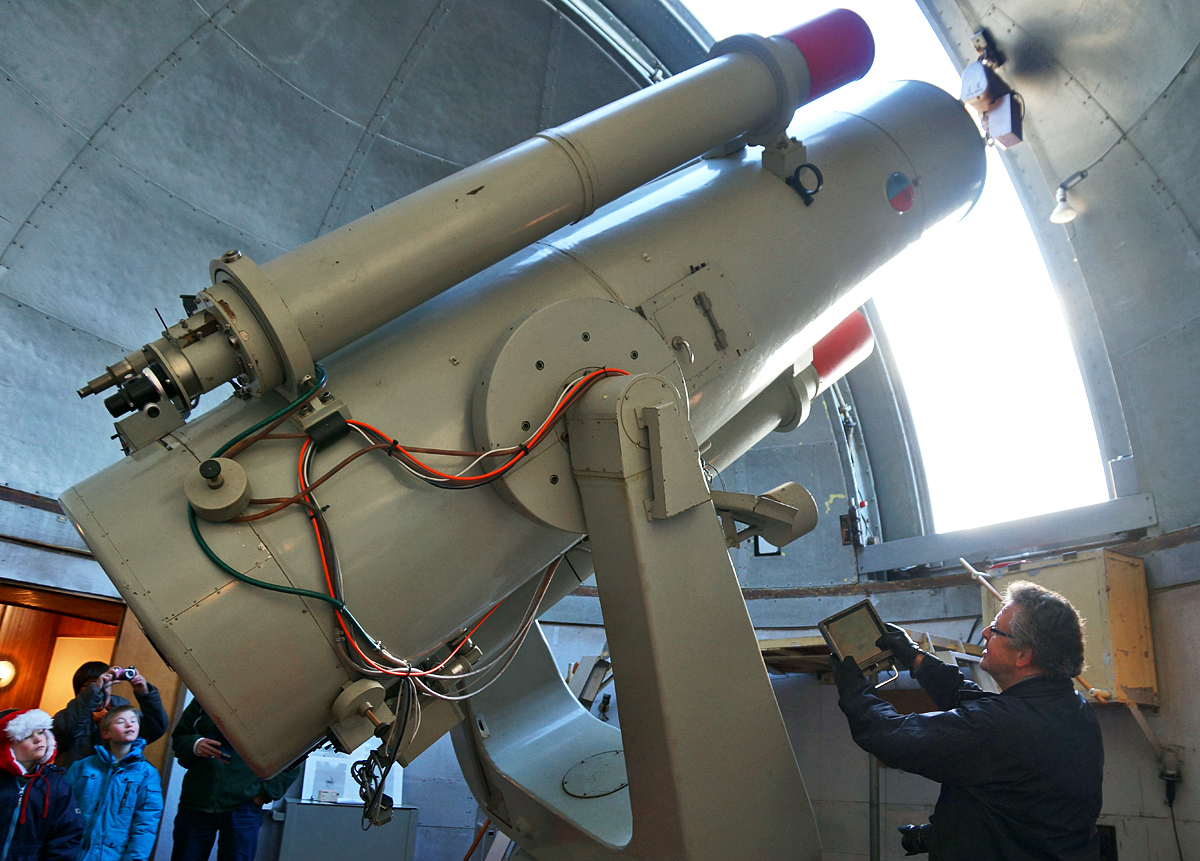
A Schmidt camera, also referred to as the Schmidt telescope, is a catadioptric astrophotographic telescope designed to provide wide fields of view with limited aberrations. The design was invented by Bernhard Schmidt in 1930.
Some notable examples are the Samuel Oschin telescope (formerly Palomar Schmidt), the UK Schmidt Telescope and the ESO Schmidt; these provided the major source of all-sky photographic imaging from 1950 until 2000, when electronic detectors took over. A recent example is the Kepler space telescope exoplanet finder.
Other related designs are the Wright camera and Lurie–Houghton telescope.
The Schmidt camera was invented by Estonian-German optician Bernhard Schmidt in 1930. Its optical components are an easy-to-make spherical primary mirror, and an aspherical correcting lens, known as a Schmidt corrector plate, located at the center of curvature of the primary mirror. The film or other detector is placed inside the camera, at the prime focus. The design is noted for allowing very fast focal ratios, while controlling coma and astigmatism.
Schmidt cameras have very strongly curved focal planes, thus requiring that the film, plate, or other detector be correspondingly curved. In some cases the detector is made curved; in others flat media is mechanically conformed to the shape of the focal plane through the use of retaining clips or bolts, or by the application of a vacuum. A field flattener, in its simplest form a planoconvex lens in front of the film plate or detector, is sometimes used. Since the corrector plate is at the center of curvature of the primary mirror in this design the tube length can be very long for a wide-field telescope. There are also the drawbacks of having the obstruction of the film holder or detector mounted at the focus halfway up the tube assembly, a small amount of light is blocked and there is a loss in contrast in the image due to diffraction effects of the obstruction and its support structure.
A Schmidt corrector plate is an aspheric lens which corrects the spherical aberration introduced by the spherical primary mirror of the Schmidt or Schmidt–Cassegrain telescope designs. It was invented by Bernhard Schmidt in 1931, although it may have been independently invented by Finnish astronomer Yrjö Väisälä in 1924 (sometimes called the Schmidt–Väisälä camera as a result). Schmidt originally introduced it as part of a wide-field photographic catadioptric telescope, the Schmidt camera. It is now used in several other telescope designs, camera lenses and image projection systems that utilise a spherical primary mirror.
Schmidt corrector plates work because they are aspheric lenses with spherical aberration that is equal to but opposite of the spherical primary mirrors they are placed in front of. They are placed at the center of curvature "C" of the mirrors for a pure Schmidt camera and just behind the prime focus for a Schmidt–Cassegrain. The Schmidt corrector is thicker in the middle and the edge. This corrects the light paths so light reflected from the outer part of the mirror and light reflected from the inner portion of the mirror is brought to the same common focus "F". The Schmidt corrector only corrects for spherical aberration. It does not change the focal length of the system.
Schmidt corrector plates can be manufactured in many ways. The most basic method, called the "classical approach", involves directly figuring the corrector by grinding and polishing the aspherical shape into a flat glass blank using specially shaped and sized tools. This method requires a high degree of skill and training on the part of the optical engineer creating the corrector.
Schmidt camera
A Schmidt camera, also referred to as the Schmidt telescope, is a catadioptric astrophotographic telescope designed to provide wide fields of view with limited aberrations. The design was invented by Bernhard Schmidt in 1930.
Some notable examples are the Samuel Oschin telescope (formerly Palomar Schmidt), the UK Schmidt Telescope and the ESO Schmidt; these provided the major source of all-sky photographic imaging from 1950 until 2000, when electronic detectors took over. A recent example is the Kepler space telescope exoplanet finder.
Other related designs are the Wright camera and Lurie–Houghton telescope.
The Schmidt camera was invented by Estonian-German optician Bernhard Schmidt in 1930. Its optical components are an easy-to-make spherical primary mirror, and an aspherical correcting lens, known as a Schmidt corrector plate, located at the center of curvature of the primary mirror. The film or other detector is placed inside the camera, at the prime focus. The design is noted for allowing very fast focal ratios, while controlling coma and astigmatism.
Schmidt cameras have very strongly curved focal planes, thus requiring that the film, plate, or other detector be correspondingly curved. In some cases the detector is made curved; in others flat media is mechanically conformed to the shape of the focal plane through the use of retaining clips or bolts, or by the application of a vacuum. A field flattener, in its simplest form a planoconvex lens in front of the film plate or detector, is sometimes used. Since the corrector plate is at the center of curvature of the primary mirror in this design the tube length can be very long for a wide-field telescope. There are also the drawbacks of having the obstruction of the film holder or detector mounted at the focus halfway up the tube assembly, a small amount of light is blocked and there is a loss in contrast in the image due to diffraction effects of the obstruction and its support structure.
A Schmidt corrector plate is an aspheric lens which corrects the spherical aberration introduced by the spherical primary mirror of the Schmidt or Schmidt–Cassegrain telescope designs. It was invented by Bernhard Schmidt in 1931, although it may have been independently invented by Finnish astronomer Yrjö Väisälä in 1924 (sometimes called the Schmidt–Väisälä camera as a result). Schmidt originally introduced it as part of a wide-field photographic catadioptric telescope, the Schmidt camera. It is now used in several other telescope designs, camera lenses and image projection systems that utilise a spherical primary mirror.
Schmidt corrector plates work because they are aspheric lenses with spherical aberration that is equal to but opposite of the spherical primary mirrors they are placed in front of. They are placed at the center of curvature "C" of the mirrors for a pure Schmidt camera and just behind the prime focus for a Schmidt–Cassegrain. The Schmidt corrector is thicker in the middle and the edge. This corrects the light paths so light reflected from the outer part of the mirror and light reflected from the inner portion of the mirror is brought to the same common focus "F". The Schmidt corrector only corrects for spherical aberration. It does not change the focal length of the system.
Schmidt corrector plates can be manufactured in many ways. The most basic method, called the "classical approach", involves directly figuring the corrector by grinding and polishing the aspherical shape into a flat glass blank using specially shaped and sized tools. This method requires a high degree of skill and training on the part of the optical engineer creating the corrector.
Recent media
Recent media