
Recent from talks
Scripps Institution of Oceanography
Knowledge base stats:
Talk channels stats:
Members stats:
Scripps Institution of Oceanography
The Scripps Institution of Oceanography (SIO) is the center for oceanography and earth science at the University of California, San Diego. Its main campus is located in La Jolla, with additional facilities in Point Loma.
Founded in 1903 and incorporated into the University of California system in 1912, the institution has since broadened its research focus to encompass the physics, chemistry, geology, biology, and climate of the Earth. The institution awards the Nierenberg Prize annually to recognize researchers with exceptional contributions to science in public interest.
Scripps Institution of Oceanography can trace its beginnings back to William Ritter, a biologist originally from Wisconsin. In 1891, Ritter was offered a job teaching biology at the University of California, Berkeley and married Mary Bennett. Their honeymoon and subsequent biological studies took them to San Diego, where Ritter met a local physician and naturalist, Fred Baker, who would later encourage him to build a marine biological laboratory in San Diego.
Ritter searched for eleven years for an appropriate place for a permanent marine biological laboratory. He spent summers at various places along the coast with students. His goal was frustrated by lack of money and lack of an appropriate place. During this time, research was being conducted at the boathouse of Hotel del Coronado on San Diego Bay.
In 1903, Ritter was introduced to newspaper magnate E. W. Scripps. Together with Scripps' half-sister Ellen Browning Scripps and Baker, they formed the Marine Biological Association of San Diego with Ritter as the Scientific Director. They fully funded the institution for its first decade. E. W. Scripps gave the biological association the use of his yacht, the Loma, in 1904 and served as the first research vessel in the history of the institution. In 1905, they moved to a small laboratory in La Jolla Cove until they arranged for the purchase of a 170-acre (0.69 km2) site in La Jolla, north of San Diego. The land was purchased for $1,000 at a public auction from the city of San Diego (the same site where the SIO main campus is today). However, construction cost estimates for a permanent building were around $50,000. Funding was secured through E. W. and E. B. Scripps, and the first permanent building (today known as the Old Scripps Building) was constructed in 1910.
The Marine Biological Association's first seafaring vessel, the Loma, would run aground in Point Loma in 1906 and prompted the search for a new one. With funds secured from Ellen Browning Scripps, the association was able to have a ship built by Lawrence Jensen strictly for oceanographic research - among the first for an American nongovernmental institution. The new vessel was acquired on April 21st, 1907 and was named the Alexander Agassiz after the Harvard biologist who had visited in 1905. The 85-foot Alexander Agassiz, a sailing vessel with twin gasoline engines, served the institution for ten years.
In 1912, the Biological Association became incorporated into the University of California and was renamed the Scripps Institution for Biological Research.
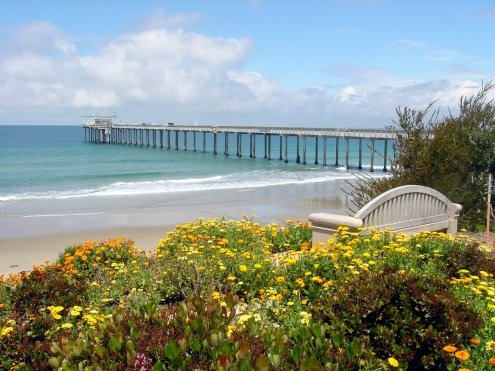
The first iteration of Scripps Pier, along with other buildings, was approved for construction in 1913, but was only completed in 1916 due to delays related to World War I. In 1915, the first building devoted solely to an aquarium was built on the Scripps campus. The small, wooden structure contained 19 tanks ranging in size from 96 to 228 U.S. gallons (360 to 860 L). The oceanographic museum was located in a nearby building. Since the pier was completed in 1916, measurements have been taken daily. The modern Scripps Pier was built as a replacement for the 1916 structure in 1988.
Hub AI
Scripps Institution of Oceanography AI simulator
(@Scripps Institution of Oceanography_simulator)
Scripps Institution of Oceanography
The Scripps Institution of Oceanography (SIO) is the center for oceanography and earth science at the University of California, San Diego. Its main campus is located in La Jolla, with additional facilities in Point Loma.
Founded in 1903 and incorporated into the University of California system in 1912, the institution has since broadened its research focus to encompass the physics, chemistry, geology, biology, and climate of the Earth. The institution awards the Nierenberg Prize annually to recognize researchers with exceptional contributions to science in public interest.
Scripps Institution of Oceanography can trace its beginnings back to William Ritter, a biologist originally from Wisconsin. In 1891, Ritter was offered a job teaching biology at the University of California, Berkeley and married Mary Bennett. Their honeymoon and subsequent biological studies took them to San Diego, where Ritter met a local physician and naturalist, Fred Baker, who would later encourage him to build a marine biological laboratory in San Diego.
Ritter searched for eleven years for an appropriate place for a permanent marine biological laboratory. He spent summers at various places along the coast with students. His goal was frustrated by lack of money and lack of an appropriate place. During this time, research was being conducted at the boathouse of Hotel del Coronado on San Diego Bay.
In 1903, Ritter was introduced to newspaper magnate E. W. Scripps. Together with Scripps' half-sister Ellen Browning Scripps and Baker, they formed the Marine Biological Association of San Diego with Ritter as the Scientific Director. They fully funded the institution for its first decade. E. W. Scripps gave the biological association the use of his yacht, the Loma, in 1904 and served as the first research vessel in the history of the institution. In 1905, they moved to a small laboratory in La Jolla Cove until they arranged for the purchase of a 170-acre (0.69 km2) site in La Jolla, north of San Diego. The land was purchased for $1,000 at a public auction from the city of San Diego (the same site where the SIO main campus is today). However, construction cost estimates for a permanent building were around $50,000. Funding was secured through E. W. and E. B. Scripps, and the first permanent building (today known as the Old Scripps Building) was constructed in 1910.
The Marine Biological Association's first seafaring vessel, the Loma, would run aground in Point Loma in 1906 and prompted the search for a new one. With funds secured from Ellen Browning Scripps, the association was able to have a ship built by Lawrence Jensen strictly for oceanographic research - among the first for an American nongovernmental institution. The new vessel was acquired on April 21st, 1907 and was named the Alexander Agassiz after the Harvard biologist who had visited in 1905. The 85-foot Alexander Agassiz, a sailing vessel with twin gasoline engines, served the institution for ten years.
In 1912, the Biological Association became incorporated into the University of California and was renamed the Scripps Institution for Biological Research.
The first iteration of Scripps Pier, along with other buildings, was approved for construction in 1913, but was only completed in 1916 due to delays related to World War I. In 1915, the first building devoted solely to an aquarium was built on the Scripps campus. The small, wooden structure contained 19 tanks ranging in size from 96 to 228 U.S. gallons (360 to 860 L). The oceanographic museum was located in a nearby building. Since the pier was completed in 1916, measurements have been taken daily. The modern Scripps Pier was built as a replacement for the 1916 structure in 1988.
Recent media