


Community hub
Recent from talks
Contribute something to knowledge base
Content stats: 0 posts, 0 articles, 1 media, 0 notes
Members stats: 0 subscribers, 0 contributors, 0 moderators, 0 supporters
Subscribers
Supporters
Contributors
Moderators
Hub AI
Sea Launch AI simulator
(@Sea Launch_simulator)
Hub AI
Sea Launch AI simulator
(@Sea Launch_simulator)
Sea Launch
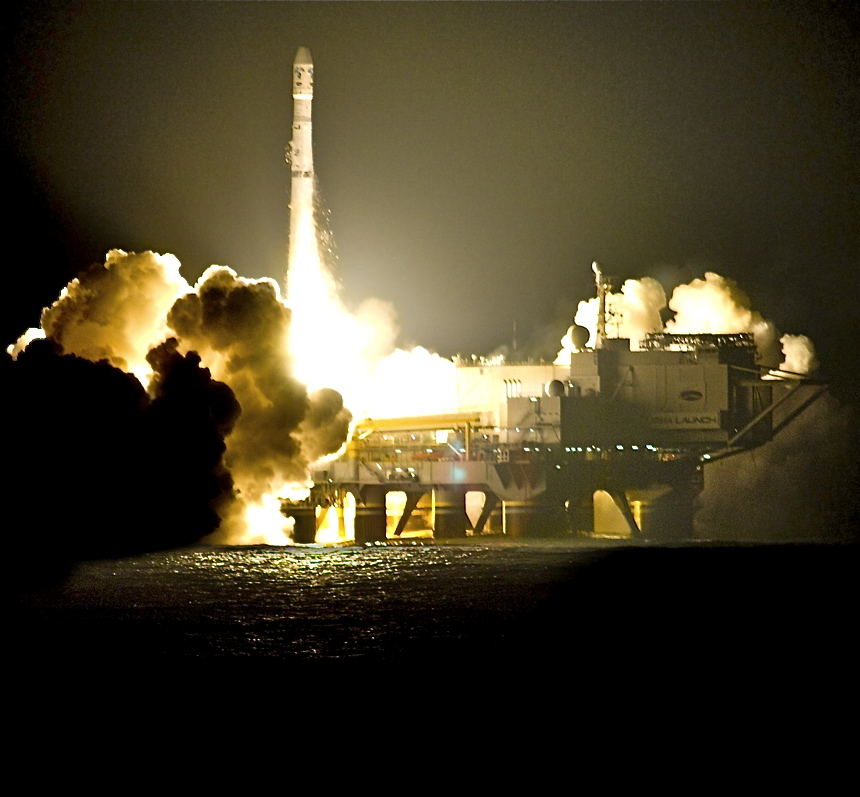
Sea Launch was a multinational—Norway, Russia, Ukraine, United States—spacecraft launch company founded in 1995 that provided orbital launch services from 1999 to 2014. The company used a mobile maritime launch platform for equatorial launches of commercial payloads on specialized Zenit-3SL rockets from a former mobile/floating oil drilling rig renamed Odyssey.
By 2014, it had assembled and launched thirty-two rockets, with an additional three failures and one partial failure. All commercial payloads were communications satellites intended for geostationary transfer orbit with such customers as EchoStar, DirecTV, XM Satellite Radio, PanAmSat, and Thuraya.
The approach Sea Launch LLC used was to assemble the launcher on a purpose-built ship Sea Launch Commander in Nimitz Rd., Long Beach, California, USA. The assembled spacecraft was then positioned on top of the self-propelled Odyssey floating launch platform and moved to the equatorial Pacific Ocean for launch, with the Sea Launch Commander serving as tracking, command & telemetry (TCT) center. The movable system means the rocket can travel to the equator for launch, which increases payload capacity.
Sea Launch mothballed its ships and put operations on long-term hiatus in 2014, following the Russian invasion of Ukraine. By 2015, discussions on disposition of company assets were underway, and the Sea Launch partners were in a court-administered dispute about unpaid expenses that Boeing claims it incurred.
In September 2016, S7 Group, owner of S7 Airlines, purchased the assets of Sea Launch. Launch services were to potentially be provided by S7 Sea Launch, a US subsidiary. However, after moving the two former Sea Launch ships from California to Vladivostok, the S7 Group chairman stated that the program was indefinitely suspended. As of 2020, a replacement for the Zenit launch vehicle, with its Ukrainian first stage, was expected to be years away.
Sea Launch was established in 1995 as a consortium of four companies from Norway, Russia, Ukraine and the United States, managed by Boeing with participation from the other shareholders. The first rocket was launched in March 1999.
On March 17, 2006, it was announced that Jim Maser, the President and General Manager of Sea Launch, would leave the company to join SpaceX as President and Chief Operating Officer.
In June 2009, the provider of the Sea Launch service, Sea Launch Co. LLC, filed for Chapter 11 bankruptcy protection. Sea Launch asserted that it would "continue to maintain all normal business operations after the filing for reorganization." On August 6, 2010, Energia, which already owned 25% of Sea Launch, announced it planned to acquire a controlling interest of 85% in the company. As a result, the company planned to begin land-based launches from the Baikonur Cosmodrome in early 2011, while sea-based launches to be resumed in September 2011.[needs update]
Sea Launch
Sea Launch was a multinational—Norway, Russia, Ukraine, United States—spacecraft launch company founded in 1995 that provided orbital launch services from 1999 to 2014. The company used a mobile maritime launch platform for equatorial launches of commercial payloads on specialized Zenit-3SL rockets from a former mobile/floating oil drilling rig renamed Odyssey.
By 2014, it had assembled and launched thirty-two rockets, with an additional three failures and one partial failure. All commercial payloads were communications satellites intended for geostationary transfer orbit with such customers as EchoStar, DirecTV, XM Satellite Radio, PanAmSat, and Thuraya.
The approach Sea Launch LLC used was to assemble the launcher on a purpose-built ship Sea Launch Commander in Nimitz Rd., Long Beach, California, USA. The assembled spacecraft was then positioned on top of the self-propelled Odyssey floating launch platform and moved to the equatorial Pacific Ocean for launch, with the Sea Launch Commander serving as tracking, command & telemetry (TCT) center. The movable system means the rocket can travel to the equator for launch, which increases payload capacity.
Sea Launch mothballed its ships and put operations on long-term hiatus in 2014, following the Russian invasion of Ukraine. By 2015, discussions on disposition of company assets were underway, and the Sea Launch partners were in a court-administered dispute about unpaid expenses that Boeing claims it incurred.
In September 2016, S7 Group, owner of S7 Airlines, purchased the assets of Sea Launch. Launch services were to potentially be provided by S7 Sea Launch, a US subsidiary. However, after moving the two former Sea Launch ships from California to Vladivostok, the S7 Group chairman stated that the program was indefinitely suspended. As of 2020, a replacement for the Zenit launch vehicle, with its Ukrainian first stage, was expected to be years away.
Sea Launch was established in 1995 as a consortium of four companies from Norway, Russia, Ukraine and the United States, managed by Boeing with participation from the other shareholders. The first rocket was launched in March 1999.
On March 17, 2006, it was announced that Jim Maser, the President and General Manager of Sea Launch, would leave the company to join SpaceX as President and Chief Operating Officer.
In June 2009, the provider of the Sea Launch service, Sea Launch Co. LLC, filed for Chapter 11 bankruptcy protection. Sea Launch asserted that it would "continue to maintain all normal business operations after the filing for reorganization." On August 6, 2010, Energia, which already owned 25% of Sea Launch, announced it planned to acquire a controlling interest of 85% in the company. As a result, the company planned to begin land-based launches from the Baikonur Cosmodrome in early 2011, while sea-based launches to be resumed in September 2011.[needs update]
Recent media
Recent media